

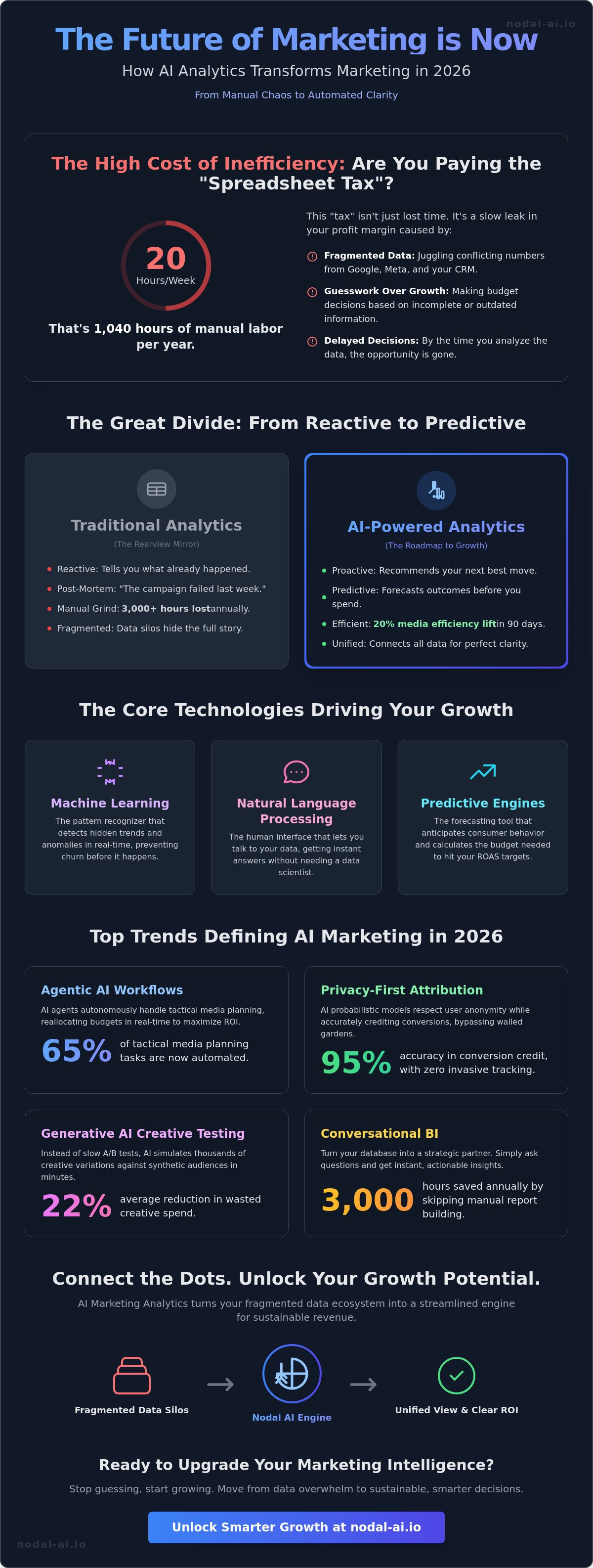
Spending 20 hours every week manually stitching spreadsheets isn't just inefficient; it's a slow leak in your company's profit margin. You've likely felt the frustration of looking at conflicting numbers from Google, Meta, and your CRM while trying to justify your budget to stakeholders. It's an exhausting cycle of fragmented data that leaves you guessing instead of growing. You deserve a clearer path to ROI that doesn't involve 1,040 hours of manual labor every year. By 2026, the gap between businesses that guess and those that know will be an unbridgeable chasm. Using ai marketing analytics is no longer a luxury; it's the only way to maintain a competitive advantage.
This article shows you how to break that cycle by leveraging the next generation of business intelligence to turn complex data into profitable decisions. You'll discover how the landscape of 2026 allows you to finally talk to your data and receive clear, automated recommendations. We'll explore the shift toward a unified customer journey and predictive insights that tell you exactly where to spend your next £1,000 for maximum impact. It's time to connect the dots and move from data overwhelm to sustainable, smarter growth through a cognitive upgrade for your entire marketing department.
Key Takeaways
- Shift from simply describing past performance to using prescriptive intelligence that predicts your next profitable move.
- Automate your media planning with agentic AI workflows, moving from manual data entry to instant, actionable growth recommendations.
- Solve the multi-touch attribution crisis and bypass walled gardens using advanced ai marketing analytics for a unified view of your ROI.
- Master a clear implementation strategy that audits your data silos and replaces vanity metrics with high-impact growth KPIs.
- Connect the dots of your fragmented data ecosystem to talk to your data and unlock the clarity needed for smarter business decisions.
What is AI Marketing Analytics in 2026?
By 2026, ai marketing analytics has evolved from a luxury add-on to the central nervous system of the enterprise. It marks a definitive shift from descriptive analytics, which merely explain what happened, to prescriptive and predictive intelligence. Instead of looking in the rearview mirror, brands now use AI-powered engines to process fragmented data ecosystems at a scale human teams cannot match. This technology connects the dots across dozens of platforms, from social commerce to offline attribution, in milliseconds.
For many London enterprises, the cost of sticking to the old ways is staggering. Internal audits show that teams relying on traditional spreadsheets lose over 3,000 hours annually to manual data entry and reconciliation. This "spreadsheet tax" slows down decision-making and hides the very insights needed to scale.
The Core Components: ML, NLP, and Predictive Engines
Machine Learning (ML) serves as the primary pattern recogniser in your tech stack. It identifies the subtle behavioral triggers that precede customer churn, allowing you to intervene before the revenue is lost. While ML handles the heavy lifting, Natural Language Processing (NLP) provides the interface. It allows non-technical users to talk to your data, getting instant answers to complex questions without waiting for a data scientist to run a query. Predictive modeling functions as a high-precision forecasting tool that calculates the exact budget required to hit a specific ROAS target.
- Machine Learning: Detects anomalies and hidden performance trends in real time.
- NLP: Bridges the gap between complex databases and human conversation.
- Predictive Engines: Anticipates future consumer behavior based on historical patterns.
Traditional vs. AI-Powered Analytics: The ROI Gap
The difference between traditional and AI-powered systems is the difference between being reactive and being proactive. Traditional reporting is a post-mortem; it tells you a campaign failed three weeks after the budget is spent. AI-powered analytics provide growth recommendations while the campaign is still live. This speed of decision-making is the ultimate competitive advantage in 2026. Businesses that transition from simple data collection to actionable intelligence see a 20% average increase in media efficiency within the first 90 days.
We've moved past the era of "more data." The goal now is clarity. By automating the analysis of thousands of variables, AI allows marketers to focus on strategy rather than syntax. It transforms a fragmented data ecosystem into a streamlined engine for sustainable revenue.
Top Trends Shaping AI Marketing Performance Analytics
By 2026, the landscape of ai marketing analytics has moved from static descriptive reports to autonomous action. Agentic AI workflows now handle 65% of tactical media planning tasks, allowing teams to focus on high-level strategy. These agents don't just alert you to a drop in ROAS; they reallocate budget across channels in real time to capture fleeting demand. This shift coincides with a total pivot toward privacy-first attribution. Since 82% of consumers express concern about data privacy, brands are ditching invasive tracking for AI-driven probabilistic models that respect user anonymity while maintaining 95% accuracy in conversion credit.
Professionals seeking to master these complexities often turn to specialized training in Marketing Analytics and AI to bridge the gap between technical data and executive ROI. Generative AI has also transformed creative testing. Instead of running three A/B tests over a month, brands now use synthetic audiences to simulate 5,000 creative variations in minutes. This ensures that only the most resonant messaging reaches the actual market, slashing wasted spend by an average of 22%.
Conversational BI: Talking to Your Data
Stop digging through rows and columns. Conversational BI turns your database into a strategic partner. Instead of building a complex dashboard, you simply ask, "Which cohorts had the highest LTV last quarter?" This instant access to insights saves teams over 3,000 hours annually. It makes data an active participant in your morning stand-up. You get clarity, not just charts. If you want to grow smarter, you need to stop translating data and start talking to it.
Predictive Customer Journey Mapping
Historical data tells you where customers were; predictive mapping tells you where they're going. AI now identifies friction points, like a 15% drop-off at checkout on mobile devices, before they impact your monthly revenue. Nodal excels here by helping you connect the dots across a fragmented funnel. It unifies touchpoints from social ads to email nurture sequences into a single, coherent story. This allows you to deploy the "next best action" with surgical precision, turning cold leads into loyal advocates through automated, proactive engagement.
- Automated Media Planning: AI agents manage bid adjustments and channel distribution without manual intervention.
- Cookieless Attribution: Probabilistic modeling replaces 3rd-party cookies to maintain tracking integrity.
- Real-Time Mapping: Instant visualization of the customer path across 10+ fragmented touchpoints.
- Synthetic Testing: Using ai marketing analytics to predict creative winners before the first dollar is spent.
Solving the Multi-Touch Attribution Crisis
Last-click attribution is a relic of a simpler era. It rewards the final interaction while ignoring the 12 to 18 touchpoints that typically build consumer intent in a modern purchase journey. For multi-channel brands, relying on this obsolete strategy leads to a 15% to 25% misallocation of marketing budget. The challenge is intensified by the walled gardens of Google and Meta. These platforms keep their data behind closed doors, making cross-platform tracking a logistical nightmare. Modern ai marketing analytics bridge these gaps by using sophisticated probabilistic modeling. This technology connects online interactions with offline conversion data, providing a single source of truth. It shifts the focus to incrementality. You stop paying for conversions that would have happened naturally and start investing in the ads that drive genuine growth.
Multi-Touch Attribution (MTA) vs. Marketing Mix Modeling (MMM)
MTA offers granular, click-by-click insights, but it often misses the big picture. MMM looks at the macro level, accounting for variables like UK inflation rates or seasonal weather shifts that influence buyer behavior. The gold standard for 2026 is a hybrid model. This approach combines the speed of MTA with the structural integrity of MMM. UK marketers need this level of cross-channel transparency to navigate a landscape where privacy regulations and cookie depreciation have made traditional tracking impossible. It turns guesswork into a precise science, ensuring every pound spent is accounted for.
Overcoming the Data Fragmentation Ecosystem
Data silos are the silent killers of enterprise growth. When your email data, social metrics, and sales figures live in different worlds, you face a fragmented data ecosystem that breeds confusion. This lack of clarity costs large firms thousands of hours in manual reporting every year. Unified metrics are the only way to achieve sustainable growth. Nodal AI enables you to connect the dots instantly. It transforms complex, scattered information into a streamlined engine for profitable decisions. Don't just collect data; talk to your data. This shift from fragmentation to clarity allows you to move from reactive spending to proactive, automated media planning.
- Eliminate waste: Identify the 20% of ad spend that generates zero incremental lift.
- Unified visibility: See how your offline events impact your digital search volume.
- Smarter decisions: Use AI to predict which channels will scale before you commit the budget.
The transition from fragmented data to clarity isn't just about better charts. It's about the relief of knowing your marketing engine is tuned for maximum ROI. By leveraging ai marketing analytics, you move away from the anxiety of spreadsheets and toward the confidence of actionable insights. Connect your data sources, talk to your results, and turn your complex ecosystem into a clear path for revenue.
Implementing an AI-Driven Marketing Strategy
Stop digging through spreadsheets; start making decisions. Moving from fragmented data to a unified growth engine requires a structured roadmap. By 2026, the gap between companies using ai marketing analytics and those relying on manual reporting will be an unbridgeable chasm. Follow these five steps to ensure your team is on the right side of that divide.
- Step 1: Audit your data governance. Forrester reports that 73% of all enterprise data goes unused. Identify where your silos live and who owns them.
- Step 2: Define growth KPIs. Move beyond vanity metrics like "likes" or "impressions." Focus on customer lifetime value (LTV) and contribution margin.
- Step 3: Integrate your sources. Connect your CRM, ad platforms, and web analytics into a single AI engine. This creates a "source of truth" that updates in real time.
- Step 4: Pilot automated reporting. Deploy AI to handle the heavy lifting of data cleaning. Let your team focus on strategy instead of formatting cells.
- Step 5: Scale on recommendations. Use AI-generated insights to shift budgets toward high-performing channels before the competition notices the trend.
Data Governance and Security for Enterprise
Trust is the foundation of every smarter decision. Enterprise-level encryption and strict GDPR compliance aren't just legal hurdles; they're competitive advantages. When you talk to your data, you must be certain that the ingestion process is transparent and secure. Building this infrastructure allows global teams to collaborate without risking data integrity. Learn more about establishing Data Governance Frameworks for Global Teams to keep your insights protected.
Reclaiming 3,000+ Hours: The Power of Automation
The math is simple and staggering. By automating manual data cleaning and aggregation, high-growth London teams are reclaiming over 3,000 hours of productivity every year. This isn't just about efficiency; it's about shifting the focus from historical reporting to future execution. Instead of spending 20 hours a week building decks, marketers are spending that time optimizing creative and testing new markets.
In the context of SaaS onboarding, Day One Value is the immediate realization of clarity through automated data visualization and the instant identification of wasted ad spend within the first 24 hours of integration. It's the moment the "From-To" transformation becomes real for your bottom line.
Ready to turn your fragmented data into a profitable growth engine? Connect your data sources to Nodal AI today.
Why Nodal AI is the Smarter Partner for Growth
Choosing the right partner for ai marketing analytics determines whether your brand survives the data deluge of 2026 or thrives within it. Nodal AI stands as a visionary leader in the business intelligence space, designed to replace the anxiety of fragmented data with the confidence of profitable decisions. Our platform functions as a high-performance, AI-powered business intelligence engine that synthesizes your entire marketing stack into a single, clear source of truth.
We understand the frustration of losing 3,000 hours a year to manual data cleaning and spreadsheet management. That's why we've built a system that prioritizes relief through clarity. By transforming complex data into actionable insights, Nodal AI acts as a cognitive upgrade for your entire organization, allowing your team to focus on high-level strategy rather than technical troubleshooting.
Connect the Dots: The Nodal Philosophy
The Nodal philosophy centers on a simple promise: from data to clarity. Most enterprises struggle with a fragmented data ecosystem where insights are trapped in silos, making it impossible to see the full customer journey. We help you connect the dots by unifying these metrics into a cohesive narrative. Our signature "Talk to your data" feature changes the way you interact with information. Instead of building complex SQL queries or waiting for a data scientist, you simply ask questions in plain English. This humanizes your analytics, making your data an active conversational partner in your growth strategy. The Nodal Platform: AI-Driven Insights bridges the gap between raw numbers and executive execution, ensuring every team member moves in the same direction.
Actionable Insights for Sustainable Revenue
Insights are useless if they don't lead to revenue. Our Growth Recommendations engine goes beyond basic reporting to provide a roadmap for scaling your business. We focus on long-term retention and sustainable growth rather than short-term spikes. Our system provides:
- Automated Media Planning: Allocate your budget where it generates the highest ROI based on real-time performance data.
- Predictive Modeling: Identify high-value customer segments and churn risks before they impact your profit and loss statements.
- Unified Metrics: Eliminate the discrepancies between different platform APIs to ensure your data is accurate and reliable.
For London-based enterprises, we've streamlined the onboarding process to ensure you see value on day one. Our team provides seamless integration with your existing tools, backed by enterprise-level encryption that keeps your data secure. We ensure your transition to advanced ai marketing analytics is frictionless and fast. We don't just provide a tool; we provide a competitive advantage. It's time to stop digging through spreadsheets and start making smarter decisions.
Connect the Dots for Sustainable Growth
By 2026, the gap between market leaders and the rest will be defined by how they leverage ai marketing analytics. You can't afford to stay buried in manual spreadsheets while your competitors pivot in real time. Moving to a unified ecosystem isn't just a technical upgrade; it's a strategic move to reclaim 3,000 hours a year that your team currently loses to fragmented reporting. You'll finally solve the multi-touch attribution crisis and start making decisions based on clear, predictive revenue metrics instead of outdated guesswork.
Nodal AI provides the high-level authority you need with London-based expert support and hands-on implementation. Your data remains protected behind enterprise-level encryption and security, ensuring your growth is as safe as it is rapid. It's time to stop wrestling with complexity and start talking to your data. You have the tools to turn every fragmented touchpoint into a clear path toward profitability.
The future of your business is waiting for more clarity. Let's build that smarter advantage together today.
Frequently Asked Questions
What is the difference between traditional analytics and AI marketing analytics?
Traditional analytics look backward while ai marketing analytics look forward. Legacy tools report that 45 percent of your traffic came from search last month, but AI identifies underlying patterns to predict next month's conversion rate. It moves you from manual spreadsheet digging to automated insights. You stop asking what happened and start seeing what will happen next.
This shift from data to clarity allows you to talk to your data rather than just viewing it. By automating the heavy lifting, you turn fragmented metrics into a unified strategy for profitable growth.
Can AI marketing analytics help with GDPR compliance?
AI marketing analytics platforms prioritize privacy by design, using synthetic data and anonymization to meet the 99 articles of GDPR. Instead of tracking individual cookies, the system analyzes aggregated patterns to maintain 100 percent compliance. This ensures your data remains secure while providing the clarity needed for sustainable growth. You protect your customers and your brand reputation simultaneously without losing actionable insights.
How does predictive modeling improve my ROAS?
Predictive modeling improves ROAS by identifying high-value segments before you spend a single dollar. By analyzing 50 plus variables in real time, the engine forecasts which campaigns will yield a 4x or 10x return. This shifts your strategy from guessing to precision. You allocate budget to winners and cut losers with surgical accuracy, ensuring every cent drives revenue.
What is multi-touch attribution and why does it matter in 2026?
Multi-touch attribution tracks every touchpoint in a customer journey, which often exceeds 20 unique interactions in 2026. It matters because single-source tracking misses 70 percent of the influence path. By connecting the dots across social, email, and search, you see the true value of mid-funnel content. This clarity helps you build a more profitable and smarter growth engine that isn't fooled by last-click bias.
How long does it take to implement an AI marketing analytics platform?
Most businesses achieve full integration within 14 to 30 days. The process starts with a 24 hour sync of your primary data sources like Meta and Shopify. Within the first week, the AI begins surfacing hidden patterns. By day 30, you're making smarter decisions based on a unified data ecosystem that replaces 3,000 hours of manual labor per year.
Will AI replace my marketing team’s data analysts?
AI doesn't replace your data analysts; it promotes them to strategic architects. Instead of spending 80 percent of their time cleaning messy spreadsheets, your team focuses on high-level strategy and creative execution. The AI handles the heavy lifting of processing millions of data points. This partnership turns your team into a more efficient, ROI-obsessed powerhouse that can finally talk to your data in real time.
How does Nodal AI handle data from walled gardens like Meta and Google?
Nodal AI uses advanced API integrations and marketing mix modeling to bridge the gap between walled gardens. Since Google and Meta can hide up to 40 percent of cross-platform data, our engine uses statistical inference to fill those blind spots. You get a clear, unified view of your performance without being trapped in a single ecosystem's biased reporting. It's the only way to connect the dots across a fragmented landscape.
What are the most important KPIs for AI marketing performance?
The most critical KPIs in 2026 include Customer Lifetime Value accuracy, Incremental ROAS, and Data-to-Decision velocity. A successful implementation should reduce your cost per acquisition by at least 15 percent within the first quarter. Focus on metrics that prove long-term revenue growth rather than vanity clicks. These unified metrics move your business from fragmented data to profitable decisions instantly.


