
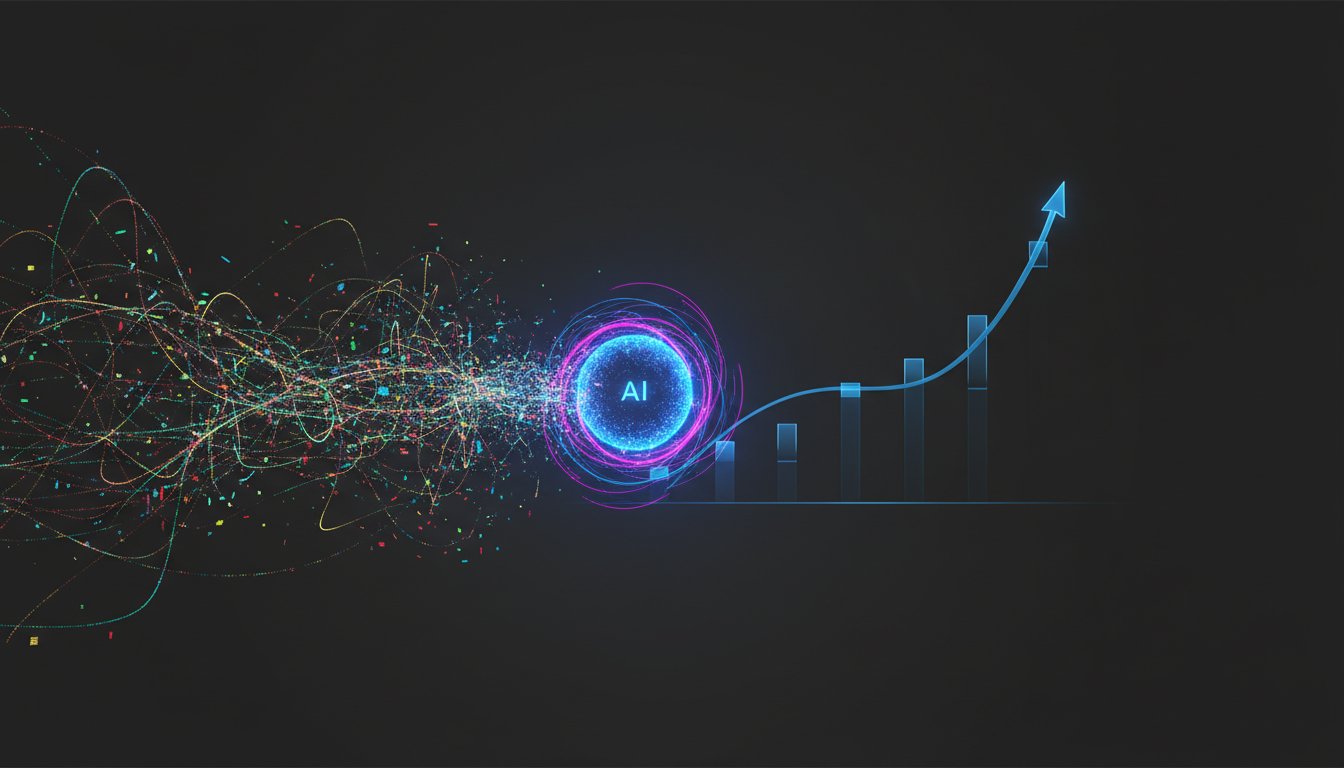
What if you could reclaim the 3,000 hours your team loses every year to manual reporting? Most marketers agree that data driven marketing is the only path to sustainable growth, yet 60% of leaders still struggle with fragmented data ecosystems that obscure their true ROI. You've likely felt the frustration of watching ad spend disappear into a black hole of inaccurate attribution while your team digs through endless spreadsheets. It's a cycle of complexity that keeps you from the high-level strategy you were hired to execute.
You deserve a clearer way forward. We'll show you how to transform raw information into a competitive advantage by moving from manual analysis to AI-powered marketing intelligence. This guide previews a future where you connect the dots across every touchpoint to gain a unified view of the customer journey. You'll learn how to talk to your data, eliminate wasted spend, and make the profitable decisions that 2026 demands. It's time to stop guessing and start growing smarter.
Key Takeaways
- Shift from intuition-based guesses to profitable clarity by replacing gut feelings with AI-unified metrics.
- Connect the dots across your entire ecosystem—from CRM to social ads—to finally visualize the complete customer journey.
- Reclaim up to 3,000 hours a year by automating manual data cleaning and escaping the common spreadsheet trap.
- Evolve your data driven marketing strategy by talking to your data to predict future growth instead of just reporting on the past.
- Discover how to build a smarter marketing engine that transforms fragmented information into instant, actionable insights.
Defining Data-Driven Marketing: From Intuition to Profitable Clarity
In 2026, guessing is a luxury your budget can't afford. The era of "spraying and praying" has ended, replaced by a precision-engineered approach to growth. Modern data driven marketing is the strategic application of unified customer information to predict future behavior and optimize every dollar spent on ROI. It's the bridge between raw numbers and sustainable growth.
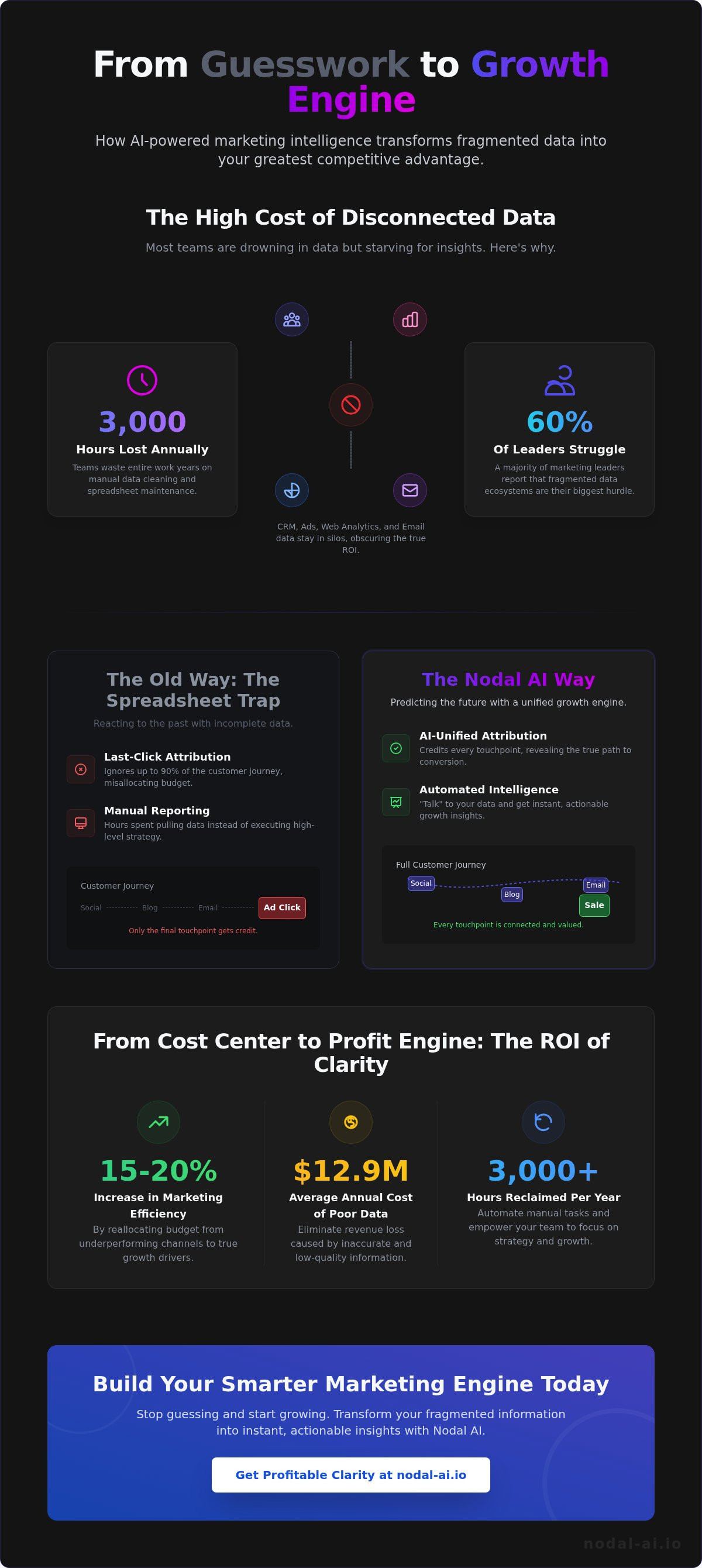
The "Old Way" of marketing relied on gut feelings and outdated last-click attribution models. This approach ignored 90% of the customer journey, leading to wasted spend and missed opportunities. By 2026, the industry has shifted to AI-unified metrics. This new standard connects the dots across every touchpoint, turning a fragmented data ecosystem into a unified growth engine. The primary goal is simple: make faster, smarter decisions that directly impact your bottom line.
A successful data-driven marketing strategy transforms your brand from a reactive participant into a proactive leader. Instead of digging into spreadsheets for hours, you talk to your data and receive instant clarity. This evolution allows teams to pivot in real-time, shifting resources to the channels that actually drive revenue.
The Core Pillars of a Data-Informed Strategy
Profitability requires more than just collecting numbers; it demands a foundation of three core pillars. Accuracy is the first requirement. According to a 2024 Gartner study, poor data quality costs organizations an average of $12.9 million annually. Clean data is the only foundation for a profitable campaign.
Accessibility ensures that insights aren't trapped in a silo. You don't need a PhD in data science to understand your performance. Insights must be available to every decision-maker in real-time. Finally, actionability moves the needle. We've moved past "interesting stats" and into the age of growth recommendations. If a metric doesn't tell you how to grow, it's just noise.
Why "Good Enough" Data is Costing You Revenue
Operating with incomplete customer journey mapping creates hidden costs that erode your margins. When you rely on "good enough" data, you're likely suffering from last-click bias. This flaw leads to misallocated marketing budgets, as it ignores the top-of-funnel awareness that made the final sale possible. Industry reports show that companies using unified attribution see a 15% to 20% increase in marketing efficiency.
Fragmented data silos prevent you from seeing the full picture, causing you to lose 3,000 hours a year to manual analysis. By unifying these sources, you turn complexity into a competitive advantage. Data driven marketing is the bridge between raw numbers and sustainable growth.
Connecting the Dots: How a Modern Data Ecosystem Works
Modern marketing isn't about having data; it's about making it speak. Most brands currently juggle four primary sources: CRM data, social ad platforms, web analytics, and email engagement. When these stay separate, you're flying blind. You need a unified ecosystem to turn these fragments into a clear map. This is the foundation of effective data driven marketing. Connect the dots between your platforms to stop guessing and start growing.
The Integration Layer: Breaking Down Silos
Connect your disparate sources into a single source of truth. Manual data ingestion remains the #1 bottleneck for teams, often wasting over 3,000 hours annually on spreadsheet maintenance. Seamless API integrations provide real-time intelligence instead of weekly post-mortems. Move from manual labor to automated clarity. This layer removes the friction between raw numbers and actionable insights. Eliminate the silos that trap your potential. When your CRM doesn't talk to your ad manager, you lose the ability to see a customer's lifetime value. Use APIs to pull this data into a centralized engine. It's the difference between guessing and knowing.
Multi-Touch Attribution vs. Last-Click
Last-click attribution is a relic. It ignores the 6 to 8 touchpoints a consumer typically interacts with before converting. Multi-touch attribution (MTA) tracks the full journey. It helps you identify which ads drove initial awareness and which ones closed the deal. Mastering Data-Driven Decision-Making ensures you invest in channels that provide true incrementality. Don't just track participation; track profit. Incrementality matters because it proves revenue lift. If a customer was going to buy anyway, that "last click" on a brand search ad didn't actually create value. MTA reveals these hidden truths, allowing you to reallocate budget to the channels that actually move the needle.
Unified metrics bridge the gap between fragmented platforms. When your email click-through rate and your social ROAS talk to each other, you see the big picture. By 2026, 85% of high-growth brands will use automated reporting to maintain a "real-time" view of performance. Talk to your data to see the "day one" value of every campaign. This shift moves your strategy from reactive guessing to proactive data driven marketing. Use these tools to maintain a pulse on your business:
- Automated Media Planning: Adjust budgets based on real-time channel performance.
- Unified Customer Profiles: See every interaction from the first ad click to the final purchase.
- Predictive Analytics: Forecast future revenue based on current engagement trends.
The relief of clarity replaces the anxiety of complexity. Once your ecosystem is connected, the path to profitable decisions becomes clear. You no longer dig into spreadsheets; you act on insights.
The Spreadsheet Trap: Why Most Teams Fail at Data-Driven Marketing
Most marketing leaders don't need more data. They need a way to survive the data they already have. The fragmented data ecosystem of 2026 has created a common state known as Data Rich, Insight Poor (DRIP). You have the numbers, but you can't see the story. This fragmentation leads to leadership paralysis. When your Meta dashboard says one thing and your CRM says another, you don't make a decision. You just wait.
Marketing teams are currently losing 3,000 hours a year to manual data cleaning and reporting. That is a staggering 1.5 years of human productivity wasted on spreadsheets. This isn't just a technical issue; it's a strategic failure. When your team spends their week copy-pasting rows into Excel, they aren't practicing data driven marketing. They are just acting as expensive data entry clerks. This manual grind creates a "Spreadsheet Trap" that keeps your business stuck in reactive mode.
The Human Cost of Manual Analysis
Manual reporting is where creativity goes to die. If your best strategists spend 15 hours a week reconciling different platforms, they aren't thinking about your next big campaign. They're just trying to make the rows match. Human error is a constant threat in complex spreadsheet-based attribution. A single broken formula can lead to thousands of dollars in wasted ad spend before anyone notices the mistake.
The shift to automation changes everything. Move from the anxiety of manual digging to the clarity of automated insights instantly. When the "how" of data is handled, your team can finally focus on the "why."
Overcoming Data Privacy and Governance Hurdles
Navigating the "Walled Gardens" of Google and Meta requires more than just basic tracking. You need a system that respects privacy without losing the signal. In 2026, enterprise-level encryption and GDPR compliance are the baseline for any successful data driven marketing strategy. Privacy isn't a hurdle to be jumped; it's a foundation to be built upon.
- Unified Metrics: Stop comparing apples to oranges across different platforms.
- Secure Data: Ensure every byte of customer info is encrypted and compliant.
- Actionable Governance: Set rules that protect data without slowing down your execution.
You can maintain a strict data governance framework without slowing your team to a crawl. The goal is to connect the dots across every platform while keeping your customer data secure. Talk to your data instead of fighting it. When your systems are unified, you spend less time on compliance checks and more time on profitable growth.
Predictive Modelling: Talking to Your Data for Future Growth
Stop looking in the rearview mirror. Traditional data driven marketing often tells you what went wrong only after the budget is spent. By 2026, the standard shifts from reactive reporting to proactive growth. You don't just read reports anymore; you talk to them. Natural language AI allows you to ask, "Which customer segment will churn next month?" and receive a direct, actionable answer. This transforms your fragmented data ecosystem into a conversational partner that prioritizes your next move.
Predictive modelling moves the needle from "What happened?" to "What will happen?" It allows you to anticipate market shifts before they impact your bottom line. Instead of digging into spreadsheets for 15 hours a week, you receive automated growth recommendations that tell you exactly where to double down. It's about replacing the anxiety of uncertainty with the confidence of high-probability outcomes.
From Historical Reporting to Future Forecasting
The transition to forecasting requires a shift in how you view your audience. Using cohort analysis, you can now predict customer lifetime value (LTV) with 85% accuracy by identifying early behavioral signals. This allows for smarter budget allocation. You can run "What-If" scenarios to see how a 12% shift in spend from search to social affects your Q4 revenue before you commit a single dollar. Real-time trend identification gives you a 48 hour head start on competitors, letting you capture emerging demand while it's still affordable.
The Rise of AI-Powered Marketing Insights
AI engines identify complex patterns that the human eye and standard Excel formulas miss. While a human might see a drop in conversions, the AI sees the subtle correlation between site speed in specific regions and a 14% dip in mobile checkout completions. Predictive modelling is the crystal ball for marketing ROI, turning raw numbers into a clear roadmap for sustainable growth.
- Automated Recommendations: Receive daily prompts on which ad sets to scale and which to kill.
- Conversational Steps: Transform 50 page reports into three simple steps you can execute immediately.
- Waste Elimination: Identify underperforming channels and reallocate spend to protect your margins.
Don't let your data sit idle while your competitors move ahead. It's time to connect the dots and turn your information into an active advantage. You can talk to your data and start making smarter, more profitable decisions today.
Building Your Smarter Marketing Engine with Nodal AI
Most marketing teams lose over 3,000 hours a year to manual data stitching and spreadsheet management. Nodal AI ends that cycle of waste. It serves as your brand’s central nervous system, built to connect the dots across every channel automatically. By unifying a fragmented data ecosystem, the Nodal Platform turns raw numbers into profitable decisions instantly. You don't need a PhD to master data driven marketing in 2026. You need a platform that thinks as fast as your customers do.
Clarity arrives in three simple steps. First, connect your existing tools through seamless integrations that require zero coding. Second, the AI-powered business intelligence engine audits your performance across the entire funnel. Third, you receive a prioritized list of growth opportunities. This isn't just another dashboard; it's an automated media planning partner that identifies where your next pound of revenue will come from before you even ask.
The Nodal Advantage: Enterprise Power, Human Simplicity
Efficiency defines the winners of the next decade. Nodal AI automates complex reporting to save teams 20+ hours a week, every week. You move from reactive digging to proactive scaling. Instead of waiting weeks for a performance audit, you access actionable growth recommendations on day one. Our London-based expert support team ensures your implementation is flawless, providing the security of enterprise-level encryption with the agility of a startup. We handle the technical heavy lifting so your team can focus on creative strategy and execution.
Ready to Grow Smarter?
The transition from data overwhelm to strategic clarity is a choice. It's time to stop treating your metrics as a burden and start treating them as a conversational partner. When you can talk to your data, the path to sustainable growth becomes obvious. Stop digging through rows of static information and start growing with a partner that understands your bottom line. The 2026 era of data driven marketing rewards the fast and the clear. Talk to your data and unlock growth with Nodal AI and take control of your business trajectory today.
Connect the Dots for a Smarter Future
The era of guessing is over. By 2026, the gap between market leaders and those falling behind will be defined by the ability to escape the spreadsheet trap and embrace a unified ecosystem. You've seen how predictive modeling turns static numbers into a conversational partner. It's time to stop digging through tabs and start making data driven marketing work for your bottom line.
True clarity comes when you connect the dots across every channel. Modern marketing teams often lose up to 3,000 hours every year to manual data entry and fragmented reporting. You can reclaim that time today. With AI-powered growth recommendations delivered in real-time and secure, enterprise-level encryption for global data governance, your strategy becomes both faster and safer. Don't let your insights sit dormant in a broken ecosystem.
The future belongs to those who talk to their data and act with confidence. Your smarter marketing engine is ready to start delivering results right now.
Frequently Asked Questions
What is the first step in becoming a data-driven marketing team?
The first step is unifying your disparate data sources into a single source of truth. Most marketing teams lose 15 hours every week jumping between disconnected platforms like Google Ads, HubSpot, and Meta. Start by connecting these silos to eliminate the fragmented data ecosystem. You can't make profitable decisions if your metrics live in ten different places.
How much time can automated reporting really save my team?
Automated reporting saves the average marketing department 3,000 hours per year. Instead of wasting 20 hours every month manually pulling numbers into spreadsheets, your team gets instant access to unified metrics. This shift moves your staff from data entry to high-level strategy. It transforms a week-long reporting cycle into a real-time competitive advantage.
Is data-driven marketing only for large enterprises with big budgets?
No, data-driven marketing is a necessity for businesses of all sizes, especially since 72% of consumers now expect personalized brand experiences. Smaller teams often see the fastest results because they can pivot quickly based on AI-powered insights. You don't need a massive budget to connect the dots. Efficiency and clarity matter more than the size of your total spend.
What is the difference between marketing analytics and data-driven marketing?
Marketing analytics describes what happened in the past, while data-driven marketing uses those insights to dictate your next profitable move. Analytics is the rearview mirror; data-driven marketing is the GPS. One tells you that your conversion rate dropped by 12% last month. The other tells you exactly where to reallocate your budget today to fix it.
How do I handle data privacy and GDPR while being data-driven?
Handle privacy by prioritizing first-party data and using platforms with enterprise-level encryption. Since the 2018 GDPR rollout, compliance has become a tool for building trust rather than a technical hurdle. Use systems that anonymize specific user details while still providing clear behavioral trends. You can respect customer privacy and still maintain a high-performance, data-backed strategy.
What is multi-touch attribution and why is it better than last-click?
Multi-touch attribution tracks every interaction a customer has with your brand, whereas last-click wrongly gives 100% of the credit to the final touchpoint. Since 67% of buyers engage with at least 5 pieces of content before purchasing, last-click is often misleading. Multi-touch shows the true value of your awareness campaigns. It helps you grow smarter by identifying the channels that actually start the customer journey.
Can AI really predict my next marketing sale?
Yes, AI engines can predict future sales with up to 95% accuracy by analyzing historical patterns and current market trends. These systems process millions of data points to forecast revenue and identify potential customer churn before it happens. You can talk to your data to see which leads are most likely to close in the next 30 days. This turns your media planning into a predictive science.
Do I need a data scientist to use a platform like Nodal AI?
You don't need a PhD or a dedicated data scientist to use Nodal AI. The platform acts as a smarter partner that handles the complex algorithmic work behind the scenes. Its intuitive interface allows any marketer to turn fragmented data into profitable decisions through simple queries. It's built for professionals who need clear, actionable answers without the technical headache of manual coding.


