

Last-click attribution is essentially trying to drive a car while staring exclusively at the rearview mirror. You likely spend upwards of 25 hours every week manually stitching together reports from Meta, Google, and Shopify, only to realize your data remains fragmented and inconsistent. It's exhausting to manage a business when you're constantly reacting to yesterday's numbers instead of shaping tomorrow's results. You deserve to move from data chaos to total clarity. We agree that digging into spreadsheets shouldn't be your full-time job when you should be focused on high-level strategy.
This article will show you how to move beyond hindsight by using predictive modelling to anticipate customer behavior, optimize your media spend, and scale your business with absolute certainty. You'll learn how to connect the dots across your entire ecosystem to unlock "day one" value from your analytics. We'll provide a clear roadmap to automate your performance forecasting and transform complex data into smarter growth recommendations that actually move the needle on your ROI.
Key Takeaways
- Shift from hindsight to foresight by learning how to turn fragmented data into a clear roadmap for anticipating future customer behavior.
- Identify the primary mathematical frameworks that help you talk to your data and unlock hidden revenue opportunities within your marketing spend.
- Move past the hidden costs of last-click attribution and use predictive modelling to achieve a smarter, more accurate view of your true ROI.
- Implement a secure 5-step roadmap to scale your business with certainty, moving from manual spreadsheets to enterprise-level intelligence.
- Discover how to reclaim over 3,000 hours a year by automating your data analysis and making faster, more profitable growth decisions.
What is Predictive Modelling? Moving From Data to Clarity
Stop driving your business by looking in the rearview mirror. Most organizations remain trapped in a cycle of reactive decision-making, buried under a fragmented data ecosystem. Predictive modelling acts as the mathematical engine that transforms this historical chaos into a clear, forward-looking map. While predictive analytics is the broad field of study, the model is the specific tool that forecasts unknown future events. It functions by connecting the dots across your entire tech stack, identifying hidden correlations that human eyes simply cannot see.
AI has changed the game by automating pattern discovery. In the past, data scientists spent 80% of their time cleaning and organizing information. Today, AI-powered engines process millions of signals instantly. They turn static numbers into a conversational asset, allowing you to talk to your data and receive instant answers about your company's trajectory. This shift allows you to move from data to clarity without needing a PhD in statistics.
The Core Purpose: Why Hindsight is No Longer Enough
Traditional reporting is a record of your past failures and successes. It tells you that your customer acquisition cost rose by 12% last quarter, but it doesn't tell you how to stop it. This is the limitation of descriptive analytics. It provides data without direction. Predictive modelling shifts the focus from "what happened" to "what will happen next."
Instead of losing 20 hours every week digging into spreadsheets, you receive actionable growth recommendations. You move from a state of constant data anxiety to one of calm efficiency. A 2023 study by Grand View Research valued the global predictive analytics market at $12.49 billion, noting that businesses using these tools see a significant edge in retention and revenue. It's the difference between guessing your budget and knowing your ROI before you spend a single dollar.
- Proactive Scaling: Identify high-value segments before competitors do.
- Risk Mitigation: Spot churn signals in real-time to save accounts.
- Efficiency: Stop wasting spend on channels that won't convert.
Predictive vs. Causal Modelling: Knowing the Difference
Understanding the distinction between these two approaches is vital for sustainable growth. Predictive models focus on the "what." They identify patterns to tell you which customers are likely to churn. Causal models focus on the "why." They isolate the specific variables, like a price change or a shipping delay, that cause the churn to happen.
Marketers need both to optimize the customer journey. One identifies the opportunity; the other identifies the lever. By combining these insights, you can turn complex data into profitable decisions with surgical precision. Predictive modelling is a cognitive upgrade for modern business.
The Engine of Growth: Key Model Types for Performance Marketing
Stop digging through fragmented spreadsheets. Your data ecosystem is a goldmine waiting for a map. Predictive modelling turns these raw numbers into a clear path for revenue. Many leaders hesitate because they believe their data is too messy for advanced analytics. This is a mistake. Research from Gartner shows that 80% of enterprise data is unstructured or "messy," yet this is exactly where the most valuable insights hide. You don't need a perfect database; you need a system that connects the dots for you.
These mathematical frameworks talk to your data to find hidden opportunities. By establishing unified metrics, you create a single source of truth. This allows the engine to learn from every click, purchase, and bounce. The result is a shift from reactive guessing to proactive scaling. You move from wondering what happened last month to knowing what will happen next week.
Regression and Classification: Predicting Value and Churn
Regression models are the workhorse of Customer Lifetime Value (CLV). They don't just tell you who bought something; they forecast the specific dollar amount a customer will spend over the next 12 months. This precision allows for smarter audience segmentation. You can stop overspending on "window shoppers" and double down on high-value targets. Classification models complement this by acting as an early warning system. They identify patterns in user behavior that signal a high risk of churn. When you spot these 30 days before a customer leaves, you can trigger automated retention campaigns that protect your bottom line.
Time Series and Propensity Modelling
Time series analysis masters the "when" of your business. It identifies seasonal demand and market cycles with surgical accuracy. Instead of generic budget planning, you can predict a 15% surge in demand weeks before it occurs, ensuring your spend is ready. Propensity modelling then identifies the "next best action" for every individual in your funnel. It determines whether a user needs a discount code, a testimonial, or a direct sales call to convert. The Nodal Platform integrates these techniques to provide instant growth recommendations. You can talk to your data and receive actionable insights that turn complex variables into profitable decisions. This level of clarity eliminates the 3,000 hours a year teams often waste on manual analysis, moving you from data overwhelm to sustainable growth.
Predictive Modelling vs. Traditional Attribution: A Smarter Approach
Stop rewarding the wrong channels. Traditional attribution models, specifically last-click, create a distorted reality where the final touchpoint takes all the credit while the heavy lifting goes unnoticed. This creates a hidden cost. When you misallocate ad spend based on flawed data, you starve the very top-of-funnel campaigns that fuel your growth. It is time to transition from fragmented tracking to a unified performance view.
Predictive modelling represents the essential evolution of measurement. It moves beyond simply recording what happened to understanding why it happened and what will happen next. By using an AI-powered business intelligence engine, you can connect the dots across complex, multi-channel journeys that involve dozens of interactions before a conversion occurs.
The Failure of Last-Click in a Multi-Touch World
The anxiety of misallocated budget is real. A 2023 Gartner study revealed that 71% of marketing leaders feel their current attribution strategy fails to capture the full customer journey. Last-click attribution is a relic of a simpler internet. It ignores the initial social media discovery, the educational blog post, and the mid-funnel email. It only sees the final branded search.
Predictive models resolve this by assigning weighted value to every touchpoint. They analyze historical patterns to determine how much each interaction actually contributed to the final sale. As we move toward 2026, the shift to multi-touch attribution is no longer a luxury; it is a requirement for survival in a privacy-first ecosystem where cookies are disappearing. Predictive modelling fills the data gaps, ensuring your ROI calculations reflect reality rather than a snapshot of the finish line.
Incrementality: The Key to True Marketing ROI
The most important question in growth is simple: Would this sale have happened anyway? Incrementality is the metric that separates growth leaders from those just burning cash. Predictive performance models calculate the "lift" provided by specific campaigns. They compare the behavior of users who saw an ad against a synthetic control group of those who did not.
- Identify Waste: Stop spending on retargeting ads for customers who were already committed to buying.
- Uncover Hidden Winners: Find high-intent channels that drive long-term revenue but rarely get the "last click."
- Optimize for Profit: Shift focus from vanity metrics like "clicks" to actual incremental revenue.
This approach turns "more data" into "profitable decisions." Instead of digging into spreadsheets to justify last month's spend, you can talk to your data to plan next month's wins. It is the difference between looking in the rearview mirror and having a high-definition map of the road ahead. Transform your complex data into a clear advantage and grow smarter by focusing on what truly drives your bottom line.
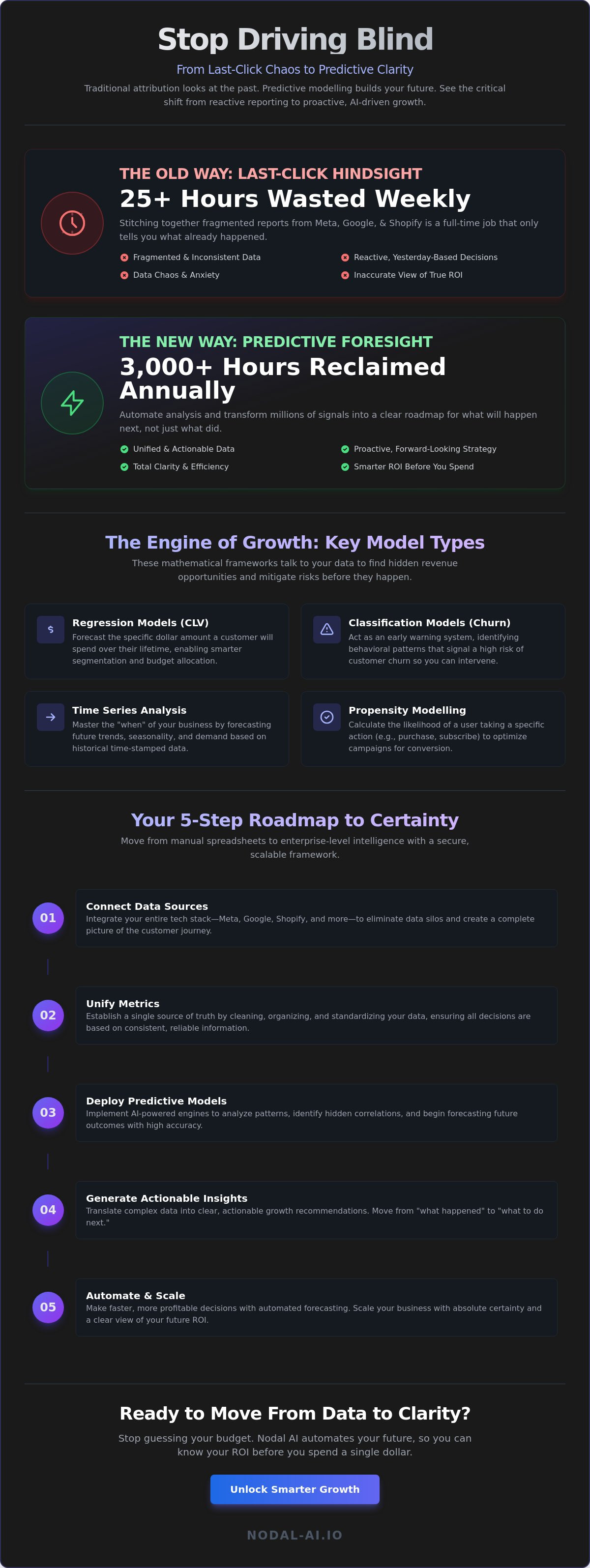
The 5-Step Framework for Implementing Predictive Models
Most businesses struggle with a fragmented data ecosystem. They have plenty of information, but it is often buried in silos or trapped in static spreadsheets. To scale, you need a roadmap that turns this noise into a signal. Effective predictive modelling is not just about complex math; it is about building a reliable bridge from data to clarity. This framework ensures your implementation delivers day one value instead of months of technical debt.
Data Ingestion and Unified Metrics
Your journey begins by connecting disparate sources into a single intelligence engine. From e-commerce platforms to social ad managers, every touchpoint must feed into a unified stream. High-quality performance analytics starts with clean data. If your historical data is messy, your predictions will be too. We prioritize enterprise-level encryption and strict data governance from the first byte. This protection ensures your proprietary insights remain secure while you build your competitive advantage. By ingestion of historical data correctly, you create a foundation where you can finally talk to your data.
Feature Selection and Model Training
Not every data point matters for your bottom line. Feature selection is the process of identifying the dots that actually drive revenue. Instead of manual sorting, AI automates feature engineering to isolate the variables that correlate with growth. You might find that a specific customer behavior on day three is a 92% predictor of long-term lifetime value. We iterate on these models until they provide clear, actionable recommendations. This moves your team from guessing to knowing, allowing you to focus on the 20% of activities that drive 80% of your results.
- Automated Reporting: Transitioning to automated systems saves organizations over 3,000 hours annually.
- Actionable Intelligence: Move from "what happened" to "what will happen" with 95% confidence intervals.
- Scalable Governance: Ensure every team member accesses the same version of the truth through unified metrics.
Data governance is not a hurdle; it is a foundation for speed. By removing the friction of manual analysis, your predictive modelling efforts translate into profitable decisions immediately. This streamlined approach ensures that your growth is not just fast, but sustainable. Stop digging into spreadsheets and start making smarter decisions based on real-time intelligence.
While data provides the direction, a structured operational plan ensures your team is aligned for execution. For those looking to streamline their documentation, GrowthGrid provides an AI-powered way to generate comprehensive business documents and templates in minutes.
Ready to see how your data can work harder? Connect your data sources and start growing smarter today.
Talk to Your Data: How Nodal AI Automates the Future
Nodal AI acts as the Smarter Partner for your marketing team, bridging the gap between raw information and real-world results. Manual analysis is a resource drain that most businesses can no longer afford. Our platform saves teams up to 3,000 hours every year by automating the heavy lifting of data processing. This isn't just about speed; it's about the relief of turning fragmented data into profitable decisions without the usual friction. Whether you're a London enterprise or a scaling global team, Nodal AI connects the dots across your fragmented data ecosystem to provide a unified view of success. We replace the anxiety of manual reporting with the confidence of instant, actionable intelligence.
The complexity of modern marketing often leaves leaders feeling buried under a mountain of metrics. Nodal AI changes the dynamic. Instead of wrestling with spreadsheets, you talk to your data. By leveraging predictive modelling, our engine identifies patterns that human analysts might miss, ensuring your strategy is proactive rather than reactive. It's the difference between guessing your next move and knowing exactly where your next pound of revenue will come from. This transition from uncertainty to clarity allows your team to focus on creative strategy while the AI handles the mathematical heavy lifting.
From Data to Clarity: The Nodal Advantage
Clarity shouldn't be a luxury. We've streamlined the path to insight into three simple steps that allow you to start talking to your data immediately:
- Connect: Integrate your fragmented data sources into a single, unified ecosystem.
- Analyze: Let our AI-powered engine identify hidden patterns and unified metrics.
- Grow: Implement automated media planning and growth recommendations that drive ROI.
This process removes the guesswork from your strategy. You'll see exactly which channels drive retention and which ones waste spend. Every insight is backed by our commitment to secure, enterprise-ready AI, ensuring your proprietary information stays protected with high-level encryption. We provide the infrastructure that turns a fragmented data ecosystem into a streamlined revenue engine through advanced predictive modelling.
Ready to Grow Smarter?
The era of digging through endless spreadsheets is over. You don't need a PhD in data science to unlock the power of automated business intelligence. You just need the right partner. It's time to move from feeling overwhelmed by your tech stack to feeling empowered by your insights. Nodal AI provides the cognitive upgrade your business needs to maintain sustainable growth in a competitive market. Stop searching for answers and start making moves that matter. Our platform is built for the pragmatic leader who values time as much as profit.
Transform your complex data into profitable decisions with Nodal AI.
Connect the Dots to Your Future Growth
The shift from looking at what happened to predicting what will happen is the defining competitive advantage for modern brands. By moving beyond the limitations of traditional attribution and adopting predictive modelling, you replace guesswork with a clear roadmap for revenue. You've learned how a structured 5-step framework turns a fragmented data ecosystem into a streamlined engine for sustainable growth. It's no longer about digging through spreadsheets; it's about gaining the clarity to make profitable decisions in real time.
Nodal AI is the partner you need to bridge this gap. Our platform saves teams 3,000+ hours annually on manual data analysis, allowing you to focus on strategy instead of syntax. With enterprise-level encryption and security, your data remains protected while our AI-powered growth recommendations deliver instant ROI. Don't let your insights stay buried in silos. It's time to turn your metrics into a conversational partner and start growing smarter today. The future of your business is already hidden in your data, and we're here to help you find it.
Talk to your data and unlock growth with Nodal AI
Frequently Asked Questions
What is the difference between predictive modelling and machine learning?
Predictive modelling is the specific goal of forecasting outcomes, while machine learning is the technical method used to achieve it. You can think of it as the difference between a destination and the vehicle. Machine learning uses algorithms to learn from your historical patterns without explicit programming. This process allows you to move from simply tracking what happened to predicting what will happen next with 90% confidence.
How much data do I need for a predictive model to be accurate?
Most accurate models require a minimum of 6 to 12 months of historical data to identify reliable patterns. While you can start with less, having 1,000 or more recorded conversions provides the statistical significance needed for 85% accuracy. This volume ensures the AI accounts for seasonal shifts and market volatility. It turns your fragmented data into a clear roadmap for growth without the usual spreadsheets.
Can predictive modelling help reduce my customer acquisition cost (CAC)?
Yes, predictive modelling reduces customer acquisition costs by identifying the top 25% of prospects with the highest lifetime value. Instead of broad targeting, you focus your budget on the segments most likely to convert. Industry reports from 2023 show that this precision can lower CAC by as much as 30%. It's the most effective way to grow smarter while protecting your margins and increasing ROI.
Is predictive modelling GDPR compliant for UK marketing teams?
These analytical tools are fully GDPR compliant for UK teams when they utilize pseudonymized data and strictly follow the Data Protection Act 2018. Nodal AI prioritizes security by using enterprise-level encryption to process information without compromising individual privacy. You get the insights you need while maintaining 100% compliance across your entire marketing stack. It replaces the anxiety of data handling with total confidence and clarity.
How does predictive modelling improve multi-touch attribution?
This approach improves multi-touch attribution by using historical data to assign a weighted value to every interaction in the customer journey. You move away from flawed last-click models that ignore 90% of the user's path. By connecting the dots across 5 or more different platforms, you see which specific ads actually triggered the final sale. This clarity ensures your media planning is based on facts rather than gut feelings.
What are the most common challenges in predictive modelling implementation?
The primary challenge is data fragmentation, as nearly 65% of companies struggle with information trapped in separate silos. Teams often lose hundreds of hours trying to manually reconcile these different sources. Implementation succeeds when you shift to a unified metrics system that connects your entire ecosystem into one dashboard. It's about removing the friction between your data and your decisions to ensure sustainable, profitable growth.
How much time can automated predictive reporting actually save?
Automated reporting saves the average enterprise team 3,000 hours per year by removing manual data entry tasks. This equates to roughly 375 working days of reclaimed time for your staff. You can stop digging into spreadsheets and start acting on insights immediately. It's a direct path from operational overwhelm to streamlined, profitable execution that keeps your business ahead of the competition.
Do I need a data scientist to use Nodal AI’s predictive tools?
You don't need a data scientist or a technical background to use Nodal AI's advanced tools. We designed the interface to be an empowering partner for marketers and business owners who value results. The engine handles the heavy lifting of complex calculations so you can just talk to your data. You get the power of high-level analytics through a simple, three-step journey from connection to clarity.


