

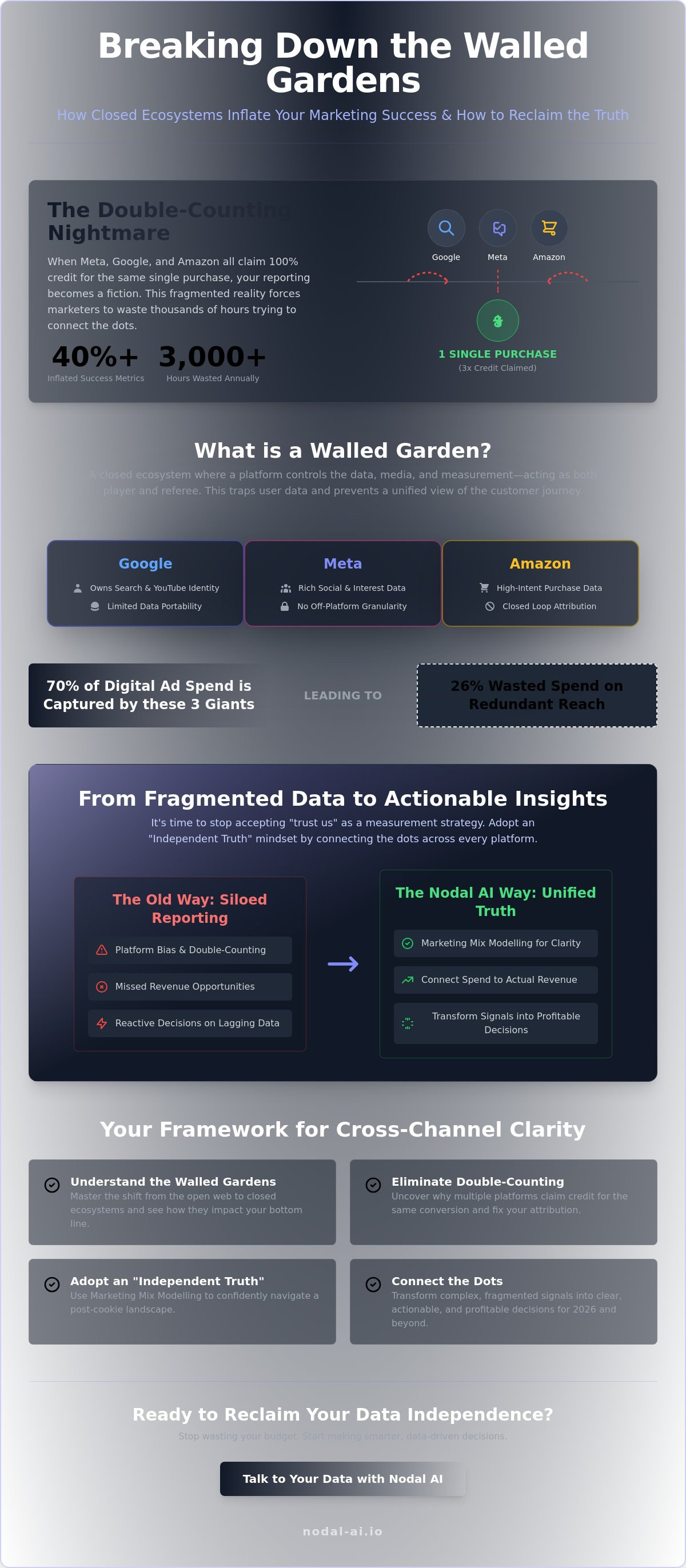
Your marketing dashboards are likely inflating your success by 40% or more. When Meta, Google, and Amazon all claim credit for the same single purchase, you aren't seeing growth; you're seeing a walled garden at work. These closed ecosystems are designed to keep you trapped in a cycle of double-counted conversions and opaque user journeys. It's a fragmented reality that forces most marketers to waste over 3,000 hours a year just trying to make sense of conflicting spreadsheets.
We agree that you shouldn't need a PhD in data science to find the truth in your metrics. This guide will show you how to reclaim your marketing attribution and connect the dots across every platform you use. You'll discover a framework for cross-channel clarity that bypasses platform bias and focuses on actual revenue. We're moving from data silos to actionable insights, giving you the power to talk to your data and make smarter decisions for 2026. It's time to transform your fragmented ecosystem into a unified engine for sustainable growth.
Key Takeaways
- Master the shift from open-web transparency to the walled garden era and learn how these closed ecosystems impact your bottom line.
- Eliminate the "double-counting" nightmare by uncovering why multiple platforms claim credit for the same customer conversion.
- Analyze the unique data restrictions of Google, Meta, and Amazon to build a measurement strategy that works across every giant.
- Adopt an "Independent Truth" mindset by using Marketing Mix Modelling to navigate a post-cookie landscape with confidence.
- Connect the dots across your fragmented data to transform complex signals into clear, actionable, and profitable decisions.
What is a Walled Garden in Digital Marketing?
The digital landscape has shifted from open-web transparency to a series of "black box" advertising models. A What is a Walled Garden? is a closed ecosystem where the platform provider maintains total authority over content, media, and user data. Google, Meta, and Amazon are the primary architects of this modern isolation. They've built environments where they control the supply, the demand, and the measurement. Currently, these three giants capture over 70% of all digital ad spend. This creates a fundamental conflict of interest. The platform acts as both the player and the referee. They grade their own performance while keeping the raw data locked away. When a platform reports a conversion, you often have no way to verify that claim against independent records. This lack of visibility turns your marketing budget into a leap of faith rather than a data-driven investment.
The Anatomy of a Closed Ecosystem
First-party data is the currency of the modern web. By 2026, these gardens will be more valuable than ever because they own the "Login." While the open web struggles with the death of third-party cookies, these platforms use identity-based tracking to follow users across every device. When a user logs into a Google account or a Meta app, they provide a persistent ID that replaces the fragmented data of the crumbling cookie. It's a seamless experience for the consumer, but a transparency trap for the marketer. You gain access to massive audiences, but you lose the ability to connect the dots between platforms. The trade-off is simple: you trade granular data ownership for ease of use. It's time to stop accepting "trust us" as a measurement strategy. Talk to your data directly instead of relying on a filtered version of the truth provided by the seller.
Literal vs. Digital: Clearing the Confusion
The term has nothing to do with physical gardening or specific software brands like "Walled Garden" security tools. The tech industry borrowed the metaphor to describe intentional data isolation. It describes a strategic perimeter built to keep user behavior data inside the platform's walls while keeping competitors out. In marketing, a walled garden is a closed loop of data and inventory where the platform controls the entire transaction from click to conversion. This isolation prevents you from seeing a unified view of your customer's journey. From fragmented data to clear insights, the goal is to break these silos. To grow smarter, you must look beyond these walls and reclaim your data independence. Connect the dots between your spend and your actual revenue to ensure sustainable growth.
This principle of looking beyond broad ecosystems for specialized quality applies to various digital fields. For instance, those interested in high-end digital assets often seek out curated platforms like lightbendernft.com to find premium art that stands apart from mass-market offerings.
The Hidden Cost of Silos: Why Your Attribution is Broken
Your data is lying to you. When Google and Meta both claim 100% credit for a single conversion, your reporting becomes a fiction. This double-counting nightmare is the direct result of the walled garden ecosystem. These platforms operate in isolation, creating a fragmented view of the customer journey. You see the click, but you lose the thread the moment a user moves between ecosystems. It's a bias problem by design. Platform-specific models always favor their own inventory, leading to a distorted reality where every channel looks like a top performer, even when overall revenue stays flat.
Data lag compounds the issue. Waiting 24 to 48 hours for platform syncs means you can't make real-time cross-channel optimizations. You're reacting to yesterday's news instead of driving tomorrow's growth. From fragmented data to profitable decisions, the path requires a unified view that these silos simply won't provide. You don't just need more data; you need the right data at the right time.
The Attribution Gap Explained
Visualizing the blind spot between a social click and a final search conversion is nearly impossible for London marketing teams using standard tools. Walled gardens prevent the connect the dots analysis needed to understand true incrementality. When data portability is limited, your long-term growth strategy suffers. You're left with a series of snapshots rather than a complete movie of your customer's behavior. Talk to your data to uncover these hidden patterns before they erode your margins.
Wasted Ad Spend: The Financial Reality
Inefficient overlap is draining your budget. A 2023 industry report suggests that up to 26% of marketing spend is wasted on redundant reach within closed systems. Relying on last-click metrics within a walled garden creates a dangerous loop. You over-pay for the same customer across multiple platforms, leading to misallocated budgets and missed revenue targets. To grow smarter, you must move beyond these closed loops and identify where your money actually drives new business.
- Redundant Reach: Paying for the same user on three different platforms without realizing it.
- Inflated ROI: Reporting that suggests your total conversions are higher than your actual bank deposits.
- Static Planning: The inability to shift budget to the highest-performing channel in real-time due to siloed reporting.
Google, Meta, and Amazon: Comparing the Giants
Google, Meta, and Amazon don't just dominate the digital market; they define the boundaries of your data. Each giant operates a distinct walled garden built on specific user behaviors. Google owns intent through search. Meta owns identity through social. Amazon owns the transaction through commerce. While they claim to protect user privacy, these barriers often serve to lock you into their specific ecosystems, making a unified view of your ROI nearly impossible. From fragmented data to clear decisions, the path is blocked by these proprietary moats.
Google's Privacy Sandbox vs. Meta's Aggregated Event Measurement
Google's Privacy Sandbox and Meta's Aggregated Event Measurement (AEM) are the technical moats of the modern era. Google moves tracking to the browser level, while Meta uses AEM to process data after Apple's 2021 App Tracking Transparency update. These features restrict your access to granular, person-level data. Instead, you receive modeled, delayed reports. This shift forces you to rely on their internal "black box" attribution, which naturally favors their own platforms. It stops you from seeing the full journey and keeps your insights fragmented.
Amazon: The Ultimate Commerce Walled Garden
Amazon offers the most lucrative data: the closed-loop purchase. They track the journey from the first ad view to the final checkout. However, exporting this data to your own BI tools is a hurdle. The Amazon Marketing Cloud (AMC) launched in 2021 to provide some transparency, but it requires sophisticated SQL knowledge and limits data granularity to protect Amazon's interests. You can see what happened inside Amazon, but connecting those dots to your Google Search or Meta Social spend remains a manual, time-consuming challenge.
The success of these three has sparked a gold rush. Retail Media Networks (RMNs) from Walmart, Target, and Kroger are the newest form of walled garden. In 2023, RMN ad spend reached $45 billion, according to Insider Intelligence. Every retailer is now a data fortress. This isolation forces marketers to manage dozens of separate dashboards, losing hours every week to manual data stitching. To grow smarter, you must break these silos and turn fragmented data into a single source of truth. Talk to your data instead of digging through spreadsheets.
- Google: Restricts data via the browser to prioritize its own search ecosystem.
- Meta: Uses modeled data to fill the gaps left by mobile privacy changes.
- Amazon: Keeps purchase data locked within its own cloud environment.
- RMNs: Emerging networks that replicate the isolation of the big three.
The competitive landscape is shifting. While some platforms claim to be "opening up" through clean rooms, they are actually doubling down on isolation by forcing measurement to happen on their terms. Connect the dots across these giants to reclaim your strategy and ensure every dollar is working toward sustainable growth.
Beyond the Walls: How to Measure Performance in 2026
Stop letting platforms grade their own homework. By 2026, relying on internal platform reporting is a recipe for wasted spend. You need an independent truth. Third-party measurement is no longer an optional layer; it's the foundation of any profitable media strategy. When you operate within a walled garden, you're seeing a version of reality that favors the house. Moving beyond this requires a shift from reactive tracking to proactive intelligence.
The Independent Measurement Framework
To reclaim control, follow this three-step transition to clarity:
- Step 1: Unify. Move your fragmented data into a single source of truth. Don't let your Meta results live in a different world than your Google Analytics. Connect the dots across every touchpoint to see the full picture.
- Step 2: Normalise. Platform standards are intentionally inconsistent. A "view" on one channel isn't a "view" on another. You must standardize these metrics to compare performance fairly.
- Step 3: Fill the gaps. Use AI to bridge the data siloes where platforms refuse to share. This isn't about guessing; it's about using sophisticated algorithms to model the missing pieces of the customer journey.
Marketing Mix Modelling (MMM) has evolved from a slow, academic exercise into a real-time necessity. By analyzing 24 to 36 months of historical data, modern MMM identifies the true drivers of revenue without relying on flaky cookies. Pair this with incrementality testing. It's the only way to prove what your ads actually do. If you pause a campaign and sales don't drop, those ads weren't driving growth; they were taking credit for it.
The Future of Cross-Channel Clarity
The era of digging into spreadsheets for answers is over. Talk to your data. This is the new standard for performance marketing. Instead of staring at a 1.2% conversion rate and wondering why, you should be asking your analytics engine which creative assets will drive the highest retention next quarter. This shift from reactive reporting to predictive customer journey mapping is how you win in 2026.
Building a sustainable data strategy means preparing for the next walled garden shift before it happens. Brands that automated their media planning in 2024 saw a 20% increase in efficiency compared to those stuck in manual analysis. Don't wait for the next privacy update to break your tracking. Transition to an AI-driven attribution model that values long-term revenue over short-term clicks. It's time to grow smarter.
Connect the Dots: Reclaiming Your Data with Nodal AI
The digital marketing landscape is fractured. Every walled garden guards its data, creating blind spots that lead to wasted spend and missed opportunities. Nodal AI serves as the essential bridge between these silos and your most profitable decisions. Our platform transforms fragmented data into actionable intelligence in three simple steps. First, we connect to your entire stack. Second, our AI-powered engine identifies the 'hidden' customer journeys that individual platforms simply can't see. Finally, we provide the clarity needed to scale. It's a streamlined journey from complexity to profit.
Platforms like Meta or Google often claim credit for the same conversion, leading to inflated reporting and skewed budgets. Nodal AI looks deeper. Our engine maps the cross-channel path to purchase, revealing how a social impression yesterday influences a direct search today. By reclaiming this data, you reclaim your budget. You'll save over 3,000 hours a year on manual reporting. This shift allows your team to focus on high-level growth instead of endless spreadsheet maintenance.
From Data Overwhelm to Strategic Clarity
Nodal AI automates the exhausting task of cross-platform data ingestion. It eliminates the friction of manual exports and broken API connections. The result is a single source of truth: unified metrics. You'll see your true ROAS across the entire ecosystem, free from the biased reporting of a single walled garden. We don't just show you what happened; we show you what to do next.
We provide growth recommendations that move the needle by identifying which channels drive incremental revenue. This means you can stop pouring money into campaigns that look good on paper but don't contribute to the bottom line. It's a shift from data overwhelm to total strategic clarity. Your team stops guessing and starts executing with confidence because they finally have the full picture.
Grow Smarter with Nodal AI
London's leading marketing teams are moving away from traditional, flawed attribution models. They're switching to AI-driven insights to maintain a competitive edge in a crowded market. Nodal AI provides 'Day One' value through seamless integrations that connect your disparate data sources instantly. There's no long setup or technical hurdle. You get immediate visibility into your performance from the moment you log in.
It's time to talk to your data and start making smarter decisions. Stop letting fragmented platforms dictate your strategy. Take control of your customer journey and unlock sustainable growth with a partner that understands the future of analytics. Connect your data and transform your decisions with Nodal AI.
From Data Silos to Profitable Decisions
Navigating the digital landscape in 2026 requires more than just managing campaigns; it requires total visibility. Every walled garden you interact with, from Amazon to Meta, creates a barrier that prevents a unified view of your customer journey. You don't have to settle for broken attribution or fragmented metrics. By centralizing your intelligence, you move from guesswork to absolute clarity.
Nodal AI is the smarter partner for your growth. We save teams 3,000+ hours a year on manual reporting by automating the complex work of multi-touch attribution. With enterprise-level data security and dedicated London-based support, your information stays protected while your insights become actionable. It's time to stop digging through spreadsheets and start driving revenue. The future of analytics is conversational, clear, and ready for you to lead.
Connect the dots and talk to your data with Nodal AI
Take the first step toward a more efficient ecosystem. Your data has a story to tell, and we're here to help you hear it.
Frequently Asked Questions
What is a walled garden in the context of digital advertising?
A walled garden is a closed ecosystem where the platform provider controls all hardware, applications, and data. In digital advertising, this refers to giants like Google and Meta that keep user data within their own proprietary systems. They restrict how much granular information leaves their environment. This creates a black box where you see the results they report but cannot verify the raw data yourself.
Why are walled gardens a problem for marketing attribution?
These ecosystems prevent a unified view of the customer journey by blocking third-party tracking. When a user clicks a Google ad and later converts on a Meta ad, neither platform sees the full path. This fragmentation leads to over-reporting; a 2023 industry study showed brands often claim 25 percent more conversions than actually occurred because each platform takes credit for the same sale.
Can I export my data from a walled garden like Meta or Google?
You cannot export raw, user-level data from these platforms due to privacy regulations like GDPR. While you can download aggregated reports, the specific click-path data remains locked away. This limitation forces marketers to rely on the platform's internal attribution models. You see the outcome, but the middle steps of the journey stay hidden. It's time to stop digging into spreadsheets and start using unified metrics.
How does a walled garden differ from the open web?
The open web consists of independent websites where third-party cookies traditionally operated. In contrast, a walled garden is a self-contained environment like TikTok or YouTube. While the open web allows for more transparent cross-site tracking, it now accounts for less than 38 percent of total digital ad spend. Budgets are shifting toward closed ecosystems that offer better user targeting but significantly less transparency for the advertiser.
What is the best way to track conversions across multiple walled gardens?
The most effective way to track performance is by using an AI-powered business intelligence engine to connect the dots. Instead of relying on platform-specific pixels, you should aggregate first-party data and server-side events. This approach turns fragmented data into a single source of truth. It allows you to talk to your data and see which channels actually drive revenue. Transform your complex data into profitable decisions today.
Is Amazon considered a walled garden?
Amazon is one of the most powerful walled gardens because it controls the entire purchase funnel from search to checkout. It held a 12.4 percent share of the US digital ad market in 2023. Because Amazon owns the transaction data, it doesn't share user identifiers with outside parties. This makes it nearly impossible to track an Amazon ad's impact on your external site without using a smarter partner for analytics.
How can AI help solve the walled garden problem?
AI solves this by using advanced modeling to bridge the gaps in your fragmented data ecosystem. It moves you from data to clarity by predicting the missing links in a customer journey. By analyzing patterns across thousands of data points, an AI engine calculates the true incremental value of each channel. It replaces manual work with automated media planning, saving teams up to 3,000 hours of analysis every year.
Will walled gardens become more common in the future?
They'll likely dominate as privacy restrictions tighten. With the 2024 phase-out of third-party cookies in Chrome, more platforms are building their own closed ecosystems to protect their data moats. This shift means marketers must adapt or lose visibility. Investing in a unified metrics strategy now is the only way to ensure sustainable growth. Grow smarter by preparing for a future where digital landscapes are increasingly siloed and complex.


