

A customer data platform and marketing analytics solve different problems. In a customer data platform vs marketing analytics comparison, a CDP brings customer data together to create usable profiles, while marketing analytics measures campaign activity and performance. They can work together, but neither replaces the other.
The distinction is easy to blur: both use data to help teams understand customers and make better decisions. The difference is what they do with it. A CDP connects information across customer interactions; marketing analytics assesses which channels and campaigns drive engagement and conversions. This guide explains how each works, where their roles overlap and how to decide what your organisation needs. It also covers how privacy, consent and data quality shape the insights they provide, helping you move from scattered information to clearer decisions.
Key Takeaways
- Separate the role of a CDP, which connects customer information, from analytics, which measures marketing performance.
- Choose campaign measures that show how channels contribute to engagement, conversions and customer retention.
- Use connected customer profiles to reduce data silos and give marketing teams a clearer view of interactions.
- Build privacy, consent and data quality into your approach so insights rest on information you can use responsibly.
- Explore how Nodal Platform, Performance Marketing Analytics, Customer Journey Mapping and Growth Recommendations can support clearer marketing decisions.
Marketing metrics, attribution, and campaign performance
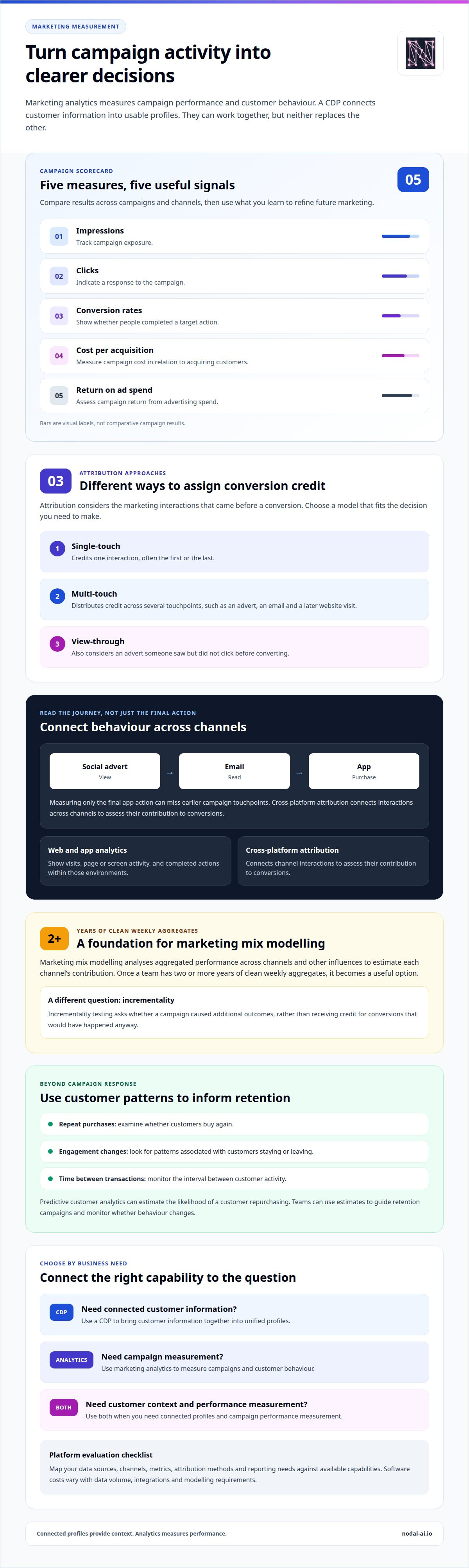
Marketing metrics turn campaign activity into evidence for decisions. In a customer data platform vs marketing analytics comparison, analytics measures campaign performance and customer behaviour. Teams track impressions, clicks, conversion rates, cost per acquisition and return on ad spend. Each metric answers a different question: clicks indicate a response, while conversions show whether people completed a target action. Compare results across campaigns and channels, then use the findings to refine future marketing.
Attribution assigns credit for a conversion to the marketing interactions that came before it. Single-touch models credit one interaction, often the first or last. Multi-touch attribution distributes credit across several touchpoints, such as an advert, an email and a later website visit. View-through attribution also considers an advert someone saw but didn’t click before converting. Each model offers a different perspective, so choose one that fits the decision you need to make.
Web and app analytics focus on behaviour within those environments. They can show visits, page or screen activity, and completed actions. Cross-platform attribution connects interactions across channels to assess their contribution to conversions. A user might view a social advert, read an email and then purchase through an app. Measuring only the final app action would miss the earlier campaign touchpoints.
Marketing mix modelling and incrementality address broader questions. Marketing mix modelling analyses aggregated performance across channels and other influences to estimate each channel’s contribution. Incrementality testing asks whether a campaign caused additional outcomes, rather than receiving credit for conversions that would have happened anyway. Once a team has two or more years of clean weekly aggregates, marketing mix modelling becomes a useful option.
Campaign analytics can also inform retention and attrition prediction. Teams can examine repeat purchases, changes in engagement and time between transactions to identify patterns associated with customers staying or leaving. Predictive customer analytics can estimate the likelihood of a customer repurchasing. These estimates may help guide retention campaigns, while teams can monitor outcomes to assess whether customer behaviour changes.
Use the customer data platform vs marketing analytics distinction to choose tools based on your business need. Choose a CDP when the priority is connecting customer information into unified profiles; choose marketing analytics when the priority is measuring campaigns. Use both when you need connected profiles and performance measurement. To evaluate platforms, map data sources, channels, metrics, attribution methods and reporting needs against available capabilities. Software costs vary with data volume, integrations and modelling requirements; pricing depends on the case and is provided after a quote request.
What is a Customer Data Platform (CDP)?
A CDP gathers customer information from different sources to build profiles an organisation can use. It can provide shared data for analytics tools, which then measure campaign performance and customer behaviour. Understanding customer data platform vs marketing analytics clarifies how connected profiles support, but don’t replace, performance measurement.
Unified Customer Profiles
A unified customer profile combines information about one person from multiple interactions and systems. For example, a retailer could connect a website visit, an email response and an in-store purchase. This joined view helps teams understand the customer journey instead of treating each interaction as unrelated. It also supports segmentation and retention analysis by giving teams a consistent record to examine.
Reducing Data Silos
Data silos occur when customer information remains separated across systems or departments. A CDP brings those records together, helping marketing and analytics teams work from a more consistent foundation. For example, a campaign team can interpret an email response alongside a related website action. This reduces reliance on separate data extracts and makes customer activity easier to compare across channels.
Once collected, customer data can be organised around profiles, events and attributes. Profiles describe known customers, while event records capture actions such as browsing or purchasing. A CDP can also handle anonymous users and associate their activity with a known profile when identification becomes possible. Clear definitions matter: teams need consistent meanings for events such as “purchase” or “subscription” before comparing reports.
Unified marketing data makes reporting easier to interpret across campaigns and customer segments. A team can examine which audience responded, what interactions came before a conversion, and whether customers returned. Without a shared foundation, different systems may count the same person or action differently. Consistent records help analysts investigate discrepancies and explain how reported results were produced.
CDPs and marketing analytics tools integrate by sharing customer profiles and interaction data with measurement systems. The CDP organises the records; analytics tools use them to assess campaign results, channel activity and customer trends. In a customer data platform vs marketing analytics approach, this connection links customer context with measurable performance. For instance, connected analytics capabilities can help bring data into a clearer view.
Marketing analytics and campaign measurement
Marketing analytics turns campaign activity into decision-making intelligence. Typical software brings together measures such as pageviews, traffic sources, time on site, goal completions and transactions. A team can compare these metrics across channels to see where engagement begins and where customers convert. For example, a campaign may attract visitors through email but lead to purchases after they return through a search advert.
Measurement starts with a defined target. If the goal is online sales, teams can track conversions, conversion rate and return on ad spend. If the aim is awareness, reach and engagement may be more useful indicators. Choose metrics that connect to the campaign objective, rather than simply reflecting what a platform makes easiest to display. This keeps reports focused on decisions.
Analytics can also help refine targeting and reduce wasted activity. Teams can compare performance by audience segment, location, device or channel, then adjust where campaigns appear. For instance, if one audience engages with an offer but rarely completes a purchase, marketers can review the message, landing page and next step. They can then shift effort towards segments showing stronger conversion behaviour.
Personalised campaigns use customer information to make messages more relevant. A retailer might send product recommendations based on previous purchases, while a subscription business could tailor content to a customer’s selected interests. Analytics can measure whether these variations increase engagement or conversions. Comparing personalised messages with broader campaigns helps teams identify which approach better serves each target audience.
Reducing costs starts with identifying spend that produces little useful response. Teams can compare campaign costs with outcomes, such as qualified enquiries or completed purchases, then adjust budgets and targeting. A low cost per click alone doesn’t prove success if visitors leave without taking action. Pairing cost metrics with conversion and customer value measures gives a fuller picture of performance.
To make findings actionable, analysts should define campaign objectives, audience groups and measurement rules before reporting. They can then review results by channel and segment, investigate unexpected changes and recommend adjustments for the next campaign. This turns raw activity into practical marketing intelligence. Clear reporting helps stakeholders understand what performed, for whom and why.
Privacy and data quality challenges
Customer data platforms and analytics tools can expose personal information across marketing channels. A profile combining email activity, website visits and purchases needs careful access controls. Limit access to roles that need it, and document why each dataset supports a business purpose. These steps help teams use customer information responsibly while reducing unnecessary exposure.
Consent affects which customer actions an organisation can use for analysis or marketing. For example, a person may agree to receive emails but not expect unrelated profiling. Keep consent preferences connected to the relevant records, then apply them when teams build audiences or evaluate campaigns. Employees who work with a CDP should understand privacy regulations such as CCPA and how secure data handling supports customer trust.
Security matters wherever customer records are collected, combined or shared. Unauthorised access can expose information and damage trust, while excessive access increases risk. Restrict permissions, protect data transfers and review who can use sensitive fields. For instance, a marketing analyst measuring email engagement may need campaign responses without needing every detail in a customer profile.
Data quality creates a separate challenge. Records may be incomplete, inconsistent across systems or affected by collection errors. One system might label an action “purchase”, while another records it as “order completed”. Before analysis, validate accuracy, consistency and completeness. Standard event names and formats help analysts compare activity across channels and avoid reports based on mismatched definitions.
Industry research shows that a majority of CTOs and chief data officers frequently consider incoming marketing data to be unreliable. Teams can address this by tracing important fields to their sources, checking duplicate records and reviewing missing values. For example, mismatched customer identifiers can split one person’s activity across several profiles. Fixing those issues before analysis makes audience segments and campaign reports more dependable.
To strengthen data practices, define ownership, access rules and quality checks before connecting new sources. Document each field’s purpose, who can use it and how teams handle consent changes. Revisit those controls when a new channel or dataset is added. Clear governance helps privacy safeguards and reliable measurement work together, rather than slowing analysis through repeated corrections.
What features do CDPs and marketing analytics platforms typically offer?
CDPs and marketing analytics platforms handle different parts of the data process. A CDP organises customer information; analytics features turn activity into reports and insights. Some capabilities overlap, particularly segmentation and data management, but their primary functions remain distinct.
CDP features often begin with collecting data from customer touchpoints. A platform may combine website visits, app activity, transactions and offline interactions. It can maintain profiles for known customers and records for anonymous visitors. Profile fields might include demographic details, preferences and a history of customer actions. These details help teams organise audiences around shared characteristics.
Identity resolution can connect separate records when available identifiers indicate they belong to the same person. For example, a customer’s browsing activity and later purchase can contribute to one profile. Data management tools help standardise fields and organise customer events. Segmentation then groups profiles by attributes or behaviour, supporting audience analysis and coordinated marketing activity.
Marketing analytics platforms typically report on pageviews, traffic sources, time on site, goal completions and transactions. Teams can compare these measures across campaigns or channels. Attribution features help assess which interactions receive credit for conversions. Visual dashboards present results for different audiences, while scheduled reports can simplify recurring performance reviews.
Some platforms also include predictive analytics and modelling. These features use historical patterns to estimate possible outcomes, such as a customer’s likelihood of repurchasing. Data visualisation can make those patterns easier to interpret. Analysts can examine trends alongside descriptive metrics, then use segmentation to explore how results differ between customer groups.
When assessing features, start with the work each team needs to do. A business focused on connecting fragmented customer records may prioritise data collection, profile management and identity resolution. A team measuring campaign outcomes may prioritise channel reporting, conversion metrics and attribution. If both needs matter, consider how the CDP’s data can feed analytics workflows without creating separate definitions for customers or events.
Discussing platform capabilities can clarify how the features fit your marketing measurement needs.
CDPs collect data from anonymous visits and track customer activity online and offline. Analytics combines predictive analytics, predictive modelling, data visualisation, data management and segmentation. Descriptive customer data includes basic persona information, such as demographics and preferences.
Nodal AI: Nodal Platform
Nodal AI’s Nodal Platform is a practical option when fragmented marketing data makes performance difficult to interpret. It helps organisations turn data into actionable intelligence, track performance, identify trends and make faster decisions. Use it when your team needs a clearer view of how marketing activity connects with business outcomes.
The distinction matters: a CDP focuses on unifying customer information, while marketing analytics focuses on interpreting performance. Nodal Platform supports the analytics side of that need. Its Performance Marketing Analytics helps teams assess campaign activity and understand results, rather than treating disconnected reports as separate answers.
Customer Journey Mapping can show how interactions relate across a customer journey. For example, a marketer may need to understand how different touchpoints contribute to an eventual conversion. Mapping those interactions gives teams a structured way to examine the path, spot patterns and identify where further measurement could clarify campaign performance.
When reporting highlights a trend but leaves the next decision unclear, Growth Recommendations can help translate insights into possible actions. Teams can use findings to decide where to focus, which performance patterns merit investigation and what changes may support their objectives. The value comes from connecting analysis to a practical decision, not simply adding another report.
Consider Nodal Platform when your organisation needs performance insights across marketing activity, clearer customer journey analysis or recommendations grounded in observed trends. It is relevant when decision-makers want to move from fragmented data towards a more coherent view of performance. Start with the business question: what should the team understand, measure or decide?
Before adopting an analytics approach, clarify the outcomes your team needs and the information available to support them. This makes it easier to focus on useful performance measures, interpret customer journeys and apply recommendations in context. Nodal AI brings these capabilities together through Nodal Platform, Performance Marketing Analytics, Customer Journey Mapping and Growth Recommendations.
Contact Nodal AI to discuss your marketing analytics needs.
Turn clearer measurement into your next decision
Use the distinction between customer data platforms and marketing analytics to define your organisation’s next decision. Start with a focused business question, such as which customer journeys deserve closer attention or where campaign performance needs clearer interpretation. Then connect the data and analysis to that decision, rather than collecting information without a practical purpose.
For teams ready to put this approach into practice, Nodal AI offers Nodal Platform, Performance Marketing Analytics and Growth Recommendations. These offerings can help turn marketing data into decisions grounded in performance insights. Start by identifying the question your team wants answered and the outcome that decision should inform.
Build from that point with a clear objective, relevant measures and an approach that respects customer data. Each well-defined decision gives your organisation a stronger basis for learning and refining its marketing activity.
Take the next step with confidence, turning clearer insights into purposeful progress.
Frequently Asked Questions
What are the benefits of a CDP?
A CDP can give teams a more consistent basis for audience decisions and customer analysis. For example, a retailer can use connected records to distinguish first-time buyers from repeat purchasers, then assess how each group responds to different offers. This makes segmentation more informed and reduces reliance on separate customer lists. The benefit depends on useful source data, clear profile definitions and appropriate handling of customer information.
What data types do CDPs use?
CDPs can use descriptive, behavioural, transactional and preference data. Descriptive details include demographics, while behavioural data records actions such as browsing or email engagement. Transaction records can show purchases, and preference data can reflect a customer’s stated interests. A CDP may also handle anonymous online activity and connect it with known profiles. For business-to-business organisations, descriptive records can include firmographic information about a customer’s organisation.
What is marketing analytics software?
Marketing analytics software helps teams organise and interpret performance data. For example, an analyst might compare campaign engagement with completed sales, then prepare findings for a planning meeting. The software can help teams assess whether a campaign met its objective and identify patterns worth investigating. Its usefulness depends on choosing meaningful metrics and interpreting them alongside the campaign’s audience, channel and intended outcome.
How does a CDP differ from marketing analytics?
A CDP organises customer data into usable profiles; marketing analytics interprets marketing results. Imagine a subscription business reviewing an email campaign. The CDP can help connect the customer’s records, while analytics measures campaign responses and subsequent outcomes. Used together, they link customer context with performance reporting. If the immediate need is unified profiles, prioritise CDP capabilities; if it is campaign evaluation, focus on analytics.
What data privacy and compliance rules apply to CDPs and marketing analytics in the United States?
US businesses should consider privacy requirements relevant to their activities, including regulations such as CCPA. The information here supports treating consent, secure handling and employee training as important parts of responsible data use. For example, teams should apply customer preferences when creating audiences and restrict access by role. Since requirements can depend on circumstances and jurisdiction, organisations should assess their obligations with appropriate legal guidance.
What are the implementation challenges and risks of CDPs and marketing analytics tools?
Common challenges include incompatible data formats, incomplete records, duplicated profiles and unclear event definitions. For example, two systems may record the same conversion under different names, making a combined report misleading. Integration work can also expose gaps in consent handling or access controls. Reduce these risks by defining priority use cases, standardising key fields, testing data flows and reviewing sample reports before relying on them for decisions.


