

The best marketing analytics vendor isn’t simply the one with the most data or the flashiest models. The most useful questions to ask a marketing analytics vendor reveal how it validates, protects and connects your data, and whether its analysis can support decisions across the customer lifecycle. Start by mapping the data you have, where it lives and how reliably it reflects customer behaviour.
It’s easy to focus on dashboards and predictions, but their value depends on sound data foundations and methods your team can understand. A clear evaluation helps you distinguish useful capabilities from complexity that won’t meet your needs. This guide covers data governance, model volume and updates, off-the-shelf versus customised solutions, and predictive analytics from early engagement through retention. It also explains what to ask about integrations, usability and turning insights into practical next steps, so you can assess fit with greater clarity.
Key Takeaways
- Assess how a vendor validates, protects and exports data, including whether it can connect insights to the systems your teams use.
- Match modelling options to your workflow: consider no-code tools alongside the ability to reuse existing Python or R code.
- Choose between off-the-shelf and customised analytics by weighing how closely each approach fits your needs and how much ongoing collaboration it involves.
- Explore how predictive analytics can inform decisions at different stages of the customer lifecycle, from early engagement to retention.
- Prioritise clear, usable insights, integrations and reporting that help teams turn analysis into practical action.
1. What type of data governance has been established?
Reliable reporting starts with governed data, not a polished dashboard. Ask how the platform validates records, flags errors and applies shared definitions across sources. For example, define a conversion consistently before comparing campaign results. Marketing analytics can vary depending on who processes data and how they measure it. To assess accuracy, examine validation rules, metric definitions and reporting outputs against known records. Ask for the sample rate in writing, including its default setting and who last changed it.
Data preparation should make inconsistent inputs usable without obscuring how they changed. Ask whether teams can inspect data during transformation, catch errors before output and automate repeatable cleaning. Check whether the platform can standardise inconsistent values, convert units, replace nulls and remove unwanted characters. If analysis includes unstructured text or images, clarify how those inputs are handled. Code-free and code-friendly preparation options suit different teams, so assess which fits your workflow.
Exports need to reach the systems where teams act on insights. Map destinations such as data warehouses, CRMs and customer support tools, then ask which formats each export supports. Clarify whether an export contains raw records or summaries, and how often it can be delivered. A warehouse may need detailed event data, while a CRM may use customer-level segments. Confirm that field names and identifiers stay consistent across destinations, or teams may struggle to connect campaign behaviour with customer outcomes.
Extensibility matters when internal data leaves gaps. Ask whether the platform connects directly to your organisation’s repositories and can combine your data with third-party demographic or spatial sources. Establish how each source is matched, refreshed and labelled. Privacy controls need equal clarity: identify what data is stored, masked and exposed, and which roles can access it. These details help teams understand how sensitive records move through preparation, analysis and export.
Implementation time depends on the number and condition of sources, required integrations, data definitions and available technical resources. Map these dependencies first, then agree on responsibilities for access, testing and stakeholder decisions. Define support, training and account management in the agreement, including who handles platform questions, user onboarding and ongoing reviews. A clear governance plan turns these points into assigned tasks rather than assumptions, helping teams maintain consistent reporting as sources and requirements change.
2. Model build volume, frequency, and update intervals
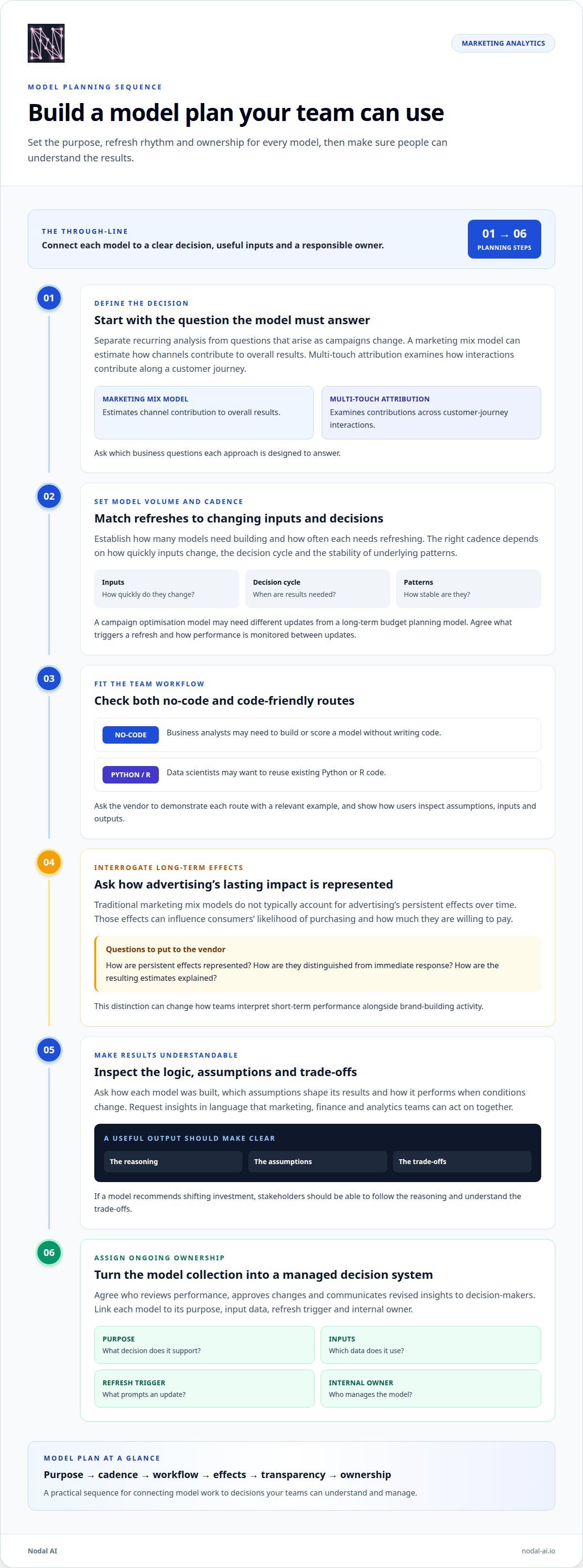
Model requirements depend on the decisions your team needs to make. Start by separating recurring analysis from questions that arise as campaigns change. A marketing mix model can estimate how channels contribute to overall results. Multi-touch attribution examines how interactions contribute along a customer journey. Ask whether the vendor supports both approaches and which business questions each model is designed to answer. This prevents a broad modelling programme from producing outputs teams cannot use.
Next, establish how many models need building and how often each needs refreshing. The right cadence depends on how quickly inputs change, the decision cycle and the stability of underlying patterns. A campaign optimisation model may need different updates from a long-term budget planning model. Ask what triggers a refresh, how the platform monitors model performance between updates, and what happens when input data shifts. The answer should link update frequency to a clear decision, not an arbitrary schedule.
Check how the platform supports both no-code modelling and existing technical workflows. Business analysts may need to build or score a model without writing code, while data scientists may want to reuse existing Python or R code. Ask the vendor to demonstrate each route with a relevant example, such as assessing campaign response or comparing channel contributions. Clarify how users can inspect assumptions, inputs and outputs. This makes model creation more accessible without hiding the logic from technical reviewers.
Marketing mix models also need a clear treatment of advertising’s long-term effects. Traditional marketing mix models do not typically account for advertising’s persistent effects over time. Yet those effects can influence consumers’ likelihood of purchasing and how much they are willing to pay. Ask how the vendor represents these effects, distinguishes them from immediate response and explains the resulting estimates. For growth planning, this distinction can change how teams interpret short-term performance alongside brand-building activity.
Transparency matters as much as model volume. Ask the vendor to explain how each model was built, which assumptions shape its results, and how it performs when conditions change. Request insights in language that marketing, finance and analytics teams can act on together. If a model recommends shifting investment, stakeholders should be able to follow the reasoning and understand the trade-offs. For a closer look at how predictive modelling capabilities fit into marketing analysis, explore the platform’s features.
Finally, define ownership for updates and monitoring. Agree who reviews performance, approves changes and communicates revised insights to decision-makers. A practical model plan links each model to its purpose, input data, refresh trigger and internal owner. This turns a growing collection of models into a managed decision system, giving teams a shared basis for evaluating results and adjusting their approach.
3. Off-the-shelf versus customised analytics solutions
An off-the-shelf solution uses a standard product and established workflows. It can suit teams whose measures, data sources and reporting needs already fit those workflows. A customised solution adapts analysis to specific business questions, systems or customer journeys. Vendor collaboration is typically a one-time event for off-the-shelf analytics suppliers, but an ongoing process with customised analytics providers. Ask what work continues after setup and who owns changes to the solution.
Compare both approaches against a defined business context. For example, a team measuring familiar campaign channels may need standard reporting, while an organisation with unusual customer journeys may need tailored analysis. Ask the vendor to demonstrate how its solution would measure your priority outcomes, use your data sources and present results to decision-makers. The useful comparison is not a broad feature count. It’s whether the approach addresses your requirements without adding complexity your team cannot use.
Customer case studies can show how a vendor and its platform work in practice. Review examples from organisations with comparable goals, data environments or industry context. Look for the problem, implementation approach, measures used and how teams applied the resulting insights. Ask what changed from the original plan and what work remained for the customer. A case study is more useful when it explains the steps behind an outcome, rather than relying on a headline result alone.
Contracts are often cancelled when a solution no longer fits an organisation’s needs, teams struggle to use it, or expected insights don’t support decisions. Treat these as risks to explore, not assumptions about every vendor. Ask how the provider handles changing requirements, user adoption and ongoing collaboration. Clarify which services, support and deliverables the contract includes, how renewal works, and what happens to data and reporting when the agreement ends.
To compare vendors for your business size and industry, assess each against the same use cases, data needs, team skills and decision priorities. Ask for a relevant case study and a demonstration using a scenario your team recognises. This makes the comparison practical without relying on unsupported claims about market position.
For pricing models, implementation fees and contract terms, request an itemised proposal that separates platform access, implementation, support and any continuing work. Price depends on scope, integrations, customisation and support requirements, and is given after a quote request. Compare the stated deliverables and renewal conditions alongside the proposed solution, so the measure of value is clear before you commit.
Before choosing, record your key requirements and ask each vendor to show how its solution addresses them. A standard product can be the right fit when it meets those needs directly; customised analytics makes sense when specific requirements call for ongoing adaptation. This distinction helps align the contract, collaboration model and expected outcomes with the work your organisation needs done.
4. Predictive analytics across the customer lifecycle
Predictive analytics can help teams anticipate customer needs at different lifecycle stages. During acquisition, a model might estimate which prospects are more likely to respond to a campaign. After conversion, it could highlight customers who may need onboarding support or identify patterns linked with repeat purchases. Later, teams can use signs of declining engagement to plan retention activity. Ask the vendor which decisions its predictions support at each stage and what data informs those outputs.
Start with the customer actions the model is meant to anticipate. A team might want to estimate purchase likelihood, compare expected responses to campaign interactions, or identify accounts showing reduced engagement. Each use case needs a defined outcome, relevant input data and a clear way to measure performance. Ask how the vendor connects predictions to observed behaviour and distinguishes useful signals from changes caused by seasonality, campaign timing or other influences.
Predictive analytics has been a business priority for years. In July 2015, Forrester Research reported that almost two-thirds of business decision-makers were implementing or upgrading predictive analytics solutions, or planned to do so within the next 12 months. The practical lesson is to evaluate more than a model’s label. Ask what customer decision it supports, how teams use its output, and how the organisation determines whether the prediction remains useful.
Ask for a walkthrough that follows one customer scenario from first interaction to a later purchase or lapse in engagement. A useful demonstration shows which signals enter the model, how the output appears and what action a team could take next. For example, a predicted drop in engagement might prompt a review of recent customer interactions. Ask how teams can understand the model’s reasoning and whether business users can interpret its insights without relying on technical terminology.
Predictions also need an evaluation plan. Ask how the vendor compares predicted outcomes with what actually happens and identifies changes in model performance. Clarify who reviews those results and how findings inform future decisions. Prediction accuracy alone may not show whether an insight helped teams act effectively. Connect each use case to a business measure, such as campaign response or customer retention, and define how teams will interpret changes in that measure.
Finally, consider how insights fit into the customer conversation. A prediction has practical value when it helps a team choose a relevant next step, such as adjusting a message or prioritising follow-up. Ask how outputs reach the people responsible for those actions and how teams can trace a recommendation to its underlying customer signals. This links lifecycle analysis to everyday decisions instead of leaving predictions isolated in a report.
5. What capabilities should a marketing analytics vendor provide?
Start with the decisions your team needs to make, then test capabilities against those tasks. A useful platform should be easy to use, connect with relevant data sources and support different roles, from business analysts to data scientists. Ask for a practical demonstration, not a tour of features. For example, can a marketing user define an interaction and analyse six months of prior behaviour without code or a software release?
Check whether teams can explore behaviour beyond events they tagged in advance. A manually instrumented platform may only track the 20 or 30 events a team tagged last quarter. Ask whether the vendor’s AI can identify untagged behaviour, and how users can inspect the underlying session behind an aggregate funnel drop-off in one click. For mobile analysis, ask how sessions are captured when a device goes offline and whether the platform supports frameworks such as Flutter and Jetpack Compose.
Look for governed self-service, not access without oversight. Business analysts, data scientists and line-of-business users need ways to collaborate while working with consistent definitions. Ask whether users can create and score models, such as logistic regressions, without coding. For technical teams, check whether the platform can process data in place on big data platforms, join sources with different structures and show combined results visually.
Test how insights become useful in daily work. Ask whether teams can inspect data during transformation to spot errors before creating an output. Check whether workflows can update Tableau on a schedule and whether users can create reports for different regions and date ranges. Clear, contextual outputs should use business language, explain how models work and support decisions people can act on. If the platform includes agentic analytics, clarify how its AI agents use governed definitions, surface alerts, trigger workflows and start the next step.
Finally, assess fit rather than choosing a tool that claims to do everything. Ask how its capabilities solve your specific marketing problem, which data and technology integrations are relevant, and what support helps users apply the results. Consider the investment alongside the resources needed to interpret insights and maintain workflows. A focused evaluation can reveal whether ease of use, extensibility and reporting match your team’s needs before a larger rollout.
Explore marketing analytics capabilities
Nodal AI: Performance Marketing Analytics
Nodal AI’s Performance Marketing Analytics is a natural next step when fragmented campaign data makes performance difficult to interpret. The Nodal Platform brings marketing analysis into clearer focus, while Growth Recommendations support decisions informed by that analysis. Automated Reporting makes performance information easier to review across teams.
Turn to this approach when you need to connect marketing measurement with practical decisions, rather than simply add another dashboard. It can suit teams assessing campaign performance, looking for patterns or seeking a more consistent view of results. Discuss your business questions and analytics needs with Nodal AI.
Contact Nodal AI to discuss your analytics needs
Turn your evaluation into a clearer next step
Your analytics strategy should grow with the decisions your organisation needs to make. Treat vendor selection as the start of a working relationship: keep business priorities visible, give teams a shared view of success, and revisit whether insights are shaping action. That focus helps prevent analytics from becoming a separate technical project with no clear connection to growth.
Use your questions to ask a marketing analytics vendor to frame a practical conversation about your goals, current measurement challenges and desired outcomes. Nodal AI brings together the Nodal Platform, Performance Marketing Analytics and Growth Recommendations to help turn marketing data into useful direction. Discuss how these capabilities could support the decisions your team wants to make.
Take the next step with a clear purpose and give your data a stronger role in the decisions ahead.
Frequently Asked Questions
How comprehensive is your available data?
Data is comprehensive when it covers the customer interactions and business outcomes relevant to your decisions. Map the sources you rely on, such as campaign platforms, booking records, CRM activity and purchase data. Then identify gaps, such as offline sales or missing customer identifiers, that could affect analysis. Ask how the vendor distinguishes observed data from estimated or modelled values, so teams can interpret findings in context.
What is the volume and frequency of models being built and how often are they to be updated?
Model volume and refresh frequency should reflect how often your decisions and underlying conditions change. A stable planning model may need a different review rhythm from one supporting a new campaign or product launch. Ask how model versions are recorded, who approves revisions and how teams can compare outputs over time. These details help distinguish meaningful changes in customer behaviour from changes caused by updated inputs or assumptions.
What type of data governance has been established?
Effective governance assigns clear ownership for data definitions, access and issue resolution. Ask who approves changes to key measures, such as what counts as a qualified lead, and how that definition is shared with teams. Find out how disagreements are escalated and changes logged. A named owner and documented decision trail can help prevent two departments from reporting different results for the same campaign.
How does the vendor collect, integrate, and validate marketing data?
Ask the vendor to trace one campaign record from its original source through integration, validation and final report. Useful questions to ask a marketing analytics vendor include how it handles missing fields, duplicate records and delayed updates. Clarify whether errors are flagged for review or silently excluded. This walkthrough shows where data can change along the way and helps your team understand which issues could affect a particular analysis.
Which marketing attribution models and analytics methods does the platform support?
Choose methods based on the decision you need to make, not just the model names available. Ask how the platform handles a customer journey involving paid search, email and a later direct visit. Find out which interactions each method considers and how teams can compare different results. A useful explanation connects the method’s assumptions to the decision at hand, such as channel planning or understanding the contribution of customer touchpoints.
What privacy, security, and regulatory compliance standards does the vendor meet?
Ask the vendor to explain its security controls and how they apply to your data, rather than relying on broad assurances. Clarify how access is managed, what information is retained, how deletion requests are handled and which third parties may process data. Requirements depend on the jurisdictions and data involved, so involve your organisation’s privacy or legal lead when assessing applicable obligations. Request evidence for any standards or compliance claims.
How does the platform integrate with our CRM, ad platforms, and data warehouse?
Integration fit depends on the systems you use and the fields your analysis requires. Ask how records from your CRM, advertising platforms and warehouse are matched, and what happens when identifiers differ. Confirm how updates and failed transfers are surfaced to users. For example, a campaign report may be difficult to reconcile with CRM outcomes if campaign names or customer IDs don’t align across systems.
What risks, limitations, or hidden costs should we look for in a marketing analytics contract?
Review the contract for charges or obligations tied to implementation, integrations, data volumes, support and changes to scope. Clarify renewal terms, cancellation notice, data access after termination and any export assistance. Ask which deliverables are included and which require additional work. These details help your team estimate the full commitment and plan an exit or transition without assuming platform access alone covers every operational need.


