

More metrics won’t fix a plan that can’t show what marketing changed. To understand how to build a marketing measurement plan, start with business goals, align the teams responsible for results, then define the metrics, data sources, owners and reporting rhythm. Connect each marketing action to an outcome the business can use.
It’s easy to collect campaign figures and still be unsure where to invest next. A useful plan gives marketing, finance and leadership a shared view of what success means, how to measure it and which decisions the results should inform. Measurement becomes a practical guide to budgets and priorities, not just a record of past activity.
This article walks through the steps, from setting objectives and mapping the customer journey to choosing metrics, validating data and assigning owners. You’ll also learn how to set a reporting cadence that supports timely adjustments while keeping longer-term outcomes in view. The result is a clearer connection between what your team does and what the business achieves.
Key Takeaways
- Start with business goals, then choose layered metrics that show reach, engagement, conversions and business outcomes.
- Align marketing, finance and leadership around what gets measured, who receives reports and which decisions the data will guide.
- Give every metric a clear definition, data source, owner, reporting cadence and intended use.
- Map audience actions across the customer journey so each stage has relevant measures and a clear link to outcomes.
- Use measurement to spot where to refine campaigns and direct budget and time towards stronger opportunities.
What is a marketing measurement plan and why is it vital?
A marketing measurement plan connects business goals to the measures, data and decisions that show progress. For digital, offline and omnichannel campaigns, build one framework to track each channel’s contribution to shared outcomes, using suitable data sources for every activity.
-
Connect business goals to marketing objectives
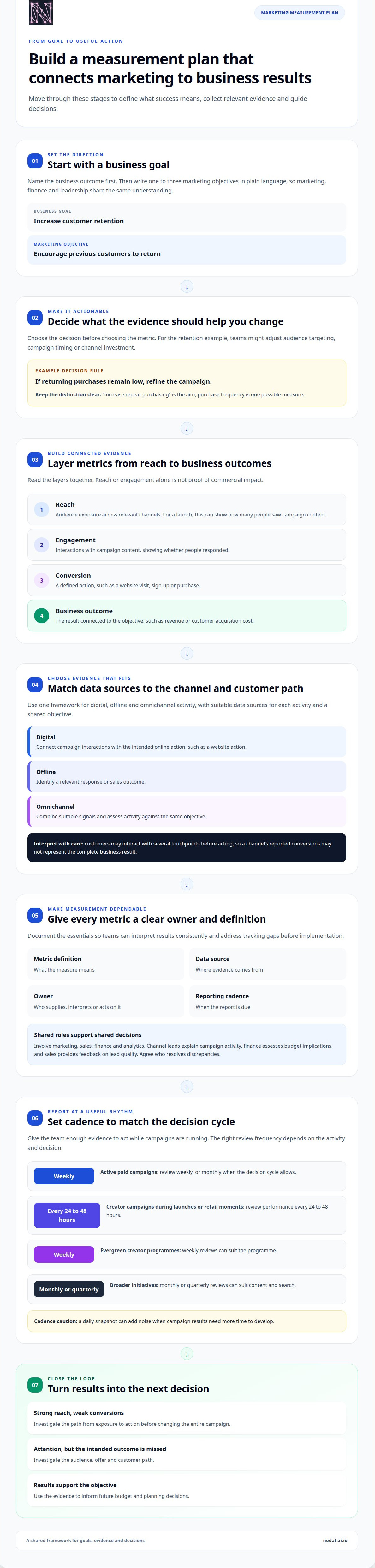
Start with a business objective, then define the marketing contribution that could support it. If the business wants more repeat purchases, a marketing objective might focus on bringing previous customers back with relevant offers. Write one to three objectives in plain language so marketing, finance and leadership recognise the intended outcome.
Next, specify the decision each objective should inform. For the repeat-purchase example, teams might decide whether to adjust audience targeting, campaign timing or channel investment. Keep the objective separate from its metric: “increase repeat purchasing” states the aim, while purchase frequency is one possible measure. Don’t choose a metric first and mistake it for the goal.
- Business goal: increase customer retention.
- Marketing objective: encourage previous customers to return.
- Decision: refine the campaign if returning purchases remain low.
This alignment makes a measurement strategy useful beyond campaign reporting. It gives each team a shared basis for interpreting results and connecting marketing activity with business priorities.
-
Layer metrics from reach to business outcomes
Build connected measurement layers instead of relying on one campaign number. Begin with reach, which shows whether the intended audience encountered the campaign. Add engagement measures, such as content interactions, to understand whether people responded. Then track conversions, such as sign-ups or purchases, and connect them to business outcomes.
For a product launch, reach might show how many people saw campaign content, while engagement indicates whether they interacted with it. Website visits or sign-ups can show progress towards conversion. Revenue or customer acquisition cost can help assess the business result. Choose measures that fit the objective, and don’t present reach or engagement alone as proof of commercial impact.
- Reach: audience exposure across relevant channels.
- Engagement: interactions with campaign content.
- Conversion: a defined action, such as a purchase.
- Business outcome: the result connected to the objective.
Read the layers together. If reach is strong but conversions are weak, investigate the path from exposure to action before changing the entire campaign.
-
Use measurement to guide business decisions
Choose the decision first, then define how campaign evidence will support it across digital, offline and omnichannel activity. A digital campaign may record website actions, while an offline promotion may use sales or response records. An omnichannel plan combines suitable signals so teams can assess activity against one shared objective.
For example, a campaign promoting a store visit might use digital engagement alongside recorded in-store outcomes. Document how each measure is collected and interpreted. Don’t treat a channel’s reported conversions as the complete business result, especially when customers interact with several touchpoints before acting.
- Digital: connect campaign interactions with the intended online action.
- Offline: identify a relevant response or sales outcome.
- Omnichannel: assess combined evidence against the same objective.
Agree in advance what action follows each result. If a campaign attracts attention but misses its intended outcome, investigate the audience, offer and customer path. If results support the objective, use that evidence to inform future budget and planning decisions.
Aligning team structure and reporting with marketing goals
Build a reporting framework around the decisions people need to make, not separate channel scorecards. The right cadence and shared data standards help teams interpret performance consistently and act while campaigns are running.
- Give each team a role in the measurement process. Include marketing, sales, finance and analytics when designing the framework. Channel specialists can explain campaign activity, while sales can clarify which leads progress and which outcomes feed back to marketing. Ask each stakeholder what question they need the report to answer, then assign responsibility for supplying, interpreting or acting on relevant data. This helps identify tracking gaps before implementation.
Organise reporting around shared business goals rather than isolated channels. A campaign owner might coordinate results, while channel leads explain changes in reach or engagement. Finance can assess budget implications, and sales can provide feedback on lead quality. Agree who resolves discrepancies so differences between teams don’t stall decisions.
- Set a reporting cadence that matches the decision. Review active paid campaigns weekly, or monthly when the decision cycle allows. Weekly or monthly reviews can help channel teams adjust campaigns while they run. For creator campaigns during launches or retail moments, review performance every 24 to 48 hours. Weekly reviews can suit evergreen creator programmes.
Use monthly or quarterly reviews for broader initiatives, such as content and search. A daily snapshot can add noise when campaign results need more time to develop. Choose a cadence that gives the team enough evidence to act, and state when each report is due and who reviews it.
- Standardise data before comparing results. Set shared naming conventions, UTM structures, attribution windows and format-level tags for creator activity. Apply the same definitions across teams so a campaign or content format isn’t counted differently in separate reports. Document tracking changes and clearly distinguish missing data from zero performance.
Platform-reported metrics are useful signals, but may reflect different attribution rules and reporting windows. Don’t add platform conversion totals together as if they were deduplicated business outcomes. Compare them with website analytics, CRM and sales records, and note where each figure comes from. Reporting tools that rely on an analytics platform’s API can also inherit gaps in its data.
- Turn each review into a testable next action. Record the result, its interpretation and the action owner. If engagement rises but qualified leads don’t, test a change to the audience or landing-page path, then review the relevant measures again. Keep the hypothesis and comparison period visible so the team can distinguish a useful change from a temporary fluctuation.
A shared dashboard can keep stakeholders aligned between reviews. For a closer look at how connected analytics can support reporting, explore marketing analytics features.
Metric definitions, data sources, owners, and cadence
Define each metric so teams can trace its data, owner, reporting schedule and intended decision. Set baselines using comparable historical results, then choose targets that reflect business objectives. For privacy, honour consent choices and applicable rules, minimise user-level tracking, and use aggregate or cohort-based measurement where possible.
-
Define objectives, KPIs, and data points
Start with the objective, then select the KPI that best indicates progress. Break each KPI into the data points needed to calculate it. For example, a lead-generation objective might use qualified leads and conversion rate, supported by form submissions and qualification status. Document the calculation, inclusion rules and reporting period beside each metric.
Keep the metric set focused on decisions. A dashboard crowded with clicks, visits and impressions can obscure whether leads meet sales criteria. Distinguish leading indicators, such as completed forms, from later outcomes, such as opportunities recorded in the CRM. This makes each measure easier to interpret and act on.
-
Assign metric sources, owners, and cadence
For every metric, name its source, owner, update frequency and intended decision. Advertising platforms can supply spend and delivery data; website or app analytics can record digital actions; CRM and sales systems can show lead progress and outcomes. Assign a person to maintain each source and resolve gaps, rather than leaving responsibility with a general team.
Decide where data will be stored before building reports. A warehouse such as BigQuery can serve as a destination for data from multiple systems, while the chosen analytics platform and its API may affect reporting availability. Set an appropriate update rhythm for each source, then make dashboards show metric definitions, date ranges and missing-data notes.
-
Set metric baselines, targets, and benchmarks
Establish a baseline from historical results that match the campaign’s audience, objective, channel and measurement method. Compare like with like: seasonality, campaign timing, website changes, offer updates and sales follow-up can all affect results. When past data uses different definitions, document the difference instead of treating the figures as directly comparable.
Set targets based on the business objective and the result the team needs to influence. Use external benchmarks as context, not automatic targets, because audiences and measurement rules may differ. Record the baseline period, target rationale and review date. If there’s no suitable history, define an initial observation period before judging performance.
-
Plan first-party data and domain tracking
Map the first-party data needed for each KPI, such as consented form submissions or CRM outcomes. Collect only relevant information, respect consent choices and apply privacy requirements in the markets where campaigns run. Avoid relying solely on individual-level tracking; aggregate or cohort-based analysis can help measure performance while limiting dependence on user-level signals.
Document which domains and customer-path steps need measurement, including mobile experiences. A dataLayer can provide a structured way to support tracking across analytics, paid media and conversion optimisation tools. Test key conversion events from campaign entry through completion, and check that consent settings affect tracking as intended. Clearly label unavailable signals in visualisations rather than presenting incomplete data as a complete result.
Mapping audiences, actions, conversions, and outcomes
Connect audience needs to observable actions, then map how those actions relate to conversions and business outcomes. A clear customer journey helps teams see where people engage, hesitate or move forward.
-
Research and segment audiences
Start with audience research that informs campaign decisions. Use customer interviews, sales feedback and first-party records to identify needs, motivations and barriers. Group people by meaningful differences, such as purchase intent or product interest, rather than using broad labels that don’t suggest a useful action.
For example, a software business might distinguish people exploring a solution from existing customers considering an upgrade. Describe each segment clearly and explain why it matters. Check that each group connects to a distinct message, journey or intended outcome, so segmentation improves measurement rather than simply multiplying audience lists.
Keep the criteria consistent across channels. If “high intent” means a pricing-page visit in one campaign and a sales enquiry in another, comparisons become difficult to interpret.
-
Map audience journeys and actions
Map the customer journey from Awareness through Consideration to Decision. For each stage, record the audience’s likely need, the marketing touchpoint and the action that signals progress. Someone might first watch a product video, later compare features, then request a demonstration. These steps make movement through the journey measurable.
Choose stage-specific indicators instead of treating every interaction as a conversion. Assess Awareness activity through reach quality, watch time and frequency control. During Consideration, saves, shares, profile taps and repeat exposure can show interest. At Decision, link clicks, product interactions and purchase influence help assess progress towards a commercial outcome.
Include the actions that happen between stages. A drop between a comparison page and an enquiry form may reveal friction that a final conversion total would hide.
-
Segment audiences by behavior and first-party data
Use relevant first-party data to group audiences by actions, such as repeat visits, content viewed, product interactions or previous purchases. Define each behaviour clearly and connect it to a campaign decision. For example, visitors who review a product’s features could receive a different follow-up journey from those who have already purchased.
Set boundaries for each segment, including the behaviours that qualify someone and the actions that remove them. This prevents outdated groups from distorting campaign results. Respect consent choices, collect only information needed for measurement, and use aggregate or cohort-based analysis where practical.
Then compare outcomes across segments using the same conversion definitions and reporting period. If one group engages but doesn’t progress, examine its next journey step before changing the whole campaign. Record the insight and resulting action so audience analysis leads to a decision, not another static report.
Marketing measurement plan purpose and benefits
A measurement plan turns campaign data into decisions about investment, priorities and future activity. Its value isn’t the volume of metrics collected, but whether the evidence helps the business act on its objectives.
- Use the plan to choose where effort goes. Connect each marketing objective to a decision about budget, time or campaign direction. For example, if a campaign generates website visits but few qualified enquiries, investigate the offer, audience and conversion path before increasing spend. This makes measurement a way to improve choices, not just a scorecard describing activity.
Review performance at plan, campaign, channel and tactic levels. A campaign-level view can show whether its specific goal was achieved, while channel comparisons help explain where results came from. Keep the question clear at each level so a channel’s reported conversions don’t automatically become proof of overall business impact.
- Account for effects that appear over different timeframes. Some marketing actions support immediate responses; others may influence consideration and future purchases. Include short-term indicators alongside longer-term outcomes, and choose review periods that reflect the customer journey. For example, an immediate click may show interest, while later sales records reveal whether that interest developed into a business result.
Interpret results in context. Seasonality, campaign timing, website updates, changes to an offer and sales follow-up can all affect performance. Compare like with like, and note relevant changes beside the results. Without this context, a seasonal shift might look like a campaign improvement, or a website change might be mistaken for a channel effect.
- Turn results into a test-and-learn cycle. Record what the evidence suggests, what action the team will take and how the next review will assess it. If a landing page attracts interest but few completed enquiries, test a change to its message or form. Keep the objective and measurement method consistent during the comparison so the team can interpret the result meaningfully.
Use attribution models to assess how multiple channels contribute, while recognising that attribution assigns credit under a chosen model. To find out whether activity caused additional outcomes, use an incrementality test with proper randomisation. These approaches answer different questions, so choose the method that fits the decision rather than treating one model as a complete account.
- Keep the plan useful as conditions change. Review the full measurement plan quarterly, and at least annually. Revisit it sooner when the business launches a new site, product or platform, or when goals, channels or regulations change. Update definitions, data sources and reporting needs so the plan supports current decisions instead of preserving obsolete assumptions.
A measurement plan becomes valuable when its findings change what the team does next. Use each review to optimise investment, refine campaigns and connect marketing activity to outcomes the business cares about.
Explore performance marketing analytics
Nodal AI: Performance Marketing Analytics
Nodal AI’s analytics platform can help when campaign data is fragmented across channels and difficult to connect to business outcomes. The Nodal Platform brings performance insights together, while Automated Reporting helps teams review results and AI Growth Insights provide actionable suggestions for what to refine.
It’s a useful next step when your measurement plan is defined but reporting remains manual, or when you need a clearer view of how campaigns contribute across the customer journey. Bring your objectives, key metrics and reporting needs into the discussion to focus on the questions your team needs answered.
Contact Nodal AI to discuss your marketing measurement needs.
Make measurement part of every next decision
A measurement plan should evolve alongside your business. Treat it as a decision system, not a document that sits untouched after launch. As objectives shift, revisit whether the evidence still answers the questions leaders need to resolve. That habit keeps measurement connected to action.
Knowing how to build a marketing measurement plan is only the starting point. Its ongoing value comes from using what you learn to shape the next campaign, test a considered change and make investment decisions with a clearer view of the evidence. Keep the process practical: each review should lead to a decision, a learning or a deliberate choice to maintain course.
If fragmented data or manual reporting makes the next step harder, Nodal AI can help you explore a clearer approach to marketing analytics.
Start with the question your team needs answered. Then give each new insight the chance to improve what comes next.
Frequently Asked Questions
How do MMM, attribution, and incrementality fit together?
They answer different questions about marketing’s contribution. Marketing mix modelling (MMM) analyses aggregate performance across channels and can account for external influences. Attribution assigns credit to touchpoints along a customer path. Incrementality testing examines whether marketing activity caused additional outcomes, often using a randomised test design. Use MMM for broader investment patterns, attribution to understand journeys, and incrementality when you need evidence about causal lift.
How do you answer questions about marketing’s performance?
Start with the decision behind the question, then match it to evidence. If leadership asks whether a campaign brought in valuable customers, examine customer quality and subsequent sales, not just initial responses. Separate what the data shows from what it can’t establish. For example, enquiries may rise alongside a promotion, but sales follow-up and other market changes can also affect the final result.
Want to create your own Measurement Plan?
Begin with the decision your organisation needs to make, then build a concise plan around it. To decide how to build a marketing measurement plan, record the business objective, audience, key question, chosen measures, data sources, owners and review schedule. Add a brief note explaining how each result could change an action. Start with one priority journey, then expand once the tracking and reporting process works reliably.
What Do Users Do As They Move Down The Funnel?
People typically move from noticing a need to exploring possible solutions, then deciding whether to act. Their path may include comparing options, returning to a product page, asking colleagues or speaking with sales. Some pause or revisit earlier information before deciding. Measuring these meaningful actions helps teams understand progression, rather than assuming everyone follows a straight path from first exposure to purchase.
What is a marketing measurement plan and what should it include?
It’s a working reference that explains how a business will evaluate marketing activity and use the findings. Include the business question, scope, audience, measurement methods, data definitions, source systems, accountable owners and reporting schedule. Add a section for assumptions and known limitations, such as a sales system that records outcomes later than campaign analytics. This gives report readers context before they interpret a result.
How do you define marketing goals and SMART objectives for a measurement plan?
Translate a business priority into an objective that is specific, measurable, achievable, realistic and timely. For example, “improve retention” is broad; an objective can specify which customer group and retention behaviour matter, how progress will be measured, whether the aim is achievable and when it will be reviewed. Confirm that marketing can influence the objective and that teams agree on what counts as success.
How do you choose marketing KPIs and metrics for each channel?
Choose measures according to the channel’s role, not because a dashboard makes them easy to access. For an email programme, assess whether recipients take the intended next action, such as renewing or requesting information. For paid search, connect search activity to qualified opportunities in the sales system. For offline activity, use a consistent campaign code or recorded response method so results can be interpreted alongside digital activity.
How do you map marketing activities to the customer journey and business outcomes?
Choose a real customer scenario and document the touchpoints that can move it forward. For a membership business, this might include seeing a renewal message, reviewing membership benefits, contacting the team and renewing. Link each action to a recorded signal, then connect renewal to the business outcome. Note where customers may enter through different channels so the map reflects actual routes rather than an idealised sequence.


