

A campaign can look like a winner in one dashboard and a wasted investment in another. Attribution tracking helps make sense of that mismatch. It goes beyond recording clicks and conversions to connect marketing interactions with bookings, revenue and other commercial outcomes they may have influenced.
If your advertising, analytics, CRM and revenue data sit in separate systems, conflicting reports are familiar. A channel may claim credit for a conversion while the wider customer journey tells a more complicated story. When teams optimise around clicks or last-step conversions alone, they risk missing value that appears further downstream.
Clearer decisions start by separating activity tracking from outcome attribution, then checking whether the underlying data is complete, consistent and fit for the question you’re asking. This guide explains how attribution tracking works, which data-quality checks to make before trusting a report, and how to connect channel performance with relevant commercial outcomes. You’ll also see why multi-touch attribution is one way to examine customer journeys, not proof that a channel caused a result. The aim is a joined-up view that helps your next budget decision rest on evidence that matters to the business.
Key Takeaways
- Separate event capture from credit assignment to understand what your reports actually measure.
- Connect advertising, analytics, CRM, booking and revenue data to build a broader view of the customer journey.
- Compare first-touch, last-touch and multi-touch perspectives, knowing that each can change channel rankings.
- Before changing spend, check campaign naming, event definitions, timestamps, duplicate records and data ownership.
- Use attribution tracking as one part of commercial intelligence, alongside customer journey analysis and business outcomes.
What Is Attribution Tracking, and What Can It Tell You?
Attribution tracking records marketing interactions and connects them with later customer actions or commercial outcomes. It helps answer a practical question: which touchpoints appeared along the journey before a booking, purchase or other defined result? The answer depends on what data is captured, how records are linked and which attribution method is used. Marketing attribution describes the wider practice of assigning credit to marketing activity. Reported credit is an analytical view, not automatic proof that a campaign caused the outcome.
Tracking data versus attribution: what is the difference?
Tracking captures events. These might include an advert interaction, a website visit, a booking or a completed stay. Records can contain a timestamp, campaign details and an identifier, such as a sign-in or booking reference, that may help connect activity across systems. A conversion record captures the outcome the business has chosen to measure.
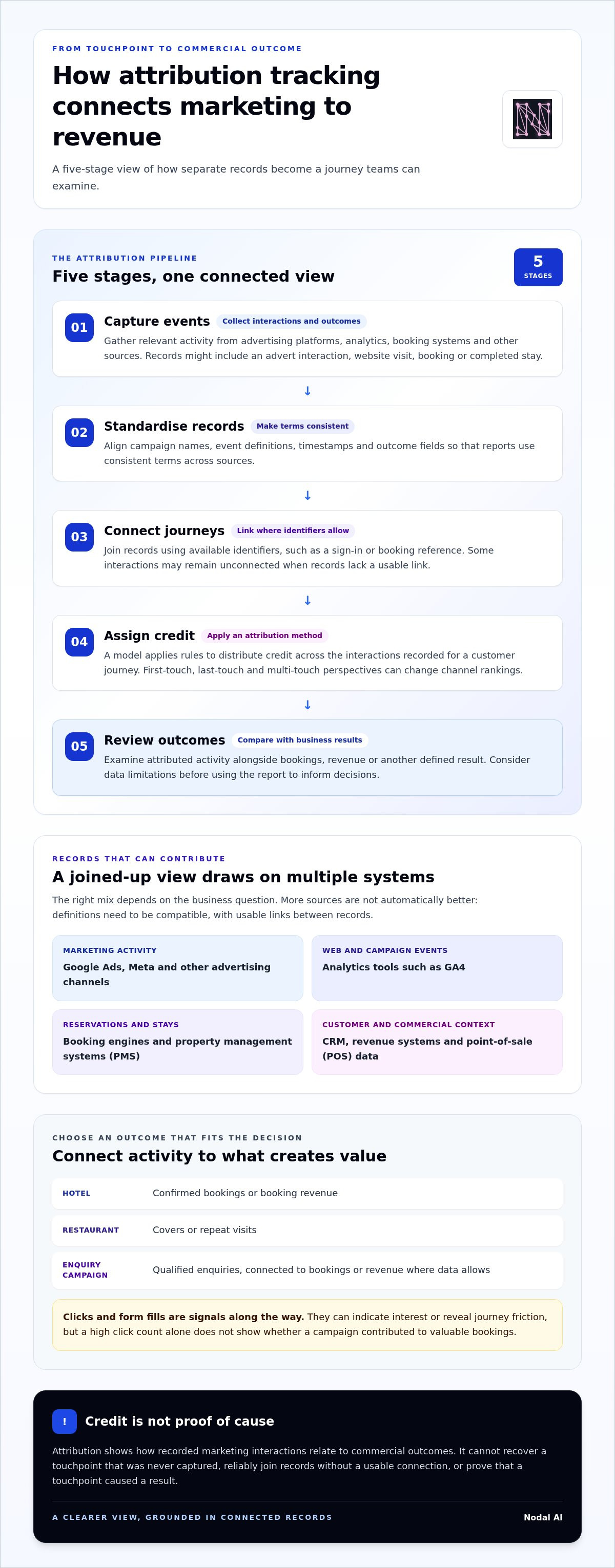
Attribution interprets those records. A model applies a set of rules to decide how credit is distributed across recorded interactions. It can’t recover a touchpoint that was never captured or reliably join records that lack a usable connection.
For example, a traveller interacts with a paid hotel advert, visits the hotel website, then books directly later. If the available records can be linked, a model can show the advert as one touchpoint in the journey. The booking channel records how the reservation was made; attribution also considers the earlier marketing interaction. This shows an observed association, not certainty that the advert caused the booking.
Which business outcomes should attribution tracking connect?
Choose outcomes that reflect how the business creates value. For a hotel, that could mean confirmed bookings or booking revenue. A restaurant may focus on covers or repeat visits. A campaign designed to generate enquiries might track qualified enquiries, then connect them to bookings or revenue where the data allows.
Clicks and form fills still have a role. They can indicate interest, reveal friction in a customer journey or help teams compare campaign engagement. But they’re signals along the way, not necessarily the final result. A high click count doesn’t show on its own whether a campaign contributed to valuable bookings, while a form fill may not become a visit.
There’s no single metric that suits every hospitality business or campaign. Define the outcome around the decision you need to make, then check whether the records can connect marketing activity to that result. This keeps attribution useful without asking it to claim more than the underlying evidence supports.
How Attribution Tracking Connects Marketing Touchpoints to Revenue
A useful attribution view is built in stages. Each source contributes a piece of the journey, but records need to be made consistent and connected before a model can interpret them.
- 1. Capture events. Collect relevant interactions from advertising platforms, analytics, booking systems and other sources.
- 2. Standardise records. Align campaign names, event definitions, timestamps and outcome fields so reports use consistent terms.
- 3. Connect journeys. Link records where identifiers allow, while recognising that some interactions may remain unconnected.
- 4. Assign credit. Apply a chosen attribution method to the interactions recorded for a customer journey.
- 5. Review outcomes. Compare attributed activity with bookings, revenue or another business result, and consider data limitations before acting.
Joined-up source data makes attribution more interpretable by showing how recorded marketing interactions relate to the commercial outcomes the business cares about. It doesn’t make every journey visible or prove that a touchpoint caused a result. It gives teams a better basis for examining how channels and outcomes relate.
Which data sources contribute to an attribution view?
Marketing data can include ad interactions from Google Ads, Meta and other channels, alongside website and campaign events recorded in analytics tools such as GA4. Hospitality records add another layer: booking engines show reservations, property management systems (PMS) can provide stay-related records, and CRM and revenue systems contribute customer and commercial context. Point-of-sale (POS) data can add information about on-property spending. Together, these sources can help connect campaign activity with what happened after a guest engaged.
The right mix depends on the business question. To understand booking contribution, prioritise records that describe campaign interactions and reservations. To assess broader commercial value, relevant revenue or customer records may add context. More sources aren’t automatically better. They need compatible definitions and usable links between records.
Why do fragmented customer journeys create tracking gaps?
Separate systems may identify the same guest differently, record events in different ways or use different reporting windows. Campaign naming can also vary between platforms. A duplicate booking event may inflate a result, while a timing difference between an advert interaction and a booking can affect whether the journey is connected.
Cross-device behaviour and offline interactions can leave gaps when there’s no reliable way to join the records. Don’t treat missing evidence as if it were captured. Document event definitions, naming conventions and ownership of data changes so teams can interpret reports consistently and spot where a comparison has limits.
To see how connected analytics can bring these sources into a broader view, explore Nodal Platform features.
How to Evaluate Attribution Tracking Without Trusting One Dashboard
Channel reports can disagree because platforms may record different interactions, use different reporting windows or apply different attribution rules. Before deciding which channel deserves more budget, compare what each view is designed to show and check whether the underlying data is sound.
What changes between first-touch, last-touch, and multi-touch attribution?
Each model answers a different question. First-touch highlights an early recorded interaction, last-touch emphasises a later one, and multi-touch distributes credit across recorded interactions according to its rules. These views are useful for different kinds of analysis, but they aren’t interchangeable.
| Attribution view | What it emphasises | Question it can help explore |
|---|---|---|
| First-touch | The earliest recorded interaction in the journey | Which channels appear at the start of recorded journeys? |
| Last-touch | The final recorded interaction before the outcome | Which channels appear closest to a booking or other conversion? |
| Multi-touch | Credit distributed across recorded interactions | How might several touchpoints contribute across the journey? |
A paid search campaign might rank highly under last-touch if it appears just before a booking, while another channel may feature more often at the start of journeys. A multi-touch model may distribute credit between them. The ranking changes because the rules change, not necessarily because performance has changed.
Attribution reports are decision aids, not verdicts, and their assumptions should remain visible. Note the model, reporting window, conversion definition and available data alongside any comparison. Also assess whether the outcome matters commercially: a channel driving clicks may look different when the measure is booking revenue.
How can teams spot unreliable attribution signals?
Look for signs that the report may be incomplete or inconsistent before interpreting channel movement:
- Unexpected gaps in reported interactions or conversions.
- Duplicate conversion events that could inflate totals.
- Campaign tags or names that vary across platforms and reports.
- A sudden shift in channel results that coincides with a tracking or data change.
Check whether the reporting window and outcome definition match across the views you’re comparing. Where relevant, compare platform figures with booking, CRM and revenue records. Differences don’t automatically mean one report is wrong, but they need explaining before they guide a decision.
Use attribution tracking to identify patterns and form a useful hypothesis, not to claim that a channel caused a booking. For consequential budget decisions, consider suitable testing to help assess whether a change contributed to an outcome. Keep the model’s limits in view, and use evidence from connected records and testing to sharpen the decision.
How to Audit Attribution Tracking Before Changing Marketing Spend
Before reallocating budget, check whether the evidence behind the report is dependable enough to guide that decision. A focused audit can reveal whether a channel’s apparent performance reflects customer behaviour, inconsistent records or a change in how data is collected.
What should an attribution tracking audit check first?
Start with a clear business question and a defined outcome, such as direct bookings or booking revenue. Then trace a sample journey from advertising and analytics records through customer and booking data. Note where identifiers connect records, where they don’t, and whether the outcome appears consistently. This grounds the audit in an actual decision rather than a dashboard’s default metrics.
Work through the checks in sequence:
- Define the outcome. Agree what counts as a result and which reporting period matters.
- Map the events. Document the interactions and conversions that should appear along the journey.
- Inspect the sources. Check campaign naming, event definitions, timestamps and identifiers across advertising, analytics, CRM and booking records.
- Reconcile outcomes. Compare attributed conversions with relevant booking or revenue records. Look for duplicate events or unexplained differences.
- Document limitations. Record gaps, assumptions and changes that could affect interpretation.
For a hotel, the audit might trace a campaign interaction through a website visit to a direct booking record. The trail may be partial. State that clearly instead of hiding the limitation behind a broad accuracy claim. A documented marketing data governance framework can help teams keep definitions, responsibilities and changes clear over time.
How should teams act on the audit findings?
Fix the issues most likely to affect a decision first. Inconsistent campaign tags can make channel comparisons unreliable; duplicate booking events can distort conversion totals; unclear event definitions can leave teams reporting different things under the same label. Assign owners for campaign tagging, event definitions, integrations and recurring quality checks so corrections don’t depend on informal handovers.
Then revisit the original business question. If the goal is to understand bookings, prioritise the records needed to interpret booking outcomes, not every available click metric. Keep a simple record of what changed, who owns it and when reports should reflect the update. That creates a clearer basis for comparing results over time.
Don’t change spend solely because one platform or attribution model ranks a channel differently. First establish whether the comparison uses consistent definitions, windows and outcome data. Treat the report as evidence to investigate, then validate consequential decisions with suitable testing where possible.
Discuss connected attribution analytics with Nodal AI
How Nodal AI Connects Attribution Tracking to Hospitality Performance
For hospitality businesses, marketing performance makes more sense when viewed alongside what happens after a guest responds. Nodal AI connects fragmented marketing, booking, customer, revenue and operational data, helping teams examine customer journeys across the systems that hold different parts of the picture.
The Nodal Platform brings together multi-touch attribution and customer journey analysis with wider commercial intelligence. Its modular intelligence engine connects disparate data sources, including systems for bookings, operations, customer relationships and marketing. Attribution helps show how recorded touchpoints relate to outcomes. The broader view helps teams consider those patterns alongside bookings, customer records and revenue, while recognising that an attributed relationship alone doesn’t prove causation.
What does hospitality-focused attribution make easier to understand?
It helps teams frame channel questions around outcomes that fit their business. A hotel might explore how marketing interactions relate to direct bookings or revenue. A restaurant may focus on covers or repeat visits. The relevant measure depends on the operation and the decision at hand, rather than a universal metric.
With marketing and hospitality records in a shared view, teams can investigate where reports align and where gaps remain. For example, a channel may appear to contribute to booking activity, while revenue records add context to the commercial result. That joined-up perspective supports more informed discussions across marketing, revenue and operations teams, without treating every touchpoint as a proven cause.
How can connected insights support the next decision?
When teams can examine performance across connected sources, they can investigate which channels appear alongside valuable outcomes, which guest segments behave differently and whether demand signals are changing. These are prompts for analysis, not automatic instructions to shift spend. Teams still need to consider data quality, business context and the limits of the attribution model.
Automated reporting brings recurring measures into a consistent view, while growth recommendations can surface areas for further investigation. They support decision-making, but don’t guarantee a particular commercial result. The value is a clearer starting point: teams can move from disconnected reports towards questions grounded in customer journeys and business performance.
Explore how connected analytics can support your hospitality decisions by booking a Nodal AI demonstration.
Turn Connected Data Into More Confident Decisions
Useful attribution tracking does more than count clicks. It connects recorded marketing interactions with relevant commercial outcomes, while making the model’s assumptions and data limitations visible. Compare attribution views, check the quality of the underlying records and look beyond a single dashboard before changing spend.
For hospitality teams, joining marketing data with booking, customer, revenue and operational information creates a broader view of performance. Nodal AI brings these sources together, with multi-touch attribution and customer journey mapping as part of wider commercial intelligence.
In the Ovolo Hotels case study, results included a 15.3% reduction in acquisition costs and a 24.5% increase in ROAS. These are reported case study outcomes, not a guarantee that attribution alone caused the results or will deliver the same outcome elsewhere.
Fragmented reports don’t have to dictate your next move. Build a clearer view of how marketing activity relates to business performance, then use that understanding to make more informed decisions.
Frequently Asked Questions
What is attribution tracking?
Attribution tracking records marketing interactions and connects them with later customer or commercial outcomes. An attribution method then assigns credit to some or all of those recorded interactions. This can help teams understand patterns across channels, such as which touchpoints appear in journeys before bookings. It doesn’t prove a touchpoint caused a booking or sale. Useful interpretation depends on relevant data, clear event definitions and an understanding of what the tracking cannot observe.
How does attribution tracking work?
Attribution tracking starts by recording events across relevant marketing and business systems. Available identifiers and timestamps can help connect interactions into a customer journey. An attribution method then applies its rules to assign credit across the recorded touchpoints. Teams should review the resulting reports alongside business outcomes and data-quality checks. Missing records, inconsistent event definitions or disconnected systems can limit what the analysis shows, so the model’s assumptions matter.
What is the difference between attribution tracking and conversion tracking?
Conversion tracking records whether a defined action, such as a booking or purchase, occurred. Attribution tracking attempts to connect that outcome with earlier marketing interactions and assign credit across them. Conversion tracking can therefore provide one input to attribution, but it doesn’t explain the wider customer journey by itself. Both rely on consistent event definitions and appropriate data access. For example, recording a booking is different from examining which recorded touchpoints preceded it.
Is multi-touch attribution more accurate than last-click attribution?
Not automatically. Multi-touch attribution can represent more recorded interactions than a last-click view, but its results still depend on the data collected and the rules used to distribute credit. Last-click can help answer a narrower question about the final recorded interaction before a conversion. Compare the methods against your business question, review their assumptions, and don’t treat any model as a complete account of what caused an outcome.
Why do marketing attribution reports differ between platforms?
Platforms may record different events, use different attribution windows or apply different rules for assigning credit. They may also miss interactions they can’t observe, define conversions differently or update reports at different times. These differences can produce conflicting totals without proving that one platform is universally correct. Document event and conversion definitions, compare reports with relevant booking, CRM or revenue records, and interpret each result in the context of its reporting rules.
How can a hospitality business improve attribution tracking?
Start by defining the commercial outcome you want to understand, such as direct bookings or another relevant measure. Map the marketing, booking, customer and revenue sources that can inform that question. Standardise campaign names and event definitions, check for missing or duplicate records, and document known limitations. Then compare connected data with appropriate business records. Repeat these checks when systems, channels or measurement needs change so reports remain useful for decisions.
Can attribution tracking prove that an advert caused a booking?
No. Attribution tracking can show that a recorded advert interaction is associated with a later booking, based on the available data and selected model. That association alone doesn’t establish that the advert caused the booking. Other influences may have contributed, and some interactions may not appear in the data. Use attribution to investigate performance patterns. If you need evidence of incremental impact, consider suitable testing designed to assess whether marketing activity contributed to additional bookings.


