

Where does guest friction start: at a visible service touchpoint or in a handoff between teams? Guest journey mapping hospitality teams can act on connects the experience a guest sees with the operational steps behind it. Booking, stay and feedback information often sits across separate systems, making it difficult to trace an issue from its first signal to its commercial impact. A journey map can quickly become a static diagram unless teams agree who owns each improvement.
This guide explains how to map guest interactions and processes, identify friction across the lifecycle, and prioritise changes using relevant guest and commercial measures. It covers how to bring operational moments into focus, connect signals from systems such as PMS, POS, CRM and booking engines, and assign clear ownership to actions. A connected view can help teams move from scattered information to better-informed decisions. Nodal Platform consolidates hospitality data for ongoing analysis, while the teams responsible for each process retain ownership of improvements.
Key Takeaways
- Make guest journey mapping hospitality actionable by starting with a focused question, guest segment or journey stage.
- Trace interactions and team handoffs across the guest lifecycle to reveal where operational friction occurs.
- Compare improvement opportunities by guest impact, ownership, evidence quality and commercial relevance.
- Turn priority findings into owned actions, then review changes against a clear baseline and agreed measures.
- Connect operational and marketing data to build a more complete view of the journey and support ongoing prioritisation.
Why guest journey mapping matters for hospitality process optimisation
A guest’s experience depends on more than the visible service. It is also shaped by the decisions, information and handoffs behind each interaction. Guest journey mapping documents those interactions, the guest’s needs and the operational steps that connect them across a lifecycle. It gives teams a shared view of where the experience flows smoothly and where it breaks down.
Guest-facing friction and internal bottlenecks often reinforce each other. If a guest has to repeat a request, there may be a handoff gap between reception and housekeeping. If booking details do not reach the property accurately, the issue may lie in disconnected systems rather than a single service interaction. PMS, POS, CRM and booking data can each hold part of the story. When records are difficult to connect, teams may see individual transactions but miss how behaviour and processes link across the journey.
Mapping is a starting point, not the improvement itself. The wider discipline of customer experience considers how interactions shape a person’s overall impression. In hospitality, mapping makes touchpoints visible and helps teams investigate causes, agree ownership and improve the processes behind them. A map creates value when it informs a decision or a testable change.
Which hospitality journeys should teams map first?
Start with a commercial or operational question instead of trying to document everything at once. A hotel might map discovery, booking, pre-arrival, the stay and post-stay to find where guests encounter obstacles or where a handoff affects service. Choose the guest segment, property or stage that best matches the question.
Adapt the lifecycle to the business. Serviced apartments may focus on demand, arrival and length of stay; hostels may examine extensions and ancillary spend. Clubs, restaurants, spas and attractions can map discovery through booking or visit, service delivery and follow-up. Keep the first map narrow enough to investigate and act on.
What a useful guest journey map needs to show
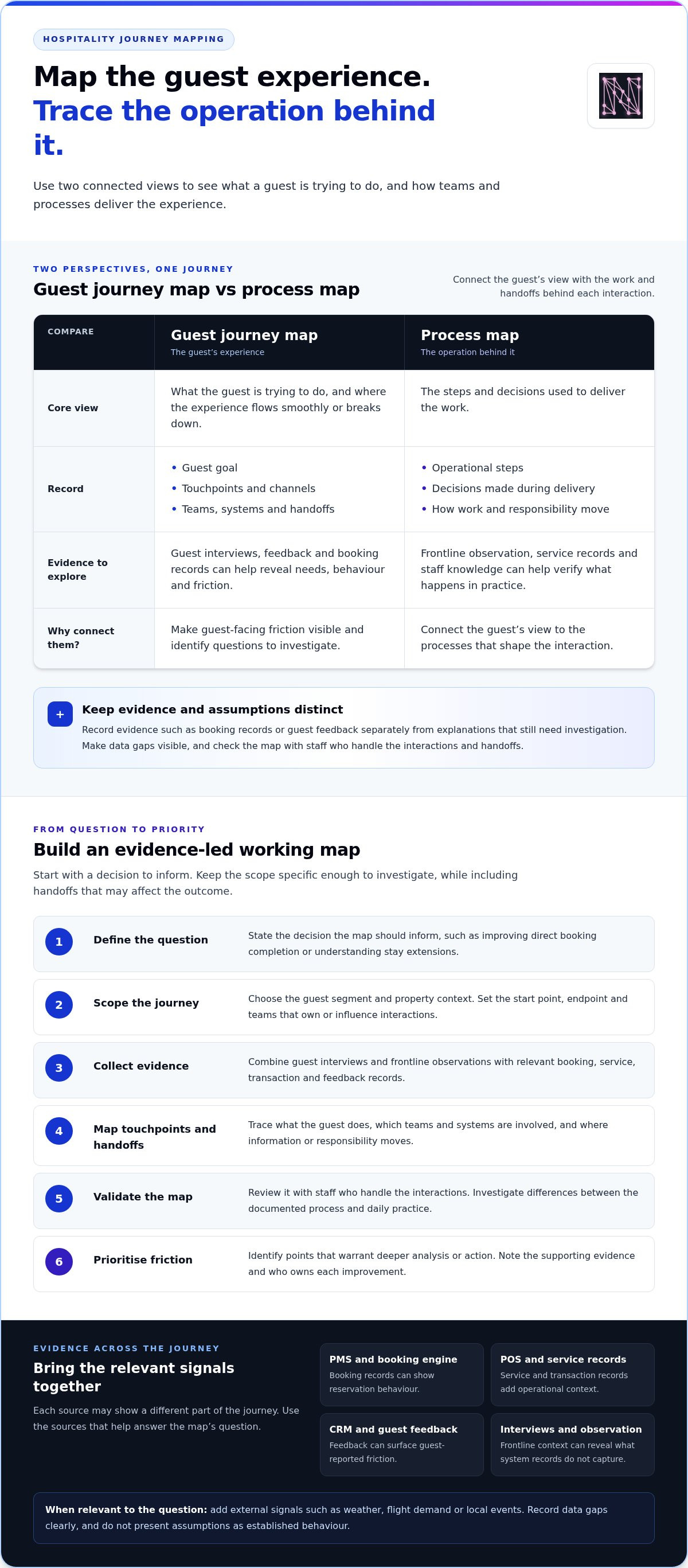
For each stage, record the guest’s goal, touchpoints and channels, teams involved, systems used, and process handoffs. Separate evidence, such as booking records or guest feedback, from assumptions that still need investigation. This makes uncertainty visible instead of presenting an untested explanation as fact.
A guest journey map shows what a guest is trying to do and how interactions and handoffs shape the experience; a process map shows the steps and decisions used to deliver the work. Use both perspectives to connect the guest’s view with the operation behind it. This gives teams a clearer set of questions to investigate and a practical basis for improving the journey.
How to map a hospitality guest journey from evidence
Build the map around a decision, not a blank canvas. Guest journey mapping hospitality teams can act on starts with a focused question, such as where potential direct bookings stall or what influences a guest to extend a stay. A clear purpose keeps the work relevant to the guest experience and the processes that shape it.
Set a hospitality use case and journey boundary
Choose one guest group, property or stage to investigate. Define the starting point and endpoint, then identify the teams that own or influence each interaction. For example, a hotel exploring stay extensions might trace the guest’s initial booking, arrival, in-stay request and extension decision. Keep the boundary specific enough to examine closely, but broad enough to include handoffs that may affect the outcome.
Use this sequence to turn the question into a working map:
- Define the question: State the decision the map should inform, such as improving direct booking completion or understanding extensions.
- Scope the journey: Set the guest segment, property context, start point and endpoint.
- Collect evidence: Combine guest interviews and frontline observations with relevant booking, service, transaction and feedback records.
- Map touchpoints and handoffs: Record what the guest does, which teams and systems are involved, and where information or responsibility moves.
- Validate the map: Review it with staff who handle the interactions, and investigate differences between the documented process and daily practice.
- Prioritise: Identify friction points that warrant deeper analysis or action, noting the supporting evidence and ownership for each.
Bring guest, operational and commercial evidence together
Relevant sources may include a PMS, booking engine, CRM, POS and guest feedback platforms. Each reveals a different part of the journey: bookings show reservation behaviour, service records help trace operational interactions, and feedback can surface guest-reported friction. Interviews and frontline observation add context that system records may not capture.
Where it helps answer the use-case question, add external signals such as weather, flight demand or local events. Record data gaps clearly, and avoid presenting assumptions as established behaviour. Staff who handle each handoff can help verify whether the map reflects what happens in practice and where exceptions occur.
For broader foundations, see this customer journey mapping guide and Harvard Business School Online’s advice on how to create a customer journey map. To connect hospitality data sources for analysis, explore Nodal Platform features.
How to compare journey friction and prioritise hospitality improvements
A map may reveal several points of friction, but not every issue needs the same response. Compare each opportunity using four lenses: its impact on guests, who can own or influence the process, the strength of the evidence, and the commercial decision it could inform. This grounds prioritisation in the property’s objectives, rather than the loudest complaint or the easiest fix.
Distinguish guest symptoms from process causes
Separate what guests experience from what may be causing it. Repeated questions about arrival arrangements are a symptom. Unclear pre-arrival information could be one cause; a missed handoff or an outdated message may also contribute. Treat these explanations as hypotheses until the evidence supports them.
Trace the issue through the relevant touchpoints and team handoffs. Compare guest feedback with operational records, such as enquiry themes or service interactions, and ask staff involved in the process how it works in practice. A pattern in feedback can identify an area to investigate, but does not prove why the problem occurs. Record observations separately from inferences.
Rank opportunities without losing commercial context
Use a consistent comparison to decide what to investigate or address first. The examples below show how the same guest symptom can lead to different actions depending on the evidence and process ownership.
- Observed friction: Guests ask repeated questions before arrival. Likely cause to investigate: Key details may be unclear or difficult to find. Owner: The team responsible for guest communications, working with reservations or front office. Potential intervention: Review the information guests receive and where it appears.
- Observed friction: Guests report delays after making an in-stay request. Likely cause to investigate: The request may not move clearly between the receiving team and the team completing it. Owner: The teams involved in that handoff. Potential intervention: Clarify how requests are recorded, assigned and followed up.
Then weigh guest impact alongside the effort and ownership involved, the quality of the evidence, and the decision the insight can inform. A hotel may need to consider occupancy and direct revenue together. A change that supports occupancy but weakens the direct relationship with guests may not serve the wider objective. The right priority depends on the property’s goals, available evidence and capacity to act.
When booking, marketing and operational signals sit across separate systems, comparing them can reveal context that one source alone misses. Nodal’s overview of fragmented data insights explores how connected analysis can support informed decisions. Use the map to surface and rank opportunities, then turn the strongest priorities into owned, measurable process changes.
How to turn a hospitality journey map into process change
A map becomes useful when it changes what teams do. Turn each priority into a specific action, name the responsible team, describe the observable change you expect, and set a point to review the outcome. For example, if guests struggle to find arrival information, revise where and how that information is shared. The measure could be fewer repeat enquiries about arrival, rather than simply marking the task complete.
Assign owners and define meaningful measures
Set a baseline before testing an improvement. Choose measures that fit the original question and journey stage: guest feedback or repeat enquiries for an information issue, request-handling records for a service handoff, or booking and revenue measures for a commercial question. Avoid applying a universal benchmark where none fits. Record the starting point, data source and assumptions so the team can interpret results fairly.
Be clear about what success means across three distinct outcomes:
- Guest experience: Did the change address the friction guests reported or encountered?
- Process efficiency: Did the relevant handoff or task become clearer or easier to complete?
- Commercial performance: Did the change support the business objective, such as direct revenue or occupancy?
These measures can move in different directions. A faster process does not automatically mean a better guest experience, and a positive guest response does not by itself establish a commercial effect. Review outcomes together at an agreed point, and note other factors that may have influenced them.
Test the change within a defined journey, team or property context before considering a wider rollout. This gives the owner a clear scope for implementation and review. If the evidence is mixed, refine the action or investigate the assumptions before expanding it. Effective guest journey mapping depends on this cycle of ownership, testing and learning, rather than treating the map as a finished deliverable.
Use connected data to keep the map current
Guest patterns and operating conditions can shift. Linked PMS, CRM, booking and feedback data can help teams spot changes across interactions instead of reviewing each source in isolation. External signals, including weather, flight demand or local events, may add context to changes in demand or property performance, but they are context, not automatic explanations.
Keep definitions consistent as teams review the map. Agree what counts as a booking, request, complaint or conversion, and document how data sources relate to those measures. Nodal Platform consolidates hospitality data for ongoing commercial, guest and operational analysis, while process ownership remains with the teams responsible for the work. For guidance on consistent data definitions, read the data governance framework guide.
Hospitality journey analysis is most useful when connected data informs a specific question, with clear ownership for the resulting action.
How Nodal AI supports hospitality guest journey analysis
A journey map shows where to investigate. Connected data helps teams examine what happens across those touchpoints and how guest, operational and commercial signals relate. Nodal Platform consolidates hospitality data for analysis, supporting guest journey mapping with a more connected view while leaving process improvements with the teams responsible for them.
Connect journey questions with hospitality data
For a hotel, a question about direct bookings may involve more than the booking engine. Teams can examine occupancy and direct revenue alongside acquisition channels, website activity and guest feedback to understand how booking behaviour connects with the wider journey. Nodal AI integrates sources including Oracle OPERA, Mews, Cloudbeds, GA4, Revinate and Google Reviews, as well as systems such as CRM, POS and booking engines.
The relevant data depends on the question. A serviced-apartment operator might explore how demand relates to length of stay, while a hostel could investigate what influences extensions or ancillary spend. External signals such as weather, flight demand and local events can add context to changes in performance. Nodal Platform is modular, with capabilities configured for distinct operational, demand, commercial and guest use cases. This lets teams shape analysis around the journey question instead of treating every source as equally relevant.
Explore Nodal Platform features to see how connected hospitality data can support analysis across relevant use cases. The platform brings signals together; interpretation, prioritisation and process ownership remain human decisions.
Move from fragmented reporting to clearer decisions
Connected reporting can help teams compare performance across sources and identify where deeper investigation may be useful. It does not, by itself, prove that a particular journey change caused a commercial result. Use the evidence to inform decisions, then assess each action against its own baseline and review measures.
Ovolo Hotels results included a 15.3% reduction in acquisition costs and a 24.5% increase in ROAS. They also included a 20% increase in paid search revenue, 13.8% more bookings and 5.5% higher average booking value. These are reported case-study outcomes, not results attributable solely to journey mapping or the platform. They illustrate commercial measures hospitality teams can consider alongside guest and operational insight.
To discuss how Nodal AI can support your hospitality use case, explore the Nodal AI platform.
Turn journey insight into lasting improvement
Effective guest journey mapping starts with a focused question and evidence from both guests and operations. Map the touchpoints and handoffs, distinguish observed friction from assumptions, then prioritise improvements by guest impact, ownership, evidence and commercial relevance. Give each priority an owner, a measurable change and a review point. This turns a useful map into an ongoing process, rather than a static diagram.
Connected hospitality data can help teams consider guest, operational and commercial signals together. Ovolo Hotels reported a 15.3% reduction in acquisition costs and a 24.5% increase in ROAS. Its results also included a 20% increase in paid search revenue, 13.8% more bookings and 5.5% higher average booking value. These outcomes demonstrate relevant commercial measures, but should not be attributed to journey mapping alone.
Start with one journey question, learn from the evidence and build on what the review reveals. A clearer view can help your teams make confident, measurable improvements. With the right insight and ownership, each improvement can build momentum towards a better guest journey.
Frequently Asked Questions
What is guest journey mapping in hospitality?
Guest journey mapping in hospitality documents guest needs, interactions and operational handoffs across relevant stages, from discovery and booking to the stay and follow-up. A useful map combines guest-facing touchpoints, such as a booking or service request, with the teams and systems supporting them. It helps teams identify friction and questions to investigate. The map alone does not prove what caused a problem or guarantee improved performance.
How do you create a guest journey map for a hotel?
Start with a decision, such as understanding booking friction or improving the stay experience. Select a guest segment and define where the journey begins and ends. Gather staff observations, guest feedback and relevant booking or operational data, then map stages, channels, owners and handoffs. Validate assumptions with frontline teams. Finally, prioritise an evidence-backed opportunity, assign an owner and test a change against a relevant measure.
What data do you need for hospitality guest journey mapping?
The right data depends on the journey question. Hotel teams may draw on booking, PMS, CRM, guest feedback and marketing information. Restaurants may also need POS records to understand transactions and service patterns. Staff observations help explain how processes work in practice. Document missing data and inconsistent definitions, and focus on sources that inform the map. Not every system is necessary for every journey or business question.
How can guest journey mapping improve hospitality processes?
A journey map makes handoffs, repeated guest effort and process questions easier to see across teams. Use those observations to identify an issue worth investigating, assign responsibility and choose a measure that fits the intended change. For example, a recurring question may prompt a review of the information guests receive. The map supports better decisions, but outcomes depend on the evidence, implementation and ongoing review, not the diagram alone.
Can AI help with guest journey mapping in hospitality?
AI-supported analytics can help teams bring information from connected sources together, identify patterns and examine guest segments. It should support clear business questions and operational judgement, not replace them. Check which data informs an insight and validate patterns with staff who understand the process. Treat relationships between events as signals to investigate, not proof that a particular process or touchpoint caused a guest or commercial outcome.
How do you measure whether a hospitality journey improvement worked?
Start with the question behind the change and record a relevant baseline before testing it. Choose measures that reflect the intended guest, operational or commercial outcome, then review the results in the context of the test. Note other changes that may have influenced performance, such as shifts in demand or process conditions. Report what the evidence supports, including uncertainty, rather than claiming a guaranteed or proven causal effect.
What happens if hotel guest data is spread across different systems?
Fragmented data can make it harder to connect booking behaviour, guest feedback and operational activity into one journey view. First identify which sources can help answer the specific question, then align definitions across teams so measures are interpreted consistently. A connected analytics approach, such as Nodal Platform, can bring relevant hospitality data together. Staff input and clear data governance help teams understand the resulting picture and its limitations.


