
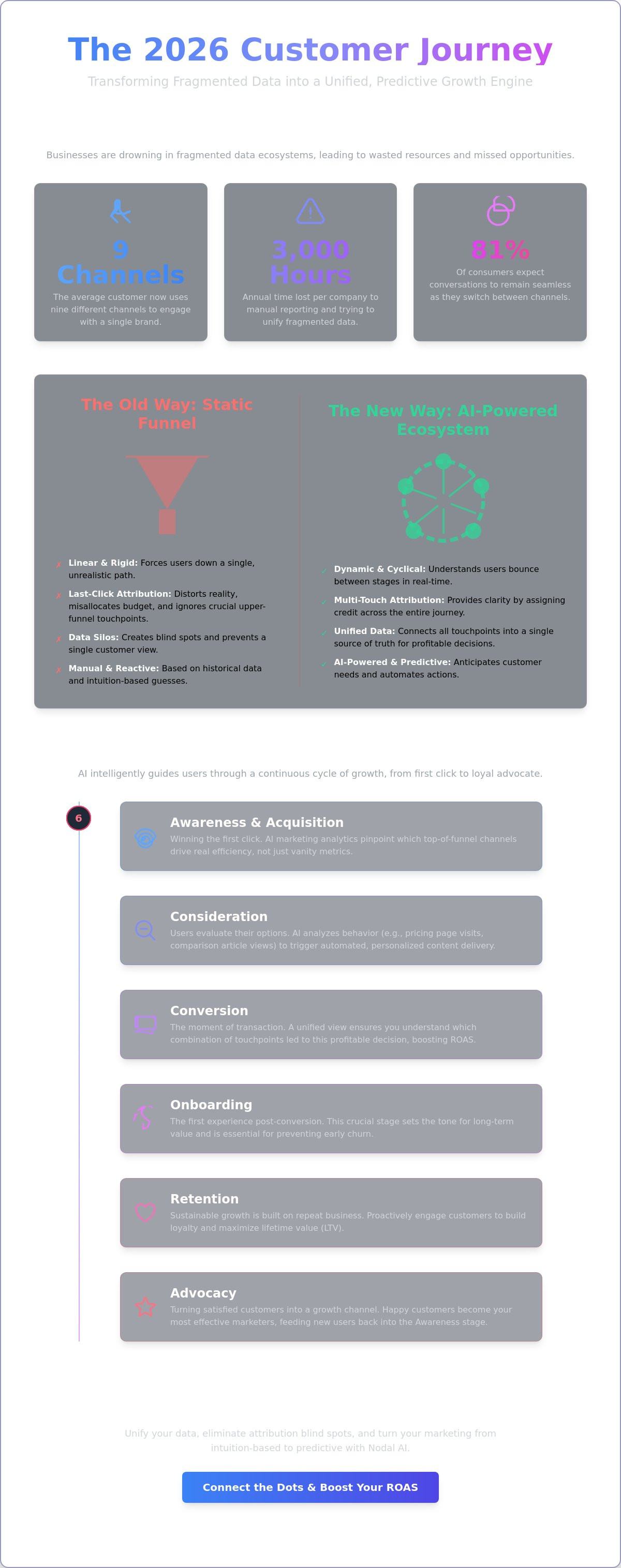
The average customer now uses nine different channels to engage with your brand, yet 81% of those consumers expect their conversations to remain seamless as they switch between them. If your data feels like a scattered puzzle, you aren't alone. Many leaders are currently drowning in fragmented data ecosystems, losing up to 3,000 hours a year to manual reporting while struggling with attribution models that don't quite add up. In 2026, a successful customer journey isn't a static map you draw on a whiteboard; it's a living intelligence engine you talk to.
We understand the frustration of seeing your budget disappear into a black hole of disconnected touchpoints. It's time to stop digging into spreadsheets and start seeing the full picture. This guide will help you connect the dots. You'll learn how to transform complex data into a unified, predictive framework that anticipates customer needs before they even arise. We'll provide a clear roadmap to build a smarter strategy that delivers higher ROAS and turns your fragmented data into profitable decisions. It's about moving from anxiety to clarity by letting your data work for you.
Key Takeaways
- Move from linear funnels to a dynamic ecosystem where every interaction becomes a clear data point for growth.
- Master the six stages of the modern customer journey and leverage AI to identify exactly where each user sits in real-time.
- Reclaim up to 3,000 hours a year by replacing manual spreadsheets with dynamic, automated intelligence that updates as your business grows.
- Unify your fragmented data sources into a single customer view to eliminate attribution blind spots and boost your ROAS.
- Connect the dots between raw metrics and profitable decisions to transform your marketing from intuition-based to predictive.
What is a Customer Journey? Beyond the Traditional Sales Funnel
The traditional sales funnel belongs in a museum. In 2026, your customers don't follow a neat, straight line from awareness to purchase. Instead, they bounce between an average of nine different channels, creating a fragmented web of interactions that can feel impossible to track. A comprehensive customer journey definition encompasses the sum of every interaction a person has with your brand, whether those moments are direct or indirect. It's no longer about pushing people through a pipe. It's about understanding a complex ecosystem where every click, view, and conversation serves as a vital data signal for growth.
To win in this environment, you must move from data to clarity. This means shifting your perspective from isolated events to a unified narrative. When you connect the dots between disparate data sources, you stop guessing and start knowing. Every touchpoint is an opportunity to learn what your audience needs next. If you aren't listening to these signals, you're leaving revenue on the table. It's time to turn your fragmented data into a competitive advantage by building a customer journey that is as dynamic as the people using it.
The Anatomy of a Modern Touchpoint
Touchpoints have evolved far beyond a simple website visit. Today, they are a mix of digital ads, physical store visits, and social media engagements. Innovative brands are also leveraging interactive digital experiences, such as virtual game nights hosted on gameznights.com, to create unique engagement points. However, the most influential moments often happen in the shadows. Dark social, such as private messaging or word-of-mouth recommendations, creates "invisible" touchpoints that traditional tracking completely misses. When your information is stuck in silos, you lose the ability to see these vital connections. This fragmented data ecosystem is the primary barrier to a clear view. It often forces marketing teams to waste 3,000 hours a year on manual reporting just to find a single source of truth.
Why Last-Click Attribution Distorts the Journey
Relying on last-click attribution is like giving all the credit for a championship win to the player who scored the final point. It ignores the assists, the strategy, and the defense that made the score possible. This model carries a heavy bias toward bottom-of-funnel channels like branded search, making them look more profitable than they actually are. If you only look at the final click, you'll likely misallocate your budget and starve the top-of-funnel channels that fuel your long-term growth. To grow smarter, you need multi-touch attribution. This approach allows you to connect the dots across the entire customer journey, ensuring every dollar spent is backed by unified metrics rather than intuition. Stop the guesswork and start making profitable decisions based on the full picture.
The 6 Stages of the 2026 Customer Lifecycle
Winning the first click is just the beginning. In 2026, sustainable growth isn't measured by a single transaction but by the total lifecycle value of a customer. This requires a transition from an acquisition-only mindset to a holistic strategy that covers six critical stages: Awareness, Consideration, Conversion, Onboarding, Retention, and Advocacy. By using unified metrics, you gain the clarity needed to see how each stage feeds the next. Success in 2026 relies on managing the entire customer journey rather than obsessing over isolated touchpoints. AI now plays the role of an intelligent guide, identifying exactly where a user sits in this cycle by analyzing real-time behavioral signals.
AI-powered engines analyze thousands of data points to place a customer in the correct stage. For instance, if a user visits your pricing page twice and then engages with a comparison article, the system flags them as being in the 'Consideration' phase. This isn't just a label; it triggers automated media planning that delivers the exact content they need to move toward 'Conversion.' This shift from intuition-based marketing to data-driven growth allows you to connect the dots and make smarter decisions that drive measurable revenue.
Awareness and Acquisition: Winning the First Click
The discovery phase is more complex than ever. Customers might find you through a viral social post, a Google search, or a targeted display ad. Tracking this phase requires ai marketing analytics to pinpoint which top-of-funnel channels are actually driving efficiency. You move from guessing which campaigns work to knowing exactly where your best leads originate. This clarity stops the bleed of wasted ad spend and focuses your resources on high-intent signals that lead to profitable growth.
Retention and Advocacy: Turning Data into Loyalty
The customer journey doesn't end at the checkout page. In fact, 75% of consumers are willing to spend more with a company that provides a consistently good experience. Success in 2026 relies on mastering the post-purchase loop. Predictive AI signals now allow you to identify churn risk before it happens, giving your team the chance to intervene. Automated reporting ensures you're tracking long-term health metrics like Net Promoter Score and repeat purchase rates without wasting thousands of hours on manual data entry. By focusing on advocacy, you turn your existing customers into a powerful engine for new, low-cost acquisition.
Static vs. Dynamic: Why Traditional Journey Mapping is Obsolete
For years, marketers treated journey mapping like a geography project. They drew rigid paths on whiteboards, assuming they could force customers down a pre-set trail. That approach is dead. In 2026, your customer journey isn't a picture; it's a living, breathing engine. We've moved from static illustrations to dynamic intelligence. Instead of looking at a snapshot of the past, you need a real-time feed of the present. This shift represents the ultimate transformation: from manual guesswork to automated clarity.
Modern mapping shouldn't just track where a customer has been. It must tell you where they're going. When you move from historical reporting to real-time analysis, you gain the ability to pivot your strategy in seconds rather than months. This is the difference between being a spectator and being a participant in your own growth. By adopting a dynamic model, you ensure your marketing remains as fluid as the behavior of your audience.
The Spreadsheet Trap: The Hidden Cost of Manual Mapping
Digging into spreadsheets is a recipe for exhaustion and inaccuracy. Manual data aggregation costs businesses up to 3,000 hours a year, pulling your team away from high-value strategy and into the weeds of data cleaning. These static maps are outdated the moment you hit "save" because they can't account for the rapid shifts in consumer behavior. Human error in complex data ingestion is inevitable, leading to skewed results and wasted spend. You need a unified data ecosystem that acts as your only source of truth. Connect your tools, automate the flow, and replace the anxiety of fragmented silos with the confidence of unified metrics.
Predictive Journey Mapping: Anticipating the Next Sale
Predictive mapping allows you to stop looking at your data and start learning to talk to your data. By utilizing predictive modelling, you can anticipate customer behavior with high statistical probability. AI identifies subtle intent signals, like a specific cadence of content engagement, that human analysts would miss. Research into the four kinds of journeys shows that different behaviors require unique responses. Predictive mapping lets you transition from asking "what happened" to knowing "what will happen next." This foresight turns your data into a proactive asset for sustainable growth.
How to Build a Data-Driven Customer Journey Map
Forget the whiteboard. In 2026, mapping your customer journey is a technical deployment, not a drawing exercise. If you're still trying to "visualize" touchpoints manually, you're likely missing the 85% of interactions that happen across the average of nine different channels. You don't need a static picture; you need a unified intelligence engine. This five-step process moves your business from fragmented data to profitable growth by building a map that updates in real-time. It's about shifting from a passive view of what happened to an active strategy for what comes next. From data to clarity, this is how you connect the dots.
Step 1: Connecting Your Data Ecosystem
Your foundation must be built on seamless integrations. Step one requires you to connect every data source including your CRM, ad platforms, web analytics, and email into a single environment. This is the only way to break through the "walled gardens" of big tech that obscure your view and hide the true path to conversion. By unifying these metrics, you can finally apply multi-touch attribution to see which channels are truly driving value and which are simply taking credit for the last click. Security is paramount during this ingestion phase. Ensure your system utilizes enterprise-level encryption for all data. This step cleans and unifies your fragmented data into a single customer view, providing the clarity needed to stop digging into spreadsheets and reclaim the 3,000 hours a year lost to manual reporting.
Step 2: Identifying Friction Points and Growth Opportunities
With a unified view, you can deploy an AI-powered insights engine to identify the actual conversion paths your customers take. You'll quickly spot "drop-off zones" where technical friction or confusing messaging causes potential revenue to vanish. Instead of guessing why people leave, use AI to find "golden paths." These are the specific sequences of interactions that lead to the highest ROI and long-term retention. You can then visualize the ai customer journey through real-time dashboards that reflect current behavior rather than last month's history. Finally, execute growth recommendations based on these statistical probabilities. This turns your map into a proactive tool for automated media planning and sustainable growth. Stop guessing where your budget goes and talk to your data today to see the future of your growth.
Connect the Dots: Transforming Journey Data into Profitable Decisions
A map is only as valuable as the destination it reaches. In the context of the customer journey, that destination is measurable ROI and sustainable growth. We've explored the fragmented nature of modern touchpoints and the technical requirements of a dynamic map. Now, we focus on the final transformation: turning that intelligence into profit. The shift from intuition-based marketing to data-driven growth is the defining characteristic of successful brands in 2026. Nodal AI serves as your visionary partner, replacing the fog of manual reporting with the sharp focus of an AI-powered business intelligence engine. It's time to stop looking at what happened and start deciding what happens next.
By connecting the dots between your CRM, ad platforms, and web analytics, you move from anxiety to clarity. You no longer have to guess which campaigns are fueling your revenue. Instead, you have a unified view that turns raw numbers into actionable insights. This is how you transform a fragmented data ecosystem into a unified narrative that drives your business forward. When you talk to your data, it answers with the truth about your performance, allowing you to stop digging through spreadsheets and start leading with confidence.
Smarter Decisions, Sustainable Growth
Clarity is the ultimate fuel for sustainable growth. When you can see every interaction across nine different channels, your budget allocation moves from a gamble to a science. Automated growth recommendations allow your team to pivot instantly, capturing high-intent leads before they cool off. This level of efficiency is what separates market leaders from those still stuck in the spreadsheet trap. By eliminating the ambiguity of attribution, you ensure every dollar spent is a dollar invested in a proven path to conversion. It's about working smarter to achieve the results your business deserves, freeing your team from manual labor so they can focus on high-level strategy.
From Day One Value to Enterprise Scale
The future of analytics shouldn't feel like a burden. You don't need a PhD in data science to master your metrics or understand your customer journey. We provide the tools that let you talk to your data, turning a passive asset into an active participant in your boardroom. Our professional onboarding is designed to resolve complexity for you, ensuring your data environment is enterprise-ready from the start. You'll move from fragmented silos to a unified view in three simple steps, seeing value from day one. Don't let another 3,000 hours slip away into manual reporting. Connect the dots with Nodal AI today and start making the profitable decisions that will define your success in 2026.
Master Your Data Strategy for Sustainable Growth
The transition from manual whiteboard drawings to dynamic intelligence is no longer optional. By moving from fragmented silos to a unified intelligence engine, you transform your customer journey into a proactive growth asset. You now have the framework to identify "golden paths" and eliminate friction before it costs you a lead. This shift represents a fundamental transformation from data anxiety to actionable clarity. It is the difference between looking at what happened and deciding what happens next.
It's time to stop digging and start leading. With enterprise-level data encryption and AI-powered growth recommendations, you can reclaim 3,000+ hours a year that were previously lost to manual reporting. You don't need a PhD in data science to achieve enterprise-scale results; you just need the right partner to help you talk to your data. Connect the dots and turn fragmented data into profitable decisions with Nodal AI. The future of your business intelligence is waiting. Take the first step toward a smarter, more profitable strategy today.
Frequently Asked Questions
What is the difference between a customer journey and a marketing funnel?
Marketing funnels focus on the seller's internal process, while a customer journey focuses on the buyer's actual experience across multiple channels. Traditional funnels assume a straight, linear path from awareness to purchase. Modern journeys are messy ecosystems where users jump between an average of nine channels before converting. Mapping the journey allows you to meet them wherever they are with the right message at the right time.
Why is customer journey mapping important for B2B companies?
B2B mapping is vital because the decision-making process often involves 6 to 10 stakeholders and can last several months. Without a clear map, you lose track of these complex interactions across different departments. Mapping ensures your sales and marketing teams stay aligned. It provides a unified experience that builds trust throughout long, high-stakes procurement cycles where consistency is the primary driver of conversion.
How do I map a customer journey if my data is currently fragmented?
You start by integrating your disparate data sources into a unified intelligence engine. This process cleans and unifies fragmented metrics from your CRM, ad platforms, and email tools into a single customer view. It eliminates the need for manual data entry, which currently wastes up to 3,000 hours a year for many teams. Once connected, your data starts telling a clear, actionable story about your growth.
Can AI really predict the next step in a customer's journey?
AI analyzes thousands of real-time signals to identify patterns that human analysts often miss. By evaluating the frequency and sequence of touchpoints, it can predict the probability of a conversion with high statistical accuracy. This foresight allows you to deliver predictive recommendations. It ensures you're always one step ahead of your customer's needs and preferences by identifying intent signals before they result in a direct inquiry.
How often should a business update its customer journey map?
A traditional, static map should be updated whenever you launch a new product or enter a new market, typically once a quarter. However, in 2026, you should move toward dynamic mapping that updates in real-time. This ensures your strategy stays as fluid as the 85% of consumers who now expect brands to adapt to their changing needs instantly. Static maps are outdated the moment they are finished.
What are the most common mistakes in customer journey mapping?
The most frequent error is relying on last-click attribution, which ignores the top-of-funnel touchpoints that fuel growth. Other mistakes include ignoring "dark social" interactions and treating the map as a static illustration. When you view mapping as a drawing exercise instead of a data integration task, you end up with a rigid model. This fails to reflect the reality of how your customers actually behave.
How does multi-touch attribution improve my journey map accuracy?
Multi-touch attribution provides the statistical weight for every interaction, not just the final click. This improves your customer journey accuracy by showing you exactly which "assists" led to the score. By seeing the full picture, you can stop misallocating your budget to bottom-of-funnel channels. You can then start investing in the top-of-funnel touchpoints that provide the highest long-term lifecycle value for your business.
Is customer journey mapping only for large enterprises?
Small and medium businesses actually have the most to gain from automation. While enterprises have large teams to manage data, smaller organizations often drown in manual reporting and fragmented silos. Automation levels the playing field. It gives smaller teams the same predictive power and ROI-focused clarity as global giants without requiring a massive staff or a PhD in data science to manage the outputs.


