

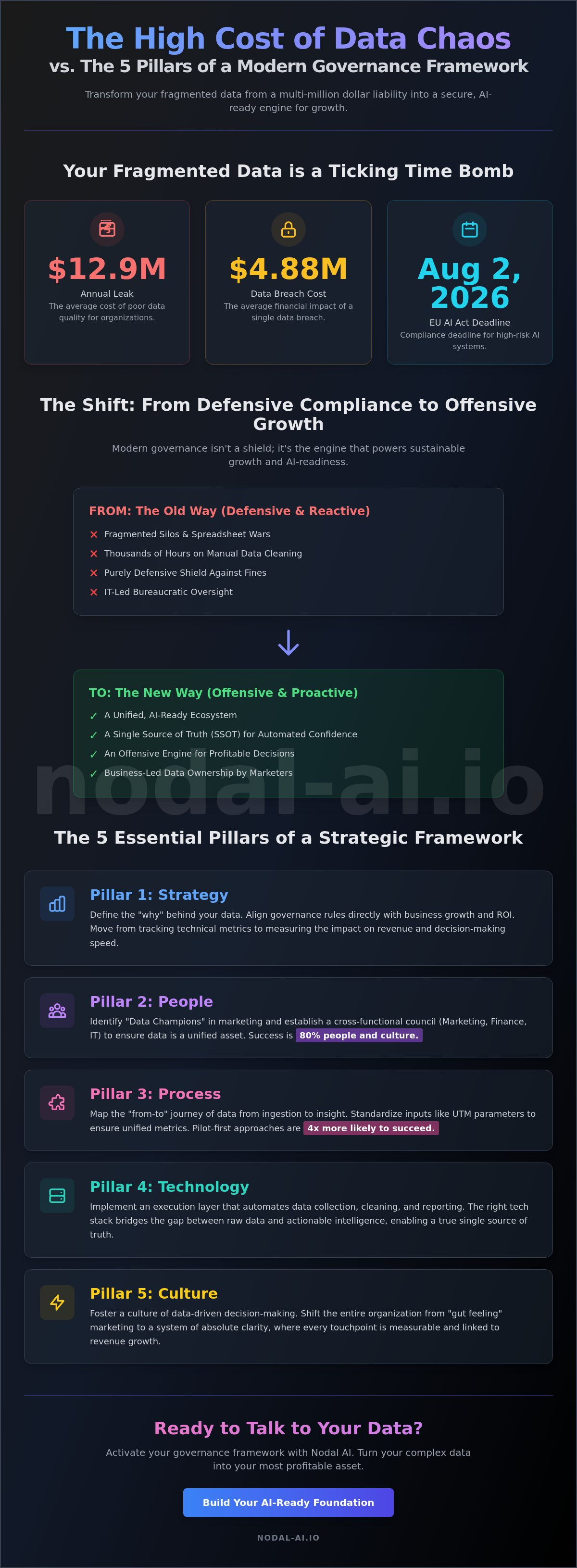
Your fragmented data isn't just a headache; it's a $12.9 million annual leak. With 137 active data privacy laws globally and the EU AI Act compliance deadline hitting on August 2, 2026, the era of "guessing" is over. You're likely wasting thousands of hours on manual data cleaning while fearing the $4.88 million average cost of a data breach. It's time to stop digging through spreadsheets and start driving revenue. You need a modern data governance framework to connect the dots across your entire ecosystem.
We understand the overwhelm of managing silos, but your governance strategy shouldn't be a bureaucratic nightmare. It's the cognitive upgrade your business needs to move from fragmented chaos to strategic clarity. This guide will show you how to build a framework that turns messy inputs into a secure, AI-ready engine for growth. It's about turning complex data into profitable decisions.
We'll explore the shift from manual reporting to automated confidence. You'll learn how to establish a single source of truth for your marketing metrics and ensure your data is ready for predictive modeling. By the end, you'll have a roadmap to automate compliance and finally talk to your data.
Key Takeaways
- Shift from defensive compliance to offensive growth by building a blueprint that turns fragmented silos into an AI-ready ecosystem.
- Compare industry-standard models like DGI and McKinsey to select the data governance framework that best aligns your people with profitable business decisions.
- Follow a structured roadmap to transition from manual data audits to automated, high-impact marketing reporting.
- Discover how to bridge the gap between technical complexity and daily execution to ensure your marketing team works from a single source of truth.
- Learn to talk to your data by activating your governance strategy through an execution layer that delivers instant, actionable intelligence.
What is a Data Governance Framework in the AI Era?
A modern data governance framework isn't a dusty manual sitting on an IT shelf. It's the blueprint you need to connect the dots across your entire marketing ecosystem. In the past, governance was purely defensive. It was a shield against fines and data breaches. Today, it's offensive. It's the engine that powers sustainable growth. This framework transforms your data from a liability into a high-performance asset, moving you from fragmented silos to strategic clarity.
The shift is driven by a hard deadline. By August 2, 2026, the EU AI Act will require operators of high-risk AI systems to be fully compliant or face penalties up to €15 million. But smart leaders aren't just checking boxes for regulators. They're preparing for "AI-ready" data. This requires a clear distinction between data management and Data governance. While management handles the day-to-day "doing" of data processing, governance establishes the rules, roles, and standards that ensure your data is trustworthy enough to fuel an AI-powered business intelligence engine.
The Core Objectives: Quality, Security, and Activation
Your framework must do more than lock data down; it must set it free for profitable use. The primary goal is establishing a single source of truth (SSOT) for every marketing dollar spent. This eliminates the "spreadsheet wars" where different departments report conflicting metrics. By embedding privacy and security into the design, you meet global standards like GDPR and the CPRA neural data updates without slowing down your team. Gartner predicts that by 2026, organizations that prioritize this level of transparency and trust will see a 50% improvement in business goal adoption. This foundation is what allows you to move into advanced predictive modelling and attribution with total confidence.
Why Marketers Are the New Data Stewards
Governance has moved out of the server room and into the C-suite. We're seeing a massive transition from IT-led oversight to business-led data ownership. Marketers are now the primary users of complex data, yet poor data quality costs organizations an average of $12.9 million annually. When you own the data, you stop losing thousands of hours to manual cleaning and start making smarter decisions. You don't need a PhD in data science to talk to your data; you just need a system that works. Data Stewardship in marketing is the proactive management of data assets to ensure every touchpoint is measurable, compliant, and directly linked to revenue growth.
The 5 Essential Pillars of a Strategic Framework
A successful data governance framework is built on five structural supports. If one is weak, the entire system for business intelligence collapses. You aren't just managing rows in a database; you're building the infrastructure for profitable decisions. This approach moves you from "gut feeling" marketing to a culture of absolute clarity. It's the difference between drowning in spreadsheets and having a clear path to growth.
Pillar 1 & 2: Strategy and People
Strategy is the "why" behind your data. It aligns your governance rules with actual business growth. Instead of focusing on technical metrics, set KPIs for data health that reflect ROI. For example, measure the reduction in time spent on manual reporting or the accuracy of your predictive modelling. This ensures your data rules serve your revenue goals, not the other way around. When your strategy is clear, every data point becomes a stepping stone to a smarter decision.
Success also depends on your people. You need "Efficient Experts" who understand the value of clean data. Identify "Data Champions" within your marketing team who can bridge the gap between technical requirements and creative execution. Establish a cross-functional governance council that brings together marketing, finance, and IT. This group ensures that your data remains a unified asset rather than a series of disconnected silos. When everyone knows their role, you move from confusion to coordinated action. This human element is why research shows that successful implementation is 80% people and culture.
Pillar 3, 4 & 5: Process, Tech, and Culture
Process is the "from-to" journey of data from ingestion to actionable insight. Standardise your UTM parameters and campaign tracking today to ensure unified metrics tomorrow. Research from SR analytics in February 2026 shows that pilot-first approaches to governance are four times more likely to succeed than enterprise-wide rollouts. Start by focusing on your high-impact marketing data to prove value quickly. This creates momentum and proves the ROI of your data governance framework within months, not years.
Technology acts as the execution layer. Use AI-powered engines to automate the heavy lifting of data discovery and classification. This removes the manual burden that often leads to "thousands of hours" of lost productivity. With the right tools, you can talk to your data in real-time, turning raw numbers into instant intelligence. This leads to the final pillar: Culture. When your team trusts the data, they stop guessing. They start making smarter decisions based on facts, fostering a data-first mindset that empowers every employee to contribute to sustainable growth.
Evaluating Framework Models: DGI vs. McKinsey vs. AI-First
Choosing a data governance framework isn't about following a trend; it's about selecting the right engine for your data maturity. Most organizations find themselves caught between three distinct paths. The Data Governance Institute (DGI) framework remains the gold standard for rules-based, traditional governance. It's rigorous, stable, and highly structured. However, its heavy focus on policy can sometimes feel like a bottleneck for fast-moving marketing teams. In contrast, the McKinsey model offers a more agile, business-led approach. It's designed for large enterprises that need to move quickly but require clear, decentralized accountability. Then there's the AI-First model. This is the new frontier for 2026. It prioritizes predictive capability and data readiness above all else, ensuring your AI-powered intelligence engine has the high-quality fuel it needs to perform.
Your choice depends on where you are today and where you want to be tomorrow. A startup might find the DGI model too cumbersome, while a global bank might find a pure AI-First approach too risky. The goal is to move from data as a burden to data as a competitive advantage. By selecting a model that aligns with your specific goals, you turn a complex set of rules into a streamlined path for sustainable growth.
Traditional vs. Modern Governance
The biggest shift in the last three years has been the move from "Command and Control" to "Enablement." Traditional frameworks focused on restriction; they were designed to stop people from making mistakes. Modern frameworks are designed to help people make better decisions. This shift relies heavily on metadata management. By documenting the "data about the data," you provide the context needed for teams to talk to their data without constant IT intervention. Nodal AI bridges this gap by acting as the execution layer, turning these abstract rules into automated, real-time actions that empower your team.
The Rise of the Hybrid Framework
In major hubs like London, enterprises are increasingly adopting hybrid models. These organizations must balance strict GDPR compliance with the aggressive need for rapid growth. A hybrid data governance framework allows you to keep tight controls on sensitive personal information while maintaining the flexibility needed for multi-touch attribution. You can't afford to wait for a weekly report to optimize your media spend. You need a system that standardizes metrics across fragmented platforms instantly. This hybrid approach ensures you remain secure while giving your marketing team the actionable intelligence they need to win.
Building Your Roadmap: From Audit to Automation
Building a data governance framework isn't a one-time project; it's a phased evolution. You don't need to fix every data point at once. Instead, follow a structured roadmap that moves you from manual chaos to automated clarity. This journey follows five clear steps: Audit, Scope, Roles, Tools, and Iteration. By focusing on high-impact areas first, you'll see measurable ROI in as little as 3 to 6 months. This structured approach ensures your strategy remains pragmatic and profitable.
Phase 1: Discovery and Assessment
Start by identifying your "Data Debt." This is the quantifiable cost of your fragmented ecosystem. Calculate how many of those 3,000 annual hours your team loses to manual cleaning and spreadsheet reconciliation. Map your customer journey to see where data is slipping through the cracks. This phase is about understanding the current state of your Data-Driven Marketing in 2026. Once you've identified the leaks, you can prioritize the touchpoints that drive the most revenue.
Phase 2: Implementation and Training
Trust is the currency of governance. You must establish unified metrics that both finance and marketing believe in. Move beyond the limitations of last-click attribution and adopt smarter models that reflect the true complexity of the buyer's journey. This requires training your "Data Champions" to use the new rules effectively. Keep your documentation clear and accessible. Nobody reads a 50-page PDF; they need real-time guidance that integrates into their daily workflow. When the rules are easy to follow, compliance becomes the path of least resistance.
Phase 3: Activation and Scaling
The final phase is where your data governance framework truly pays off. You move from static, backward-looking reports to automated, real-time growth recommendations. Use predictive modelling to forecast how better data quality will impact your future ROI. As your data volume grows, your system should scale effortlessly without adding headcount. It's time to stop managing data and start leading with it. Connect your data ecosystem today to turn these insights into instant action and sustainable growth.
Activating Your Framework with Nodal AI
A blueprint is only as good as the engine that powers it. You have established your data governance framework, but now you need the execution layer to turn those rules into revenue. Nodal AI acts as that essential bridge. We move your business from the anxiety of "digging into spreadsheets" to the confidence of "actionable insights." By acting as the primary execution layer, the Nodal Platform ensures that your governance policies aren't just words in a document; they are automated realities that drive daily performance. This is how you transform fragmented marketing data into a secure, AI-ready engine for growth.
For London-based marketing teams, Nodal AI is the smarter partner that understands the pressure of high-stakes environments. We connect the dots between your disparate data sources, ensuring that every touchpoint follows your established standards. This isn't just about technical compliance. It's about strategic clarity. From day one, you move from fragmented chaos to a single source of truth. You stop managing data and start leading with it, using our AI-powered business intelligence engine to make profitable decisions in real-time.
Automating the Governance Heavy Lifting
Manual data ingestion is the graveyard of most governance strategies. Nodal automates the complex reporting and ingestion processes that typically drain your team's energy. Every piece of data entering your ecosystem is instantly discovered, classified, and secured. We provide enterprise-level encryption to ensure your data handling remains airtight, protecting you from the $4.88 million average cost of a breach. This rigorous automation provides the high-quality fuel required for Predictive Modelling. When governance is automated, you gain the freedom to forecast future growth rather than just documenting past mistakes.
Ready to Talk to Your Data?
The ultimate reward of a governed ecosystem is psychological relief. There is a profound calm that comes from knowing your unified metrics are accurate across every platform. Nodal AI saves your team over 3,000 hours a year in manual analysis. That is time you can reinvest into creative strategy and sustainable growth. You no longer have to guess which campaigns are driving ROI; you can simply talk to your data and get the answer instantly.
It is time to replace your manual hurdles with frictionless progress. Connect with the Nodal Platform today to activate your data governance framework and give your entire business a cognitive upgrade. Turn your complex data into your most profitable asset and start growing smarter.
Step Into the Future of Strategic Clarity
Your journey from fragmented silos to a high-performance ecosystem is now mapped out. By establishing a robust data governance framework, you've moved beyond simple compliance to create an offensive strategy for growth. You've identified the pillars needed to support your team and the roadmap required to transition from manual "Data Debt" to automated intelligence. This foundation is what allows your marketing team to stop guessing and start making profitable decisions based on a single source of truth.
The transition to AI-ready data doesn't have to be a multi-year struggle. You can protect your business with enterprise-level encryption while receiving AI-powered growth recommendations that actually move the needle. Don't let your experts waste another 3,000 hours annually on manual data cleaning and spreadsheet reconciliation. It's time to reclaim that time and focus on creative strategy that drives revenue.
Ready to see the results for yourself? Connect the dots and talk to your data with the Nodal Platform. Reaching strategic clarity is the cognitive upgrade your business deserves. Start growing smarter today.
Frequently Asked Questions
What is the difference between data governance and data management?
Data governance establishes the high-level rules, roles, and standards for your data ecosystem. In contrast, data management is the technical execution of those rules, such as data processing and storage. Think of the data governance framework as the blueprint and data management as the construction. You need the rules to ensure the technical work aligns with your profitable business decisions and revenue goals.
How much does it cost to implement a data governance framework?
Initial implementation consulting for a comprehensive framework typically ranges from $100,000 to over $500,000. Annual licensing fees for governance platforms can also range between $50,000 and $500,000. While these figures represent significant investments, the cost of poor data quality averages $12.9 million annually. Investing in a framework early prevents these massive losses and prepares you for the AI-ready growth required in today's market.
Is a data governance framework mandatory for GDPR compliance?
Yes, a governance framework is practically mandatory because GDPR requires "privacy by design" and documented accountability. You must prove how you handle personal data to avoid fines that can reach 4% of global turnover. With the EU AI Act taking effect on August 2, 2026, having a documented system for data transparency is no longer optional. It's the only way to ensure your marketing remains secure and compliant.
Can small marketing teams benefit from a data governance framework?
Small teams benefit significantly because they often lack the resources to fix "Data Debt" once they scale. Implementing a data governance framework early prevents the thousands of hours lost to manual data cleaning as your company grows. It allows a lean team to talk to their data with the confidence of a much larger enterprise. Starting with a pilot-first approach makes this transition manageable and results-oriented from day one.
What are the most common challenges in data governance implementation?
The most common challenge is culture, as research shows implementation is 80% people and only 20% technology. Siloed departments often resist sharing data or changing established manual workflows. Another major hurdle is the lack of clear ownership, which leads to fragmented metrics that finance and marketing don't trust. Overcoming these requires a cross-functional council and a clear roadmap that demonstrates immediate ROI to every stakeholder.
How does AI improve data governance for marketing?
AI automates the heavy lifting of data discovery, classification, and monitoring that used to take months of manual effort. It turns static governance into a real-time execution layer that keeps pace with data complexity. By 2026, AI-powered platforms will be essential for maintaining a competitive advantage. This allows marketers to move from manual reporting to automated growth recommendations. AI ensures your data is always ready for predictive modelling and instant attribution.
What is a data steward and do I need one for my marketing team?
A data steward is the "Efficient Expert" responsible for the quality, security, and usability of specific data assets. For a marketing team, this person ensures that campaign data follows established standards and remains GDPR compliant. You don't necessarily need a new hire; you can appoint a "Data Champion" from within your existing team. This role is vital for turning fragmented inputs into actionable intelligence and ensuring your data stays clean.


