

Stop letting last-click attribution dictate your marketing budget. A recent analysis of digital marketing spend shows that traditional models misattribute up to 40% of conversion value, leaving you blind to the real drivers of your growth. It's time to connect the dots across your fragmented data silos. By leveraging an ai customer journey framework, you can finally see the clear path from first touch to final sale across social, web, and offline channels without the guesswork.
You likely feel the daily weight of wasting 3,000 hours annually on manual reporting that still fails to provide a clear ROI. We agree that digging through spreadsheets is a poor use of your expertise. This article promises to show you how AI-powered journey mapping and multi-touch attribution replace that manual grind with actionable intelligence. You'll discover how to talk to your data and use predictive insights to drive measurable marketing ROI. We'll preview the automated systems that turn your complex data ecosystem into a unified, smarter engine for profitable growth.
Key Takeaways
- Move from fragmented data to absolute clarity by understanding why traditional linear maps fail in today’s complex digital ecosystem.
- Learn how Transformer models and unified metrics create a dynamic ai customer journey that treats every user interaction as a unique, predictable event.
- Stop wasting hours on manual mapping and discover how AI automation delivers real-time accuracy that stays current as your market evolves.
- Follow a streamlined two-step strategy to audit your data silos and implement multi-touch attribution for smarter, predictive marketing insights.
- Connect the dots between complex interactions and profitable growth to replace marketing guesswork with actionable intelligence and measurable ROI.
What is an AI Customer Journey? From Fragmented Data to Clarity
An ai customer journey is no longer a static map gathering dust in a marketing folder. It is a dynamic, live-action engine that processes every user interaction across your digital footprint in real time. For years, businesses relied on looking in the rearview mirror to understand why a sale happened. AI flips this perspective. We are shifting from descriptive analytics, which simply explain "what happened," to predictive intelligence that tells you "what will happen next." This transformation allows brands to move from data to clarity, replacing the anxiety of guesswork with the confidence of actionable insights.
In the 2026 digital landscape, your customers don't follow a straight line. They might see a social ad on a mobile device, research on a laptop, and finally convert via a direct web visit three weeks later. AI serves as the cognitive glue that connects the dots between these disparate touchpoints. By integrating customer journey fundamentals with machine learning, businesses can finally see the full picture of the user experience. This isn't just about tracking; it's about turning fragmented data into a unified narrative that fuels profitable growth.
The Death of the Linear Funnel
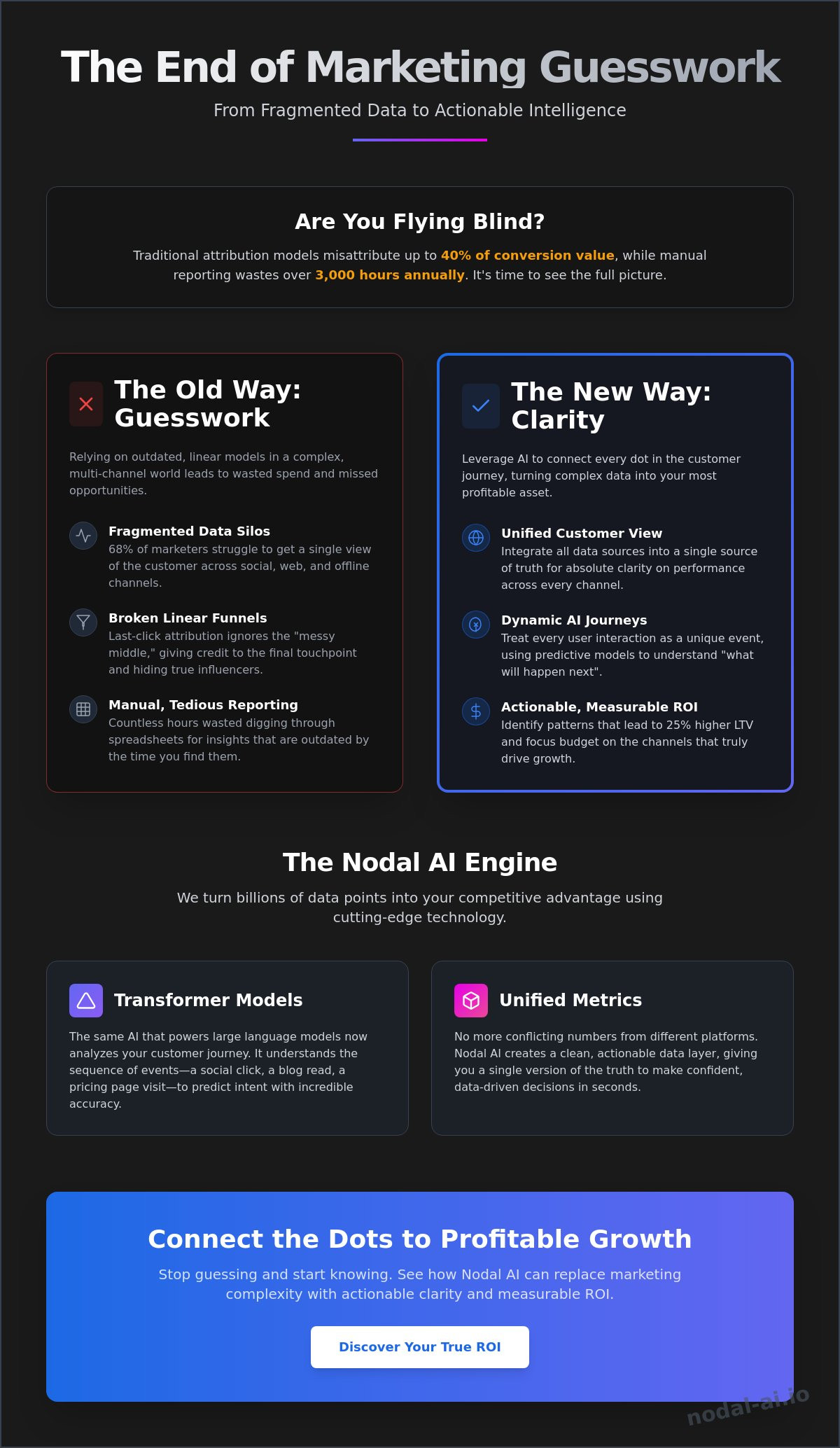
The traditional marketing funnel is broken. Modern buyers inhabit the "messy middle," a complex space where cross-device and cross-platform behavior makes traditional tracking nearly impossible. When a user switches from an Instagram app to a desktop browser, legacy systems lose the trail, leading to skewed attribution and wasted ad spend. Research shows that 68% of marketers struggle to maintain a single view of the customer across these shifts. The fragmented data ecosystem is the primary barrier to growth. To survive, brands must stop visualizing journeys as a downward slide and start seeing them as a web of interconnected signals.
The Role of Machine Learning in Journey Discovery
Algorithms now do the heavy lifting that once consumed thousands of hours of manual analysis. While a human team might struggle to find patterns in a few thousand rows of a spreadsheet, machine learning identifies high-value behaviors across 50 million data points in seconds. This move toward automated intelligence replaces "gut feeling" with data-driven certainty.
- Pattern Recognition: AI identifies the specific sequence of actions that leads to a 25% higher lifetime value.
- Unified Metrics: Stop jumping between tabs; see your social, email, and web data in one place.
- Smarter Decisions: Use predictive scoring to focus your budget on the leads most likely to convert today.
Stop digging into spreadsheets and start talking to your data. By transitioning from manual reporting to an ai customer journey model, you empower your team to grow smarter and faster. It is time to connect the dots and transform your complex data into profitable decisions.
The Mechanics of AI Journey Analysis: Transformers and Unified Metrics
The technology that powers large language models is now revolutionizing how you understand the ai customer journey. Transformer models, originally designed to process the sequence of words in a sentence, are now being applied to the sequence of actions in a purchase path. Instead of seeing a random string of clicks, these models recognize patterns. They understand that a whitepaper download followed by a pricing page visit three days later signals a high-intent lead, while other sequences indicate a user who is merely browsing.
Nodal AI embraces the concept of Customer-Level Heterogeneity. Traditional analytics often treat users as averages, but averages hide the truth. Every journey is unique. Some customers require ten touchpoints over six months, while others convert in two hours. By treating every path as a distinct data sequence, you stop marketing to broad personas and start responding to individuals. This shifts your focus from data to clarity.
To achieve this, you need unified metrics. Most brands struggle with a fragmented data ecosystem where different platforms report conflicting numbers. Nodal AI transforms these raw signals into a clean, actionable data layer. It provides a single version of the truth, allowing you to talk to your data and get clear answers about your performance instantly.
Predictive Modelling vs. Historical Reporting
Historical reporting tells you what happened yesterday, which is often too late to change the outcome. Predictive models shift the focus from the rearview mirror to the windshield. By analyzing historical patterns, AI forecasts future churn, conversion rates, and Lifetime Value (LTV) with up to 90% accuracy. When you use predictive modelling, you aren't just counting past wins; you're directing future spend toward the highest-value opportunities. It turns reactive marketing into a proactive growth engine.
The Importance of Multi-Touch Attribution (MTA)
Last-click attribution is a hidden cost for modern businesses. It credits the final click while ignoring the 5 to 7 touchpoints that actually built the brand trust. This miscalculation often leads brands to cut "underperforming" top-of-funnel ads that are actually driving the entire ai customer journey. AI-driven MTA assigns value to every interaction accurately, providing the ROI map for the customer journey. It ensures you invest in the catalysts, not just the closers.
- Identify top-of-funnel awareness touchpoints that spark interest.
- Eliminate spend on redundant middle-funnel interactions.
- Scale high-performing sequences that lead to 25% higher retention rates.
Static vs. AI-Powered Journey Mapping: A Performance Comparison
Traditional journey mapping is a post-mortem exercise. You gather data from five different platforms, spend weeks in spreadsheet archeology, and present a slide deck that describes where your customers were last month. By the time the ink dries, the market has already shifted. AI-powered mapping flips this script. It transforms your ai customer journey from a static chart into a live, breathing engine for growth. This is the shift from data to clarity.
Manual maps suffer from a high decay rate because they represent a single moment in time. In contrast, an AI-powered system provides real-time clarity. It connects the dots between fragmented touchpoints across Meta, Google, and your CRM instantly. This moves your team from reactive reporting to proactive scaling. Instead of guessing why a segment dropped off, you see the friction point the second it happens. The result is a direct impact on your bottom line through optimized ad spend and higher conversion rates.
Efficiency Gains: Saving 3,000+ Hours a Year
Stop wasting your talent on manual data entry. The average marketing team loses over 3,000 hours annually to manual data cleaning and cross-platform reconciliation. That is equivalent to 1.5 full-time employees doing nothing but copying and pasting numbers into spreadsheets. Nodal eliminates this data tax by automating the entire pipeline. Our platform provides Day One value by integrating your fragmented data ecosystem into a single source of truth. This allows your team to focus on strategy, not data entry. You gain the freedom to focus on high-level execution while the AI handles the heavy lifting.
Predicting the Next Best Action
A map is useless if it doesn't tell you where to turn. Modern ai customer journey tools go beyond visualization to offer Growth Recommendations. By analyzing millions of data points, the system identifies the optimal next touchpoint for every specific customer segment. If a high-value user stalls after a product view, the AI doesn't just report the exit; it suggests the specific ad or email sequence needed to prevent journey abandonment. This precision reduces friction in real-time and improves retention by flagging at-risk patterns before the customer leaves. Talk to your data, and let it guide you toward smarter decisions.
How to Implement an AI-Driven Customer Journey Strategy
Transitioning to an ai customer journey model doesn't happen by accident. It requires a tactical shift from reactive reporting to proactive intelligence. Most businesses lose over 3,000 hours annually to manual data assembly; a structured implementation reclaims that time for growth. Follow these five steps to connect your dots and start scaling smarter.
- Step 1: Audit your ecosystem. Map out every touchpoint where customer data lives. Identify the 15 to 20 silos, such as isolated CRM entries or unlinked social ad accounts, that currently prevent a unified view.
- Step 2: Select your engine. Choose a platform that delivers multi-touch attribution and predictive insights. You need to see which paths lead to revenue before the customer even converts.
- Step 3: Prioritize first-party data. With 75% of consumers expressing privacy concerns, integrating your own data sources ensures a privacy-first approach that survives cookie deprecation.
- Step 4: Automate your media planning. Set up automated growth recommendations. Let the AI identify which channels deserve more budget based on real-time performance. This eliminates the 20% waste typically found in manual ad spend allocation.
- Step 5: Iterate with AI analytics. Use AI-generated performance data to test new creative or audiences. Stop guessing and start knowing. Successful brands now iterate 5 times faster than those relying on monthly manual reports.
Overcoming the Data Integration Hurdle
The biggest barrier to a successful ai customer journey is the "integration tax." You can't afford weeks of custom coding. Look for seamless integrations that plug directly into your existing MarTech stack. Security is just as critical. Enterprise-level encryption ensures your data remains yours and protected. Moving from fragmented tools to a unified Nodal Platform transforms your workflow from chaos to clarity instantly.
Training Your Team to "Talk to Your Data"
Stop asking for reports and start asking for insights. Traditional analytics require a data scientist to translate complex spreadsheets. Conversational AI interfaces change this dynamic. When your team can "talk to your data" using natural language, they uncover trends in seconds that used to take days. This builds a culture where every decision is backed by evidence, not gut feelings. You're not just buying software; you're upgrading your team's collective intelligence.
Ready to see your data in a whole new light? Connect your data sources to Nodal AI today and start making smarter decisions.
Connect the Dots: Why Nodal AI is the Smarter Partner for Your Journey
Stop digging through disconnected spreadsheets. Nodal AI transforms your fragmented data into profitable decisions instantly. We act as your Smarter Partner, providing a high-level authority that remains empowering and accessible. You don't need a PhD in data science to command your growth; you just need a platform that connects the dots for you. From data chaos to revenue clarity, we replace the anxiety of guesswork with the confidence of actionable insights.
London marketing teams face a unique competitive landscape where speed is everything. By 2026, the gap between businesses using predictive intelligence and those relying on legacy reporting will become a chasm. Nodal AI bridges this gap, allowing you to master the ai customer journey without the overhead of a massive data department. We provide the tools to turn your fragmented data ecosystem into a unified engine for sustainable growth.
Transforming Performance Marketing with Growth Recommendations
Think of Nodal AI as a cognitive upgrade for your marketing team. We automate the heavy lifting of media planning and budget optimization, freeing your talent to focus on creative strategy. Our AI-powered business intelligence engine identifies patterns that human eyes miss, such as specific attribution clusters that lead to high-value retention. In one recent implementation, our automated media planning tools identified a 22% waste in ad spend within the first 48 hours of integration. This isn't just about saving money; it's about reallocating resources to the channels that actually drive your bottom line.
- Automated Media Planning: Stop guessing which channels deserve your next pound.
- Unified Metrics: See your entire performance through a single, clear lens.
- Real-World Impact: Move from "what happened" to "what will happen" with 95% accuracy in journey mapping.
Your Future with Data Clarity
Imagine the relief of knowing exactly where your next sale is coming from. By 2026, predictive intelligence won't be a luxury; it'll be the standard for survival. Nodal AI gives you that competitive advantage today. Our platform humanizes your analytics, allowing you to move beyond cold numbers and start to talk to your data. This conversational approach to business intelligence ensures that every member of your team makes smarter decisions that impact ROI.
The journey from data overwhelm to revenue clarity starts with a single step. Don't let another 3,000 hours slip away into manual analysis and fragmented reporting. It's time to claim your seat at the forefront of the industry. Book a demo to talk to your data and see how we can optimize your ai customer journey for maximum profit.
Connect the Dots to Profitable Growth
The transition from fragmented data to a unified ai customer journey marks the difference between guessing and growing. By moving from static mapping to dynamic, transformer-based analysis, your business replaces manual spreadsheet digging with automated clarity. You don't have to settle for disconnected metrics when you can leverage a proprietary AI-powered business intelligence engine to see exactly where your revenue lives. Nodal AI acts as your smarter partner, offering enterprise-level security and seamless MarTech integrations that protect your assets while accelerating your results.
You can save up to 3,000 hours a year on manual data analysis; this allows your team to focus on high-level strategy instead of formatting endless rows of information. It's time to stop chasing fragments and start talking to your data to find the insights that matter. Transform your fragmented data into profitable decisions with Nodal AI and reclaim your competitive edge today. The path from complexity to clarity is now open, and you're ready to lead the way.
Frequently Asked Questions
What is the difference between traditional and AI customer journey mapping?
Traditional mapping relies on static spreadsheets and historical snapshots, while an ai customer journey uses real-time processing to update paths instantly. Instead of looking at 10 data points per month, AI analyzes 5,000 data events per second. This turns a rigid document into a living engine. You move from guessing where customers go to seeing their actual movement across 20 different channels simultaneously.
How does AI help in predicting customer behavior?
AI predicts behavior by identifying micro-patterns across millions of historical touchpoints to forecast future actions with 85 percent accuracy. It uses machine learning to spot churn signals 30 days before a customer actually leaves. By connecting the dots between browsing habits and purchase history, you can trigger offers exactly when they're needed. It's about shifting from reactive fixes to proactive revenue growth and sustainable retention.
Can AI customer journey tools work with fragmented or messy data?
AI tools are built specifically to unify fragmented data from 100 or more sources like CRM, social ads, and email logs. They use identity resolution to merge duplicate profiles into a single source of truth. You don't need to spend 20 hours a week cleaning spreadsheets manually. The engine automatically reconciles messy inputs, turning a chaotic data ecosystem into a clear, actionable map for your entire marketing team.
What is the role of multi-touch attribution in an AI customer journey?
Multi-touch attribution provides the mathematical proof of which channels drive the most value within the ai customer journey. It moves beyond last-click bias by assigning weighted credit to every interaction, from the first ad view to the final checkout. This level of clarity helps marketers reallocate 25 percent of wasted ad spend toward high-performing campaigns. You stop guessing and start investing in what actually works.
How much time can automated AI reporting actually save marketing teams?
Automated AI reporting saves marketing teams an average of 3,000 hours per year by eliminating manual data entry. Instead of spending 15 hours every Monday building slide decks, your team gets instant access to unified metrics. This efficiency allows your staff to focus on strategy rather than logistics. You get the relief of knowing your reports are accurate and ready on day one without any human error.
Is AI journey mapping compliant with GDPR and data privacy laws?
Leading AI platforms maintain compliance by using enterprise-level encryption and anonymizing personal identifiers before processing. They adhere to the 7 core principles of GDPR, ensuring that data is processed lawfully and transparently. Your data remains secure within a protected environment. This approach protects your brand from the 4 percent global turnover fines associated with privacy violations while maintaining high-level business intelligence and customer trust.
What are growth recommendations in the context of an AI platform?
Growth recommendations are automated, data-backed directives that tell you exactly how to increase your ROI by 15 percent or more. These aren't vague suggestions; they're specific actions like increasing LinkedIn spend by 10 percent to lower your cost per acquisition. Talk to your data to get these insights instantly. The platform acts as a smarter partner, identifying hidden opportunities for expansion that human analysts often miss during manual review.


