

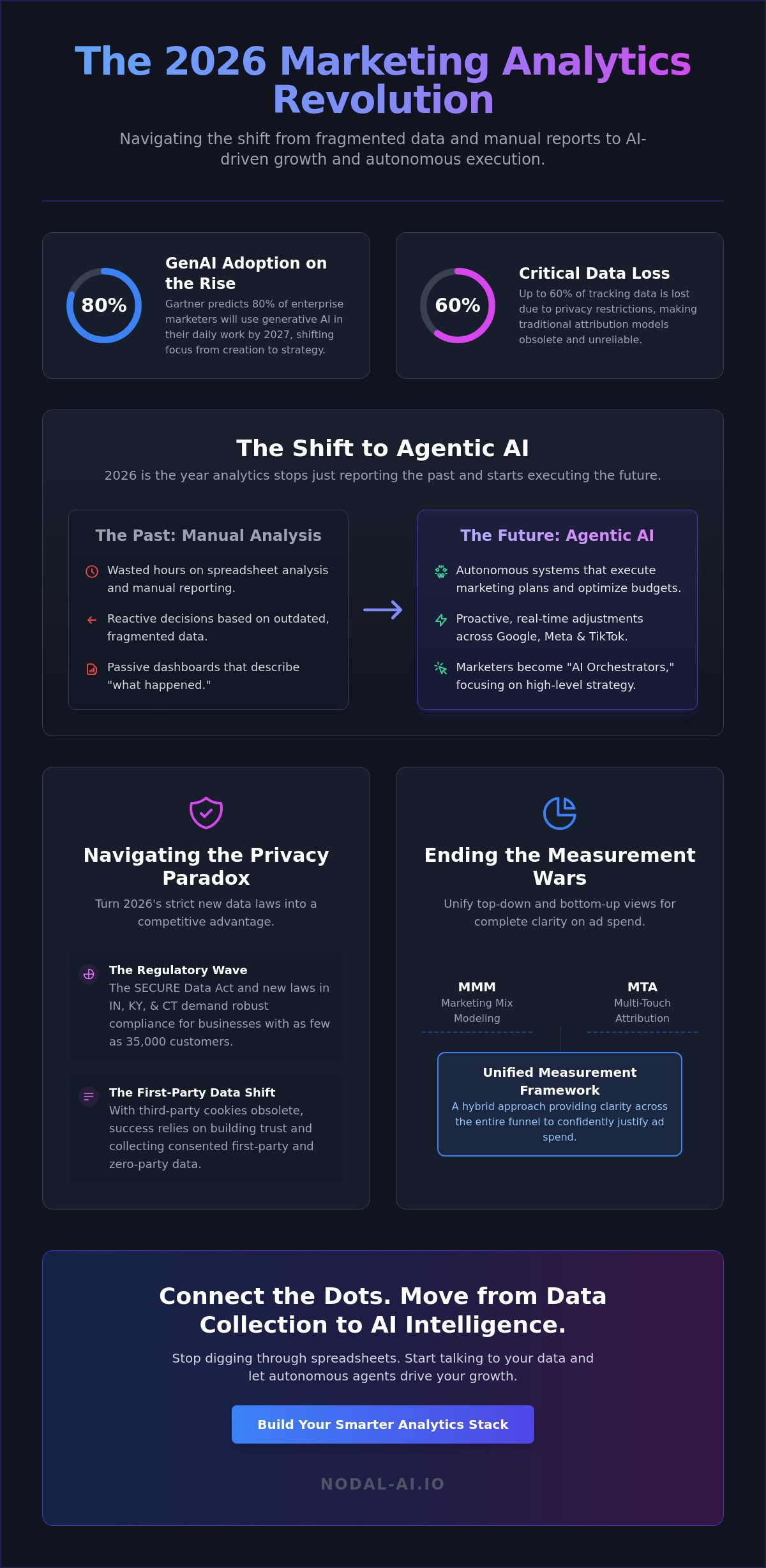
Gartner predicts that by 2027, 80% of enterprise marketers will use generative AI daily, yet 75% of companies are currently losing up to 60% of their tracking data to privacy restrictions. You've likely felt the weight of this shift while scanning the latest marketing analytics news. It's exhausting to justify ad spend when the cookie-less world feels like it's closing in, especially with the SECURE Data Act introduced on April 22, 2026, threatening to rewrite the rules for any company processing data for over 200,000 consumers. You know that manual spreadsheets aren't enough anymore. The path to clarity feels buried under a mountain of fragmented metrics.
We're here to help you move from data collection to AI intelligence. This guide promises to clear the fog, offering a comprehensive roundup of the regulatory shifts and AI breakthroughs defining this year. You'll learn how to connect the dots between your fragmented data sources and finally talk to your data through agentic AI. We'll preview the essential updates for 2026, including the impact of new privacy laws in Indiana and Kentucky, the rise of hybrid measurement models, and the frameworks you need to make smarter, more profitable decisions with confidence.
Key Takeaways
- Transition from passive reporting to agentic AI that autonomously executes your marketing plans. Stop wasting hours on manual spreadsheet analysis and start focusing on high-level strategy.
- Master the "Privacy Paradox" by integrating consent signals directly into your data ecosystem. Learn how to maintain high-resolution insights while staying compliant with 2026's strict new state and federal regulations.
- End the debate between MMM and Multi-Touch Attribution by adopting a unified measurement framework. This hybrid approach provides the clarity needed to justify ad spend across the entire funnel.
- Shift your focus from descriptive reporting to prescriptive growth by leveraging predictive customer journey mapping. Identify and engage high-value users before they even reach your checkout page.
- Stay competitive by auditing your current tech stack against the latest marketing analytics news and trends. Connect the dots across fragmented sources to create a single, smarter source of truth.
The Rise of Agentic AI: Why 2026 is the Year of Autonomous Analytics
The era of passive dashboards is over. For years, marketing analytics news focused on how to gather more data, but 2026 marks the definitive shift toward how we use it. We've moved beyond the Spreadsheet Era into the age of autonomous execution. In major hubs like London, marketing teams are already replacing thousands of hours of manual analysis with agentic systems that don't just report on performance; they improve it in real-time. This isn't just a tech update. It's a fundamental change in how you grow your business.
Your role is changing. You aren't a data entry clerk or a report builder anymore. In 2026, the most successful marketers act as AI Orchestrators. They set the goals, define the guardrails, and let the agents handle the heavy lifting. This shift allows teams to turn fragmented data into profitable decisions without the traditional friction of human-led analysis. It's about moving from complexity to clarity with a single command. By adopting this "self-driving" approach, brands are seeing a direct impact on budget allocation, as AI identifies high-performing segments and shifts spend before a human could even open a laptop.
From Generative to Agentic: A New Era
While 2024 was about generative AI creating copy and images, 2026 is about agentic AI managing entire ecosystems. Generative tools are your creative assistants; agentic tools are your infrastructure. These systems are designed to identify anomalies in customer journeys long before a human analyst spots a dip in the charts. Agentic AI is a system capable of independent goal-pursuit within a marketing stack. It doesn't wait for your permission to flag a failing campaign or adjust a bid. It acts on the data it sees, ensuring your revenue remains protected around the clock. This transition moves your team from data collection to true AI intelligence.
Practical Applications for Growth Teams
The practical benefits of this shift are immediate. Automated media planning has transformed from a buzzword into a daily reality. AI agents now handle cross-channel bid adjustments across Google, Meta, and TikTok simultaneously, reacting to performance shifts in seconds. This level of agility is impossible for human teams relying on weekly syncs. You can now move from static monthly reports to live data streams with real-time cohort analysis. By integrating these agentic tools with your existing automated reporting workflows, you connect the dots between raw numbers and sustainable growth. Stop digging into spreadsheets. Start talking to your data and let the agents drive your results.
Data Privacy and Governance: Navigating the Post-Cookie Ecosystem
The SECURE Data Act, introduced on April 22, 2026, has fundamentally changed the marketing analytics news cycle. For any business processing data for more than 200,000 U.S. consumers, the era of guesswork is over. This federal framework, combined with new state laws in Indiana, Kentucky, and Rhode Island that went live on January 1, 2026, means your data ecosystem must be bulletproof. Connecticut’s privacy law applicability threshold drops to 35,000 customers on July 1, 2026, pulling even more mid-sized firms into the compliance net. You can't rely on the fragmented data of the past. You need a system that turns compliance into a competitive advantage.
The Privacy Paradox is real. Customers want personalized experiences but refuse to be tracked. While Google's 2024 pivot to "user choice" in Chrome didn't kill the cookie entirely, the results are clear: 40% to 60% of your tracking data is likely missing. To survive, you must move from third-party reliance to first-party and zero-party data strategies. This is the only way to fuel the predictive models and agentic AI we discussed previously. From data collection to AI intelligence, the path forward requires a foundation of absolute trust and transparency.
The Death of the Third-Party Cookie (Finally)
Retargeting strategies built on third-party cookies are officially obsolete. Since Safari and Firefox began blocking these by default years ago, the industry has scrambled for a replacement. First-party data is your most sustainable asset. It's the difference between owning your audience and renting it from a platform that can change the rules at any moment. You must bridge the gap between privacy and personalization by using consent signals as a direct input for your AI. This ensures ROI doesn't drop even as tracking becomes more restricted. Start building your own data moats today.
Data Governance for Global Teams
For London-based enterprises, the ICO's 2026 guidelines on AI-driven profiling are strict. You need a Privacy-First stack that uses enterprise-level encryption to secure customer journey data. This isn't just about avoiding fines; it's about building trust. A robust data governance framework allows you to connect the dots across global regions without sacrificing clarity. When your data is secure and unified, you can finally talk to your data with total confidence. Replace the anxiety of compliance with the relief of a streamlined, secure ecosystem.
Measurement Wars: MMM vs. Multi-Touch Attribution in 2026
The conflict between Marketing Mix Modelling (MMM) and Multi-Touch Attribution (MTA) has reached a turning point. For years, teams were forced to choose between the long-term strategic view of MMM and the real-time, granular insights of MTA. In 2026, the most significant marketing analytics news is that the industry has moved toward "Unified Measurement." This isn't just a compromise; it's a necessity. With 75% of companies now using MTA but losing up to 60% of their tracking data to privacy restrictions, relying on a single source of truth is a recipe for wasted spend. You need a way to see the full picture without the blind spots.
AI is the catalyst for this peace treaty. It bridges the gap between aggregate MMM data and granular MTA insights, allowing you to see how a top-of-funnel brand awareness campaign in London impacts a specific digital conversion days later. You no longer have to guess which channel deserves the credit. You can connect the dots across your entire fragmented ecosystem. This shift moves your strategy from reactive reporting to proactive growth, ensuring every pound spent contributes to your bottom line. It's about turning complex data into profitable decisions.
Unified Measurement Frameworks
Think of your data as raw oil. Without a refinery, it's just a mess of numbers that provides no value. A Unified Measurement Framework acts as that refinery, transforming raw data into actionable context. When your MMM suggests increasing brand spend while your MTA highlights retargeting success, you don't have to freeze. AI-powered engines reconcile these discrepancies by identifying the hidden correlations between channels. Recent industry data shows that brands adopting this hybrid approach achieve 15% higher budget efficiency compared to those stuck in a single-model mindset. It turns confusion into clarity and relief.
Solving the Walled Garden Problem
Walled gardens like Meta and Google continue to offer a blurry big picture of ad revenues. They often over-report their own success, making it difficult to justify ROI to stakeholders with total confidence. To solve this, marketers are turning to incrementality testing. This acts as a "truth serum" for your attribution claims, proving whether a sale would have happened without the ad. Modern multi-touch attribution software UK enterprises use is evolving to respect privacy while providing the tactical optimization needed for daily growth. By combining these tests with your unified metrics, you can finally talk to your data with authority and stop the measurement wars for good.
Predictive Analytics: Moving from "What Happened" to "What Will Happen"
Descriptive reporting is a rearview mirror. You can't drive a business toward sustainable growth by only looking at where you've been. While the latest marketing analytics news often highlights the tools of today, the real winners in 2026 are mastering the tools of tomorrow. Despite the rapid adoption of AI, 75% of marketers still feel their measurement systems fall short of their predictive goals. They remain trapped in the "what happened" phase, manually digging into spreadsheets to explain last month's dip in revenue while their competitors are already simulating next month's success.
Budget decision-making has evolved. In 2026, the most efficient teams rely on "Scenario Planners." These are advanced AI models that simulate thousands of market variables, from shifts in consumer sentiment to the impact of the SECURE Data Act, to find the most profitable path forward. This shift replaces the anxiety of justifying ad spend to stakeholders with the confidence of data-backed modeled outcomes. You're no longer guessing; you're orchestrating. By moving from data collection to AI intelligence, you transform your analytics stack from a cost center into a prescriptive growth engine.
Mapping the Future Customer
Stop treating every visitor like a generic data point. Using predictive modelling allows you to forecast Lifetime Value (LTV) at the moment of the first touch. By ingesting years of historical data, these systems identify "churn-risk" segments long before they show signs of disengagement. This automated data analysis helps you focus your resources on high-value users who are actually likely to convert. It's about moving from broad, wasteful targeting to precise, individual trajectories. When you connect the dots between past behavior and future intent, clarity becomes your primary competitive advantage.
Prescriptive Growth Recommendations
The era of manual A/B testing is officially over. It's too slow for the pace of 2026. In its place, we have continuous, AI-driven optimization that happens in real-time. Modern AI engines don't just show you a chart of declining performance; they suggest the exact "pivots" in ad spend required to capture emerging demand. A Smarter Partner is an analytics system that provides actionable answers, not just colorful charts. This is the ultimate expression of talking to your data. You provide the goals, and the system provides the roadmap to reach them. If you're ready to stop looking backward and start driving revenue, it's time to connect your data to Nodal AI and see what's coming next.
Turning News into Strategy: Building Your Smarter Analytics Stack
Reading the latest marketing analytics news is only the first step. The real challenge is turning those headlines into a functional roadmap for your business. Many organizations remain stuck in the "Spreadsheet Era," losing thousands of hours to manual data entry and fragmented silos. It's time to stop digging and start deciding. By connecting the dots between your disparate platforms, you move from a reactive state to a position of high-level authority. You need a single source of truth that replaces complexity with clarity and relief.
The future of Business Intelligence isn't a complex dashboard; it's a conversation. Our "Talk to Your Data" philosophy means using natural language queries to extract instant, actionable insights. You shouldn't need a PhD in data science to understand why your revenue fluctuated yesterday. Nodal AI transforms 2026's technical breakthroughs into a genuine competitive advantage. We provide a unified metrics engine that acts as your Smarter Partner, ensuring your data is an active participant in your growth rather than a passive asset.
The 3-Step Implementation Roadmap
- Consolidate: Move away from fragmented silos. Bring your Meta, Google, and first-party data into a unified ecosystem where every metric is verified and encrypted.
- Automate: Leverage ai marketing analytics to handle the heavy lifting of reporting. Let the system identify anomalies and trends while you focus on the big picture.
- Act: Stop waiting for monthly reviews. Use real-time growth recommendations to scale your revenue faster and pivot your ad spend with total confidence.
Why London Enterprises are Choosing Nodal
London-based enterprises face unique market nuances, from local regulatory shifts to specific consumer behaviors. As a London-based Smarter Partner, we understand these complexities deeply. Our platform allows teams to save 3,000 hours a year through automated reporting and AI insights. This isn't just about efficiency; it's about the relief that comes from knowing your decisions are backed by the most advanced intelligence available. Stop losing time to the fragmented data ecosystem. It's time to grow smarter, faster, and with absolute clarity. Connect your dots with Nodal AI today and transform your marketing analytics news into a sustainable strategy for 2026 and beyond.
Master Your Measurement Future
The shift from passive reporting to agentic AI is no longer a luxury; it's the standard for survival in 2026. Staying ahead of the marketing analytics news cycle means moving beyond the fragmentation of the past and embracing a unified, predictive ecosystem. You've seen how autonomous agents and unified measurement frameworks can protect your ROI in a post-cookie world where the SECURE Data Act now defines the rules. Transitioning from being a data collector to an AI Orchestrator is the only way to maintain a competitive edge. Now, it's time to turn these technological breakthroughs into sustainable revenue growth.
Don't let complexity hold your business back. Nodal AI provides enterprise-level data encryption and London-based expert support to help you reclaim your focus. We save teams over 3,000 hours annually by eliminating the manual grind of data analysis and spreadsheet management. It's time to move from data collection to true AI intelligence. Talk to your data and make smarter decisions with Nodal AI today. The future of your business is waiting for you to connect the dots. You have the tools; now take the lead.
Frequently Asked Questions
What is the most important marketing analytics news for 2026?
The most critical marketing analytics news for 2026 is the introduction of the federal SECURE Data Act on April 22. This legislation creates a national framework for data privacy, affecting any business processing data for more than 200,000 U.S. consumers. Alongside this, the rapid rise of agentic AI is shifting the industry focus from simple data collection to autonomous execution. This ensures teams stay compliant while moving from fragmented metrics to profitable decisions.
How is Agentic AI different from regular AI in marketing?
Regular AI typically focuses on generative tasks like writing copy or creating images. Agentic AI is different because it's capable of independent goal-pursuit within your marketing stack. Instead of just providing a static chart, an agentic system identifies a performance dip and autonomously adjusts bids or reallocates budget. It acts as an execution layer that turns complex data into growth without requiring constant human prompts or manual spreadsheet analysis.
Is multi-touch attribution still relevant in a cookie-less world?
Multi-touch attribution remains relevant, but it's no longer a standalone solution in 2026. With 40% to 60% of tracking data now lost to privacy restrictions, MTA must be part of a unified measurement framework. It's best used for tactical, real-time optimization of digital campaigns rather than broad strategic planning. Successful teams combine MTA with incrementality testing to validate their results and bridge the visibility gap left by third-party cookies.
What is the difference between MMM and attribution modelling?
Marketing Mix Modelling (MMM) is a top-down approach used for long-term strategic planning and cross-channel budgeting. It doesn't rely on individual user tracking, making it ideal for the post-cookie era. Attribution modelling is a bottom-up method that tracks granular touchpoints to optimize specific digital journeys. In 2026, the industry is moving toward a hybrid model that uses both methods to provide a single, smarter source of truth for revenue growth.
How can I stay compliant with GDPR while using AI analytics?
Compliance starts with a "Privacy-First" data architecture and strict adherence to the ICO’s 2026 guidelines on AI-driven profiling. You must implement enterprise-level encryption and ensure your AI only processes the minimum data required for the task. By using agentic tools that respect consent signals from integrations like OneTrust, you can maintain high-resolution insights without violating user trust. This approach turns data governance into a core competency for your business.
Why are my marketing measurement systems falling short of my goals?
Most systems fall short because they are descriptive rather than prescriptive. While 75% of marketers aim for predictive goals, they often remain trapped in a fragmented data ecosystem that only shows what happened in the past. This creates a "Measurement Gap" where teams can't justify ad spend to stakeholders with confidence. To fix this, you must connect the dots between silos and move toward systems that provide actionable insights instead of manual reports.
What are growth recommendations in the context of analytics?
Growth recommendations are prescriptive "pivots" suggested by an AI engine to improve your bottom line. Instead of just reporting a 10% drop in conversion, a smarter system tells you exactly where to shift your budget to capture emerging demand. These recommendations are based on real-time cohort analysis and predictive modeling. They allow you to stop digging into spreadsheets and start making profitable decisions that lead to sustainable, long-term growth for your organization.


