

What if the channel credited with a booking wasn’t the one that first sparked a guest’s interest? A traveller might see a social post, visit a hotel website, return through a search advert and then book direct. Cross-channel marketing attribution helps connect those interactions, but separate channel reports can still tell conflicting stories. When booking and revenue data sit in different systems, it’s hard to see how marketing activity relates to commercial results. Last-touch reporting can also overlook earlier interactions that helped bring a customer across the line.
Clearer evidence can help you make more considered decisions about budget and strategy. No attribution model is perfect: the practical goal is to connect available journey data with revenue, understand what it can and can’t show, and use that view to guide decisions. This article explains how cross-channel attribution works, where its limits lie and how to build a more consistent picture of performance. It includes hospitality examples, from direct bookings to restaurant transactions, and shows how journey mapping and connected data can support growth decisions.
Key Takeaways
- Cross-channel marketing attribution can bring touchpoints and commercial outcomes into a more consistent view, but its usefulness depends on the quality of the connected data.
- Collect, standardise, connect and interpret journey data to make information from different systems easier to compare.
- Choose an attribution model to answer a specific measurement question, rather than treating one approach as the definitive account of performance.
- Agree event names, channel groupings and revenue definitions before comparing models or reporting results.
- Use hospitality insights to explore booking patterns, guest segments and commercial performance. Treat external signals as context, not proof of cause.
Why Cross-Channel Marketing Attribution Matters When Data Is Fragmented
A channel report may credit paid search with a booking because it recorded the final click. But the guest might first have discovered the hotel through social media, returned after reading an email and then searched for the property by name. Each report may accurately describe the interactions it can see, but none necessarily captures the whole journey.
Cross-channel marketing attribution connects relevant marketing interactions with a business outcome, such as a direct booking, and assigns credit according to a chosen method. The aim is to make channel contribution easier to assess, not to claim that one channel alone caused a conversion.
Definition: Cross-channel marketing attribution is the process of assigning credit for a conversion or revenue outcome across relevant customer interactions recorded across multiple marketing channels.
What Does Cross-Channel Marketing Attribution Measure?
Attribution examines interactions that happened before an outcome and applies a method for distributing credit among them. A channel is a broad source of marketing activity, such as email or paid search. A touchpoint is a specific interaction, such as clicking an advert or opening a campaign email. A conversion is the action the business wants to measure, such as completing a booking. Revenue is the commercial value associated with that outcome.
The resulting view depends on which interactions were captured, how records can be connected and which attribution method is used. As Marketing attribution explains, assigning credit is not the same as proving causation. A model can show that a channel featured in journeys associated with bookings. On its own, that does not prove those bookings would not have happened without that channel.
Why Hospitality Teams Need More Than Channel Reports
Hospitality data often sits across separate systems. An advertising platform may record an advert interaction, a booking engine may hold the reservation, a customer relationship management (CRM) system may contain guest details, and a property management system (PMS) may record the stay. If those records can’t be meaningfully connected, teams may see channel activity and booking totals without knowing how they relate.
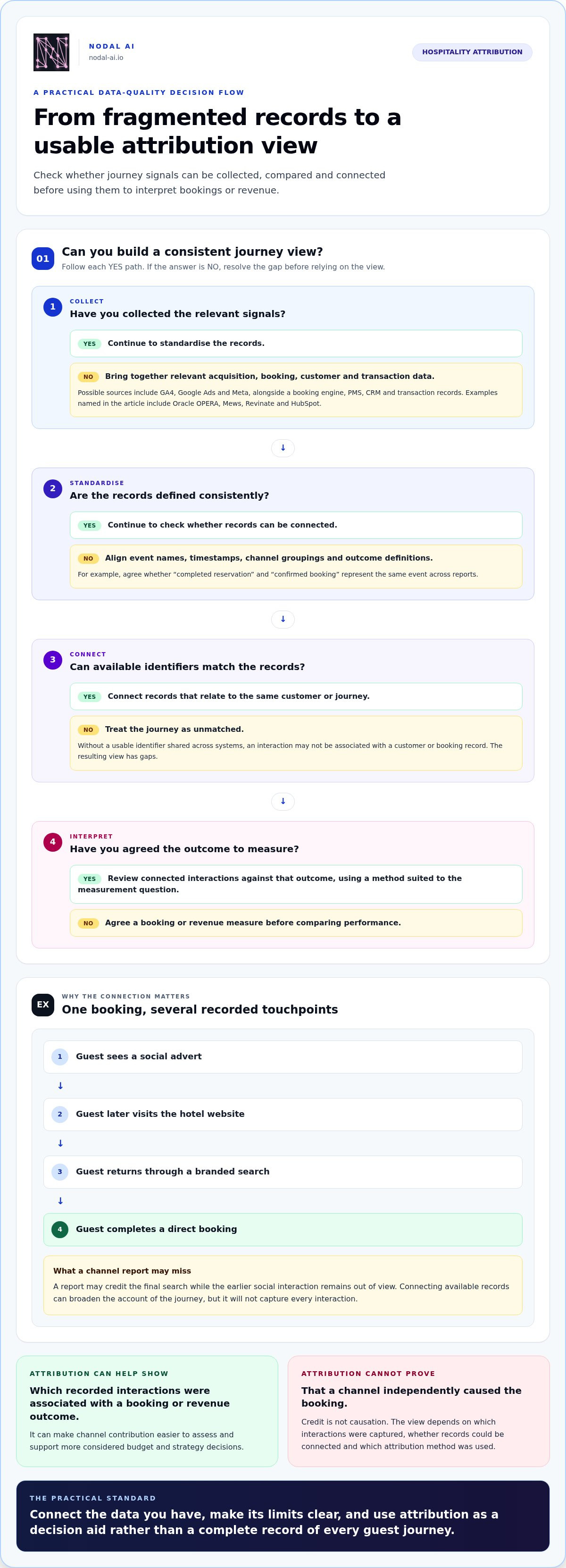
Consider a guest who sees a social advert, later visits a hotel website, then books direct after a branded search. A channel-level report may credit the final search while the earlier advert remains out of view. Connecting available records can offer a broader account of the journey and its commercial value, including how direct bookings relate to guest segments or wider performance. It still won’t capture every interaction or establish what independently caused the booking. Treat attribution as a decision aid, not a complete record of every guest journey.
How Cross-Channel Attribution Connects Touchpoints, Customers and Revenue
A useful attribution view starts with more than advertising clicks. It brings marketing activity together with customer, booking and transaction records, then applies a consistent structure so teams can interpret how those signals relate to commercial outcomes. For a hospitality business, that might mean putting campaign interactions in context with a direct booking, a guest profile or an on-property transaction.
A shared customer journey view is only as reliable as the consistency of the data used to build it.
- Collect: Bring together relevant demand and acquisition signals from sources such as GA4, Google Ads and Meta, alongside booking engine, PMS, CRM and transaction records.
- Standardise: Align event names, timestamps, channel groupings and outcome definitions. For example, agree whether a completed reservation and a confirmed booking represent the same event in every report.
- Connect: Use available identifiers to match records that relate to the same customer or journey. The result depends on which identifiers are present and accessible across systems.
- Interpret: Review connected interactions against an agreed outcome, such as a booking or revenue measure. Apply an attribution method that fits the question being asked.
Which Data Sources Can Contribute to an Attribution View?
Acquisition data can show which campaigns or channels recorded an interaction. Booking and transaction data can show whether a reservation or purchase followed, while CRM and PMS records may add useful customer or stay context. Relevant hospitality systems include booking platforms, property management systems such as Oracle OPERA or Mews, and customer platforms such as Revinate or HubSpot. Each contributes distinct signals, but none serves as a complete journey record on its own.
Connecting these sources can help a team compare campaign activity with direct bookings and commercial outcomes. It can also reveal gaps: an interaction recorded by one platform may not have a corresponding customer or booking record elsewhere.
How Data Matching Shapes the Customer Journey
Matching depends on data access, available identifiers and clear event definitions. If a guest’s campaign interaction and booking record share no usable identifier, the systems may not be able to associate them. Duplicate records can make activity look more frequent than it was, while missing or inconsistent events can hide steps or misstate outcomes. Matching rules and data quality matter as much as the number of connected sources.
For a deeper look at how interactions form a journey, explore The Definitive Guide to the Customer Journey. Nodal AI’s connected analytics capabilities bring fragmented hospitality data into a more coherent view.
Which Cross-Channel Attribution Model Fits Your Measurement Question?
Different models can assign different credit to the same customer journey. In cross-channel marketing attribution, a model is a lens for answering a question, not a change to what the guest actually did. Consider a hypothetical journey: a guest discovers a hotel through social media, returns via email, clicks a paid search advert and books directly.
How Do First-Touch, Last-Touch and Multi-Touch Models Differ?
| Model | How it allocates credit in this journey | What it may underrepresent |
|---|---|---|
| First-touch | Credits social media, the first recorded interaction. | Email, paid search and other later interactions. |
| Last-touch | Credits paid search, the final recorded marketing interaction before the direct booking. | The earlier activity that introduced or renewed interest in the hotel. |
| Linear | Shares credit evenly across the recorded social, email and paid search interactions. | The possibility that some interactions mattered more than others. |
| Position-based | Gives greater weight to selected positions, often the first and final interactions, and shares the remainder across the middle. | Interactions that matter but receive less weight under the chosen rules. |
Linear and position-based approaches both consider multiple interactions, but distribute credit differently. Position-based models use weighting rules that can vary. A data-driven model uses available journey data to allocate credit based on observed patterns. Its output depends on the data captured and the model’s methodology, so don’t assume every platform uses the same inputs or logic.
Choose a model based on the question. First-touch can help examine discovery; last-touch can show which interaction immediately preceded a booking. Multi-touch approaches offer a broader allocation across recorded steps. Compare models to see how channel rankings shift, while keeping the underlying journey and revenue definitions consistent.
What Attribution Models Cannot Prove on Their Own
Attribution reporting describes how credit is assigned to recorded interactions. It doesn’t prove that a channel independently caused a booking or that the booking wouldn’t have happened without it. Consent choices, missing touchpoints and platform reporting limits can all affect which interactions appear in the data. An apparently low contribution may reflect incomplete observation, not necessarily low influence.
To investigate incremental impact, use an incrementality test designed to compare outcomes with and without exposure to a marketing activity. That question differs from attribution, which distributes credit across observed journeys. For further context on attribution methods, see Mastering Marketing Attribution: The Definitive Guide for 2026. Treat model outputs as evidence for investigation and decisions, not causal proof or a universal ranking of channels.
How to Build a Reliable Cross-Channel Attribution Process
A reliable process starts with clear business questions, not a model or dashboard. Decide what the team needs to understand, define the outcome to measure, then agree how each source contributes. This gives marketing, commercial and data teams a shared basis for interpreting cross-channel marketing attribution.
Set Measurement Rules Before Connecting the Data
Define the outcome first. It might be a completed direct booking, a qualified lead or a restaurant transaction. Specify which event counts, which revenue definition applies and what time period the report should cover. Then assign owners for source systems, event and channel definitions, data access, and decisions made from the reporting. For governance context, see the published Modern Data Governance Framework article.
Before comparing models, agree on a practical measurement dictionary. Set consistent names for booking events and channel groupings, for example, and decide whether revenue means the initial booking value or another business-defined measure. Have the relevant data owners review access, consent and retention practices for the records being used. Clear ownership helps teams resolve differences without turning every reporting question into a new interpretation.
Validate Reports Before Changing Marketing Decisions
Check the foundations before acting on attribution outputs. Use this checklist:
- Coverage: Confirm which sources and journey events appear in the reporting, and identify known gaps.
- Duplication: Look for repeated bookings, transactions or campaign events that could inflate counts.
- Time alignment: Check that timestamps, reporting periods and conversion windows are comparable across systems.
- Missing records: Investigate where expected interactions or outcomes cannot be matched, rather than treating their absence as proof that they didn’t occur.
- Revenue reconciliation: Compare attributed conversions and revenue with the relevant system-of-record reports. Investigate material discrepancies before drawing conclusions.
Once the data passes these checks, compare channel rankings across more than one attribution view. If a channel’s apparent contribution changes under first-touch, last-touch or a multi-touch approach, that difference is useful context. It shows how the allocation rule shapes the result, not necessarily which channel caused the outcome.
Use the findings to frame a decision or test, not as an automatic instruction to move budget. A reported shift may reflect data coverage, model assumptions or genuine changes in customer behaviour. Record the question, method and limitations alongside the result, then review whether later evidence supports the action taken.
Turn Cross-Channel Attribution Into Better Hospitality Decisions
Attribution becomes valuable when it helps hospitality teams ask sharper commercial questions. Cross-channel marketing attribution can show which recorded channels are associated with direct bookings, but the next step is to relate that view to property performance, guest segments and booking value. The aim isn’t to crown a channel. It’s to understand what the evidence suggests and decide what to investigate next.
Apply Attribution Insights to Hospitality Questions
Compare patterns by property. Do channels associated with direct bookings also appear in journeys linked to valuable guest segments or higher booking value? Look at the business outcome alongside attributed activity, rather than treating booking volume alone as the full picture. These comparisons can help teams identify useful patterns, but they don’t guarantee that a channel will deliver the same results elsewhere.
External signals such as local events, weather or tourism trends can add context when relevant data is available. A change in booking patterns alongside a local event, for example, may prompt a useful question about timing or demand. It doesn’t prove that the event, or a particular marketing channel, caused the change. Use context to guide analysis, then test important assumptions before making major commercial decisions.
Where a Connected Analytics Platform Can Help
Nodal Platform is a modular analytics engine that connects relevant hospitality data sources and supports commercial analysis. Customer journey mapping helps teams examine recorded interactions alongside booking and customer information, while multi-touch attribution provides a way to assess how credit is distributed across those interactions. Automated reporting and growth recommendations can help turn connected data into practical next steps. The value lies in connecting evidence to commercial questions, not promising a specific outcome.
Ovolo Hotels case study results include a 15.3% reduction in acquisition costs, a 24.5% increase in ROAS, a 20% increase in paid search revenue and a 13.8% increase in bookings. These are reported case study outcomes, not a guarantee or proof that attribution alone caused the changes. Interpret them in the context of the case study’s measurement period, data and attribution methodology.
For hospitality teams, the opportunity is a clearer line of sight from marketing signals to bookings and wider commercial performance. Explore hospitality commercial intelligence and consider how a connected view could support your next measurement question.
Make Every Marketing Signal More Useful
Cross-channel marketing attribution is most useful when it connects recorded customer touchpoints with bookings and revenue, while staying clear about what the data can’t prove. A consistent view of connected systems, shared definitions and data quality checks helps teams compare performance with greater confidence. The right model depends on the commercial question, and attributed credit should guide investigation, not dictate budget changes on its own.
For hospitality teams, the next step is to relate channel insights to property-level bookings, guest segments and wider commercial performance. Nodal AI’s platform connects data across operational, booking, acquisition, customer and commercial systems, helping bring fragmented signals into a more connected view.
Ovolo Hotels’ case study reports a 15.3% reduction in acquisition costs and a 24.5% increase in ROAS. Treat these as reported case study outcomes, and assess them alongside the measurement period and attribution methodology used.
With clearer evidence, your team can move from conflicting reports to better questions, more considered decisions and a stronger foundation for sustainable growth.
Frequently Asked Questions
What is cross-channel marketing attribution?
Cross-channel marketing attribution assesses how recorded marketing interactions across different channels relate to a customer outcome, such as a booking. It assigns credit according to a chosen model, helping teams compare channel contributions across a journey rather than viewing each source in isolation. The result depends on the available data, the outcome being measured and the method used. It’s an analytical view, not proof that a channel caused the conversion.
How is cross-channel attribution different from multi-touch attribution?
Cross-channel attribution focuses on interactions across different marketing channels, while multi-touch attribution describes methods that distribute credit across multiple touchpoints. Those touchpoints may span several channels, so the approaches often overlap. When defining a report, specify which channels and interactions are included, what outcome is measured and how credit is allocated. This helps teams compare results consistently and avoid treating different measurement terms as interchangeable.
Which attribution model is best for cross-channel marketing?
There’s no universally best model for cross-channel marketing. First-touch and last-touch models give credit to the first or final recorded interaction, while multi-touch approaches distribute it across several interactions using chosen rules. Select a model that fits the business question and the data available. Compare its results with other evidence, and explain its assumptions so stakeholders understand that allocated credit is not the same as incremental impact.
Can cross-channel attribution prove which marketing channel caused a booking?
No, attribution alone can’t prove which channel caused a booking. It assigns credit based on a model and the interactions recorded, which may not capture every step or match every record. Use attribution to identify patterns and shape questions, not as causal proof. To assess whether marketing activity generated additional bookings, use evidence designed to test incremental impact rather than relying only on attributed conversions.
How do you measure cross-channel marketing attribution in hospitality?
Start by defining the outcome, such as a direct booking or completed transaction, then identify relevant marketing, booking, customer and revenue data. Agree on event names, channel groupings and revenue definitions before connecting records and assessing data quality. For example, a hotel might compare recorded acquisition interactions with booking and guest records. Interpret results in property and commercial context, and document the model and its limits.
Does cross-channel attribution work when customer data is fragmented?
It can still offer a useful view, but fragmented data limits how complete and reliable the results are. Identify where marketing interactions, bookings and customer records are held, then standardise definitions and review how well records can be matched. Flag duplicate, missing or unconnected records before interpreting channel contribution. A consolidated analytics approach can bring relevant sources together, but conclusions remain dependent on the quality and coverage of the underlying data.


