

What if your next Facebook Ads budget decision drew on more than yesterday’s ROAS? When results swing and platform reporting captures only part of the customer journey, it’s hard to know whether to scale, hold or cut spend. Predictive roas modeling can help estimate what may happen next, but a forecast is not a promise of future returns.
Clearer evidence starts with connecting forecasts to trustworthy data and checking whether predicted outcomes match real commercial results. That means looking beyond Meta’s reported ROAS to understand customer value and cross-channel influence, including whether ad activity is associated with bookings or revenue recorded elsewhere.
This article explains what predictive ROAS modelling can and can’t tell you. You’ll learn what data and measurement checks to make before relying on a forecast, how to validate it against outcomes, and how to create a repeatable process for testing and reallocating Facebook Ads spend. The aim is to make deliberate decisions under uncertainty, not to guarantee that every campaign will perform as predicted.
Key Takeaways
- Use predictive roas modeling to estimate future returns, not as a guarantee of what Facebook Ads will deliver.
- Define the revenue outcome you want to forecast, then check that spend, campaign, conversion and revenue data are available and consistent.
- Compare forecasting approaches by how easy they are to interpret, the data they need, how often they can be updated and whether they support real decisions.
- Validate forecasts against observed results before acting, and treat campaign or segment flags as prompts to investigate rather than automatic reasons to cut budget.
- Build a repeatable cycle of forecasting, prioritising, testing, measuring and updating, using connected data to support clearer decisions.
What predictive ROAS modelling can tell you about Facebook Ads
A Facebook campaign can look promising one week and less convincing the next. Should you increase spend, wait for more evidence or investigate a performance change? Predictive roas modeling helps frame that decision by estimating future revenue relative to advertising spend, using selected historical and current signals.
Think of the forecast as a planning aid, not a promise. It isn’t a guaranteed result, a performance target or the ROAS Facebook has already reported. Its usefulness depends on what it predicts, which data informs it and whether later results support the estimate. A forecast can help identify what to examine or test. Measurement and testing show whether the decision worked.
How predictive ROAS differs from reported ROAS
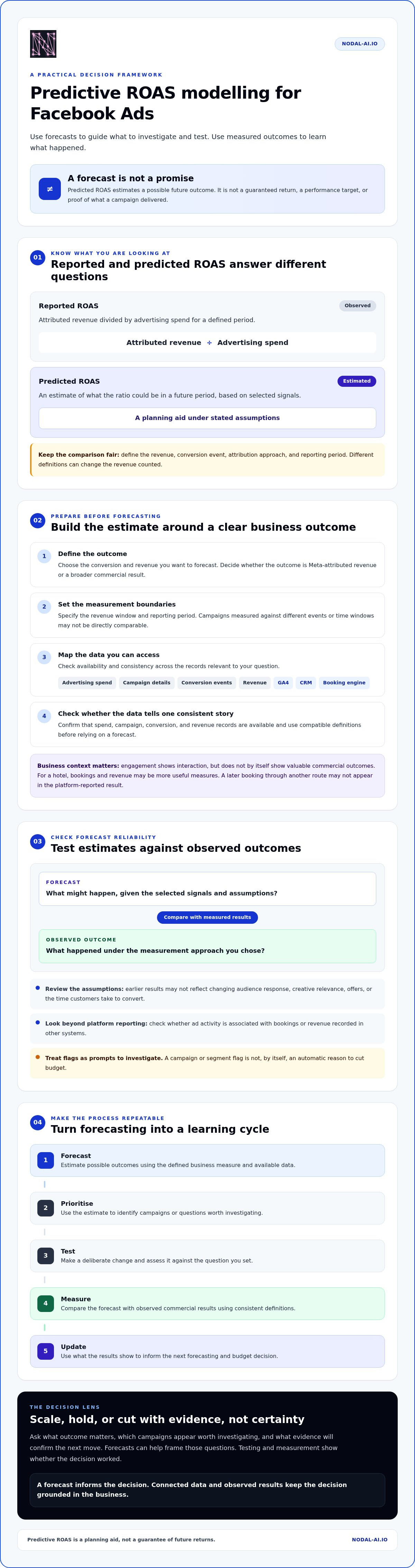
Reported ROAS is an observed ratio: attributed revenue divided by advertising spend for a defined period. Predicted ROAS is an estimate of what that ratio could be in a future period, based on selected signals. Neither number is meaningful without a clear definition of revenue and attribution. The interactions you choose to credit can change the revenue counted in both measures.
ROAS is one advertising focused view of return. For a broader perspective on how marketing investment relates to business outcomes, see Return on Marketing Investment (ROMI). Keep the distinction clear: an estimate can inform a decision, but only observed results show what happened under the measurement approach you chose.
Why Facebook Ads forecasts need business context
Performance may shift as audiences respond differently, creative loses relevance, offers change or customers take longer to convert. A forecast based on earlier results may not reflect those conditions. Treat it as a view of likely outcomes under stated assumptions, then check whether those assumptions still fit the campaign.
Engagement can show that people are interacting with an ad, but it doesn’t by itself show whether the campaign is producing valuable commercial outcomes. For a hotel, bookings and revenue may be more useful measures. Where reliable booking and customer data is available, teams can also consider direct bookings and wider guest value. If someone discovers a property through Facebook but books later through another route, the platform reported result may not capture the full journey.
Use predictive ROAS modelling to ask a better question, not to skip the answer: which campaigns appear worth investigating, what outcome matters, and what evidence will confirm the next move? This keeps forecasts connected to decisions while leaving room for real results to correct the picture.
Prepare Facebook Ads data before building a predictive ROAS model
A forecast is only as useful as the outcome and data behind it. Before you start predictive roas modeling, define what you want to estimate, confirm the relevant records are available, and check that figures mean the same thing across systems. A clear preparation process makes gaps visible before they shape a budget decision.
Choose a ROAS outcome that matches the business question
First, decide whether you’re forecasting revenue attributed within Meta or a broader commercial outcome that includes data from other sources. Then define the conversion event, revenue window and reporting period. If one campaign is measured against completed purchases and another against a different event or time window, their forecasts won’t be directly comparable.
For a hotel, the question might be whether Facebook activity contributes to direct bookings, rather than simply generating clicks or enquiries. Where records allow, connect campaign activity with booking data and specify which booking revenue is included. Predictive analytics uses data to estimate future outcomes, as IBM explains in its overview of predictive analytics. The business question determines which outcome the estimate should serve.
Check data coverage across Facebook and commercial systems
Map the records you can access before choosing an approach. Potential inputs include advertising spend, campaign details, conversion events and revenue, alongside relevant GA4, CRM or booking engine records. Availability varies by business. Nodal Platform is designed to consolidate marketing and commercial data from sources such as Meta, GA4, CRM systems and booking engines, helping teams examine campaign activity alongside business outcomes.
Use this readiness sequence:
- Define the outcome: Write down the conversion, revenue measure, attribution basis and time window.
- Inventory available inputs: Note which periods contain spend, campaign, conversion and revenue records, and where each record comes from.
- Align definitions: Standardise campaign names, event meanings, currencies, time zones and date handling before comparing sources.
- Inspect data quality: Look for missing periods, duplicated events, inconsistent values and delayed revenue or conversion records.
- Document limitations: Record gaps and assumptions. Don’t hide incomplete coverage or treat absent data as zero without checking what it means.
These checks matter because misaligned dates or event definitions can make reporting differences look like changes in campaign results. Delayed bookings, for instance, may not appear in the same period as the ad interaction. If you’re assessing how connected sources support this analysis, explore Nodal Platform features as one option for bringing fragmented data into a clearer view.
Compare predictive ROAS approaches and test forecast reliability
A more complex forecast isn’t automatically a better one. In predictive roas modeling, start with a simple historical baseline, such as recent ROAS for comparable campaigns, and use it as a reference. Then assess whether a model that incorporates additional signals gives more useful guidance. Predictive modeling in marketing uses historical information to estimate future outcomes, but its value depends on how well the estimate supports a real decision.
What to assess when comparing model approaches
Compare approaches on practical grounds, not technical complexity alone. A baseline may be easier to interpret and maintain. A model using more inputs may offer useful context, but only if those signals are reliable, consistently available and relevant to the campaign decision. Extra data can also add work without improving the forecast enough to change what you do.
- Interpretability: Can you explain what the forecast represents and what influenced it?
- Data needs: Are the required inputs complete and dependable enough to use?
- Update frequency: Can the forecast be refreshed in time for the decisions it needs to inform?
- Decision usefulness: Does it help prioritise a campaign, test a change or review spend?
Choose the approach that provides clear, usable guidance for your available data. A simple reference forecast is useful if it helps you spot when a more elaborate model isn’t adding enough decision making value.
How to validate predictions against campaign outcomes
Test forecasts on periods that weren’t used to build them. For example, develop an approach using earlier campaign data, then compare its forecasts with observed results from a later period. Keep the time windows, conversion definitions, revenue measure and attribution rules consistent. Otherwise, the comparison may reflect a change in measurement rather than forecast performance.
Track how far predictions differ from observed ROAS and look for patterns. Does the forecast regularly overestimate certain campaigns, audiences or periods? Are errors larger when conversions arrive late? Record what you find and revisit the assumptions. A single overall score can hide where a forecast is useful and where it needs caution.
Campaign conditions can change. A new offer, platform shift or market disruption may make past patterns less relevant, so check for these changes when results diverge. Where practical, test a proposed budget adjustment on a limited scale and compare it with an appropriate control before making a material change. Keep measurement consistent, then use the observed outcome to decide whether to adapt the forecast or the action it informed.
Use predictive ROAS forecasts to improve Facebook Ads decisions
A forecast is most valuable when it changes how you investigate and test, not when it dictates a budget move. Build a repeatable cycle: forecast likely returns, prioritise campaigns or segments for review, test a focused change, measure the outcome and update the approach. A lower forecast is a prompt to look closer, not an automatic reason to cut spend.
Before acting, decide what level of forecast difference would trigger a review and how long you’ll assess the result. Set thresholds and review periods to fit your campaign volume, conversion timing and business goals. There’s no universal ROAS threshold that makes a budget decision right for every advertiser.
Turn model outputs into controlled budget tests
Choose a limited change you can evaluate, such as adjusting spend for one campaign or testing a defined audience allocation. Record the forecast, the action taken, the comparison period and the observed result. Keep the outcome definition and attribution approach consistent with the forecast you’re assessing.
Where possible, change one meaningful factor at a time. If you alter the audience, offer and budget together, it becomes harder to tell which change influenced the result. A controlled test won’t remove every source of uncertainty, but it gives you clearer evidence than making several changes at once and relying on a simple before and after comparison.
Improve decisions when channel and booking data disagree
Meta’s reported conversions and your booking or CRM records may not match. Investigate the difference before judging performance: compare reporting periods and conversion definitions, and consider whether a customer interacted with an ad before converting through another route. For a hotel, a booking recorded outside Meta may still be part of a customer journey that included Facebook.
Keep correlation separate from causal lift. A campaign and an increase in bookings happening together doesn’t, by itself, prove the campaign caused the increase. Incrementality testing can help assess whether advertising generated outcomes that might not otherwise have happened. Use an incrementality framework alongside predictive ROAS modelling, and consult your marketing attribution guide for a broader view of how different touchpoints receive credit.
Close the loop after each review. Compare the forecast with the measured result, note any market, platform or offer changes, and update your assumptions before the next allocation decision. This turns model output into a learning process rather than a one off instruction.
Explore a Nodal Platform demonstration
Connect predictive ROAS modelling to a clearer growth workflow
Put the work into a repeatable sequence: define the ROAS outcome, prepare the data, validate the forecast against later results, then test actions before making broader budget changes. This keeps predictive roas modeling connected to business decisions instead of treating a forecast as an instruction. Review what happened, learn from the difference between predicted and observed performance, and refine the next decision.
Where connected hospitality data can add useful context
For a hotel, Facebook campaign signals are only one part of the commercial picture. Booking records can show whether activity is associated with direct reservations, while guest and revenue information may add context about value beyond the initial booking, where those records are available and appropriate to use. This lets teams consider occupancy, direct revenue and acquisition performance together, rather than judging a campaign on platform engagement alone.
Nodal AI’s modular analytics platform is designed to bring fragmented marketing and commercial data into a more connected view. Sources may include Meta, GA4, CRM systems and booking engines. The relevant data depends on the business question and what’s accessible. Predictive modelling principles can inform how you approach forecasts, but the right inputs and outcome definitions still depend on your business context.
When to explore an analytics platform
If teams are reconciling separate reports by hand or struggling to connect campaign activity with bookings and revenue, a platform that consolidates data may be worth considering. Nodal Platform supports predictive modelling, attribution and customer journey analysis, alongside performance marketing analytics and growth recommendations. Check which data sources and features are currently available and relevant to your needs before deciding what to use. Explore Nodal Platform features to understand the platform’s stated scope.
Ovolo Hotels’ case study reports changes in ROAS, acquisition costs, paid search revenue and bookings. Those outcomes should be understood in the context of the case study’s measurement scope and reporting period, and they shouldn’t be presented as Facebook Ads results. Check those details before using the figures to inform expectations or comparisons.
Start with the measurement question you need to answer, then identify which data would make the answer more useful. That keeps the next step grounded in your reporting needs, not assumptions about what a model or platform can deliver.
Make your next Facebook Ads decision with clearer evidence
Predictive ROAS modelling works best as part of a disciplined decision process. Define the return you want to forecast, prepare consistent data, check predictions against later results and test changes before scaling them. Use predictive roas modeling to identify where to investigate, not as a guarantee or an automatic instruction to shift budget.
Connected marketing and commercial data can add useful context, especially when platform reporting doesn’t reflect the full customer journey. Nodal Platform is designed to consolidate fragmented data, but check which integrations are currently available for your needs. Ovolo Hotels’ case study reports a 24.5% increase in ROAS. Check the scope, measurement method and reporting period, and don’t treat this as evidence of Facebook specific performance.
If clearer measurement and more connected data could support your decisions, explore whether Nodal AI’s platform fits your requirements.
With sound data and careful testing, you can make each budget decision with greater confidence.
Frequently Asked Questions
What is predictive ROAS modelling?
Predictive ROAS modelling estimates future revenue relative to advertising spend using selected historical and current data. It can help marketers assess likely campaign outcomes and decide what to investigate or test. It isn’t a guarantee, a target or the same as reported ROAS, which describes attributed revenue already observed against spend. Its usefulness depends on clear revenue definitions, consistent data and checks against later results.
How can I improve ROAS on Facebook Ads?
Start by defining the revenue outcome you want to improve and checking that campaign, conversion and revenue data are consistent. Review performance by campaign or segment, then investigate changes to audience, creative, offer or timing rather than changing everything at once. Test a focused adjustment, measure it against a suitable comparison and use the results to guide the next decision. Don’t treat platform reported ROAS as the whole customer journey.
Can predictive modelling forecast Facebook Ads ROAS accurately?
It can estimate future Facebook Ads ROAS, but accuracy depends on data quality, measurement choices and whether conditions remain similar to those represented in the data. Compare predictions with results from later periods that weren’t used to build the forecast. Keep attribution rules and revenue definitions consistent, track where estimates miss and investigate changes in campaigns or market conditions. A forecast supports judgement, but it can’t guarantee future performance.
What data do I need for predictive ROAS modelling?
Useful inputs may include advertising spend, campaign details, conversion events and revenue, depending on what’s available and the outcome you want to forecast. For broader context, marketers may also review GA4, CRM or booking records. Align time periods, currencies, event definitions and attribution rules before comparing sources. Note missing, duplicated or delayed records, since these gaps can limit how confidently you interpret a forecast.
Is Facebook Ads ROAS the same as incremental return?
No. Facebook Ads ROAS usually compares attributed revenue with advertising spend under a chosen attribution approach. Incremental return asks whether advertising caused outcomes that would not otherwise have happened. An attributed conversion can be associated with an ad without proving the ad created that sale. Controlled incrementality tests can help assess causal lift, while attribution helps describe how credit is assigned across customer interactions.
How often should I update a predictive ROAS model?
There isn’t one update schedule that suits every model or campaign. Review forecasts in time for the budget decisions they inform, and reassess them when campaign conditions, offers, measurement or data availability change. Compare predictions with observed results using consistent definitions, then update assumptions or inputs if performance shifts. Frequent updates aren’t automatically better if reliable new data hasn’t arrived or the forecast hasn’t been validated.
Can Nodal AI manage my Facebook Ads campaigns?
No. Nodal AI doesn’t offer managed media buying or manage Facebook Ads campaigns. It provides Nodal Platform and services including Performance Marketing Analytics, Predictive Modelling, Multi-Touch Attribution and Customer Journey Mapping. These can help teams examine marketing performance and connected commercial data to support their own decisions. Check which data integrations and features are currently available for your requirements, as availability should be confirmed before relying on a specific source.


