

What if the guests who could drive your strongest long-term returns are hidden across disconnected systems? A customer lifetime value prediction model can help bring their signals together, but only when teams distinguish past spend from predicted future value. That distinction matters: a historical total describes what a guest has already spent, while a prediction estimates what they may contribute over time.
If your PMS, booking, CRM, POS and marketing data don’t connect, it’s difficult to build a clear view of guest value. Even when a model produces a forecast, teams need to judge whether it’s reliable and decide what to do with it. The answer isn’t simply to choose the most complex model. Start with a clear definition of value, suitable data, sound validation and a decision your teams can act on.
This practical guide shows you how to define customer value for your business, compare predictive modelling approaches and assess prediction quality. You’ll also learn how to use predicted value to shape audience segments and guide commercial decisions, turning scattered guest data into a clearer picture of where to focus.
Key Takeaways
- Define the value you want to forecast and the time period, so predicted future value stays distinct from revenue already recorded.
- Map guest identifiers across PMS, POS, CRM, booking and marketing systems to build a more consistent view of customer behaviour.
- Choose a customer lifetime value prediction model that fits your data, use case and need for interpretability, rather than defaulting to complexity.
- Start with a clear commercial decision, then prepare the data, test prediction quality and connect the results to a practical next step.
- Explore how connected data and audience segmentation can help hospitality teams turn CLV insights into more focused commercial decisions.
What Is a Customer Lifetime Value Prediction Model, and Why Does It Matter?
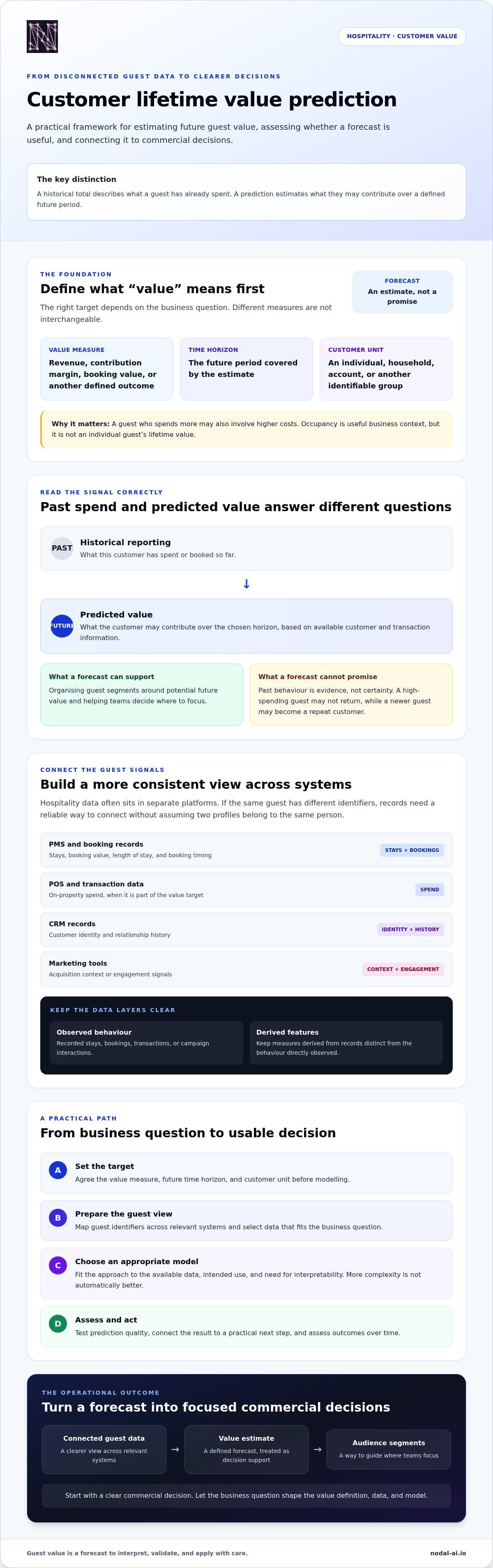
A customer lifetime value prediction model estimates the value a customer is likely to contribute to a business over a defined future period. It uses available customer and transaction information to forecast an outcome, rather than simply adding up revenue or bookings already recorded. The forecast can help teams decide which guest segments to prioritise, but it’s an estimate, not a promise of future behaviour.
Define “value” before modelling begins. A business might measure expected revenue, contribution margin, booking value or another commercial outcome. These measures aren’t interchangeable: a guest who spends more may also involve higher costs. For background on the broader concept, see Customer lifetime value.
What Does Customer Lifetime Value Mean in Hospitality?
For a hotel, value could include room revenue and additional purchases across repeat stays. Direct bookings may also matter if the business wants to compare the commercial value of booking channels. Occupancy is useful business context, but it is not an individual guest’s lifetime value.
For a private members’ club, the measure might reflect retention and on-property spend. For a restaurant or attraction, it could focus on repeat visits, orders or attendance. A serviced apartment operator might consider length of stay, while a hostel could include stay extensions and ancillary spend. The right definition depends on the business question. A model built to support retention planning may use a different value measure from one intended to inform acquisition priorities.
Why Predict Future Value Instead of Reviewing Past Spend?
Historical reporting answers a useful question: what has this customer spent or booked so far? A prediction looks forward, estimating what they may contribute over a chosen horizon. That can help teams organise segments around potential future value rather than relying only on past totals.
Past behaviour is evidence, not certainty. A guest with high historical spend may not return, while a newer guest may become a repeat customer. Treat predictions as decision support, not guarantees. Teams can use them to inform segmentation, then assess outcomes over time.
Consistency makes the output easier to interpret and use. Before comparing customers, agree on:
- The value measure: revenue, margin or another defined business outcome.
- The time horizon: the future period the estimate covers.
- The customer unit: whether value is measured by an individual, household, account or another identifiable group.
With these choices set, a customer lifetime value prediction model gives commercial teams a shared basis for interpreting forecasts and deciding what action, if any, to take.
Which Data and Customer Signals Should a CLV Prediction Model Use?
A useful model starts with a joined-up view of the guest, not a longer list of data fields. Hospitality information often sits across a property management system (PMS), point-of-sale (POS) platform, customer relationship management (CRM) system, booking engine and marketing tools. If the same guest appears under different identifiers, teams need a reliable way to connect those records without assuming that two profiles belong to the same person.
Useful CLV data categories include identity links, observed customer behaviour, derived features and a clearly defined prediction target, selected to fit the business question. They aren’t universal requirements. A hotel forecasting room revenue may need different inputs from a club assessing retention and on-property spend.
Which Hospitality Data Sources Can Feed the Model?
Choose sources according to the value measure you’ve defined. PMS and booking records can describe stays, booking value, length of stay and booking timing. Add POS or other transaction data if on-property spend is part of the target. CRM records can support customer identity and relationship history, while marketing data may provide acquisition context or engagement signals. For example, a hotel could use linked stay and booking records to define a room-revenue target, then include POS transactions only if its definition also covers spend on property. Each source should have a clear purpose.
Keep three layers distinct:
- Observed behaviour: recorded stays, bookings, transactions or campaign interactions.
- Derived features: measures calculated from those records, such as time since a last stay or a guest’s booking frequency.
- Predicted outcome: the future value the model estimates, not a fact already present in the source data.
This separation makes it easier to trace what the model knows, what the team has calculated and what remains an estimate.
How Should Teams Define the Prediction Target?
Write down the target before selecting inputs or comparing models. Specify which customer group is included, the future period being forecast and the value measure, such as revenue or margin. Choose the measure that best supports the decision: revenue may help compare expected sales, while margin can better reflect value after relevant costs.
Record exclusions and limitations alongside the definition. Note whether cancellations, refunds, missing transactions or unlinked guest records are excluded, and explain how that could affect interpretation. Missing or duplicated bookings can distort customer histories; inconsistent currencies, dates or guest identifiers can make comparisons unreliable. Fix what you can, and make remaining gaps visible.
Customer value analysis should guide choices, not turn a forecast into an automatic verdict about a guest. Harvard Business Review’s The Right Way to Manage Unprofitable Customers offers a business perspective on acting thoughtfully on customer-value insights. For hospitality teams bringing fragmented sources together, Nodal AI’s data integration and analytics features may be relevant to explore.
How Do You Compare CLV Prediction Model Approaches?
Start with the simplest method that can answer the commercial question, then test whether added complexity improves the decision. A historical-value baseline might rank guests by past revenue or repeat bookings. Statistical approaches can estimate future activity using patterns in purchase frequency and time between transactions. Machine-learning approaches can combine a broader set of signals to capture more complex relationships, but they may also require more data, technical oversight and explanation.
There’s no universally best customer lifetime value prediction model. Compare candidates against the same target and validation data, and consider how the result will be used. A model that’s difficult for commercial teams to interpret may be less useful than a simpler forecast they can explain and act on.
| Approach | What it offers | Consider when |
|---|---|---|
| Historical baseline | Uses observed customer value as a reference, such as past spend or booking activity. | Customer histories are limited, or you need a clear benchmark before modelling future value. |
| Statistical model | Uses defined behavioural patterns to estimate future activity or value. | You need an approach whose assumptions and outputs are relatively straightforward to explain. |
| Machine-learning model | Combines multiple inputs to identify more complex patterns in customer data. | Data quality, technical capacity and a clear validation plan can support the added complexity. |
When Is a Simple Baseline More Useful Than a Complex Model?
A baseline is a reference point, not a fallback to dismiss. If a more advanced candidate can’t produce more useful estimates than a simple historical measure, its extra complexity may not be worthwhile. Sparse guest activity, short histories and inconsistent identifiers can also limit what a model can learn. Fix or account for those constraints before assuming a sophisticated method will overcome them.
How Can Teams Check Whether Predictions Are Trustworthy?
Test forecasts against outcomes the model wasn’t trained on. For example, build estimates using earlier guest records, then compare them with actual value over a later period. Review overall error and check whether the model consistently overestimates or underestimates value for relevant guest groups or properties, where the data allows. Keep the comparison fair by using the same prediction target and time horizon for every candidate.
Validation isn’t a one-off sign-off. Booking patterns, customer behaviour and business conditions can change, so track whether predictions remain useful and revisit the model when performance or underlying data shifts. Choose the approach that improves a real decision, such as prioritising a segment, and that your team can maintain and interpret. Accuracy matters, but it’s not the only test: clarity and practical value matter too.
How Can You Build and Apply a Customer Lifetime Value Prediction Model?
Build from a decision, not from the model. Are you trying to identify guest segments for retention activity, or inform which audiences to prioritise for acquisition? A clear use case keeps the work focused and gives the team a practical way to judge whether the forecast helps. The steps below take a customer lifetime value prediction model from question to commercial action.
What Are the Practical Steps to Develop the Model?
- 1. Set the objective. Define the decision, the customer unit being assessed, the value measure and the prediction period. Make sure these choices match the commercial question.
- 2. Assign ownership. Name who is responsible for source data and identity quality, who reviews model performance, and which commercial team owns the action based on the output.
- 3. Connect and prepare data. Bring together relevant guest, booking and transaction records. Check how identities are matched across systems, address duplicates where possible, and document gaps that could affect the forecast.
- 4. Establish a baseline. Compare a straightforward historical measure with the model candidates. This gives the team a reference point for assessing whether added complexity makes the estimates more useful.
- 5. Validate before use. Compare predictions with outcomes not used to build the model. Review performance for relevant guest groups or properties where the data allows, then record the limitations alongside the results.
- 6. Apply, monitor and review. Use the forecast to inform a defined commercial action, then track whether the insight remains useful as guest behaviour and business conditions change.
For more detail on modelling options, consult the existing predictive modelling guide. The customer journey guide can help teams consider where a guest is in their relationship with the business before deciding how to act on a value segment.
How Should Teams Turn Predictions into Decisions?
A predicted value is a signal, not an action in itself. A hotel might use it to inform audience segmentation or retention priorities, then shape relevant activity around the guest’s journey stage. For example, a high predicted value could prompt a team to consider how it recognises repeat guests, while a newer guest’s score may be too uncertain to justify the same approach.
Keep the decision measurable. If a campaign is informed by CLV segments, assess its contribution using a consistent approach to marketing attribution. The existing marketing attribution guide can help teams examine how campaign touchpoints relate to outcomes, rather than assuming the model alone caused a change.
Explore a Nodal AI platform demonstration
How Can Hospitality Teams Operationalise CLV Insights with Nodal AI?
A customer lifetime value prediction model is only useful if its outputs can be understood alongside the commercial context behind them. When guest, booking, revenue and marketing information sits in separate systems, teams may see only part of each customer relationship. Connecting relevant data can give analysts and commercial teams a more consistent view for exploring value, reviewing segments and considering what action to take.
What Should Hospitality Teams Look for in a CLV Analytics Setup?
Start with the foundations. Check whether the setup can connect the sources relevant to your definition of guest value, such as PMS, POS, CRM, booking and marketing data. Then assess whether teams can understand how segments are formed and relate them to decisions such as retention priorities or campaign planning. An output that can’t be interpreted is difficult to apply responsibly.
Also review data governance and access. Confirm who can view or use customer information, how records are handled across connected systems, and whether the proposed setup fits your organisation’s policies and applicable obligations. Keep ownership clear: data teams can maintain source quality, while commercial teams should define and review the actions informed by the analysis.
How Can Nodal AI Help Connect Data to Commercial Decisions?
The Nodal Platform is a modular intelligence engine designed to consolidate fragmented hospitality data and generate tailored commercial, customer and operational insights. It connects data from systems such as PMS, POS, CRM, booking, marketing and revenue platforms, helping teams bring relevant signals into a more consistent analysis view. AI-driven audience segmentation can help teams consider how customer groups relate to marketing decisions. This can support CLV analysis, but it doesn’t guarantee a particular forecast or commercial result.
For example, a team could use a defined value measure to examine how guest segments differ, then decide whether those insights should inform campaign planning or retention activity. Nodal AI’s automated reporting and growth recommendations can help teams review analysis and consider next steps. The model’s estimates remain one input to that decision. Teams should continue to validate predictions and assess commercial outcomes using their chosen measurement approach.
Ovolo Hotels reported a 15.3% reduction in acquisition costs, a 24.5% increase in ROAS and a 13.8% increase in bookings. These figures are broader marketing performance results, not outcomes attributed to a CLV prediction model.
Explore the Nodal Platform’s analytics features to see how connected data and modular insights may fit your needs, then book a Nodal AI demo to discuss your hospitality data and commercial questions.
Turn Guest Value into Clearer Commercial Decisions
A useful customer lifetime value prediction model starts with a clear definition of value and a forecast period that fits the business question. Connect relevant guest and commercial data, check its quality, then compare model approaches against a simple baseline. Most importantly, validate predictions before using them to guide decisions.
Use predicted value as a signal for segmentation, acquisition priorities or retention planning, not as a guarantee or an automatic instruction. The value comes when teams can interpret the estimate, connect it to the guest journey and assess whether the action helped.
With connected data, thoughtful validation and clear ownership, hospitality teams can move from fragmented records to more confident commercial choices. Start with one well-defined decision and build from there.
Frequently Asked Questions
What is a customer lifetime value prediction model?
A customer lifetime value prediction model estimates the value a customer may contribute over a defined future period. The business first decides what “value” means, such as revenue or margin, and which customer unit to assess, such as an individual guest or account. The model uses available data to produce an estimate that can inform decisions. It isn’t a guarantee of future spending, bookings or visits.
How does a customer lifetime value model work?
A CLV model looks for patterns in past customer behaviour and uses them to estimate a defined future outcome. Depending on the approach, it might consider booking frequency, transaction value, time between visits or other relevant signals. Teams compare the estimate with actual outcomes that weren’t used to build the model. They can then assess whether it adds useful insight beyond a straightforward historical measure.
Which data do you need for a CLV prediction model?
The data depends on the value being predicted. A hotel estimating future room revenue may use linked booking and stay records, while a model that includes on-property spend may also need transaction data. CRM and marketing records can add customer identity or acquisition context. Connect records carefully across systems, and document missing or duplicated data, inconsistent identifiers and other gaps that could affect the analysis.
What is the difference between historical CLV and predicted CLV?
Historical CLV describes value already observed over a past period, such as a guest’s recorded bookings or spend. Predicted CLV estimates what that guest may contribute during a specified future period. The first is retrospective reporting; the second is a forecast that can inform forward-looking decisions. Because predictions involve uncertainty, teams should keep forecast values distinct from actual results in reports and commercial discussions.
How can you measure whether a CLV model is accurate?
Compare the model’s predictions with actual outcomes from data that wasn’t used to build it. Check how far estimates differ from observed value, whether the model tends to overestimate or underestimate, and how it performs across relevant guest groups or properties. Compare it with a simple baseline using the same target and period. Also consider whether its outputs are useful for the commercial decision they’re meant to support.
Can a CLV model work with fragmented hospitality data?
Yes, provided relevant records can be connected well enough to form a usable customer view. Data from a PMS, booking engine, POS, CRM and marketing platforms may contribute different parts of the picture. Identity mismatches, duplicates or missing transactions can limit what the model can reliably learn. Teams should assess match quality, document unresolved gaps and interpret results with those limitations in mind.
How often should a customer lifetime value model be updated?
There’s no single update schedule that suits every business. Review the model when new data becomes available, customer behaviour shifts, commercial conditions change or predictions stop aligning with observed outcomes. The timing should also reflect how often the business makes decisions based on the estimates. Check data quality and prediction performance before refreshing the model, so updates don’t simply carry forward inaccurate or incomplete inputs.


