

A busy content calendar can still leave you unable to answer the question leadership cares about: is your content changing audience behaviour and contributing to business results? Measuring content marketing effectiveness means looking beyond views and engagement to understand how people respond and whether content supports the outcomes that matter.
If reporting is split across analytics, CRM and commercial systems, that connection can be difficult to see. A popular article may attract attention without showing whether it supports consideration, enquiries or repeat visits. When every objective is judged by the same handful of metrics, useful signals get lost.
This framework helps you match metrics to content objectives, create a repeatable evaluation process and use evidence to make better publishing and investment decisions. It also shows how to connect audience signals with commercial outcomes, work with imperfect attribution and focus on decisions your measurement can improve, rather than trying to assign a precise value to every piece of content.
Key Takeaways
- Separate publishing activity, audience response and commercial impact to see what content contributes to its intended objectives.
- Define the objective and audience first, then choose one primary outcome and a small set of supporting metrics.
- Combine analytics, CRM or booking data, surveys, experiments and attribution to build a fuller picture, while recognising what each source can and cannot show.
- Use a measurement brief to set out the audience, channels, metrics, data sources and review cadence for each content initiative.
- Turn evidence from measuring content marketing effectiveness into decisions about what to refine, where to distribute it and what to measure next.
What does measuring content marketing effectiveness actually mean?
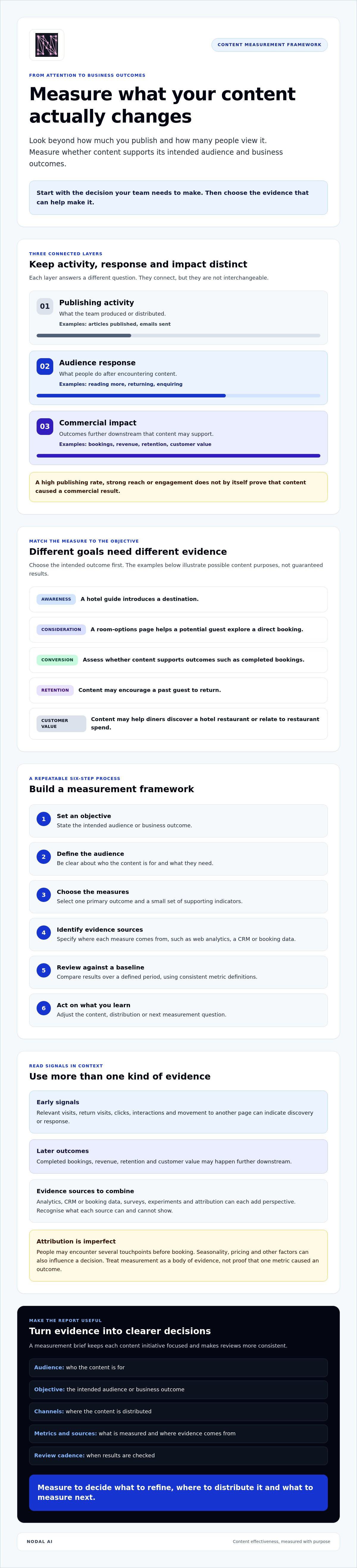
Start with the decision your team needs to make. Are you deciding whether to invest in a topic, change a distribution channel or create content for a different audience? That question determines what evidence matters. Measuring content marketing effectiveness means assessing whether content contributes to its intended audience and business outcomes, not counting how much content a team produces.
Production and distribution figures, such as articles published or emails sent, describe activity. Audience response shows what people do next, such as reading more, returning or enquiring. Commercial impact looks further downstream to outcomes such as bookings or customer value. These signals connect, but they are not interchangeable. A high publishing rate does not prove an effective strategy.
Which business outcomes can content support?
Content can support awareness, consideration, conversion, retention or customer value. The right outcome depends on the business model, audience and purpose of the content. A hotel guide designed to introduce a destination might aim to build awareness. A page explaining room options could help a potential guest consider a direct booking.
Other hospitality examples include content that encourages a past guest to return or helps diners discover a hotel restaurant. The relevant outcome might be repeat visits or restaurant spend. These are measurement ideas, not guaranteed results. For an overview of content marketing, consider how measures of awareness, sales and brand health relate to the specific objective.
Why views alone cannot prove content effectiveness
Views and reach show that content was seen. Engagement measures a response, such as a click or interaction. These are useful early signals: they can indicate whether a topic attracts attention or a format prompts people to explore further. But attention alone does not demonstrate that someone considered a product, made a booking or returned.
Commercial outcomes can follow several touchpoints. A guest might read an article, see a social post, ask a colleague for a recommendation and book later through another channel. Seasonality, pricing and other factors may influence that decision too. Do not treat one metric as proof of cause. Build a body of evidence to judge whether content supports the outcome and what to test or improve next.
How to build a useful content marketing measurement framework
A framework makes measurement repeatable, so each report answers a business question rather than adding disconnected numbers. Start with the decision you need to make, then build the evidence around it. Choose metrics to serve the decision, not simply because your tools make them easy to access.
Use this sequence for a campaign, content series or wider programme:
- Set an objective: State the intended audience or business outcome.
- Define the audience: Be clear about who the content is for and what they need.
- Choose metrics: Select one primary outcome and a small number of supporting indicators.
- Collect evidence: Identify where each measure comes from, such as web analytics, a CRM or booking data.
- Review: Compare results with a baseline over a defined period.
- Act: Use what you learn to adjust the content, distribution or next measurement question.
Record the baseline, reporting period, channels included and exact definition of each metric. For example, specify what counts as an engaged visit or a content-assisted booking. Keep definitions consistent between reviews. Otherwise, a change in the numbers may reflect a change in measurement rather than performance. This discipline is central to measuring content marketing effectiveness clearly.
Turn a content objective into measurable questions
Translate broad goals into questions about behaviour or business performance. For a hotel, discovery content might ask whether relevant travellers find and explore destination information. Content supporting direct booking consideration might ask whether readers continue to room or booking pages. Before publishing, decide what evidence would lead you to revise the topic, format or distribution channel.
Choose leading and lagging indicators
Leading indicators show early signs of discovery or response, such as relevant visits, return visits or movement to another page. Lagging indicators capture outcomes that may happen later, such as completed bookings, revenue, retention or customer value. Choose measures that reflect the objective, not a standard dashboard.
Read the two groups together. Strong early engagement with no later movement may suggest a gap between the content and the next step, or that the outcome takes longer to emerge. A later conversion alone does not show which content helped. Neither group settles the question on its own, so interpret patterns in context and use them to guide the next review.
When data is spread across analytics, CRM and booking systems, a consolidated view can make the evidence easier to compare. Teams assessing their data needs can explore Nodal Platform analytics features as one option for connecting marketing and commercial signals.
Which methods and metrics reveal content marketing performance?
No single data source captures the whole journey. Web analytics can show what people do on a site, while CRM or booking data can reveal later customer actions when records can be connected. Surveys capture people’s reported views, experiments can compare different approaches, and attribution models describe how tracked touchpoints relate to outcomes. Together, these methods provide a more useful picture than any one dashboard.
Match the measure to the question. For discovery, look at relevant reach or visits. For engagement, examine actions such as reading further or exploring another page. For conversion, consider booking engine actions or completed bookings. For commercial and customer outcomes, a hospitality team might track repeat visits, restaurant covers or average spend. These are examples, not universal success metrics. The right choice depends on the content’s purpose.
Understand what each measurement method can and cannot show
Use the table to choose evidence with its limits in view. Analytics reflects observed digital behaviour within its configured measurement scope. CRM and booking data can connect content interactions with subsequent actions when tracking and records permit, but may miss activity across devices or channels. Surveys capture stated feedback, not necessarily actual behaviour. Experiments can help compare alternatives, though results may not explain every audience or setting.
| Method | Question it helps answer | Limitation to consider |
|---|---|---|
| Web analytics | Are people finding and engaging with this content? | Shows measured digital activity, not the full customer journey. |
| CRM or booking data | Do content interactions precede enquiries, bookings or repeat visits? | Connections depend on data quality and available tracking. |
| Surveys | What do audiences recall, value or intend to do? | Reported opinions may differ from later actions. |
| Experiments | Does one content or distribution approach perform differently from another? | Findings apply to the tested conditions and need careful interpretation. |
| Attribution | Which tracked touchpoints appear along a conversion path? | Modelled credit does not prove a touchpoint caused an outcome. |
Use attribution as one part of the evidence
Multi-touch attribution can help teams examine how tracked interactions, such as an article visit followed by a booking page visit, appear across a customer journey. It assigns or analyses credit according to a model. It does not independently prove incrementality or show what would have happened without the content. Consider attribution alongside other evidence, including experiments where suitable. For model-specific detail, refer to your existing guide to marketing attribution.
When measuring content marketing effectiveness, the aim is not to force every signal into one score. Combine relevant evidence, understand its blind spots and make a better-informed decision about what to improve or investigate next.
How to measure content marketing effectiveness step by step
Put the measurement plan in place before a campaign goes live. A short brief connects the objective, tracking and review, and makes it easier to spot missing evidence before drawing conclusions.
Set up measurement before publishing
- State the objective and audience. Record who the content is for, what action you hope they will take and which business outcome that action should support.
- Describe the content and channels. Note the asset being measured and where it will appear, such as a destination guide shared through a website and email.
- Choose the metrics. Define one primary outcome and supporting indicators. Clarify what counts as a booking engine action, an enquiry or a completed conversion.
- Name data sources and owners. Specify where each measure comes from, who checks it and who is responsible for resolving gaps. Align definitions and data handling with your organisation’s data governance framework.
- Set the baseline and review cadence. Record the comparison period and when the team will review results. Choose a timeframe appropriate to the objective and customer journey.
Before distribution begins, check that campaign links use consistent channel tags and that relevant page actions or conversion events are being recorded. Confirm that the data appears in the expected reports. If a booking system cannot be connected to content interactions, document that limitation in the brief. Measuring content marketing effectiveness means knowing not only what the numbers say, but also what they leave out.
Review results and decide what to change
At review, compare results with the baseline and the period you agreed, not an unrelated universal benchmark. If a hotel’s destination article draws visits but few readers continue to booking information, check that the links work and the next step is clear before concluding the topic has failed.
Investigate unexpected changes in context. Consider distribution activity, shifts in audience, seasonal patterns and operational factors that could affect the outcome. Where data is incomplete, separate observed results from assumptions. Do not present a missing booking connection as proof that content had no commercial contribution.
Finish by recording the decision: keep the approach, refine the content, change distribution or improve tracking. Then review the next iteration using the same definitions. This turns a report into a learning loop, with each action creating a clearer basis for the next decision.
Explore Nodal Platform analytics features
Turn content measurement into clearer commercial decisions
Measurement earns its value when it changes what the team does next. Use the evidence to decide whether to refine a topic, change its format or distribution, focus on a different audience, or improve tracking before drawing another conclusion. Record the signal, the decision and what you will look for in the next review. That turns reporting into a practical learning loop.
Move from disconnected reports to a joined-up view
When marketing, booking, customer and commercial data sit in separate systems, it can be difficult to follow the journey from a content interaction to a later outcome. A hotel team might want to examine whether people who read a destination article go on to use the direct booking engine. If web analytics and booking data cannot be viewed together, that connection may remain unclear. Linking relevant sources can provide more context, while an observed journey still does not prove that content caused a booking.
Nodal Platform is a modular analytics platform that consolidates marketing, customer, operational and commercial data to support customer and commercial insights. Nodal AI connects sources such as GA4, Google Ads, CRM systems, booking engines and operational platforms. This data consolidation helps teams consider how different signals fit together.
Results from the Ovolo Hotels case study include a 24.5% increase in ROAS and a 20% increase in paid search revenue. These are case study results, not evidence that content marketing alone produced those changes.
Know when a platform can help
A platform may be worth considering if teams repeatedly assemble reports by hand, use inconsistent metric definitions or struggle to connect information across source systems. Consolidated data and capabilities such as customer journey mapping, multi-touch attribution, predictive modelling and automated reporting can support a more connected view. They cannot resolve every tracking gap or prove causation on their own, so keep data quality, metric definitions and the limits of each method in view.
Explore the Nodal Platform features to understand how its capabilities relate to your measurement needs.
For broader background on consolidating data across the platform, see the Nodal Platform article in your resource library.
Make your next content decision with confidence
Measuring content marketing effectiveness works best as a repeatable cycle: set an objective, choose evidence that fits it, review results in context and use what you learn to decide what to publish or distribute next. A clear primary outcome, supported by relevant audience and commercial signals, makes reporting more useful without pretending every result has a single cause.
Joined-up data can help connect content interactions with customer behaviour and business outcomes. Nodal Platform consolidates fragmented marketing, customer and commercial data for analysis. In the Ovolo Hotels case study, results included a 24.5% increase in ROAS and a 20% increase in paid search revenue. These are case study results, not proof that content alone drove the changes.
Start with one content initiative and one decision you want the evidence to inform. Build from there, and each review can bring greater clarity to your content and investment choices.
Book a Nodal Platform demonstration
Frequently Asked Questions
Which metrics should I use to measure content marketing effectiveness?
Start with the objective and the audience action your content is intended to support. Choose one primary outcome, then a small set of supporting indicators, such as relevant visits, engagement, conversion actions or repeat behaviour. The right measures depend on the content and your business model. Reach and engagement can signal interest, but do not prove commercial impact on their own.
How do you measure content marketing ROI?
Define which content costs and business outcomes you will include, then choose an evaluation period that fits the customer journey. Use reliable data to connect content activity with outcomes, and state any assumptions or tracking gaps. Other channels and touchpoints may influence a purchase, so a single report cannot prove that content caused the result. Use ROI alongside other evidence when making investment decisions.
Can you measure content marketing without relying on last-click attribution?
Yes. Combine web analytics with CRM or booking data, customer research and suitable experiments where available. Multi-touch attribution can help describe how tracked interactions appear across a customer journey, but it does not provide a complete measure of incremental impact. Choose methods based on the question you are asking, the quality of your data and whether you can observe the customer actions that matter.
How often should content marketing effectiveness be reviewed?
Set a review cadence that matches the objective and allows time for meaningful audience or business outcomes to appear. Check relevant early indicators during distribution, then assess downstream results when enough data is available. Keep the timing consistent enough to compare performance, but interpret changes in context. Seasonality, campaign activity and operational conditions can affect results, so avoid reacting to every short-term fluctuation.
What happens if content gets engagement but no conversions?
First, check whether the content reaches the intended audience and whether its next step suits their stage in the journey. Verify that conversion tracking works and the call to action is clear. Then look for relevant later or assisted actions, such as a subsequent booking, where reliable data permits. Use what you find to refine the content or customer journey, rather than assuming engagement without an immediate conversion means the content has no value.
How can hospitality businesses measure content marketing effectiveness?
Connect each content objective to a relevant hospitality outcome, such as direct booking consideration, repeat visits, restaurant covers or average spend. Use suitable marketing, booking, customer and operational data where available, and document gaps between systems. Interpret results alongside demand and trading conditions. The right measures vary across hotels, restaurants, clubs and other hospitality businesses, so no single metric can answer every question.
What is the difference between content performance and content effectiveness?
Content performance describes observed results, such as reach, visits or engagement. Effectiveness asks whether those results support the intended audience and business objective. A post may attract strong engagement without supporting a commercial goal, while another asset may help prompt a valuable action with less visible interaction. Define the objective first, then interpret performance measures in relation to it.


