

Meta Ads can report a conversion that your analytics or booking system credits to another channel. That doesn’t automatically mean one of them is wrong. Meta ads attribution offers one view of how people interact with your campaigns, but it can’t show the whole customer journey or settle every question about business impact.
If the numbers don’t line up, you’re not alone in finding them difficult to interpret. Different attribution windows and measurement methods can produce different totals, while a channel report may leave out what happened before or after an ad interaction. Treating Meta’s reported conversions as the complete picture can make performance harder to assess, not clearer.
This guide explains what Meta Ads attribution represents, where its limits are, and how to check the signals behind the results. You’ll learn how to review settings consistently, compare platform reporting with analytics and booking data, and connect campaign activity to outcomes such as direct bookings and guest value. The aim is a practical, repeatable way to use Meta’s data while keeping the wider business picture in view.
Key Takeaways
- Use meta ads attribution to understand how Meta credits campaign interactions, not as standalone proof of incremental impact.
- Check how your Pixel or Conversions API setup records website activity and conversions before interpreting campaign results.
- Compare Meta reporting with GA4 and booking-system records, keeping each source’s purpose and limitations in view.
- Start a performance audit with the business question, then check event definitions, campaign links, attribution settings and date ranges.
- For hospitality, connect advertising signals with bookings, CRM and property-level performance to add commercial context.
What Meta Ads attribution measures, and what it leaves out
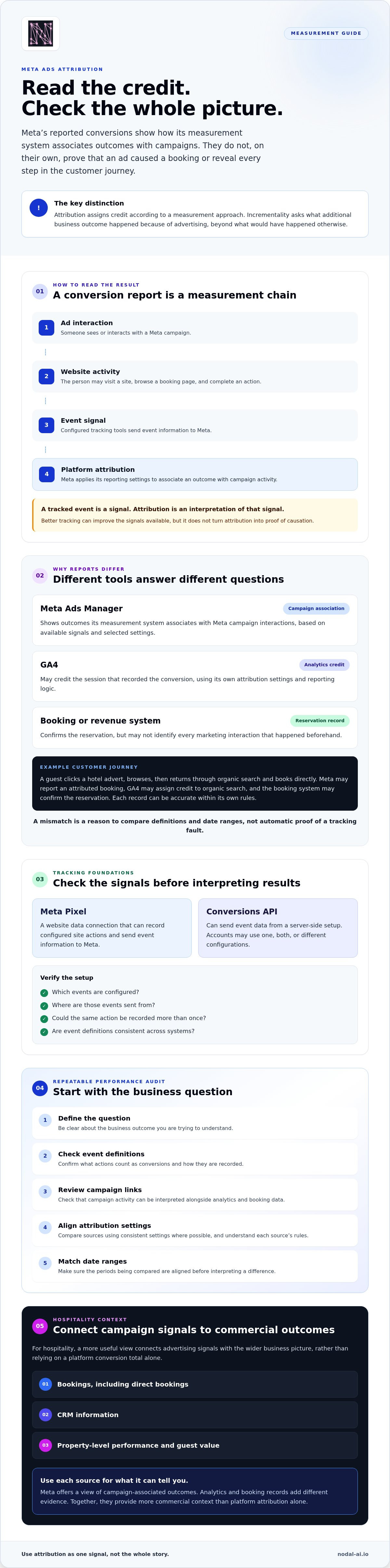
Attribution assigns credit to marketing touchpoints according to a chosen measurement approach. In marketing attribution, that credit helps teams interpret which interactions are associated with a conversion. Meta Ads attribution applies this idea to activity linked with Meta campaigns. A reported conversion is a platform measurement, not automatic evidence that the ad caused a sale.
Attribution: A method for assigning credit to marketing interactions along a path to conversion.
Conversion tracking: The process of recording a defined action, such as a completed booking, through configured measurement tools.
Incrementality: The additional business outcome that occurred because of advertising, beyond what would have happened otherwise.
What does Meta Ads attribution actually tell you?
Meta’s reporting shows which outcomes its measurement system associates with your campaigns. It gives teams a useful view of campaign activity, but the result depends on the signals available, the attribution settings selected, and the quality of event tracking. If a conversion event is missing, duplicated, or defined differently across systems, the reported picture can shift.
Use the report to ask focused questions: are campaigns associated with bookings, which ads appear in the path, and how do results change under consistent settings? Don’t treat it as a complete customer journey. A person may see an ad, return through another channel, and complete a booking later. One platform report cannot necessarily show every interaction or establish what would have happened without the ad.
Why can Meta and analytics reports disagree?
Meta Ads Manager, GA4, and a booking or revenue system may answer different questions. They can use different attribution settings, data sources, and reporting logic. Meta can associate a conversion with an ad interaction, while GA4 may credit the session that recorded the conversion. A booking system records the reservation itself, but may not identify every marketing interaction that preceded it.
Consider a guest who clicks a hotel advert, browses, then returns later through an organic search result to book directly. Meta may report an attributed booking, GA4 may assign credit to organic search, and the booking system may simply confirm the reservation. These records can all be accurate within their own rules. Compare their definitions and date ranges before treating a mismatch as a tracking fault.
Attribution shows how a measurement system assigns credit; it does not, by itself, prove that advertising caused the outcome.
Use Meta’s figures as one signal, then add analytics and booking data to understand the wider commercial picture. This distinction is the foundation for reading campaign performance without mistaking platform credit for full business impact.
How Meta Ads attribution works across a changing customer journey
A conversion report is the end of a measurement chain. First, someone interacts with an ad. They may visit a website, browse a booking page, and complete an action such as submitting a booking. Tracking tools can send event information to Meta, where the platform applies its reporting settings to associate outcomes with campaign interactions.
That chain depends on what can be observed and recorded. An event sent to Meta is a tracking signal; the credit assigned to an ad is a reporting interpretation. The interpretation depends on available data and selected attribution settings, so it shouldn’t be read as a complete or certain record of every influence on the customer.
Where Meta Pixel and Conversions API fit
The Meta Pixel is a website data connection that can record configured actions on a site and send event information to Meta. The Conversions API can send event data from a server-side setup. Some advertisers use one, both, or different configurations, so don’t assume every account captures events in the same way.
Check the actual setup before drawing conclusions: which events are configured, where they’re sent from, and whether the same action could be recorded more than once. Meta’s terminology and configuration options can change, so consult current documentation when auditing an account. Better tracking can improve the signals available, but it doesn’t turn attribution into proof of causation.
What happens when customers use several channels?
Picture a potential hotel guest who discovers a property through a Meta ad, later searches for reviews, joins an email list, and eventually returns directly to make a booking. Meta, search, email, and the hotel’s booking system each hold a different view of that journey. Depending on their tracking and reporting rules, each may show a different part of the path or assign credit differently.
That matters when the decision takes time. A campaign interaction may introduce a property without being the last interaction before booking. Review the sequence across channels rather than expecting one Meta Ads attribution report to explain every step. Harvard Business Review’s discussion of marketing mix models offers a wider measurement perspective, using aggregated analysis to consider marketing effects across channels rather than relying only on user-level paths.
For a fuller view, organise touchpoints around stages such as discovery, consideration, and booking. Customer journey mapping can help teams connect campaign signals with direct bookings and wider commercial outcomes. Nodal Platform brings advertising, analytics, booking, CRM, and commercial data into a shared view. Explore its integrated measurement features to see how analysis across sources can add context to platform reporting.
Meta attribution settings versus cross-channel measurement
Meta Ads Manager, GA4, and your booking or revenue system each provide a different view of performance. The useful question isn’t which one is always right. It’s what each source can tell you, and whether its definitions match the business question you’re asking.
| Source | Question it helps answer | Data used | Limitations to check |
|---|---|---|---|
| Meta Ads Manager | Which campaign activity and outcomes does Meta report? | Campaign delivery and signals available to Meta, interpreted under the selected attribution settings. | Settings, event quality and platform reporting rules affect results. It doesn’t show the full journey or prove the ad caused the conversion. |
| GA4 | How do people arrive at and interact with the website? | Website analytics events and traffic-source information recorded by GA4. | Tracking coverage, attribution choices and session-based reporting can differ from Meta’s approach. |
| Booking or revenue records | Did a booking or commercial outcome occur? | Transactions and other records held by business systems. | Records confirm the outcome, but may not capture every marketing interaction that influenced it. |
When should you use Meta Ads Manager, GA4, or business data?
Use Meta reporting to assess campaign delivery and the outcomes it records under its settings. Use GA4 as a separate view of website activity, not as an automatic referee when the numbers differ. Then check booking or revenue records to establish whether the measured outcome aligns with a real commercial result.
Before comparing totals, confirm the date range, conversion event, and attribution settings in each tool. Meta’s available options and interface labels can change, so note the current settings shown in your account rather than relying on an old report or a remembered label. Keep comparisons consistent, and treat differences as a prompt to investigate, not proof that one system has failed.
How is attribution different from incrementality?
Attribution assigns credit across observed interactions under a chosen approach. Incrementality asks a different question: did marketing generate outcomes that would not otherwise have happened? A campaign can receive attribution credit without that report proving causal lift or guaranteeing a revenue increase.
To assess whether advertising produced additional outcomes, teams may use a suitable test or comparison design rather than relying on attributed conversions alone. The right approach depends on the business question and available data. For a deeper explanation, see the article’s incrementality explainer.
Use each source for the decision it can support. Meta Ads attribution helps interpret campaign signals; analytics adds website context; business records confirm commercial outcomes. Together, they build a more useful performance view without mistaking assigned credit for proven incremental impact.
Audit Meta Ads attribution when numbers do not match
Start with the decision, not the dashboard. Are you checking whether a booking event is being recorded, comparing campaign trends, or assessing advertising against revenue? A clear question keeps the audit focused and stops teams from trying to force every platform to report the same total.
A practical five-step attribution check
- 1. Define the outcome. Name the action you’re investigating, such as a completed booking, and the commercial result that matters, such as booking value. Confirm that everyone uses the same definition.
- 2. Check event tracking. Review how the conversion event is configured in Meta and GA4. Confirm it represents the intended action, and check for missing or duplicated records where possible.
- 3. Review campaign links. Check that ads use the expected UTM parameters and that campaign names follow a consistent structure. Inconsistent tags can make traffic harder to group and compare in analytics.
- 4. Align settings and dates. Record the attribution settings applied in Meta, the relevant reporting choices in GA4, and the date range used by each source. Verify current Meta labels in the account before documenting them.
- 5. Compare, then investigate. Look at the broad direction of results across Meta, GA4, and booking or revenue records first. If trends differ, investigate specific events and conversions without assuming the totals should match.
This sequence makes a Meta Ads attribution review repeatable. Keep a brief audit record with the business question, event definitions, campaign-link conventions, settings, date ranges, and known data limitations. That gives the team a consistent reference for later comparisons, even when reporting settings or tracking change.
Make the findings useful to decision-makers
Separate three things in your reporting: what the data directly shows, what the team infers, and what still needs testing. For example, Meta may show campaign-attributed bookings, while booking records confirm completed reservations and GA4 reports website activity. Present these views together with a note explaining how each was measured. Don’t describe assigned attribution credit as proven incremental revenue.
If the same event is defined differently across teams or systems, resolve ownership and agree on a shared definition before drawing performance conclusions. A data governance framework can help clarify who maintains those definitions and how changes are recorded.
For a clearer view across campaign, analytics, and commercial data, explore Nodal Platform’s measurement features.
Connecting Meta Ads attribution to hospitality performance
For hotels, an attributed conversion is only one part of the performance picture. Teams also need to understand whether advertising activity aligns with direct bookings, booking value, and results across properties. Meta Ads attribution can provide campaign signals, while business systems help show what those signals mean commercially.
From campaign conversions to booking and revenue context
Compare Meta’s reported outcomes with GA4 website activity, booking-engine transactions, and records in the property management system (PMS) and CRM. Look at completed bookings alongside average booking value, and review results by property where the underlying data allows. These views can help identify patterns, such as a campaign associated with booking-page visits while completed reservations appear in the booking system.
Campaign conversions and commercial outcomes are related, but one is a platform-reported signal and the other is a business result. A booking record confirms that a reservation exists; it doesn’t, by itself, explain which interactions influenced the guest. Equally, an attributed conversion shouldn’t automatically be treated as a booking or as proof that an ad generated additional revenue.
Bring the sources together to add context, not to force an exact match. Check that teams are comparing the same dates, booking definitions, and properties. Differences may reflect the systems’ distinct roles or the way activity is recorded. Keep those limits visible when reviewing campaign performance.
How joined-up data can support better decisions
When advertising, analytics, booking, CRM, and commercial information sit in separate systems, it can be difficult to connect campaign activity with bookings and guest value. Nodal Platform consolidates fragmented data from sources including Meta, GA4, booking systems, CRM, and commercial systems, helping teams build a wider view and draw tailored commercial insights.
That joined-up view can help hospitality teams ask more useful questions: do campaign signals align with direct bookings, how does performance vary by property, and are the outcomes valuable to the business? The answers provide context for decisions, but they don’t establish that Meta alone caused a change. Interpret platform reporting alongside commercial records and the wider customer journey.
See how Nodal Platform’s features bring marketing and commercial data into a shared view.
Turn campaign signals into clearer business decisions
Use meta ads attribution as one useful view, not the final verdict on performance. Check its settings and tracking, compare patterns with GA4, and bring in booking and revenue records to understand whether campaign signals align with commercial outcomes. That wider view helps teams make decisions with context rather than chase matching totals across different systems.
Nodal Platform connects Meta and GA4 with booking, customer, and commercial data sources, helping bring fragmented information together. In work with Ovolo Hotels, results included a 24.5% increase in ROAS and a 15.3% reduction in acquisition costs. These are case study outcomes, not results attributed solely to Meta Ads attribution or any single channel.
With clearer connections between advertising signals and business results, your team can move from uncertainty towards more confident, commercially grounded decisions.
Frequently Asked Questions
What is Meta Ads attribution?
Meta Ads attribution is the way Meta assigns credit to conversions associated with ad interactions under selected reporting settings. It helps advertisers review outcomes linked to campaigns, but it isn’t a complete record of every customer touchpoint or proof that an advert caused a conversion. Interpret the results alongside other evidence, such as website analytics and booking or revenue records, to understand their wider business context.
Why does Meta Ads attribution differ from GA4?
Meta and GA4 can differ because they use distinct data sources, attribution rules, and reporting methods. Meta may associate a booking with an earlier ad interaction, while GA4 may credit the session or channel recorded when the booking was completed. Check that you’re comparing the same conversion event, dates, and settings. A difference doesn’t automatically mean either system is tracking incorrectly.
How do I check whether Meta Ads conversions are being tracked correctly?
Start by confirming that the event represents the action you care about, such as a completed booking, and check that it appears as expected in your tracking tools. Review the Meta Pixel and, if your setup uses it, Conversions API events for gaps or possible duplicates. Check campaign links and UTMs, then compare reporting dates and attribution settings with GA4 and booking records. Document any known tracking limits.
What is the difference between Meta attribution and incrementality?
Meta attribution assigns credit to ad interactions according to the platform’s measurement rules. Incrementality investigates whether advertising produced outcomes that would not otherwise have happened. The first interprets recorded signals; the second seeks evidence of additional impact, often through a suitable test or comparison. Attributed conversions can inform analysis, but they don’t establish that a campaign generated incremental bookings or revenue on their own.
Can Meta Ads attribution show which campaigns drove direct bookings?
Meta can report direct bookings associated with campaigns when booking events are captured and configured appropriately. That report is a platform view, not a complete explanation of what drove each reservation. Compare it with booking-engine or property management system records, GA4, and CRM data. Check event definitions, dates, and campaign tagging, and avoid treating an attributed booking as proof that the campaign alone caused it.
What attribution window should I use for Meta Ads?
Choose a window that suits the conversion cycle and the question you’re assessing, then apply it consistently when comparing campaigns or time periods. As of September 2026, Meta’s default for new campaigns is 7-day click, 1-day engage-through, and 1-day view. Active click and view options include 1-day click, 7-day click, and 1-day view, which can be combined. Verify the current settings in your account before analysis.
Does Meta Ads attribution prove that an advert caused a sale?
No. Meta Ads attribution shows how Meta assigns credit to conversions under its selected measurement approach. It doesn’t, by itself, prove the sale would not have happened without the advert. To investigate whether advertising generated additional outcomes, use an appropriate incrementality test or comparison. Also review sales or booking records alongside platform reporting, so campaign signals are considered in the context of actual commercial results.


