

What if the campaign that gets credit for a booking isn’t the marketing that created its value? For hospitality businesses, learning how to track marketing sourced revenue means connecting campaign activity to the final transaction in the PMS or POS, even when a guest’s journey crosses channels, systems and OTAs.
Fragmented data makes that difficult. Last-click attribution can overlook the interactions that shaped a booking, while OTA leakage can obscure how a guest first discovered your property. The result is an incomplete view of channel performance and where marketing spend is working hardest.
This guide explains how to connect acquisition and operational data, choose attribution methods that reveal more than the final click, and measure revenue across the guest lifecycle, including ancillary spend. You’ll learn how to build a clearer view of ROAS, identify high-propensity guest segments and allocate spend with greater confidence. The goal is commercial intelligence: turn disconnected signals into practical insight, so you can make more and waste less.
Key Takeaways
- Track marketing sourced revenue by linking campaign data with the transactions recorded in hospitality systems.
- Define revenue sourcing consistently, then align data from platforms such as GA4, Google Ads, Meta and LinkedIn.
- Compare first-touch, last-touch and multi-touch attribution to understand how different models assign marketing credit.
- Audit system silos and standardise tracking across paid, owned and earned channels to strengthen your measurement foundation.
- Bring operational, demand and commercial insights together to make more informed decisions.
The Challenge of Tracking Marketing Sourced Revenue in 2026
A campaign can generate clicks, enquiries and bookings, yet still leave you unsure whether it created profitable guest revenue. In hospitality, marketing data often sits apart from the operational systems that record reservations, payments and on-property purchases. To understand how to track marketing sourced revenue, you need more than a campaign dashboard. You need a connected view of the guest journey and its commercial outcome.
Clicks and bookings are useful signals, but neither tells the full story. A booking may generate room revenue and later spending at a restaurant, bar or other service. If those transactions aren’t connected to the guest journey, channel performance can look stronger or weaker than it is. The aim is to move from reporting activity to commercial intelligence: understanding revenue, guest value and, where the data allows, the margin left after acquisition costs.
Why Traditional Analytics Fail Modern Enterprises
Digital platforms record ad interactions and website behaviour. A property management system (PMS) records reservations and stays, while a point-of-sale system (POS) captures transactions such as meals or drinks. When identifiers and reporting structures don’t align, the path between a campaign and a transaction breaks. Marketing may optimise for bookings while Revenue Management focuses on occupancy and rate, leaving neither team with the whole picture.
Last-click attribution adds to the problem. It assigns credit to the final recorded interaction, which might be a brand search or a booking-site visit, while overlooking earlier activity that introduced or reassured the guest. Marketing attribution assigns value to touchpoints in a customer journey, but a single-touch model can simplify that journey too much. If teams treat the last click as the complete explanation, they risk shifting spend away from channels that helped create demand and towards channels that mainly capture it.
That misallocation can waste budget and obscure the true cost of acquiring direct bookings. OTA leakage creates another blind spot: a guest may discover a property through its marketing, then complete the reservation through an online travel agency. The booking appears under the intermediary, making the original influence harder to see and reducing the clarity of direct-revenue reporting. Don’t assume an OTA booking proves marketing had no role. Connect the available campaign, booking and guest data before drawing that conclusion.
From Marketing-Sourced Revenue to Commercial Intelligence
Revenue sourcing is a starting point, not a complete measure of marketing value. A stronger view considers guest lifetime value, including repeat stays and ancillary spend, rather than stopping at the first reservation. Context can help explain results too: weather, flight demand and local events may affect travel intent and booking patterns. Treat these as signals to investigate, not proof that a specific campaign caused a change.
The goal is to move from reactive reports to useful recommendations. When marketing, booking and transaction data can be considered together, teams can identify which channels attract valuable guests, where OTA leakage may be obscuring influence and what deserves closer investigation. That’s the foundation for better decisions: make more from effective activity and waste less on spend that isn’t delivering measurable commercial value.
The Technical Foundation: Unifying Your Data Ecosystem
Marketing-sourced revenue is income from customers whose journey was initiated or meaningfully influenced by marketing. Measuring it means connecting campaign signals to validated bookings and transactions, not simply adding up conversions reported by advertising platforms. For hospitality teams, the technical challenge is ensuring each source contributes the right information to a consistent measurement framework.
Start by listing what each system records and deciding which source is authoritative for each data point:
- GA4: website sessions, landing pages and conversion events.
- Google Ads, Meta and LinkedIn: campaign interactions and platform-reported results.
- PMS: reservation, stay and guest records in systems such as Oracle OPERA or Mews.
- POS: transactions that help show guest spend beyond the room booking.
- CRM: guest profiles and known interactions, which can add context to booking records.
Use the CRM as a reference for guest profiles, but don’t treat it as the final financial source. Validate reservation revenue against the PMS and on-property purchases against the POS. Decide which system is authoritative for each field, such as booking value, guest identifier and campaign source. This gives teams a consistent basis for comparing marketing activity with confirmed operational revenue.
Connect Systems Around the Guest
Marketing and operational platforms often identify the same person in different ways. A website may record a session, while the booking engine creates a reservation reference and the PMS stores a guest profile. Define a consistent guest ID where systems and consent allow, and document how records should be matched across the journey. Without a reliable connection, a reservation can remain separate from the marketing activity associated with it.
Automated data ingestion can reduce manual exports, spreadsheet joins and reporting errors. A modular architecture can bring PMS, POS and CRM data together with marketing signals while preserving each system’s role. Before implementation, confirm which systems and versions are supported, and identify the fields each connection can provide.
Build Reliable Tracking Infrastructure
Standardise UTM parameters across campaigns. Use consistent naming for source, medium and campaign, then document the conventions so teams don’t label the same channel in conflicting ways. Test that campaign values persist from the landing page through the booking process and can be matched to operational records.
Server-side tracking can support measurement where browser restrictions limit some signals, but it doesn’t replace sound data matching or permission-aware practices. Choose an approach that fits your consent and data governance requirements. Data consolidation is the process of unifying fragmented systems into a single view for clearer analysis.
For hospitality businesses assessing this approach, data unification and analytics features can help clarify how a modular intelligence platform fits into the measurement stack. With the technical foundation in place, you can track marketing sourced revenue using connected campaign, guest and transaction data.
Selecting the Right Attribution Model for Revenue Sourcing
No single attribution model tells the whole story. First-touch credits the first recorded interaction, making it useful for seeing what introduces guests to a property. Last-touch credits the final interaction before conversion, which can help assess booking channels but often favours brand search or direct traffic. Multi-touch attribution (MTA) distributes credit across several touchpoints, offering a broader view of the path to purchase. Each model answers a different question, so choose one based on the decision you need to make.
For example, a guest might first see a social advert, later search for the hotel by name, then book directly. Last-touch may award all the credit to brand search. First-touch highlights the introduction, while MTA can recognise both interactions and other recorded touchpoints. This is more informative, but it describes observed journeys rather than proving which activity caused the booking.
Look Beyond Static Attribution
Hospitality journeys are rarely linear. Guests may return to a site, compare properties, speak with a travel agent or book through an OTA after discovering a hotel elsewhere. Tracking gaps can make these paths look simpler than they are. Brand search and direct traffic may receive too much credit because they appear near the booking, while earlier demand-generating activity is undercounted. Use marketing attribution to examine how models assign value and look for channels that assist conversions without closing them.
To understand incremental impact, complement attribution with controlled tests where practical. Compare outcomes between groups exposed to a campaign and comparable groups that weren’t, while accounting for other differences. Attribution helps describe the journey; incrementality helps test whether marketing changed the outcome. Neither is a perfect standalone answer.
Use Predictive Modelling with Context
Predictive modelling can analyse connected historical and current signals to estimate conversion likelihood or future revenue. It may help identify guest segments with stronger booking propensity, so teams can assess where marketing deserves more attention. These are forecasts, not guarantees. Model quality depends on the coverage, consistency and relevance of the data, and outputs should be checked against actual bookings and revenue.
For example, a quick-service restaurant (QSR) may focus on campaign response and repeat visits over a shorter decision cycle. A luxury hotel may need to account for a longer consideration period, booking value, repeat stays and ancillary spend. Apply a model that reflects the customer journey and commercial outcome that matter to each operation.
Explore predictive modelling as a way to turn joined-up signals into forward-looking estimates. To decide how to track marketing sourced revenue, combine a suitable attribution view with incrementality testing and validated operational revenue. That gives teams a clearer basis for optimising spend without mistaking correlation for cause.
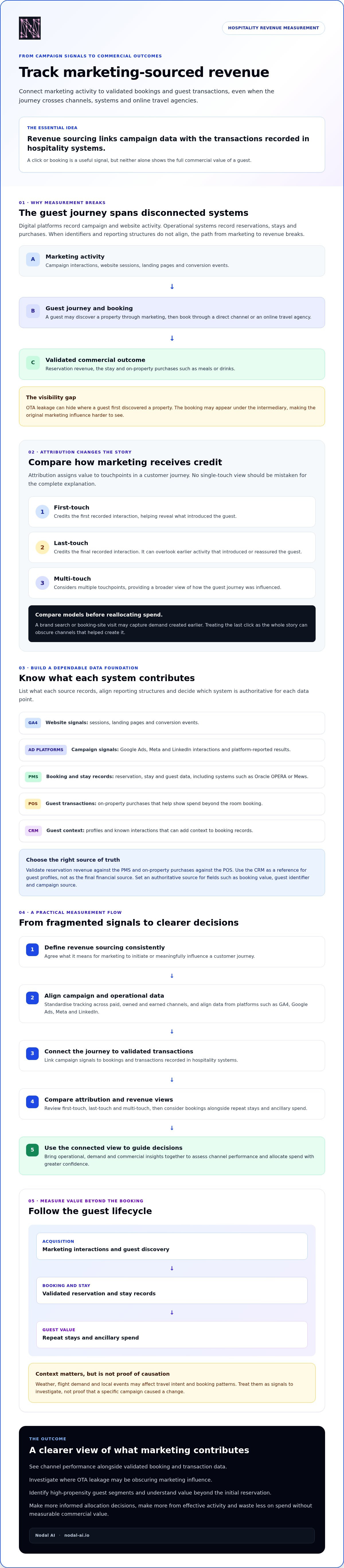
A 5-Step Framework to Track Marketing Sourced Revenue
Turn fragmented data into a repeatable measurement process. This framework takes you from identifying tracking gaps to reviewing revenue in a shared commercial view. Start with the systems and definitions you have, then improve the connections in manageable stages.
- 1. Audit your data and systems. List the platforms that capture campaign activity, website behaviour, bookings, guest profiles and payments. Map where each data point begins and where it should appear next. Trace a sample guest journey using customer journey mapping, noting where identifiers disappear, records don’t match or OTA bookings obscure the original source.
- 2. Standardise tracking. Set a shared naming convention for campaigns, channels and content across paid, owned and earned activity. Define consistent UTM fields and document how teams should use them. Include governance checks for data access, retention and consent, and make sure tracking practices align with your organisation’s privacy obligations.
- 3. Connect marketing and operational systems. Plan how campaign and analytics data will connect to booking and transaction records in your PMS and POS. If your operation uses a booking engine such as SynXis or TravelClick, confirm its current integration options and data fields before designing the flow. Don’t assume a named system is compatible without checking.
- 4. Define sourced and influenced revenue. Agree what qualifies as marketing-sourced, such as a journey that began with a traceable campaign, and what counts as influenced, such as marketing touchpoints that contributed before a booking. Record the attribution rules and any weighting your team applies. Keep the definitions visible so Marketing and Revenue Management interpret the results consistently.
- 5. Automate reporting and review. Build a dashboard that brings campaign activity alongside validated booking revenue and, where available, ancillary spend. Set a regular review cadence to investigate mismatches, compare channel performance and turn findings into practical actions. Automated data flows can reduce repetitive exports, but they still need checks for missing or duplicated records.
To verify an integration, select one booking ID and confirm that it matches the same reservation in the booking engine, the guest or booking record in the PMS, and the corresponding campaign or conversion record in your analytics environment.
A clear framework gives teams a consistent way to assess how to track marketing sourced revenue without treating every system report as interchangeable. Review the Nodal Platform features to see how modular data connections and commercial insights may fit your measurement needs.
Connecting the Dots with the Nodal Platform
Once campaign, booking and transaction data can be connected, the next step is turning that information into decisions. The Nodal Platform brings fragmented hospitality data into a shared commercial view, helping teams relate marketing activity to bookings and guest value across the lifecycle. That can make it easier to investigate OTA leakage: a booking completed through an online travel agency may still have been influenced by earlier marketing, and disconnected records can hide that contribution.
Its modular architecture can be configured for different perspectives on performance:
- Operational insights bring relevant PMS and POS information into view, including bookings and available transaction data.
- Demand insights help teams examine marketing activity and guest journeys across channels.
- Commercial insights connect those signals to revenue outcomes, supporting a clearer assessment of direct bookings and guest value.
This joined-up view can help teams move from raw reporting towards growth recommendations. Instead of reviewing campaign results in isolation, they can investigate which activities attract valuable guests, where the journey shifts to an OTA and how ancillary spend contributes to overall value.
Insights for Hospitality Businesses
Hotels and hostels can use connected data to assess how acquisition activity relates to bookings, repeat stays and on-property spend. For upscale food and beverage brands, POS transactions can add context beyond a reservation or initial visit. QSR groups and pubs operating across multiple locations can compare available demand and revenue signals by site, provided the underlying systems supply consistent data. The precise view depends on the systems connected and the quality of their records.
Ovolo Hotels reported a 24.5% increase in ROAS and a 15.3% reduction in acquisition costs. These are reported outcomes, not a promise of equivalent results. Performance depends on each organisation’s data, operating context and measurement approach.
From Data to Commercial Decisions
Successful implementation starts with confirming which systems and versions can be connected, agreeing how guest and booking records will be matched, and validating that revenue figures reconcile with operational sources. Teams should also define sourced and influenced revenue before using dashboards to guide spend. These steps help turn integration into usable commercial intelligence, rather than simply creating another place to view data.
Explore how the Nodal Platform connects fragmented data and supports strategic clarity. For teams asking how to track marketing sourced revenue, the aim is to make more from measurable opportunities and waste less on activity that cannot demonstrate commercial value.
Turn Revenue Tracking into a Growth Advantage
Knowing how to track marketing sourced revenue starts with a connected view of campaigns, bookings and guest spend. The value comes when that view changes how you make decisions. Bring marketing and operational data together, use attribution to understand the journey rather than rely on a single touchpoint, and turn reporting into practical growth recommendations.
For hospitality businesses, that means looking beyond the booking source alone. OTA activity, direct reservations and guest spending across the lifecycle all contribute to a more complete commercial picture. Nodal AI’s modular intelligence engine is designed to connect these signals. Ovolo Hotels reported a 24.5% increase in ROAS and a 15.3% reduction in acquisition costs. Results depend on each organisation’s context and data.
Replace fragmented reporting with clearer commercial intelligence, then use that clarity to make more and waste less.
Frequently Asked Questions
What is the difference between marketing sourced and marketing influenced revenue?
Marketing-sourced revenue comes from customers whose journey began with a marketing interaction, based on the sourcing rules your organisation defines. Marketing-influenced revenue includes bookings where marketing played a role, even if another channel initiated or completed the journey. For example, a guest might discover a hotel through an advert, then book after a brand search. Report the two measures separately and document your definitions to avoid double-counting or comparing unlike figures.
How do I track revenue if my booking engine is separate from my website?
Connect the website and booking engine through consistent campaign parameters and identifiers, then match booking records with the analytics data. Check that campaign information carries from the landing page into the booking process, and confirm that completed reservations can be reconciled against your PMS. If the connection can’t preserve a guest identifier, use an agreed booking reference or aggregated reporting method, and clearly record what the data can and can’t attribute.
Can I track marketing sourced revenue without a CRM?
Yes. You can track marketing sourced revenue without a CRM if you can connect campaign and website data to booking and transaction records using consistent identifiers. A CRM can help maintain guest profiles and interactions, but it isn’t the only possible source of customer context. Start with reliable booking data from your PMS and transaction data from your POS, then document gaps such as unmatched OTA reservations or unidentified repeat guests.
How does AI improve the accuracy of revenue tracking in 2026?
AI can analyse connected data to identify patterns across marketing touchpoints, bookings and guest transactions, then estimate which signals are associated with valuable outcomes. Predictive modelling can help surface high-propensity guest segments or forecast revenue from current signals. It doesn’t automatically prove that a campaign caused a booking. Validate model outputs against operational revenue, check data quality, and use incrementality testing when you need to assess causal impact.
What are the best KPIs to measure along with sourced revenue?
Pair sourced revenue with measures that show efficiency and guest value. Useful KPIs include return on ad spend (ROAS), acquisition cost, direct booking contribution, booking conversion rate, average booking value, repeat booking behaviour and ancillary spend. Where your data supports it, assess profit margin as well as revenue, since a high-value booking may also carry higher acquisition or fulfilment costs. Keep definitions consistent across channels and reporting periods.
How do I handle offline conversions or phone-in bookings in my tracking?
Capture the source during the call or booking process, for example by asking how the guest heard about you and recording the answer against the reservation. Use a consistent set of source options and link the record to a booking ID where possible. Call-tracking tools may provide additional campaign context, but assess their data handling and consent requirements before use. Treat self-reported sources as useful evidence, not perfect attribution.
Is multi-touch attribution necessary for smaller hospitality brands?
No. Smaller hospitality brands can begin with a clearly defined first-touch or last-touch model if it answers their immediate question and their data is limited. Multi-touch attribution becomes more useful when teams can reliably connect several guest interactions and need to understand each channel’s contribution. Start with a method you can maintain, compare it with booking and revenue records, then add complexity only when it improves a real decision.
How often should I audit my revenue tracking systems?
Set a regular review cadence that fits your campaign activity and reporting needs, and audit after major changes such as a new booking engine, website update, analytics configuration or PMS integration. During each check, test a sample of journeys from campaign interaction to confirmed booking and revenue, look for missing identifiers or duplicate records, and confirm that channel naming and sourcing rules remain consistent. Record issues and assign ownership for fixing them.
Ready to connect fragmented marketing and revenue data? Book a Nodal AI demo.


