

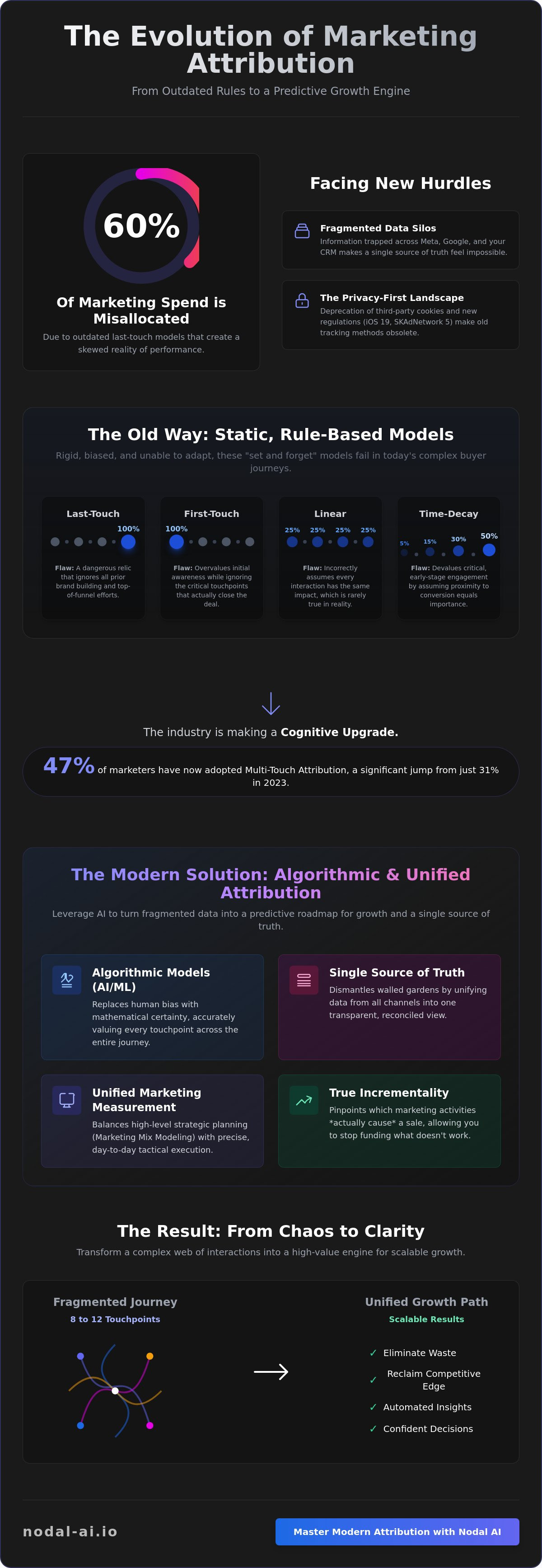
Up to 60% of marketing spend is currently misallocated under outdated last-touch models. It's a staggering figure that highlights the hidden cost of inaccurate reporting. You've likely experienced the frustration of watching manual reporting drain your team's time while data silos make a single source of truth feel impossible. With the deprecation of third-party cookies and the arrival of iOS 19's SKAdNetwork 5, the old ways of tracking marketing attribution aren't just inefficient; they're broken.
You deserve the confidence that comes from seeing exactly how every pound drives your bottom line. It's time to transform fragmented touchpoints into a clear, predictive roadmap for growth. This guide empowers you to master modern attribution by integrating Multi-Touch Attribution with Marketing Mix Modeling. We'll show you how to navigate new privacy laws in states like Indiana and Oregon while leveraging automated analytics to eliminate waste and reclaim your competitive edge. Let's turn your chaotic data into a high-value engine for scalable results.
Key Takeaways
- Upgrade your perspective from simple tracking to a sophisticated science that values every interaction across the entire customer journey.
- Replace rigid, rule-based systems with algorithmic marketing attribution to leverage the cognitive upgrade provided by machine learning and predictive modelling.
- Navigate the privacy-first landscape by dismantling walled gardens and reconciling siloed data into a single, transparent source of truth.
- Implement a Unified Marketing Measurement framework to balance high-level strategic planning with precise, day-to-day tactical execution.
- Follow a structured roadmap to transition from time-consuming manual reporting to automated insights and high-impact growth recommendations.
Defining Marketing Attribution in the Age of Intelligence
In 2026, marketing isn't just about presence; it's about precision. We define marketing attribution as the rigorous science of assigning commercial value to every specific interaction across a buyer's journey. It's no longer enough to look at a spreadsheet and guess which ad worked. You need a cognitive upgrade that turns raw inputs into a clear roadmap for growth. Understanding what marketing attribution is provides the foundation, but modern execution requires a shift into advanced performance analytics.
Most teams are stuck in retrospective reporting. They look at what happened last month and try to fix it next month. That's a reactive trap that costs you market share. The Nodal Platform moves you toward active intelligence. Instead of staring at a rearview mirror, you gain a forward-looking perspective that anticipates customer needs. This transition solves the "fragmented data" problem where information is trapped in silos across Meta, Google, and your CRM. We unify these signals to give you total clarity. By personifying your data, we turn passive numbers into active participants in your growth strategy.
The Core Purpose of Attribution
Decision-makers in 2026 cannot rely on "gut feeling." With B2B buyers now averaging 8 to 12 touchpoints before a conversion, according to Kleene.ai research, the path to purchase is a complex web. You must identify true incrementality. This means knowing which marketing activities actually caused a sale to happen, rather than just being present when it occurred. Use this intelligence to reduce waste by eliminating non-performing touchpoints. When you stop funding what doesn't work, you free up resources for the channels that truly scale. It's about lean, efficient expansion.
Why Last-Click Attribution is Obsolete
Last-click attribution is a dangerous relic. It assigns 100% of the credit to the final step, completely ignoring the brand awareness and education that happened weeks prior. This bias creates a skewed reality where top-of-funnel efforts are undervalued and eventually cut. Consumer behavior is non-linear and privacy-centric. Relying on a single pixel to tell the whole story is a recipe for missed opportunities. Master marketing attribution by looking at the entire ecosystem to see how early-stage engagement fuels late-stage conversions. Protect your brand's future by valuing every stage of the journey. Stop the bias and start seeing the full picture.
The Evolution of Attribution Models: Static vs. Algorithmic
The journey from basic tracking to advanced intelligence marks a fundamental shift in how we value marketing efforts. In the past, teams relied on static, rule-based systems that assigned credit based on rigid assumptions. These heuristic models were "set and forget" tools that failed to adapt to changing market conditions. Today, marketing attribution has evolved into a dynamic learning process. By moving toward algorithmic models, you're not just changing a spreadsheet formula; you're implementing a cognitive upgrade for your entire organization. This shift replaces human bias with mathematical certainty and ensures your data works for you rather than against you.
According to Digital Applied (April 2026), 47% of marketing teams have now adopted multi-touch attribution, a significant jump from just 31% in 2023. This rapid adoption is driven by the need for accuracy in a world where 60% of spend is misallocated under old models. High-tech systems now transform these chaotic data points into high-value outputs, ensuring every pound spent is an investment in measurable growth. It's the difference between guessing which door the customer walked through and having a key to the entire building.
Heuristic Models: The Traditional Rules
Traditional models operate on pre-defined logic. They don't learn; they simply follow instructions. While they provided a starting point for early digital marketing, they're often too blunt for the complexity of 2026. Common rules include:
- First-Touch: This gives all credit to the initial introduction. It's useful for brand awareness but ignores everything that actually closed the deal.
- Linear: This spreads credit equally across all touchpoints. It assumes every interaction has the same impact, which is rarely true in a real-world scenario.
- Time-Decay: This favors touchpoints closer to the conversion. It assumes proximity equals importance, often devaluing the critical early-stage education that built the intent.
Algorithmic Attribution: The 2026 Standard
Algorithmic models represent the new industry standard. Instead of following fixed rules, these systems use machine learning to calculate the unique weight of every interaction within your customer journey. By leveraging predictive modelling, the Nodal Platform identifies patterns that the human eye would miss. This process personifies your passive data assets, transforming them into active participants in your business strategy. It uses advanced methods like Shapley Value and Markov Chains to determine how the presence or absence of a specific touchpoint changes the probability of a sale.
This approach makes your marketing attribution resilient to market fluctuations. When consumer behavior shifts, the AI adapts in real-time. It removes the anxiety of manual reporting and replaces it with the confidence of data-driven precision. If you're ready to stop guessing and start growing, explore how automated intelligence can refine your strategy. This is the only way to achieve total clarity in a fragmented market.
Navigating the Privacy-First Landscape and Walled Gardens
Privacy isn't a hurdle; it's the new operating environment. As of early 2026, third-party cookies are fully deprecated, making cross-site tracking via pixels a relic of the past. Comprehensive privacy laws in Indiana, Kentucky, and Rhode Island now demand strict compliance, while Oregon's OCPA amendments ban the sale of precise geolocation data. These regulations create a climate of anxiety for many, but they also offer a competitive advantage for those who adapt. You need a marketing attribution strategy that respects user boundaries while still delivering the clarity required for growth.
The Nodal Platform maintains data integrity by moving beyond individual-level snooping. We focus on aggregate signals and predictive patterns, ensuring you stay compliant with evolving standards like iOS 19 and SKAdNetwork 5. This transition from "tracking" to "modelling" replaces the vulnerability of fragmented data with the security of a robust data governance framework. It's a move from chaos to control.
Attribution in a Cookieless World
Stop chasing individual pixels and start mastering aggregate intent. The shift to a cookieless world requires you to leverage first-party data as your primary foundation. This is the data you own, and it's the most valuable asset in your business. By implementing server-side tracking, you bypass browser-level restrictions that stifle traditional methods. This approach ensures your marketing attribution remains accurate without infringing on user privacy. You gain a high-level perspective that turns anonymous interactions into a clear, actionable roadmap.
Breaking Down Walled Gardens
Every major platform wants to be your only source of truth. Google, Meta, and TikTok operate as a walled garden, intentionally siloed to prevent their data from "talking" to competitors. This often leads to double-counting conversions and inflated ROI reports. If you simply add their numbers together, you're looking at a fiction. Some competitors suggest using expensive, slow randomized controlled trials (RCTs) to measure these silos, but this is a reactive approach that can't keep pace with 2026 market speeds.
Break through these barriers by using a unified platform to bridge the gap. We reconcile disparate signals into a single source of truth, removing the ambiguity of platform-reported data. This allows you to see how a search ad in Google actually supports a social conversion in Meta. You stop being a spectator of your data and start being its master. The result is a streamlined, efficient operation where every pound is accounted for across the entire ecosystem.
Unified Marketing Measurement (UMM): The Future Framework
Mastering the forest and the trees simultaneously is the hallmark of a visionary leader. For too long, marketing teams were forced to choose between the high-level perspective of Marketing Mix Modelling (MMM) and the granular detail of Multi-Touch Attribution (MTA). Unified Marketing Measurement (UMM) ends this compromise. It's a comprehensive framework that synthesises these two powerful methodologies into a single source of truth. By adopting UMM, you're not just tracking data; you're implementing a cognitive upgrade that turns your marketing attribution into a predictive growth engine.
This integration is essential because digital journeys are no longer linear. While MTA excels at real-time performance, MMM captures the long-term impact of brand building and offline channels. According to Digital Applied, MMM adoption has surged to 26% in 2026, while MTA adoption has grown to 47%. Forward-thinking organisations are now using the Nodal Platform to bridge these worlds, ensuring that tactical wins don't come at the expense of strategic stability. This is the essence of ai marketing analytics, where technology does the heavy lifting, allowing you to focus on high-level decision-making.
Combining MMM and Multi-Touch Attribution
MMM acts as your strategic compass. It identifies how broad factors like seasonality or economic shifts influence your returns over the long term. Conversely, MTA provides the tactical map, showing which specific digital interactions are driving conversions in the moment. The Nodal Platform acts as the bridge between these two perspectives. It personifies your data assets, transforming them from static reports into active participants in your planning process. This dual-model approach ensures your marketing attribution is both deep and wide, providing total clarity across the entire ecosystem.
The Role of Predictive Growth Recommendations
The real value of UMM lies in its ability to forecast. We move you beyond the anxiety of "what happened" and into the confidence of "where should I spend next?". Through advanced modelling, our system identifies hidden trends before they become visible to your competitors. You gain the ability to reallocate budgets with total certainty, often identifying high-performing channels that were previously invisible in siloed reports. It's about automating the path to higher ROAS and achieving frictionless progress toward your growth targets. Stop reacting to the past and start commanding your future. Experience the power of Unified Marketing Measurement with the Nodal Platform.
Implementing Your Attribution Roadmap: From Data to Decisions
Transitioning from fragmented inputs to high-value outputs is a journey of operational relief. You've seen the impact of inaccuracy; up to 40% of marketing budgets are wasted without proper tracking and attribution. Moving toward a sophisticated marketing attribution model isn't just a technical shift. It's a strategic liberation. This process replaces the anxiety of manual data entry with the confidence of a high-level perspective. By leveraging automated reporting, your team stops acting as data processors and starts acting as growth architects. You gain back hours of productivity while ensuring your decisions are rooted in mathematical certainty.
Step 1: Audit Your Current Data Silos
Identify where your intelligence is currently trapped. Data silos in your CRM, fragmented signals in Google Analytics 4, and platform-specific reporting in Meta create a distorted reality. Assess the cleanliness of these streams. If the input is chaotic, the output will be too. Use Customer Journey Mapping to visualise the typical path of your primary personas. This audit reveals the gaps where your current marketing attribution fails to capture value. It's the first step in turning passive data into an active participant in your business strategy.
Step 2: Choose the Right multi-touch attribution software UK
Select a partner that manages the technical complexity so you don't have to. When evaluating platforms, prioritise those that offer proactive Growth Recommendations rather than just static charts. In the UK market, compliance with global privacy standards and the latest iOS updates is non-negotiable. Look for solutions that offer Predictive Modelling to forecast future returns. The right tool should feel like a cognitive upgrade for your entire department, providing total clarity across every channel. It should simplify the complex, not add to it.
Step 3: Execute and Optimise
Don't try to transform every channel simultaneously. Start with a pilot channel to prove the model's accuracy and build internal trust. Use the initial insights to make small, incremental budget shifts. Once you see the uplift in ROAS, scale the unified measurement framework across the entire organisation. This structured approach ensures frictionless progress and allows you to refine your strategy in real-time. It's about building momentum through measurable wins.
The Nodal Platform manages the underlying complexity of these systems, allowing you to focus on high-level strategic action. We turn your fragmented data into a competitive advantage, providing the transparency you need to lead with authority. Stop guessing and start growing. Transform your chaotic data into a clear roadmap for success today.
Command Your Growth with Predictive Clarity
The journey from fragmented data to strategic clarity is the most significant upgrade your marketing department can undertake. You've seen how the move toward algorithmic models and Unified Marketing Measurement replaces manual guesswork with mathematical certainty. By prioritising first-party signals and predictive modelling, you transform your marketing attribution from a retrospective reporting task into a proactive growth engine. This evolution eliminates the friction of data silos and restores your team's focus to high-level commercial strategy.
The Nodal Platform is your partner in this transformation. We provide enterprise-ready data governance and AI-driven growth recommendations that turn complex inputs into clear, actionable results. With our London-based expert support, you're never navigating the technical nuances of 2026 alone. It's time to replace the anxiety of manual reporting with the confidence of a streamlined, future-proof measurement framework. You have the tools to turn chaos into a competitive advantage.
Book a demo of the Nodal Platform to solve your attribution challenges and take command of your roadmap today.
Frequently Asked Questions
What is the difference between multi-touch attribution and last-click?
Multi-touch attribution distributes commercial credit across every interaction in the customer journey, while last-click assigns 100% of the value to the final step. Last-click creates a biased perspective that ignores the 8 to 12 touchpoints typically required for a 2026 conversion. Transitioning to a multi-touch model allows you to value early-stage awareness and mid-funnel education, providing a clear roadmap for scalable growth.
How does AI improve marketing attribution accuracy in 2026?
AI processes massive datasets to identify non-linear patterns that human analysts would miss. It uses machine learning to perform data-driven attribution, automatically adjusting weightings based on real-world impact rather than static rules. This cognitive upgrade ensures your marketing attribution remains accurate despite privacy shifts like iOS 19, turning chaotic data into high-value growth recommendations.
Can marketing attribution work without third-party cookies?
Yes, modern attribution thrives by shifting focus to first-party data and server-side tracking. By leveraging aggregate modelling and Marketing Mix Modelling, you bypass browser-level restrictions and pixel deprecation. This privacy-first approach maintains data integrity without infringing on user boundaries, ensuring your reporting remains robust in a post-cookie landscape.
What are walled gardens, and how do they affect attribution?
Walled gardens are closed ecosystems like Meta, Google, and TikTok that do not share granular data with outside platforms. These silos often lead to double-counting conversions and inflated ROI reports within their own dashboards. You must use a unified platform to reconcile these disparate signals, dismantling the silos to achieve a single source of truth across your entire marketing spend.
How long does it take to see results from a new attribution model?
Initial insights regarding channel efficiency often emerge within the first 30 days of data integration. However, a full strategic recalibration typically requires one complete sales cycle to validate the predictive modelling. Start with a pilot channel to prove accuracy quickly, then scale the framework across your organisation for frictionless progress.
Is marketing attribution software expensive for mid-sized teams?
The cost of marketing attribution should be viewed against the 30% to 40% of budget typically wasted through poor tracking. Automated reporting and AI-driven insights significantly reduce manual labour costs, often paying for the platform through found efficiencies. Mid-sized teams should evaluate platforms based on their ability to provide actionable growth recommendations rather than just static visualisations.
How do I choose between MMM and MTA for my business?
You don't have to choose; the 2026 standard is to use both within a Unified Marketing Measurement framework. Use Marketing Mix Modelling for high-level strategic budget allocation and offline impact. Employ Multi-Touch Attribution for tactical, real-time digital optimisations. This dual-model approach provides both the big-picture strategy and the granular execution required for modern performance.
Does marketing attribution help with offline sales tracking?
Yes, sophisticated models correlate digital marketing activity with physical sales data through CRM integrations and Marketing Mix Modelling. This identifies the "halo effect" where online ads drive in-store or phone-based conversions. By personifying these offline assets, you gain total clarity on how your digital spend fuels your entire commercial ecosystem.


