

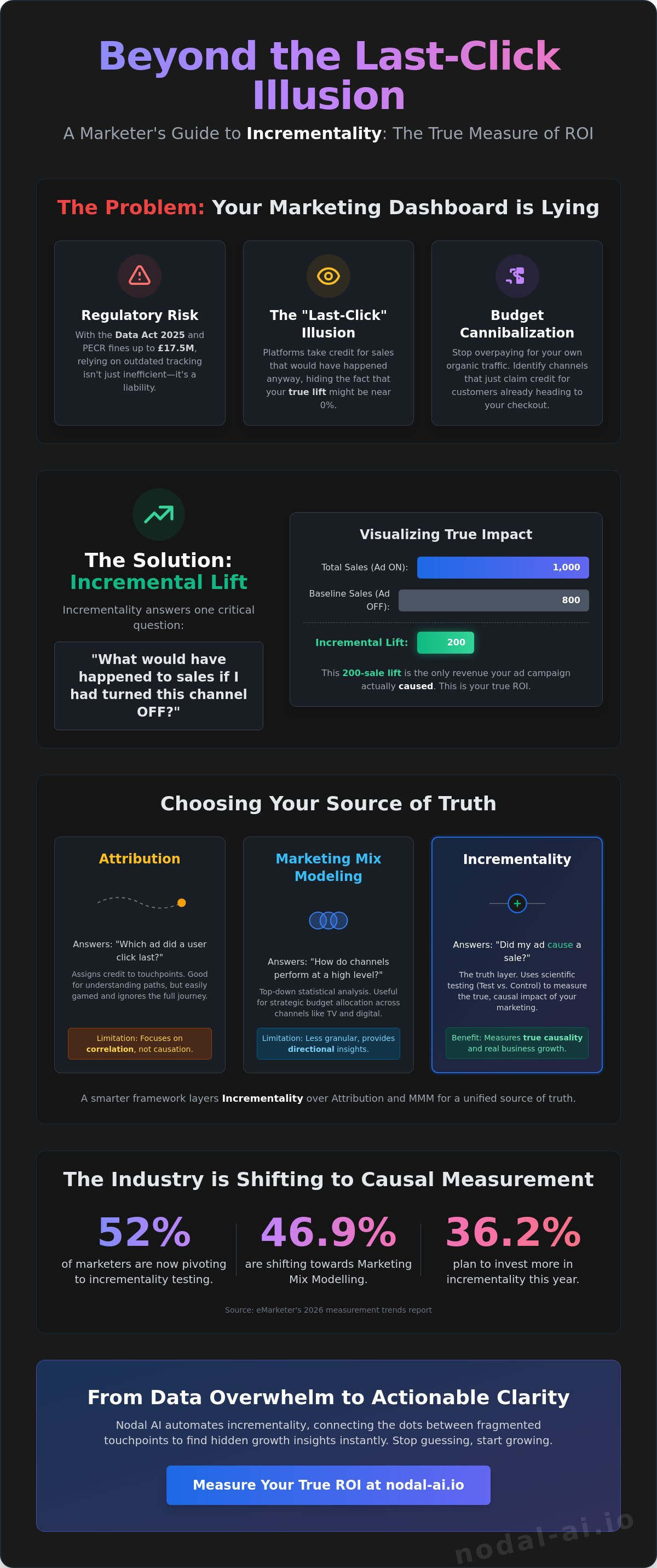
Your marketing dashboard is likely lying to you about your true ROI. With 52% of brand marketers now pivoting to incrementality testing, the industry has finally realised that platform reporting often takes credit for sales that would have happened anyway. Since the Data (Use and Access) Act 2025 tightened its grip on February 5, 2026, and PECR fines jumped to £17.5 million, relying on shaky attribution isn't just inefficient; it's a liability. You've probably felt the pressure of budget cannibalisation while trying to prove your department's value to a skeptical CFO.
It's time to stop overpaying for existing customers and start identifying the true revenue impact of every marketing pound spent. We'll provide a clear framework for measuring incremental lift so you can optimise your media spend for actual growth rather than vanity metrics. You'll learn how to talk to your data to find hidden insights and connect the dots between fragmented touchpoints. This guide ensures you move from data overwhelm to the smarter, actionable clarity needed to lead in 2026.
Key Takeaways
- Move beyond the "last-click" illusion to understand exactly what happens to your revenue when you turn a specific channel off.
- Master geographic testing to isolate the true signal from platform noise, using specific UK regions as clean holdout groups.
- Build a smarter measurement framework by layering incrementality over your existing attribution and mix modelling for a unified source of truth.
- Identify "suspicious" high-spend channels to reclaim your budget from walled gardens that consistently over-report their impact.
- Transform complex data into clarity by using automated tools to talk to your metrics and find hidden growth insights instantly.
What is Incrementality? Moving Beyond the "Last-Click" Illusion
Stop trusting the flattering numbers your ad platforms feed you. In a fragmented ecosystem where 46.9% of marketers are now shifting toward Marketing Mix Modelling, incrementality has emerged as the only way to find the truth. It's the measure of the "lift" or additional conversions that occurred solely because of a specific marketing intervention. It answers the counterfactual question: what would have happened if you had turned off that specific channel? According to eMarketer's 2026 measurement trends report, 36.2% of marketers intend to invest more in this methodology this year.
By May 2026, privacy regulations like the Data (Use and Access) Act 2025 have made user-level tracking increasingly complex. If you're still chasing "vanity ROAS," you're likely over-investing in bottom-of-funnel channels that don't actually grow the business. They just claim credit for customers who were already on their way to your checkout. This leads to budget cannibalisation, where you're effectively paying a tax on your own organic traffic.
The Difference Between Attribution and Incrementality
Marketing teams often confuse these two concepts. While Marketing Attribution focuses on assigning credit to various touchpoints, this approach is about proving causality. Attribution tells you which ads a user clicked; causal measurement tells you if those ads actually changed their behavior. You need to know if your spend is a driver or just a passenger.
Consider your branded search campaigns. You might see a 10x ROAS in your dashboard, but if those users were already searching for your brand, your lift is effectively 0%. You're simply paying for clicks you would've received for free via organic search. Identifying this "organic cannibalisation" allows you to stop wasting spend and start scaling what works. Connect the dots between your spend and your actual bank balance to find the smarter path forward.
Why Last-Click Attribution is Costing You Millions
Last-click reporting is a relic of a simpler time. It rewards the final touchpoint, completely ignoring the complex journey that created the initial demand. This creates a dangerous incentive for platforms like Google and Meta to claim credit for every sale, even when their influence was minimal. It's time to turn away from these biased reports and look for actionable insights.
When you move beyond these limited views, you gain the clarity to move your spend where it actually generates new revenue. You shift from being a passive observer to an active architect of growth. Incrementality is the truth layer that separates profitable growth from expensive noise. Talk to your data to find out where your next million is really coming from and ensure every pound spent is working for you.
The Mechanics of Incremental Lift: How to Separate Signal from Noise
Understanding incrementality requires moving from passive observation to active experimentation. The core mechanism is simple yet powerful: the use of Test and Control groups. By exposing one group of users to an ad while withholding it from a similar "holdout" group, you isolate the exact impact of your spend. This is the only way to separate the signal of true growth from the noise of organic conversions that would have happened anyway. It's about finding the revenue that wouldn't exist without your marketing intervention.
One of the most effective ways to execute this in the UK is through geographic testing. You might run a campaign in London while keeping Manchester as a holdout region. This provides a clean environment for data analysis, effectively bypassing the walled garden problem where platforms refuse to share granular user-level data. You don't need their permission to see how your total revenue shifts when a specific region is "dark." This method identifies high-intent users who would have converted regardless of ad exposure, allowing you to stop paying for sales you already owned.
Designing a Robust Incrementality Test
When implementing incrementality testing, you move beyond mere correlation. The gold standard is the Randomised Control Trial (RCT). For results to be valid, a test usually needs to run for 2 to 4 weeks to account for weekly purchase cycles and achieve statistical significance. Avoid common pitfalls like selection bias or "pollution," where your control group accidentally sees the ads through other channels. You can automate these complex experiments through a unified platform to ensure your tests remain clean and actionable.
Measuring "Incremental ROAS" (iROAS)
To find your true value, you must calculate Incremental ROAS (iROAS). The formula is simple: (Test Revenue minus Control Revenue) divided by Ad Spend. Be prepared; your iROAS will almost always be lower than the ROAS reported by Google or Meta. However, it's a far more honest metric. While a platform might claim a 5x return, your incrementality test might reveal the true lift is closer to 2x. Smarter decisions require looking at the revenue that wouldn't exist without the ad spend. Use these insights to reallocate budget from saturated, low-lift channels to high-growth opportunities that actually drive your bottom line. It's time to connect the dots between your spend and real-world impact.
Incrementality vs. Attribution vs. MMM: Choosing Your Source of Truth
Marketers often struggle to reconcile conflicting signals from different dashboards. Multi-Touch Attribution (MTA) acts as your microscope; it's best for granular, tactical creative optimisations. Marketing Mix Modelling (MMM) serves as your telescope, providing high-level budget allocation across both offline and online channels. However, neither can definitively prove causality on their own. This is where incrementality steps in as the tactical validator. It ensures your MTA and MMM aren't simply hallucinating growth by claiming credit for existing demand. To truly master marketing attribution, you must adopt a unified analytics approach that connects the dots between these three methodologies.
When to Use Each Methodology
Clarity comes from knowing which tool to use for which decision. Use MTA for your daily bid adjustments and creative swaps. Reserve MMM for your quarterly planning and high-level strategic shifts. Finally, use experimental lift studies for monthly channel validation to ensure your "profitable" campaigns are actually driving new revenue. In the hierarchy of evidence, controlled testing sits at the top of the truth pyramid because it relies on active experiments rather than historical correlation. When your MMM suggests a channel is performing but your incrementality test shows zero lift, trust the experiment. It's the only way to move from fragmented data to profitable decisions.
The Rise of "Always-On" Incrementality
The days of running a single, manual "dark test" once a year are over. Modern growth requires a continuous feedback loop. AI now allows organisations to run hundreds of micro-tests simultaneously without manual oversight, providing a real-time stream of actionable insights. This "always-on" approach ensures you never overpay for customers who would've converted anyway. If you're evaluating tools to support this transition, our multi-touch attribution software UK guide highlights platforms that integrate these testing capabilities natively. By automating the process, you save thousands of hours and gain a permanent competitive advantage. Stop guessing and start talking to your data to find the smarter path to sustainable growth.
Implementing Incrementality Testing: A Framework for UK Marketing Teams
Execution requires a disciplined structure to move from data overwhelm to profitable decisions. While 52% of brand marketers already use incrementality testing, many fail because they lack a repeatable framework. Success starts with identifying your "suspicious" channels. These are usually the high-spend platforms boasting massive ROAS that doesn't seem to correlate with your actual bank balance. Once you've identified these targets, follow this five-step sequence to find the truth:
- Identify Suspicious Channels: Target platforms with high platform-reported ROAS but low perceived business impact.
- Define Holdout Strategy: Choose between a geo-split or an audience-split based on your technical capabilities.
- Establish a Baseline: Measure at least 14 days of organic performance to understand your "natural" conversion rate.
- Execute the Test: Run a "Dark Test" by turning off the channel or a "Ghost Ad" test to see if users convert without exposure.
- Analyse the Delta: Calculate the difference between your test and control groups to find your true, incremental CPA.
This process turns fragmented data into a unified source of truth. It allows you to stop guessing and start investing where the lift is real. You can use an automated reporting engine to handle these complex calculations instantly, saving your team thousands of hours of manual spreadsheet work.
Geo-Testing in the UK Market
The UK is uniquely suited for geographic testing because of its distinct regional media consumption patterns. In 2026, technical requirements for clean geo-fencing have become stricter following the Data (Use and Access) Act updates on February 5. Use London as a "high-noise" control group while testing smaller regional hubs like the East Midlands or the North East. This regional isolation provides the cleanest data environment for incrementality studies. It bypasses the tracking limitations of walled gardens and gives you a clear view of regional demand without relying on third-party cookies.
Communicating Results to Stakeholders
Talking to your CFO requires a shift in language. You must be prepared to explain why a lower reported ROAS is actually a sign of a healthier business. When you identify and cut non-incremental spend, your reported ROAS might drop, but your total net profit will rise. Visualise the "Lift" to prove the value of top-of-funnel brand awareness that attribution software often misses. Use this data to secure larger budgets for unproven but promising channels. Connect the dots for your stakeholders by showing them the revenue that wouldn't exist without your strategic marketing interventions. It's about moving the conversation from vanity metrics to sustainable growth.
Connect the Dots: How Nodal AI Automates Incrementality for Scalable Growth
Manual testing is a slow, error-prone process that often leaves your team buried in spreadsheets. Nodal AI transforms this struggle. From fragmented data to clarity, our platform ingests information from every silo in your ecosystem to build a single, unified truth. You don't have to wait weeks for a manual "dark test" to conclude. Instead, you can talk to your data. Ask our AI-powered engine specific questions like "What is my true incremental lift on Meta this month?" and receive instant, actionable insights. We turn your metrics into a conversational partner that guides your strategy.
The platform goes beyond retrospective testing. By leveraging predictive modelling, Nodal AI forecasts future incrementality before you spend a single pound. This proactive approach allows you to simulate budget shifts and see the likely revenue impact in real-time. By automating the complex math of causal inference, we help marketing teams save 3,000 hours a year. This reclaimed time lets your experts focus on high-level strategy rather than manual data entry. Our engine ensures every growth recommendation is backed by causal proof, not just platform correlation.
AI-Powered Business Intelligence
The Nodal engine is designed to turn raw touchpoints into specific growth recommendations. It doesn't just show you what happened; it tells you what to do next. We ensure your incrementality data remains secure with enterprise-level encryption, meeting the strict standards required by the Data (Use and Access) Act 2025. You move from the anxiety of waiting for test results to the confidence of real-time performance analytics. This is the cognitive upgrade your business needs to stay competitive in a privacy-first world. We eliminate the ambiguity that stalls growth.
Smarter Decisions for Sustainable Growth
Nodal AI is the smarter partner for London enterprises looking to scale with precision. Our onboarding process is built for speed, ensuring you see day-one value as we connect your disparate data sources. We help you identify the "truth layer" in your marketing spend, protecting your margins from platform over-reporting and budget cannibalisation. It's time to stop guessing and start growing with a framework built for 2026. Transform your fragmented data into profitable decisions with the Nodal Platform and reclaim your true ROI today.
Scale Smarter with Causal Clarity
Adopting a robust framework for incrementality is no longer a luxury; it's a survival requirement for the modern enterprise. By moving beyond the last-click illusion, you protect your budget from cannibalisation and the reporting biases of walled gardens. You now have the blueprint to bridge the gap between tactical creative adjustments and high-level strategic modelling. This transition ensures that every marketing pound spent is an investment in genuine growth rather than a tax on existing demand.
Nodal AI simplifies this journey by automating the complex math of causal inference. Our platform provides unified metrics across your fragmented data ecosystem while ensuring absolute security through enterprise-level encryption and full GDPR compliance. By removing the burden of manual analysis, we save teams over 3,000 hours annually. This allows your experts to focus on high-impact strategy instead of endless spreadsheet management. It's time to stop guessing and start knowing. Connect the dots and talk to your data; book a Nodal AI demo today. You have the tools to transform fragmented data into profitable decisions. The future of your marketing ROI is clear. Now it's time to claim it.
Frequently Asked Questions
Is incrementality testing expensive to implement?
The cost of implementation is significantly lower than the cost of wasted ad spend. While manual testing previously required thousands of hours of data science resources, automated platforms now make this accessible for any enterprise. Investing in these tests typically pays for itself by identifying the 15% to 30% of budget often lost to organic cannibalisation.
How does incrementality differ from standard ROAS?
Standard ROAS measures correlation while incrementality measures causation. Platform ROAS simply tracks if a user saw an ad and later converted, often taking credit for customers who were already planning to buy. Incremental ROAS (iROAS) isolates the specific lift generated by the ad, providing a truthful view of your actual revenue growth.
Can I run incrementality tests on Google and Meta simultaneously?
You can run tests across multiple platforms as long as you use a unified measurement framework to prevent cross-channel pollution. Geographic testing is the most effective way to handle this. By using specific UK regions as holdout groups, you can see the total business impact of your entire media mix without fragmented data silos clouding the results.
What is a 'holdout group' in marketing incrementality?
A holdout group is a randomised control group of users who are intentionally not exposed to your marketing interventions. This group establishes your baseline of organic performance. By comparing the conversion rate of the holdout group against the exposed group, you find the "delta" that represents your true incremental lift.
How long does a typical incrementality test need to run for statistical significance?
A standard test should run for 14 to 28 days to capture at least two full weekly purchase cycles. This duration ensures the data accounts for weekend shopping spikes and pay-day fluctuations. Running tests for less than 14 days often leads to "noisy" data that doesn't accurately reflect long-term consumer behaviour or causal impact.
Is incrementality testing compliant with GDPR and privacy laws?
Testing is fully compliant and actually serves as a privacy-safe alternative to third-party cookies. Methods like geo-split testing don't require personal identifiable information (PII). This approach aligns perfectly with the Data (Use and Access) Act 2025, which came into force on February 5, 2026, and prioritises high-level data transparency over individual tracking.
What happens if my incrementality test shows zero lift?
A zero lift result is a massive win for your bottom line because it identifies budget that can be immediately reallocated. It proves that the specific channel or campaign is simply claiming credit for sales that would have happened organically. You can then move that spend to high-growth opportunities that actually drive new customer acquisition.
Do I need a data science team to measure incrementality?
You don't need a dedicated data science department when you use an AI-powered business intelligence engine. Modern platforms automate the complex math of causal inference and predictive modelling. This allows marketers to talk to their data and receive clear growth recommendations instantly, moving from fragmented spreadsheets to smarter, profitable decisions without technical hurdles.


