

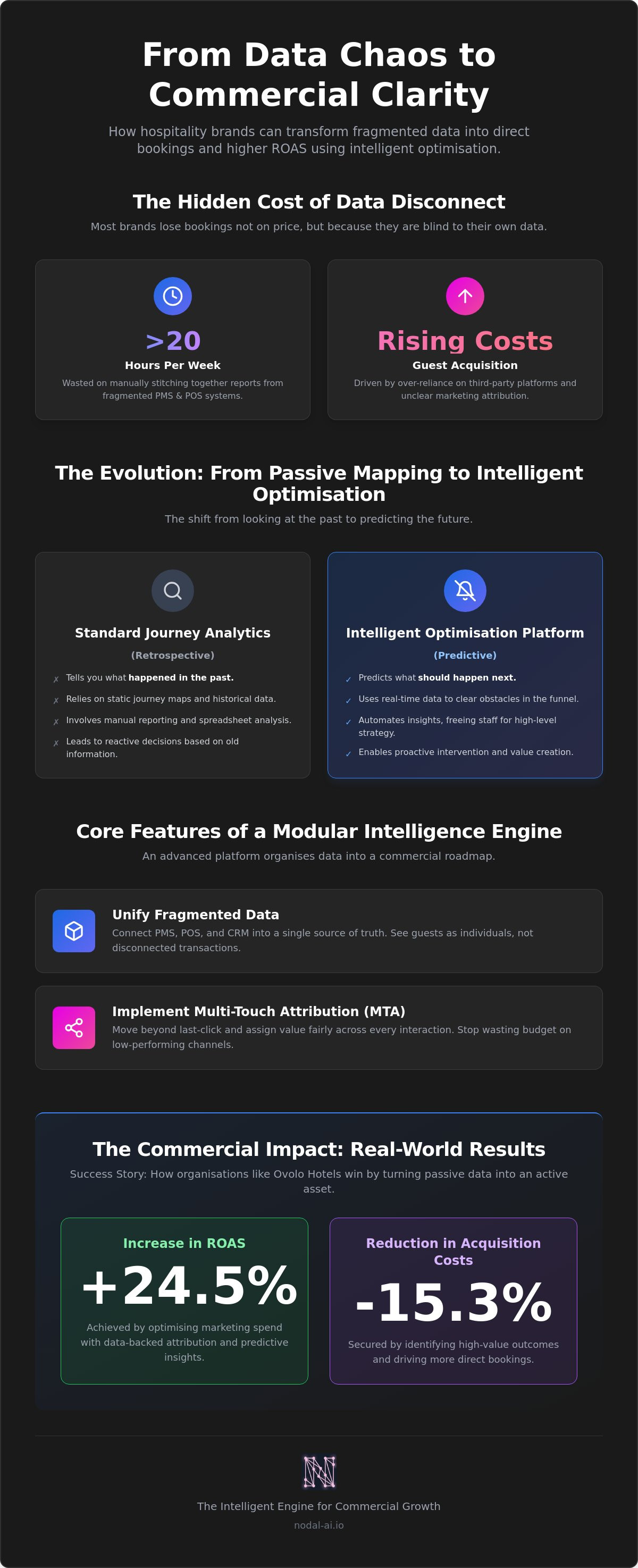
Most hospitality brands aren't losing bookings because of their price; they're losing them because they're blind to their own data. If you're spending over 20 hours a week manually stitching reports together from your PMS and POS, you already know the frustration of fragmented insights. It's difficult to justify marketing spend when attribution feels like a guessing game and acquisition costs continue to climb through third-party platforms. You need clarity to regain control of your commercial strategy.
This guide shows you how to transform that chaos into a high-converting experience using advanced customer journey analytics software. We'll demonstrate how to establish a single source of truth that replaces manual labour with predictive insights, allowing you to dictate where to spend next for maximum impact. You'll learn why true optimisation is about building a modular intelligence engine rather than just drawing maps. We'll explore how organisations like Ovolo Hotels achieved a 24.5% increase in ROAS and a 15.3% reduction in acquisition costs by turning passive data into an active commercial asset.
Key Takeaways
- Learn the critical difference between standard analytics and predictive optimisation to anticipate guest behaviour before it happens.
- Unify fragmented data from legacy PMS and POS systems into a single source of truth using a modular intelligence engine.
- Master the use of customer journey analytics software to implement multi-touch attribution and stop wasting budget on low-performing channels.
- Apply a structured five-step framework to identify infrastructure gaps and prioritise high-value outcomes like direct bookings.
- See how organisations can achieve a 24.5% increase in ROAS by transforming passive data into an active commercial asset.
What is Customer Journey Optimisation Software?
Customer journey optimisation software is the modular intelligence engine that unifies fragmented data from your PMS, POS, and CRM into a single, actionable perspective. While traditional customer journey analytics software tells you what happened in the past, an optimisation platform predicts what should happen next. It transforms passive data into a proactive commercial partner. Instead of looking at a spreadsheet of historical cancellations, you gain the foresight to adjust pricing or targeting before those gaps emerge. This shift represents a move from mere observation to active intervention.
Most hospitality organisations struggle with data silos where guest information remains trapped in legacy systems. This fragmentation creates a distorted view of the customer journey, leading to missed opportunities and wasted marketing budget. Optimisation technology bridges these gaps. It provides a cognitive upgrade for your marketing team, replacing the anxiety of manual reporting with the clarity of a unified commercial view. By using AI to process thousands of multi-channel touchpoints simultaneously, the software identifies patterns that human analysts might miss. It effectively personifies your data, allowing it to speak directly to your commercial goals.
The Shift from Passive Mapping to Intelligent Optimisation
Static journey maps are relics of a simpler digital age. Within the complex 2026 digital environment, guest behaviour changes in minutes, not months. Intelligent optimisation uses real-time data to move prospects through the funnel, turning a casual browser into a brand advocate. It doesn't just map the path; it clears the obstacles. This technology excels at identifying need periods weeks in advance, allowing you to deploy targeted campaigns that secure direct bookings and reduce reliance on expensive third-party platforms. By predicting demand fluctuations, you can shift from reactive discounting to proactive value creation. Modern customer journey analytics software must evolve into an active optimisation engine to remain relevant.
A key part of clearing these obstacles involves ensuring the physical journey matches the digital promise; for instance, premium service providers like CentralEuropeTransfer help maintain brand standards by offering reliable, high-quality transportation for guests arriving in Central European destinations.
Why London Marketing Teams are Prioritising These Tools
London's hospitality market is currently facing intense pressure from profit margin erosion and rising operational costs. In this high-stakes urban environment, slow decisions are expensive ones. Marketing teams are adopting these tools to gain a competitive edge through faster, data-backed interventions. By connecting disparate data sources, they can realise immediate efficiency gains and protect their bottom line from OTA leakage. The ability to act on predictive insights allows teams to outmanoeuvre competitors who are still reliant on manual, retrospective reporting. Customer journey optimisation is a strategic necessity for 2026 growth.
Key Features of Advanced Optimisation Platforms
Advanced platforms don't just show you data; they organise it into a commercial roadmap. To deliver seamless customer journeys, you must first solve the persistent problem of data fragmentation. Modern customer journey analytics software acts as the connective tissue between your PMS, POS, and CRM systems. It removes the inherent ambiguity of manual data entry, replacing it with a single, high-fidelity source of truth. This consolidation allows you to see the guest as a single individual rather than a series of disconnected transactions across multiple legacy systems.
Efficiency is the primary output of this integration. Marketing and operations teams often waste over 20 hours a week on manual reporting, a tedious task that drains productivity and introduces human error. Advanced optimisation platforms automate this process entirely. By generating real-time insights, these tools free your staff to focus on high-level strategy rather than wrestling with spreadsheets. It's about turning a passive archive of numbers into an active participant in your business growth, providing the relief that comes from total clarity.
Multi-Touch Attribution and Revenue Accuracy
Last-click attribution is a dangerous oversimplification that ignores the majority of the guest's path to purchase. If you only reward the final touchpoint, you'll likely cut funding to the very channels that first sparked interest. Multi-touch attribution (MTA) provides the granular visibility needed to assign value fairly across every interaction. This accuracy is vital for maintaining high margins in competitive markets, ensuring your ad spend is always working at peak efficiency. You can explore these concepts further in our guide to Mastering Marketing Attribution.
Predictive Modelling for Future Growth
Beyond looking backward, the most powerful feature of modern software is its ability to forecast future demand. Predictive modelling uses historical data to identify high-propensity guest segments, telling you exactly who is likely to book next. These growth recommendations serve as a cognitive upgrade for your organisation, pinpointing where to spend your next pound for the highest return. Discover how to apply these techniques in our Predictive Modelling Guide. This approach replaces the anxiety of guesswork with the confidence of data-backed projections.
This technology delivers measurable commercial results. Ovolo Hotels realised a 24.5% increase in ROAS and a 15.3% reduction in acquisition costs by leveraging these specific features to drive direct bookings. By focusing on the revenue engine rather than just visual maps, they transformed their marketing into a profit centre. If you're ready to stop guessing and start growing, you can explore the full feature set of a modular intelligence engine designed for the hospitality sector.
The Data Fragmentation Problem: Connecting the Dots
Internal systems that refuse to talk to each other are the primary barrier to commercial growth. Many hospitality leaders assume their legacy tech stacks are permanently siloed, believing that platforms like Oracle OPERA or Mews simply cannot communicate with modern marketing tools. This technical stalemate is exactly what modern customer journey analytics software is designed to resolve. By employing a modular intelligence engine, you can bridge these gaps without the need for a costly infrastructure overhaul. Much like how Foundation ResQ addresses physical structural issues through specialized stabilization and remediation, this technology transforms chaotic, disconnected inputs into a streamlined flow of high-value outputs.
The relief that comes from resolving this complexity is profound. Instead of your team wrestling with manual data exports, the software acts as a cognitive upgrade for your entire organisation. It personifies your passive data, turning it into an active participant that guides your commercial strategy. This unification allows you to gain a significant competitive advantage by seeing the guest journey in its entirety. When you connect the dots between every touchpoint, you stop losing revenue to the blind spots created by fragmented systems.
Bridging the Gap Between PMS, POS, and Marketing
The technical challenge of connecting property management systems with GA4 often leaves marketing teams flying blind. Without this integration, you cannot accurately link a specific digital campaign to a guest's actual spend at the bar, restaurant, or spa. When you deploy sophisticated customer journey analytics software, you replace fragmented guesses with a single commercial view. This reveals the true lifetime value of your guests across all properties. It allows operational data to shape your marketing strategy, ensuring you target the guests who contribute most to your bottom line rather than just those who click the most ads.
Incorporating External Growth Signals
In the complex digital landscape of 2026, looking inward is no longer enough. True optimisation requires the integration of external signals such as FX rates, flight demand, and local tourism trends. These factors influence guest behaviour as much as your own room rates or seasonal offers. By transforming this external noise into actionable intelligence, revenue managers can anticipate demand spikes before they occur. You can explore how these disparate sources are unified through the Nodal Platform Features. This approach replaces the anxiety of reactive pricing with the confidence of predictive, data-backed interventions.
Unifying your data is the most effective way to reduce OTA leakage. When you understand exactly where guests are dropping out of your direct booking funnel, you can intervene with precision. This clarity boosts direct booking contributions and protects your profit margins from high commission fees. It moves your organisation from a state of overwhelmed manual labour to one of calm, automated efficiency, ensuring every marketing pound is an investment in measurable growth.
How to Implement Journey Optimisation: A 5-Step Framework
Implementation begins with a shift in perspective. You must move away from manual, static mapping toward a dynamic, automated framework. The first step involves a comprehensive audit of your existing infrastructure to identify critical data gaps. Whether your data resides in Mews, Cloudbeds, or other integrated CRM platforms, you need to understand how these systems interact. Once these gaps are identified, you can prioritise your commercial goals. Are you focused on driving direct bookings to reduce OTA leakage, or is ancillary spend at the spa and restaurant your primary target? Defining these objectives ensures your customer journey analytics software is configured to deliver the most relevant growth recommendations.
Configuration follows strategy. A modular intelligence engine allows you to activate specific operational or guest-specific modules that align with your defined goals. This setup transforms your passive data into an active commercial partner. By automating your reporting, you reclaim the 20+ hours a week previously lost to manual spreadsheet labour. This transition replaces the anxiety of tedious tasks with the confidence of high-level brand planning. Finally, you must monitor real-time growth recommendations to adjust your marketing spend dynamically, ensuring every pound is invested in high-propensity segments.
Setting the Right KPIs for Every Stage
Success requires moving beyond vanity metrics like page views or social engagement. You should focus on commercial outcomes such as average booking value and guest lifetime value. Measuring the effectiveness of loyalty and member retention models provides a clearer picture of long-term profitability. KPIs must align with the total guest lifecycle, not just the first click. This holistic approach ensures that your customer journey analytics software provides insights that actually impact your bottom line, moving you from chaotic inputs to high-value outputs.
Reducing Friction in the Path to Purchase
Technical reliability is a cornerstone of a frictionless experience; if your booking engine or website faces downtime, it creates a significant break in the customer journey. To safeguard your reputation, you can explore Uptime Monitoring with StatusPulse to maintain transparency during service disruptions.
Friction is the enemy of conversion. You must identify exactly where prospects drop off in the booking process and understand the underlying reasons for this abandonment. Modern optimisation platforms use AI to personalise the journey for high-value guest segments, delivering the right message at the perfect moment. This level of precision is essential for maintaining a competitive edge in a crowded market. To understand the full scope of this process, read The Definitive Guide to the Customer Journey.
Book a demo to see this framework in action
Nodal AI: The Intelligent Engine for Commercial Growth
Nodal AI is the London-based leader in hospitality and commercial intelligence, providing the cognitive upgrade your organisation needs to thrive. We don't just offer another customer journey analytics software; we provide a modular intelligence engine that transforms passive data into a proactive commercial partner. By unifying fragmented insights from your PMS, POS, and CRM, we replace the anxiety of manual reporting with the clarity of a single source of truth. Our approach combines advanced technology with strategic consultancy, ensuring you have both the tools and the expertise to realise consistent, profitable growth.
The results of this integration are measurable and significant. Ovolo Hotels achieved a 24.5% increase in ROAS by leveraging the Nodal Platform to identify and target high-propensity guest segments. This success demonstrates the power of moving beyond static mapping toward a dynamic, predictive engine. Whether you are managing a boutique hotel or a global brand, our architecture provides the transparency required to regain control of your commercial strategy. We turn chaotic inputs into high-value outputs, allowing you to focus on strategic brand planning rather than manual data entry.
Transforming Hospitality Performance
Our modular architecture is specifically designed for the unique challenges of the hospitality sector. For hotels, hostels, and private members clubs, we provide the granular visibility needed to reduce OTA leakage and drive direct bookings. In the Quick Service Restaurant (QSR) space, Nodal helps operators measure the direct link between digital footfall and actual revenue across multiple locations. This level of specialised insight is only possible because our platform was built by performance marketing experts for experts. We understand the pressure of profit margin erosion and provide the technical depth required to protect your bottom line.
Making More and Wasting Less
The ultimate goal of any optimisation strategy is to increase efficiency while reducing costs. Organisations using Nodal have seen a 15.3% reduction in acquisition costs by eliminating waste in their multi-channel ad spend. As we move into 2026, the ability to act on predictive insights will be the primary differentiator between market leaders and those struggling with legacy silos. Nodal provides the intelligence required to anticipate guest behaviour and dictate where to spend next for the highest return. It is time to replace fragmented guesses with a unified commercial view.
This drive for efficiency and cost-reduction is also transforming how employees manage their benefits. For instance, those in the Australian workforce are increasingly using Novated Lease Quotes to compare multiple providers and ensure they are maximizing their salary through optimized vehicle leasing.
Secure Your Commercial Future with Predictive Intelligence
True growth in 2026 requires more than just collecting data; it requires the cognitive upgrade of a unified intelligence engine. By moving from passive mapping to active optimisation, you can realise a single source of truth that dictates exactly where to invest your next marketing pound. This transition replaces the anxiety of manual reporting with the calm efficiency of automated, high-level perspectives. You have the power to turn fragmented silos into a streamlined roadmap for direct bookings and higher margins.
Leading hospitality brands are already using customer journey analytics software to eliminate OTA leakage and reclaim their profit margins. As a winner of the Performance Marketing Awards, the Nodal Platform is trusted by global luxury brands to turn chaotic inputs into high-value commercial outputs. We've seen this approach deliver a 24.5% increase in ROAS for organisations like Ovolo Hotels, proving that clarity is the ultimate competitive advantage in a high-cost market.
Book a personalised demo of the Nodal Platform
Take the first step toward total transparency today and watch your organisation transform into a high-performance profit centre. The future of your commercial success depends on the intelligence you deploy now.
Frequently Asked Questions
What is the difference between customer journey mapping and optimisation?
Journey mapping is the static visualisation of historical touchpoints, whereas optimisation is the active, predictive process of improving those interactions in real-time. Mapping tells you where guests have been; optimisation dictates where you should intervene next to secure a direct booking. By using customer journey analytics software, you move from passive observation to a proactive strategy that protects your profit margins and enhances the guest experience.
How does customer journey optimisation software improve ROI?
Optimisation improves ROI by identifying and eliminating waste in your marketing spend through multi-touch attribution. It reveals which channels actually drive revenue rather than just vanity clicks, allowing you to reallocate budget to high-performing campaigns. This clarity helps organisations achieve significant increases in ROAS by reducing their reliance on expensive third-party booking platforms and focusing on direct, high-value guest segments.
Can this software integrate with my existing PMS or CRM?
Yes, modern optimisation engines are designed with a modular architecture to integrate seamlessly with major hospitality systems. Whether you use Oracle OPERA, Mews, Cloudbeds, or other established CRM and guest management databases, the software unifies these fragmented sources into a single source of truth. This connectivity ensures that guest data informs your marketing strategy without manual intervention, providing the relief that comes from total system interoperability.
Is AI necessary for customer journey optimisation in 2026?
AI is a strategic necessity for processing the complex, multi-channel guest journeys that define the current digital landscape. Manual analysis cannot keep pace with the thousands of data points generated across various digital and physical touchpoints every hour. AI-driven customer journey analytics software provides the predictive modelling required to forecast demand and personalise experiences at scale, ensuring your organisation remains competitive in a high-speed market.
How long does it take to see results from journey optimisation software?
Teams typically realise immediate operational efficiency by replacing manual reporting with automated insights, which clears the way for high-level strategy. Commercial results, such as increased direct bookings or a reduction in acquisition costs, generally become visible within the first full campaign cycle. This rapid output allows you to refine your strategy continuously based on live performance data rather than waiting for retrospective monthly reports.
What are the best customer journey tools for the hospitality industry?
The best tools for the hospitality sector are those that offer deep integration with industry-specific legacy systems rather than generic enterprise solutions. While broad platforms provide scale, specialised modular intelligence engines are better suited for hotels, QSRs, and wellness brands. These tools are built by experts to address the specific challenge of profit margin erosion and OTA leakage, providing a cognitive upgrade for your entire organisation.
Does journey optimisation software help with GDPR compliance?
Journey optimisation software supports GDPR compliance by centralising guest data into a transparent and secure environment. It allows you to manage consent across multiple touchpoints more effectively, reducing the risk of data silos where privacy preferences might be lost or ignored. This unified approach provides the high-level protection of assets that modern professionals require while ensuring that all guest interactions remain fully compliant with regional regulations.
How much does customer journey optimisation software cost?
The investment for optimisation software depends on the volume of your data and the specific modules your organisation requires to meet its goals. Most providers offer tiered structures that align with the scale of your properties and the complexity of your technical integrations. It is best to consult with a specialist to define a modular setup that delivers the highest measurable return for your specific commercial needs and operational requirements.


