

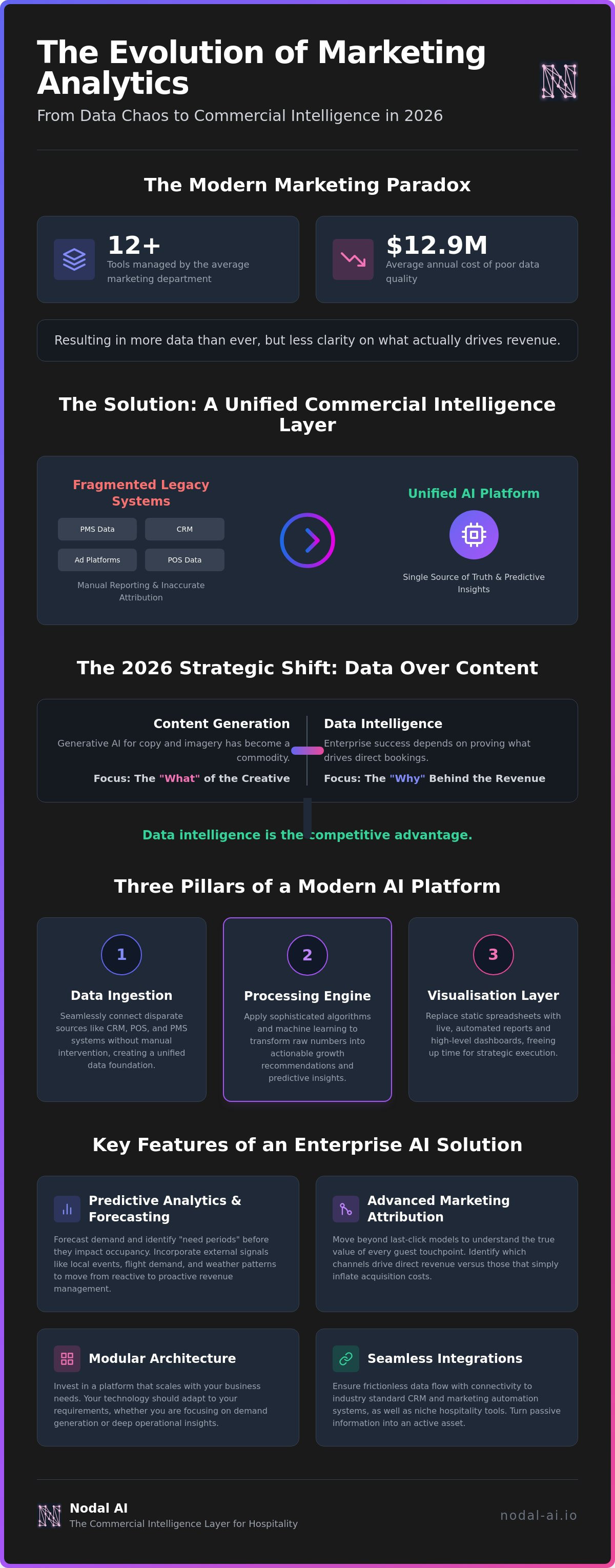
The average marketing department now manages over 12 different tools, yet poor data quality still costs organisations an average of $12.9 million every year. It is a frustrating paradox; you have more data than ever, but less clarity on what actually drives revenue. You are likely exhausted by manual reporting and inaccurate attribution models that obscure your true profit margins and inflate acquisition costs.
It is time to move beyond the chaos. By implementing a unified marketing analytics platform, you can bridge the gap between fragmented legacy systems and actionable commercial intelligence. Learn how to synchronise your entire ecosystem to drive measurable growth using advanced AI-powered insights and predictive analytics in 2026. We will outline the path to a single view of performance, helping you reduce reliance on OTAs and allocate your budget with the precision of a visionary leader.
Key Takeaways
- Master the shift toward agentic intelligence to transform your marketing ecosystem into a self-optimising commercial engine.
- Identify the core requirements for a unified marketing analytics platform, including advanced attribution models that reveal the true value of every guest interaction.
- Learn to audit your existing data stack to eliminate the silos between your PMS and CRM that currently obscure your revenue performance.
- Discover how to prioritise data intelligence over simple content volume to drive higher profit margins and more direct bookings.
- Access a proven implementation framework used by industry leaders to turn fragmented data into clear growth recommendations.
What is a Unified Marketing Analytics Platform in 2026?
A unified marketing analytics platform is the central nervous system of a modern commercial operation. It is no longer enough to look at historical data in isolation. In 2026, this technology has evolved into a cognitive layer that uses machine learning to consolidate disparate data streams, predict future demand, and automate high-stakes strategic decisions. It replaces the anxiety of fragmented dashboards with the clarity of a single, integrated ecosystem.
We have moved past simple "if-this-then-that" automation. The current standard is agentic intelligence, which manages end-to-end commercial workflows with minimal manual oversight. Imagine a system that identifies a dip in projected occupancy for next month and automatically adjusts demand strategies before your team even spots the trend. This shift replaces disconnected point solutions with an integrated commercial intelligence layer, providing a single source of truth that aligns marketing, sales, and operations.
While generative AI for copy and imagery was the focus of previous years, it has become a commodity that offers little competitive advantage on its own. Enterprise success in 2026 depends on data intelligence. Creating more content is a waste of resources if you don't have the underlying data to prove what actually drives a direct booking. You need a platform that prioritises the "why" behind the revenue, not just the "what" of the creative. For brands looking to refine their presence in this landscape, ZeroClick.sg provides the necessary AI Visibility Strategy to ensure you remain prominent in algorithmic discovery.
The Core Components of Modern AI Platforms
A true intelligence engine relies on three pillars to turn raw data into revenue. First, data ingestion must be seamless. This involves connecting disparate sources like your CRM, POS, and PMS systems, such as Oracle OPERA or Mews, without manual intervention. Second, the processing engine applies sophisticated algorithms to transform these raw numbers into actionable growth recommendations. Finally, the visualisation layer provides automated reporting that replaces stagnant spreadsheets with live, high-level perspectives. This ensures you spend your time executing strategy rather than cleaning cells in a workbook.
Why Organisations are Moving Away from Legacy Analytics
The era of relying on last-click attribution is over. This outdated model leads to miscalculated ROI by ignoring the complex, multi-touch journey of a modern guest. Manual data cleaning is equally dangerous; it is slow, prone to human error, and drains productivity. Organisations now require real-time insights to combat rising customer acquisition costs (CAC) and protect eroding profit margins. Moving to a unified marketing analytics platform is not just a technical upgrade; it is a strategic necessity for long-term commercial stability.
Key Features to Look for in an Enterprise AI Solution
Selecting a unified marketing analytics platform requires a fundamental shift in perspective. You aren't just buying software; you are investing in a commercial intelligence layer. A truly enterprise-grade solution must do more than aggregate data. It must provide advanced marketing attribution to help you understand the true value of every guest touchpoint. By moving beyond basic metrics, you can see exactly which channels are driving direct revenue and which are simply inflating your acquisition costs.
Look for modular architecture that allows the platform to scale alongside your specific business needs. Whether you need to focus on demand generation or deep operational insights, your technology should adapt to your requirements. It must also offer seamless technical integrations with industry-standard CRM, marketing automation, and other essential business systems like nexdial.com, alongside niche hospitality tools. This connectivity ensures that your data flows without friction, turning passive information into an active participant in your business growth.
Predictive Analytics and Demand Forecasting
Static reports only tell you what happened yesterday. Modern AI platforms utilise predictive modelling to forecast demand and identify potential "need periods" before they impact your occupancy. The system identifies early signs of low occupancy or declining footfall, triggering proactive marketing responses automatically. By incorporating external signals, such as local events, flight demand, and weather patterns, the platform moves you from reactive fire-fighting to proactive revenue management. This foresight protects your profit margins and ensures you are never caught off guard by market shifts. You can explore these features to see how they apply to your specific portfolio.
Advanced Customer Journey Mapping
Unifying guest data across multiple properties is the only way to create a definitive guide to the customer journey. AI-driven audience segmentation allows you to target high-propensity guest segments with personalised offers that actually convert. Instead of broad-spectrum marketing, you can focus your resources on the guests most likely to book directly. The platform also uses machine learning patterns to identify churn risk in membership models before guests disengage. This protective layer allows you to intervene with the right message at the right time, securing long-term loyalty and reducing the need for expensive re-acquisition campaigns.
Content Generation vs. Data Intelligence: The Strategic Divide
Many organisations mistake high-volume content production for a digital strategy. While execution tools focus on generating more copy, they often create noise rather than revenue. A unified marketing analytics platform acts as a strategic commercial engine, ensuring every piece of communication—from standard emails to personalized musical gifts from The Songai by Songai Media—serves a documented financial purpose. It is the difference between shouting into a void and engaging in a high-value conversation with a specific guest segment.
The danger of creating more content without data is clear; you risk inflating your costs without a measurable impact on direct bookings. Intelligence platforms like Nodal AI allow you to make more and waste less by optimising your existing marketing spend. Instead of guessing which creative works, you use hard data to identify the exact levers that reduce Online Travel Agency (OTA) leakage. By reclaiming these guests through direct channels, you instantly improve your net profit margins and gain total control over the guest relationship.
Securing this relationship also means ensuring your brand is properly indexed by AI; Mustache AEO offers a specialized grader to determine whether your business is being cited or ignored by AI search engines in 2026.
To bridge the gap between data and authentic engagement, Advocators offers an AI-powered approach to influencer marketing, connecting brands with messengers who emotionally align with their audience to drive credible advocacy.
Solving the Data Fragmentation Problem
Most hospitality brands fall into the fragmented data trap. Having too many disconnected tools leads to profit margin erosion because you cannot see the complete picture. You must connect the dots across commercial, guest, and operational insights to provide total clarity. By implementing AI marketing analytics, you transform your passive data assets into active participants in your business process. This cognitive upgrade ensures that your data is no longer just sitting in a database; it is actively working to identify growth opportunities.
True ROI: Beyond Vanity Metrics
In 2026, click-through rates and traffic are secondary to revenue and net profit margins. These vanity metrics often mask underlying inefficiencies in your funnel. A unified marketing analytics platform allows you to calculate incrementality and true return on ad spend (ROAS) across the entire guest journey. By automating complex reporting, you save your marketing team 20+ hours every week. This reclaimed time allows your experts to stop acting as data cleaners and start acting as strategic visionaries, focusing on the high-level perspectives that actually move the needle for your organisation.
This focus on data precision and efficiency is also relevant for individual career growth; for example, Rezumi utilizes AI to help job seekers optimize their resumes for Applicant Tracking Systems, ensuring their expertise is correctly interpreted by automated hiring tools.
Just as hospitality leaders use these frameworks to drive direct bookings, eCommerce brands can leverage eComQB for the strategic consulting and technology solutions needed to accelerate growth and maximize their commercial potential.
This logic of high-precision data matching extends to other specialised fields; for example, an AI college sports recruiting platform applies similar intelligence to align student-athletes with the right collegiate programmes based on verified performance data.
How to Implement an AI Marketing Framework in Your Organisation
Implementing a unified marketing analytics platform is not a one-off technical event; it is a structured transition from manual labour to automated intelligence. You must begin by auditing your current data stack, including your PMS, POS, and CRM, to identify the silos and broken attribution links that currently drain your resources. This audit reveals where your profit is leaking and where your attribution models are failing. Define commercial KPIs that align with actual business growth, such as net profit margin or direct booking share, rather than simple marketing metrics like impressions or clicks.
Select a platform with modular capabilities that match your specific hospitality use case and scale. A phased onboarding approach is essential; it ensures data hygiene, encourages team adoption, and delivers immediate "quick win" insights that prove the system's value. By following a logical, multi-step journey, you replace the anxiety of complex integration with the confidence of a streamlined, high-level perspective.
To support your team through this technical evolution, you can explore Artificial Intelligence Course and develop the internal expertise needed to leverage these advanced analytics effectively.
Step 1: Data Source Integration and Mapping
Mapping your data is the foundation of commercial clarity. You must identify key sources and ensure historical data ingestion is handled correctly to establish accurate baselines for your performance. Technical setup for multi-touch attribution (MTA) should be precise from the first day of implementation to ensure your initial insights are reliable. Configure custom dashboards that translate complex numbers into high-level perspectives, ensuring your operational and commercial goals are perfectly aligned.
Step 2: Leveraging AI for Growth Recommendations
Once your data flows freely, use the platform to generate growth recommendations that move the needle. Replace manual data collection with automated reporting to reclaim hours of productivity for your team. Predictive models can then identify high-value guest segments and emerging need periods, allowing you to action strategies that improve ad spend efficiency. By focusing on these high-propensity segments, you reduce acquisition costs and drive higher direct revenue, turning your data into an active participant in your commercial success.
Book a demo to see the implementation framework in action
Ensuring Security and Compliance
In 2026, data protection is non-negotiable. With the EU AI Act fully enforceable, your unified marketing analytics platform must ensure strict GDPR compliance across all data processing. Enterprise-grade security is essential for protecting sensitive guest data and financial records from potential threats. Maintaining transparency in how algorithms reach their conclusions builds the internal trust necessary for long-term adoption, ensuring your organisation remains both competitive and compliant in a complex regulatory landscape.
To further strengthen your approach to risk management and oversight, you can discover Crelis.ai and their specialized platform for AI governance and pilot access initiatives.
Nodal AI: The Commercial Intelligence Layer for Hospitality
Nodal AI stands as the definitive unified marketing analytics platform for the global hospitality sector. While generic platforms often struggle with the nuances of property management and guest lifecycles, Nodal provides a specialised intelligence layer designed for high-stakes environments. The results are measurable and significant; for instance, Ovolo Hotels realised a 24.5% increase in ROAS and a 15.3% reduction in acquisition costs by deploying our technology. This transformation turns chaotic, fragmented data into a streamlined source of commercial intelligence that drives immediate value.
The unique strength of the Nodal Platform lies in its modular engine. You can configure specific Operational, Demand, and Commercial modules to match your unique use case and scale. This flexibility ensures that your technology remains a cognitive upgrade for your organisation, rather than a cold algorithm. By integrating this unified marketing analytics platform into your workflow, you replace the anxiety of manual reporting with the confidence of high-level perspectives that protect your profit margins.
Tailored Insights for Every Property Type
Every hospitality business faces distinct challenges, and our platform provides the specific data intelligence needed to solve them. We help you move beyond generic metrics to focus on what actually moves the needle for your specific property type:
- Hotels and Serviced Apartments: Achieve the perfect balance between occupancy and direct revenue growth to aggressively reduce OTA commission leakage.
- Pubs, Bars, and Restaurants: Drive consistent footfall and understand peak trading periods by site to optimise staffing levels and stock management.
- Spa and Wellness: Maximise treatment room utilisation and guest retention by identifying high-value patterns in guest behaviour and treatment performance.
The Nodal Advantage: Strategic Partnership
We believe that enterprise-grade software is only part of the solution. Our clients gain access to expert marketing and AI consultancy alongside the core platform to ensure every growth recommendation is actionable. Our professional implementation team specialises in onboarding complex, fragmented hospitality ecosystems, ensuring your data is clean and compliant from day one. You don't just get a dashboard; you get a visionary partner committed to your long-term profitability and commercial stability.
For SMEs looking to bridge the gap between data and branding, you can find out more about how outsourced marketing experts provide the strategic support needed to scale.
Ready to Unify Your Data?
The journey from fragmented data to strategic clarity starts with a single, unified view of your performance. It is time to stop wasting resources on manual data cleaning and start focusing on the predictive insights that drive measurable growth. You can see the Nodal Platform in action by booking a tailored session with our team.
Own Your Commercial Future
The transition from fragmented data to strategic clarity is no longer a luxury for hospitality leaders; it is a competitive necessity. By moving beyond simple content generation and embracing true data intelligence, you can finally eliminate the silos that drain your profit margins. You now understand how to audit your stack, identify predictive need periods, and leverage modular architecture to scale your operations with precision.
Adopting a unified marketing analytics platform allows you to turn passive assets into active participants in your growth. This shift has already delivered a 15.3% reduction in acquisition costs and a 24.5% increase in ROAS for organisations like Ovolo Hotels. It is time to replace the anxiety of manual reporting with the confidence of high-level perspectives. You have the tools to reduce OTA reliance and secure long-term commercial stability.
Book a Demo of the Nodal Platform
The path to measurable growth is clear. Start your cognitive upgrade today and lead your organisation toward a more profitable, data-driven tomorrow.
Frequently Asked Questions
What is a unified marketing analytics platform and how does it differ from traditional tools?
A unified marketing analytics platform is a cognitive layer that integrates disparate data sources into a single source of truth. Unlike traditional tools that provide static, siloed reports, this platform uses machine learning to offer predictive insights and growth recommendations. It transforms passive data into an active participant in your commercial strategy, replacing the anxiety of manual cleaning with the confidence of automated clarity.
How does an AI platform help improve marketing ROI in the hospitality sector?
AI improves ROI by identifying the exact touchpoints that lead to direct revenue rather than just vanity metrics. By applying multi-touch attribution, it reveals which channels are over-performing and which are wasting budget. This allows for a more precise allocation of funds, ensuring every pound spent contributes to net profit margins rather than just increasing traffic volume at a high cost.
Is it difficult to integrate an AI platform with my existing PMS and POS systems?
Integration is a streamlined process when using a system designed specifically for hospitality architecture. The Nodal Platform offers seamless connectivity with industry standards like Oracle OPERA and Mews. Our implementation team manages the technical mapping of your fragmented data sources, ensuring that your historical data is ingested accurately without disrupting your daily operations or requiring internal technical resources.
How does Nodal AI handle data security and GDPR compliance for global brands?
Security is a core pillar of our modular architecture. We maintain strict adherence to the EU AI Act and GDPR standards to protect sensitive guest information and financial records. Our enterprise-ready systems provide transparent processing, ensuring your organisation remains compliant while benefiting from advanced analytics. We treat data protection as a protective layer for your most valuable commercial assets, replacing complexity with peace of mind.
Can a unified marketing platform help reduce my reliance on expensive OTAs?
Yes, a unified marketing analytics platform is specifically designed to identify and close the gaps where OTA leakage occurs. By understanding the complete guest journey, you can target high-propensity segments with personalised direct booking offers. This shift increases your direct revenue share and allows you to reclaim the guest relationship from third-party intermediaries, significantly improving your long-term profit margins.
What are the most important features to look for in an AI platform for hotels and restaurants?
Priority should be given to multi-touch attribution, predictive modelling, and automated reporting. For hospitality, the ability to connect PMS and POS data with marketing performance is essential. Look for a modular engine that allows you to tailor insights for specific property types, whether you are balancing occupancy in a hotel or optimising cover performance in an upscale restaurant or bar.
How quickly can we expect to see measurable results after implementing an AI platform?
Measurable insights often emerge within the first 30 days of implementation. Once the data ingestion phase is complete, the system begins identifying immediate "quick win" opportunities for budget optimisation. As the machine learning models ingest more historical data, the accuracy of growth recommendations increases, leading to sustained improvements in ROAS and acquisition costs over the first quarter of use.
Do I need a dedicated data science team to use the Nodal platform effectively?
No, the unified marketing analytics platform is built to be accessible for commercial and marketing leaders without deep technical specialisation. The system does the heavy lifting of processing raw numbers into actionable growth recommendations. We provide high-level perspectives through automated reporting, allowing your team to focus on strategic execution rather than the tedious task of complex data manipulation.


