

What if the clearest sign of brand marketing’s impact appears before a customer clicks? Knowing how to measure brand marketing impact means looking beyond immediate conversions to changes in perception, demand and behaviour that can support future growth. A single channel metric cannot tell the whole story.
Brand results can feel harder to prove than short-term response. Awareness, consideration and trust build over time, while reports from separate channels and systems can point in different directions. The answer is not to choose between brand and performance. It is to connect audience signals with meaningful commercial outcomes.
This practical framework will help you choose measures that reflect how people respond to your brand and how the business performs. You will learn how to test brand activity, interpret results without overstating causation and communicate findings clearly to stakeholders. By bringing brand perception, tested demand and commercial indicators into one scorecard, teams can turn fragmented data into better-informed decisions.
Key Takeaways
- Learn how to measure brand marketing impact by separating campaign activity from audience response and business outcomes.
- Choose measures across perception, behaviour and commercial performance, and understand what each can and cannot show on its own.
- Use a clear testing sequence, including holdout or geographic comparisons, to investigate whether brand activity contributed to a change.
- Build a repeatable measurement plan with defined owners, data sources and review points, then use the results to guide next steps.
- See how Unified Metrics can bring revenue and marketing measures into a single view for more connected analysis.
What Does Brand Marketing Impact Actually Mean?
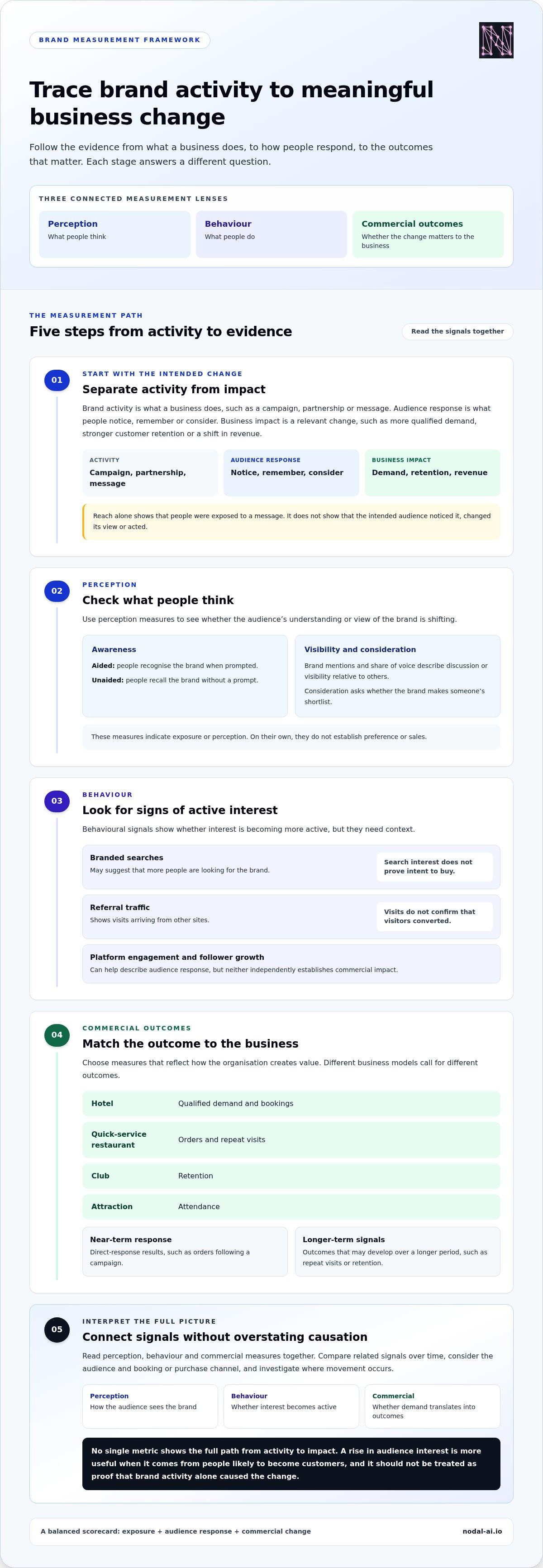
Brand activity is what a business does: a campaign, partnership or message designed to shape how people see it. Audience response is what people notice, remember or consider. Business impact is what changes as a result, such as more qualified demand, stronger customer retention or a shift in revenue. These stages are connected, but they are not interchangeable. A campaign can reach a large audience without changing what that audience thinks or does.
Brand marketing impact is evidence that brand activity has changed a relevant audience response or commercial outcome, not simply proof that the activity took place. When deciding how to measure brand marketing impact, start with the change the activity is meant to influence. Then look for evidence linking that response to a meaningful business result. Brand management provides useful context for how businesses shape and maintain a brand, but measurement still needs to connect that work to specific outcomes.
Consider a hotel building awareness around a distinctive guest experience. More people recognising its name is a useful signal, but it does not show whether the activity is influencing potential guests. A stronger question is whether the hotel is gaining consideration among travellers who fit its audience, and whether that qualified demand is reflected in direct bookings. This pattern helps teams investigate a possible contribution without assuming brand activity alone caused the change.
How Is Brand Impact Different from Brand Awareness?
Awareness describes whether people recognise a brand or can recall it without prompting. Consideration goes further: does the brand make someone’s shortlist? Action asks whether they book, buy or return. Recognition and recall help describe audience response, but they do not establish that perceptions shifted into preference or that preference led to a commercial result.
For a restaurant, familiarity with its name is not the same as more covers, repeat visits or higher average spend. Track these measures together to see where movement occurs and where the evidence stops.
Why One Brand Metric Cannot Tell the Whole Story
Reach and mentions can show that a message was exposed to people or discussed. On their own, they do not reveal whether the intended audience noticed it, changed its view or acted. Short-term conversions have the opposite limitation: they capture immediate response, but may miss brand contribution that develops over a longer customer journey.
A balanced scorecard combines evidence of exposure, audience response and commercial change, because no single metric can show the full path from activity to impact. Read the measures as a connected picture, not as competing verdicts. This gives teams a clearer basis for deciding what to investigate next.
Which Metrics Reveal Brand Marketing Impact?
Choose metrics that follow the path from how people see a brand to what they do and what the business gains. A useful scorecard groups measures into three categories: perception, behaviour and commercial outcomes. Together, they help answer different questions. No single measure can confirm the full journey, so interpret each in context and compare related signals over time.
Perception metrics answer what people think; behaviour metrics answer what they do; commercial metrics answer whether those changes matter to the business. The American Marketing Association’s overview of branding strategies and value provides context for why brand strength matters. For measurement, the key is choosing indicators that connect your brand objective to an outcome you can observe.
Perception and Behaviour Metrics: What Do They Show?
Use perception measures to assess whether the audience’s understanding or view of the brand is shifting. Aided awareness asks whether people recognise a brand when prompted; unaided awareness asks whether they recall it without a prompt. Brand mentions and share of voice can show how often the brand is discussed or how visible it is relative to others. These measures indicate perception or exposure, not preference or sales on their own.
Behavioural signals show whether interest is becoming more active. A rise in branded searches may suggest that more people are looking for the brand, while referral traffic can reveal visits arriving from other sites. Both need context: search interest does not prove intent to buy, and referral visits do not confirm that visitors converted. Platform engagement and follower growth can help describe audience response, but neither independently establishes commercial impact.
For a hotel, read these indicators together. Awareness and consideration surveys describe how the property is perceived, branded search and referral visits show active interest, and booking data shows whether demand is translating into reservations. Consider the booking channel and audience, too. A rise in interest is more useful when it comes from travellers likely to book than when it reflects broad, unqualified attention.
Commercial Outcomes: Which Measures Fit the Business?
Match the outcome to the business model. A hotel might track qualified demand and bookings; a quick-service restaurant could examine orders and repeat visits; a club could focus on retention; an attraction could monitor attendance. These measures reveal different business effects, so do not compare them as if one outcome fits every organisation.
Separate direct-response results, such as orders following a campaign, from indicators that may develop over a longer period, such as repeat visits or retention. A near-term conversion can show immediate response, while longer-term measures help assess whether preference is enduring. Perception shows whether the brand is resonating, behaviour shows whether interest is becoming action, and commercial outcomes show whether that action supports the business.
Use connected marketing and revenue measures to bring these categories into a clearer view. Marketing attribution measurement can help examine how touchpoints relate to outcomes, while keeping the distinction between an observed association and proven cause clear.
How Can You Test Whether Brand Marketing Drove a Change?
A rise in bookings or brand consideration after a campaign is encouraging, but timing alone does not prove the campaign caused it. To test whether activity contributed to a change, set up a fair comparison and decide what evidence would count before results arrive. This makes how to measure brand marketing impact a practical question of test design, not just reporting.
Use this four-step sequence to keep the analysis focused:
- Define the question. State the activity you want to assess, the audience it targets and the response or business outcome it aims to influence. For example: did the campaign increase consideration among potential guests, and was that followed by more bookings?
- Set a baseline. Record the relevant measures before the activity starts. Keep definitions, time periods and data sources consistent so the before-and-after comparison is meaningful.
- Select a test. Choose an experiment or modelling approach that suits the campaign, available data and decision you need to make.
- Interpret the results. Compare the evidence with your starting question, account for other influences and describe what the test can reasonably support.
Set a Baseline and Choose a Suitable Test
A holdout test withholds the campaign from a suitable comparison group while another group is exposed. Comparing their outcomes can help estimate what changed alongside exposure. A geographic test uses comparable areas, with activity running in one and not the other. Both approaches depend on groups being sufficiently similar and on avoiding other differences that could distort the comparison. Document the audience, dates and outcome definitions before launch.
For broader activity across channels, media mix modelling can estimate how different marketing inputs relate to outcomes over time. It can help when a single controlled experiment cannot represent the full campaign, but its results are estimates shaped by the data and assumptions used. Match the method to the question: a focused campaign may suit a holdout, while a wider mix of activity may call for modelling. Incrementality measurement is useful context for assessing whether outcomes are additional to what might otherwise have happened.
Interpret Results Without Overclaiming Causation
Start by separating an observed change from one credibly associated with the campaign. If bookings rise after brand activity, check whether seasonality, a promotion, a channel change or broader market conditions could also explain the movement. For a geographic test, consider whether the comparison areas experienced similar conditions. These checks do not eliminate all uncertainty, but they make conclusions more transparent.
Report the result in plain language: what changed, for which audience or group, over what period, and how strong the comparison is. If the test has limitations, name them. Say the findings suggest a contribution when the evidence supports that wording, rather than presenting an estimate as a guaranteed outcome or proof of sole cause. A credible test guides the next decision, even when it does not deliver a simple yes or no.
How Should You Build a Brand Measurement Plan?
A measurement plan turns a business priority into a consistent way to assess progress and decide what to do next. Keep it focused: a short scorecard with clear owners is more useful than a long list of metrics no one has time to interpret. A data governance framework also helps keep definitions and data sources consistent across teams.
Turn Business Objectives into a Focused Scorecard
Start with a question the business needs answered, such as whether brand activity is supporting direct hotel bookings or encouraging more repeat visits at a venue. Then choose a small set of measures that reflects the path from audience response to business outcome. For a hotel, that might include consideration among target travellers, branded search interest and direct bookings. For a membership business, it could include brand preference, enquiry activity and renewals.
For each measure, record the details that make it interpretable:
- Audience: Who should the activity influence, such as potential guests, local diners or current members?
- Definition and source: What exactly counts as a booking, repeat visit or positive audience response, and which system supplies the data?
- Channel and timeframe: Which activity is in scope, and when will you review the signal or outcome?
- Owner and limitation: Who maintains the measure, and what can’t it establish on its own?
Assign an owner to every measure, even if several teams contribute data. A marketing lead might own the campaign and audience measures, while a commercial or operations colleague maintains booking, attendance or retention definitions. Record changes to tracking or reporting so that shifts in the numbers are not mistaken for shifts in customer behaviour.
Make Reporting Useful for Decisions
Separate leading indicators from outcomes that need more time. A change in consideration or branded search may appear before a movement in bookings, repeat visits or membership retention. Set review points that suit each measure: check early signals during activity, then revisit longer-term outcomes after enough time has passed to make the comparison meaningful.
At each review, report three things: what changed, what evidence supports your interpretation, and what remains uncertain. Compare results with relevant context, such as the previous period, a similar venue or known changes to promotions and operations. A hotel’s booking pattern may differ from a venue’s attendance pattern, so use a comparison that fits the business rather than applying one benchmark everywhere.
Close the review with a recorded decision. Keep the approach, adjust the activity, investigate an unexpected result or design a test to answer the next question. This makes the plan a working tool, not just a reporting document. A clear process also makes it easier to explain how to measure brand marketing impact to stakeholders, with measures tied to business priorities and their limitations stated plainly.
Once the scorecard is clear, connect its marketing signals with the relevant commercial measures to make the next analysis more useful.
How Can Nodal AI Help Connect Brand Activity to Business Outcomes?
Once you have defined the measures and testing approach, the next challenge is bringing the evidence together. Marketing and revenue data can sit in separate systems, making it difficult to see how brand signals relate to commercial performance. Nodal AI’s analytics platform brings unified metrics and AI-powered insights into one view, helping teams investigate relationships between activity and outcomes without treating a connection as proof of causation.
Connect Fragmented Metrics with Unified Analytics
Nodal AI’s Unified Metrics brings revenue and marketing metrics into a single view. This gives teams a shared foundation for examining audience signals alongside business results, rather than relying on separate reports that may tell different stories. The aim is not to make every measure say the same thing. It is to make relationships, gaps and questions easier to see.
For a hotel, a team might examine changes in brand interest, demand, bookings and marketing performance together. If demand and bookings shift during a brand initiative, the combined view can help the team investigate timing and patterns across those measures. It does not prove the initiative caused the booking change. Other factors may also be involved, so use the view to guide analysis and testing, not to overstate attribution. Explore how unified marketing and revenue metrics can support this connected approach.
The same principle applies beyond hospitality. A venue can place marketing activity alongside attendance trends, while a membership business can review campaign measures with retention. The relevant commercial outcome will differ, but a consistent view can help teams assess the evidence against the objective they set.
Move from Measurement to a Clearer Next Decision
Connected data is useful when it helps teams decide what to examine next. Nodal AI’s AI Growth Insights surfaces actionable suggestions from analytics, reducing reliance on manual spreadsheet work. Teams can use those insights as prompts for investigation, then assess whether a suggested action fits their strategy and the available evidence.
Impact Analysis helps teams examine initiatives associated with longer-term revenue and retention. For example, a hotel could review whether an initiative coincided with changes in repeat bookings or revenue over time. That analysis can highlight a relationship worth exploring, but it should not be presented as proof that the initiative alone produced the result. Pair the findings with a suitable test or comparison, and keep the assumptions visible.
For teams working through how to measure brand marketing impact, Nodal AI helps create a clearer bridge from marketing signals to commercial questions. Unified Metrics brings measures into one view, while AI Growth Insights and Impact Analysis support further investigation. Use the evidence to refine the next question, test or decision.
See how the Nodal Platform supports connected measurement
Make Your Next Measurement Decision Count
Choose one brand question to carry into your next planning cycle. What audience change would matter, which business outcome should follow, and what evidence would help you decide whether to continue, adjust or test a different approach? A focused question gives measurement a practical purpose and helps teams move from reporting activity to making more confident decisions.
Nodal AI’s Unified Metrics brings revenue and marketing metrics into one view, while Impact Analysis helps identify initiatives associated with long-term revenue and retention. A real estate owner testimonial describes discovering features linked with retention within the first week. Treat findings as a starting point for investigation, then use them to shape the next measurement question. That is a practical way to keep improving how to measure brand marketing impact as priorities evolve.
Build a clearer view of your brand’s contribution, one informed decision at a time.
Frequently Asked Questions
How often should a business measure brand marketing impact?
Set a cadence that reflects the campaign and the measures you need to monitor. Review suitable early indicators while activity is running, then assess outcomes over a period suited to the customer journey. To measure brand marketing impact consistently, keep measure definitions and data sources stable between reviews. Avoid rebuilding the scorecard after every fluctuation. Consistent tracking makes trends easier to interpret and decisions more comparable.
Can you measure brand marketing impact without running a survey?
Yes, surveys are useful but they are not the only source of evidence. Branded search, referral activity, brand mentions and relevant commercial outcomes can offer additional clues. For instance, a rise in referral visits from a local event partner may show increased interest, while booking or order data can show whether that interest reached a transaction. Each measure has limits, so combine evidence rather than treating one as a complete substitute for audience research or incremental testing.
How do you measure brand marketing for a business with multiple locations?
Use common definitions across sites, then interpret each location in its local context. A restaurant group could track orders and returning customers, while a hotel group might examine bookings and direct revenue. Compare similar sites where possible, such as venues with comparable trading patterns, and record differences in promotions, audience or operating conditions. A group-wide average can conceal local variation, so review location-level patterns before deciding whether an approach should be repeated elsewhere.
What is the difference between brand lift and brand marketing impact?
Brand lift refers to a measured change in audience response, such as improved awareness or consideration. Brand marketing impact asks a broader question: whether activity contributed to relevant audience changes and business outcomes. Lift can indicate that people responded differently, but it does not establish that a campaign caused more bookings, revenue or retention. For example, increased consideration alongside stable bookings calls for further investigation, not an automatic conclusion that the activity failed.
How can a business measure offline brand marketing?
Pair measures suited to the activity with relevant business results. A local event campaign might be assessed through audience research, responses in the areas reached and changes in nearby visits or sales. Record when and where the campaign ran, then note other activity or conditions that could affect results. Geographic comparisons or media mix modelling may help, depending on the campaign and data available. Explain what the evidence supports and where uncertainty remains.
Why can brand marketing results look different from performance marketing results?
Brand activity often aims to shape familiarity, preference or future demand, while performance activity may be assessed through immediate responses such as enquiries or purchases. Their useful measures and observation periods can therefore differ. A campaign that builds consideration may not produce an immediate conversion change. Review near-term behaviour alongside outcomes that take longer to emerge, and avoid judging brand work only by same-period conversions or treating awareness movement as proof of commercial results.
Can AI analytics prove that a brand campaign caused revenue growth?
No, analytics can bring measures together, surface patterns and help teams investigate an initiative’s relationship with revenue. A pattern alone does not establish causation. The strength of a conclusion depends on the data and measurement design, including whether a suitable comparison is available. For example, if revenue rises alongside campaign activity, consider other changes that may have influenced it. Use AI-generated insights to guide follow-up analysis, and communicate estimates and uncertainty clearly.


