

How much revenue is slipping through the cracks because your guest data is trapped in isolated silos? For most hospitality leaders, the reality is a disjointed mess of legacy PMS records, POS transactions, and CRM profiles that simply refuse to talk to one another. You're likely tired of watching profit margins shrink under the weight of high OTA commissions while struggling to predict which guests will actually return. By leveraging ai powered customer journey analytics, you can stop the guesswork and start identifying the high-value patterns hidden within your existing systems.
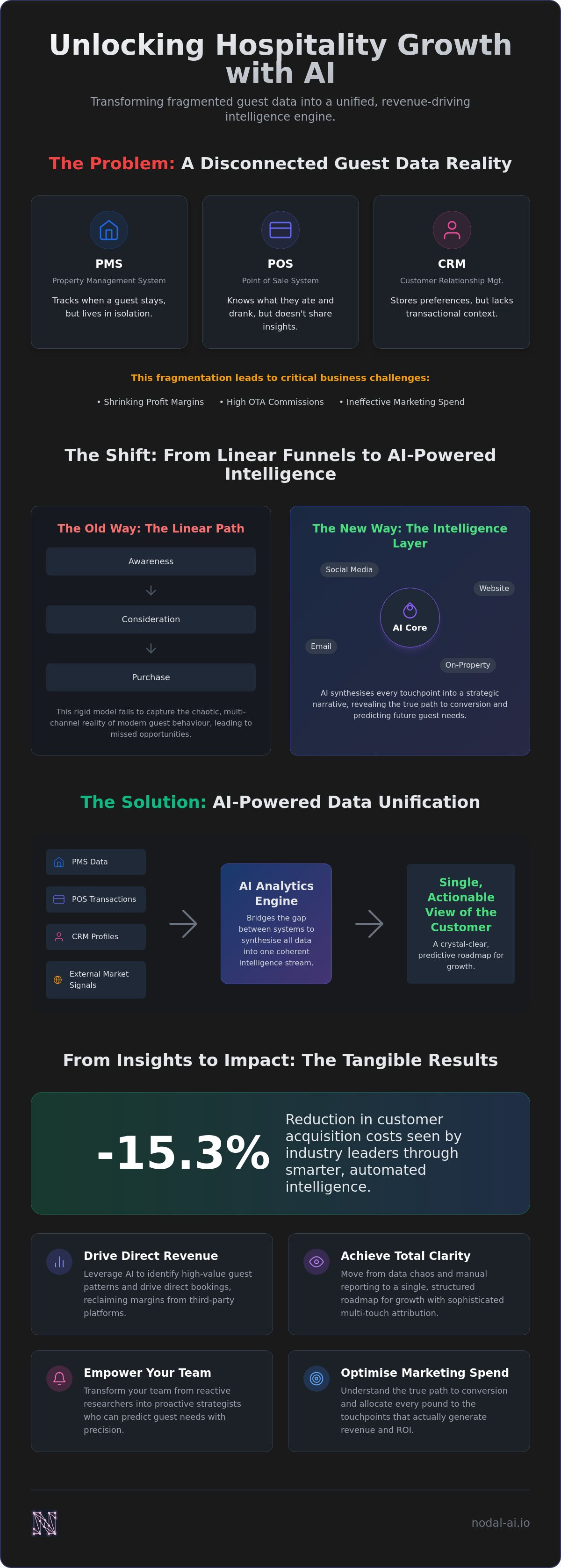
We recognise the immense pressure to perform in an increasingly competitive digital market where acquisition costs continue to climb. This article promises to show you how to transform these fragmented signals into a single, crystal-clear view of your customer to drive direct revenue. We'll explore how to bridge the gap between disconnected platforms, helping you to reclaim your booking margins and turn passive data points into active growth engines. Learn how to achieve the same results as industry leaders who have seen acquisition costs drop by 15.3 per cent through smarter, automated intelligence.
Key Takeaways
- Replace traditional linear funnels with a proactive intelligence layer that captures the true complexity of modern guest behaviour.
- Bridge the gap between your PMS, POS, and CRM systems to transform fragmented data into a single, actionable view of the customer.
- Enhance your predictive accuracy by integrating external market signals, such as local events and currency fluctuations, into your analysis.
- Leverage ai powered customer journey analytics to identify high-value guest patterns and drive direct booking revenue without the need for a massive internal data team.
- Follow a proven four-step framework to consolidate data and execute growth recommendations that significantly reduce your acquisition costs.
Beyond the Funnel: Why AI-Powered Customer Journey Analytics is Essential in 2026
Modern hospitality leaders are no longer satisfied with looking in the rear-view mirror. Traditional reporting tells you what happened last month, but it fails to explain why it happened or what will happen next. This is where ai powered customer journey analytics transforms your operations. It serves as a proactive intelligence layer that synthesises every guest interaction into a clear, strategic narrative. By shifting from reactive reporting to predictive commercial intelligence, you gain the ability to influence guest behaviour before they even reach your booking engine.
Today, the path to purchase is erratic and multi-dimensional. Guests don't follow a neat sequence of awareness, consideration, and purchase; they jump between channels, devices, and platforms at will. Attempting to manage this complexity with legacy tools leads to wasted spend and missed revenue. Adopt a sophisticated approach to resolve this complexity through automated data consolidation. This provides the relief that comes from total clarity, turning chaotic inputs into high-value commercial outputs.
The Death of the Linear Path to Purchase
In 2026, guests traverse dozens of touchpoints before a transaction occurs. Much of this happens in "dark social" or through offline interactions that traditional tracking tools simply cannot see. Mapping the customer journey is no longer about following a straight line; it's about understanding a complex ecosystem of intent and influence. Journey analytics is the process of connecting these fragmented digital footprints to reveal the true path to conversion. It provides a single view of the customer that spans every touchpoint, ensuring no interaction is left uncounted.
From Data Chaos to Strategic Clarity
For the modern commercial leader, the primary enemy is data fragmentation. Manually stitching together reports from the PMS and POS creates a state of constant anxiety and missed opportunities. Leveraging ai powered customer journey analytics allows you to replace that chaos with a sense of calm, streamlined efficiency. This transition represents a cognitive upgrade for your entire marketing department. It turns your team from reactive researchers into proactive strategists who can predict guest needs with surgical precision. Instead of fighting with spreadsheets, you focus on high-value growth recommendations that drive direct bookings and protect your margins.
Breaking Data Silos: How AI Unifies Fragmented Customer Intelligence
The core struggle for hospitality brands isn't a lack of data; it's the fragmentation of that data. Your Property Management System (PMS) knows when a guest stays, your Point of Sale (POS) knows what they ate, and your CRM tracks their personal preferences. However, these systems rarely communicate with each other. This disconnect forces marketing teams to make critical decisions based on incomplete snapshots rather than a holistic reality. By implementing ai powered customer journey analytics, you create a modular bridge that unifies these disparate sources into a single, high-value intelligence stream. This allows you to recognise patterns that were previously invisible, turning chaotic inputs into a structured roadmap for growth.
This unification allows for sophisticated multi-touch attribution that goes far beyond last-click models. Instead of guessing which channel drove a booking, you can see the exact path from the first social media interaction to the final checkout. It removes the ambiguity of marketing spend, ensuring every pound is allocated to the touchpoints that actually generate revenue. You move from a state of uncertainty to one of total commercial clarity. This level of transparency is essential for protecting margins against the rising costs of third-party platforms. It empowers you to invest with confidence, knowing exactly which campaigns are moving the needle.
Integrating Operational and Commercial Data
To truly understand your guest, you must connect booking engines with on-property spend. Room rates are only one part of the equation. POS data provides the missing context, revealing how guests interact with your bars, restaurants, and wellness facilities. When you integrate these operational signals, you can calculate the true lifecycle value of every individual. This intelligence allows the system to identify high-propensity guest segments automatically. You no longer waste resources on low-value acquisitions; instead, you focus on the guests most likely to return and spend more over time.
The Nodal Platform Advantage
The Nodal Platform modular architecture is designed specifically to solve the fragmentation problem in hospitality. It acts as a cognitive upgrade for your existing tech stack, seamlessly connecting systems like Mews, Cloudbeds, and SevenRooms. By leveraging ai powered customer journey analytics within a unified platform, you turn passive data into active growth recommendations. For a deeper look at how to structure this process, consult our definitive guide to the customer journey. If you are ready to see how this unified view can transform your bottom line, consider how Performance Marketing Analytics can reveal your hidden revenue opportunities.
The External Signal Advantage: Integrating Market Context into Journey Analysis
Relying solely on internal data is like navigating a ship by only looking at the deck. While your PMS and POS provide essential historical context, they cannot account for the external forces that dictate future guest intent. To truly master the market, you must integrate external signals into your decision-making process. By leveraging ai powered customer journey analytics, you can synthesise market context with your own operational data to create a high-definition view of the future. This approach turns passive market trends into active commercial advantages, allowing you to move beyond reactive reporting into the realm of predictive commercial intelligence.
True predictive accuracy requires a modular intelligence engine that understands how the world affects your business. Key external signals, such as weather patterns, FX rates, and local events, are the primary drivers of hospitality journeys. AI models use these signals to forecast demand and occupancy with surgical precision. For instance, flight demand data can act as an early warning system for international bookings. When the system detects a surge in searches for flights from a specific region, it can trigger proactive marketing campaigns to capture that intent before your competitors even realise the opportunity exists.
Predicting Need Periods Before They Occur
External trends often signal low occupancy need periods as far as six weeks in advance. This foresight allows you to shift from reactive, last-minute discounting to proactive demand generation. Instead of slashing rates to fill rooms at the eleventh hour, you use Predictive Modelling to identify and target high-value segments earlier in their journey. This protects your brand equity and your margins simultaneously. It's a strategy that applies across sectors; for example, specific weather patterns correlate directly with QSR footfall, allowing food and beverage operators to optimise staffing and inventory before a single guest arrives.
Currency Fluctuations and International Demand
Fluctuations in FX rates fundamentally alter the journey of the luxury international traveller, shifting their preference for destinations almost overnight. Sophisticated ai powered customer journey analytics adjust your audience segmentation based on these global economic signals in real time. If a currency strengthens, the system automatically prioritises that market, ensuring your Performance Marketing Analytics are always focused on the most profitable opportunities. Mastering these future-facing analytics provides a definitive competitive edge, replacing the anxiety of market volatility with the confidence of a cognitive upgrade for your entire organisation.
From Insights to Action: A Framework for Implementing AI-Driven Journeys
Transitioning from raw data to consistent revenue requires a structured methodology. You don't need an army of internal data scientists to achieve this; you simply need the right modular intelligence engine. Our four-step framework (Consolidate, Analyse, Predict, and Execute) provides a clear path from operational chaos to commercial success. This approach relies on analyst-approved AI that builds internal trust by providing transparent, verifiable logic behind every recommendation. By implementing ai powered customer journey analytics, you replace the anxiety of manual reporting with the relief of automated intelligence, freeing your team to focus on high-value strategic work rather than spreadsheet maintenance.
Step 1: Auditing Your Fragmented Data Landscape
Your first priority is identifying where your data is failing you. Most hospitality brands suffer from "broken" attribution data, where third-party platforms take credit for direct guest intent. Conduct a thorough audit to find these gaps and reclaim your booking margins. Use AI marketing analytics to pinpoint exactly where your digital footprints are being lost. The goal is to achieve total clarity across all channels, ensuring every touchpoint is an active participant in your growth strategy.
Step 2: Leveraging Growth Recommendations
Move beyond passive dashboards that only show what happened in the past. Real growth comes from actionable instructions that tell you exactly what to do next. Sophisticated ai powered customer journey analytics identify which specific promotions increase your overall margin rather than just shifting existing demand. This ensures your marketing efforts are truly incremental. By leaning on the predictive modelling pillar, you can forecast the outcome of every campaign before a single pound is spent, protecting your profitability at every turn.
Book a demo to see the framework in action
Driving Direct Revenue: The Nodal AI Approach to Customer Intelligence
Nodal AI stands as the definitive partner for hospitality brands obsessed with measurable returns. We don't just provide software; we deliver a strategic engine designed to reclaim your margins. Consider the transformation at Ovolo Hotels, where our platform delivered a 15.3 per cent reduction in acquisition costs. By deploying ai powered customer journey analytics, you move from a reactive stance to a position of total commercial dominance. You stop being a passive recipient of third-party bookings and start becoming an active architect of your own growth.
The primary goal is simple: reduce OTA leakage and maximise direct booking contributions. Every booking that shifts from an Online Travel Agency to your direct engine represents a significant victory for your bottom line. Our platform acts as a cognitive upgrade for your entire organisation, turning your historical data into a forward-looking roadmap. It identifies exactly where your revenue is being diverted and provides the precise instructions needed to bring it back home. This transition replaces the anxiety of manual data stitching with the confidence of a unified, high-level perspective.
Measurable ROI in Hospitality and F&B
Real results are the only metric that matters in a competitive market. Our clients have experienced an average 24.5 per cent increase in ROAS by focusing on the signals that actually drive conversion. The ai powered customer journey analytics within the platform identify the highest value guest segments for each specific property, ensuring your marketing spend is never wasted on low-propensity audiences. This level of granularity allows you to optimise your budget with surgical precision, ensuring every pound spent is an investment in long-term stability. To see how our modular architecture can be tailored to your specific needs, we invite you to book a professional demo and experience the clarity of automated intelligence.
The Future of Commercial Intelligence
The future belongs to those who can connect the dots before their competitors. By integrating your disparate systems into a unified view, you replace the anxiety of manual labour with the confidence of streamlined efficiency. Make more and waste less by transforming your passive assets into active participants in your business process. For a deeper understanding of how to quantify your success across every touchpoint, explore our mastering marketing attribution guide. The journey from fragmented data to profitable growth starts with a single, intelligent step toward total commercial clarity.
Master Your Commercial Future with Intelligence
Unifying fragmented data silos and integrating external market signals allows hospitality brands to move beyond the limitations of linear funnels. By adopting a proactive framework, you can reclaim booking margins and drive direct revenue with surgical precision. Implementing ai powered customer journey analytics is no longer a luxury; it's the definitive cognitive upgrade required to realise your full revenue potential in 2026. This modular, hospitality-first architecture ensures your marketing spend is always tethered to concrete business outcomes.
The transition from manual reporting to automated intelligence delivers immediate, measurable value. Our partners have achieved a 24.5 per cent increase in ROAS and a 15.3 per cent reduction in acquisition costs by simply connecting the dots within their existing tech stack. You can replace the anxiety of fragmented systems with the confidence of streamlined, high-level perspectives. Turn your chaotic data inputs into high-value commercial outputs today.
Book a demo to transform your customer journey data
Step into a future where every guest interaction is an opportunity for profitable growth.
Frequently Asked Questions
What is AI-powered customer journey analytics?
It is a proactive intelligence layer that synthesises guest interactions across all digital and physical touchpoints into a unified view. Unlike traditional reporting, it uses machine learning to identify hidden patterns in guest behaviour and predict future intent. This allows hospitality brands to move beyond static data and act on real-time growth recommendations that drive direct revenue.
How does AI help in mapping complex hospitality customer journeys?
AI automates the connection of fragmented digital footprints that legacy systems often miss. It tracks the guest from the initial search through to on-property spend at the POS, creating a single view of the customer journey. By processing thousands of variables simultaneously, it reveals the true path to conversion without the need for manual data stitching or tedious spreadsheet work.
Can AI analytics help reduce our reliance on OTAs like Booking.com?
Yes, it identifies exactly where third-party platforms are siphoning off direct intent and provides strategies to reclaim those bookings. By using ai powered customer journey analytics, you can target high-value guests before they reach an OTA. This focus on direct booking contributions helps protect your margins and reduces the high cost of acquisition associated with external platforms.
Do I need a data science team to use Nodal AI platform?
No, the platform is designed as an accessible cognitive upgrade for existing marketing and commercial teams. It provides analyst-approved growth recommendations in a user-friendly interface, removing the need for deep technical specialisation. You get the benefits of advanced predictive modelling and multi-touch attribution without the overhead of a dedicated internal data science department.
How does Nodal AI handle data from fragmented legacy systems?
The Nodal Platform uses a modular architecture to act as a bridge between disparate systems like your PMS, POS, and CRM. It cleans and unifies data from legacy software that typically doesn't communicate, resolving complexity automatically. This creates a transparent intelligence stream from chaotic inputs, ensuring you have a reliable foundation for high-level commercial decision-making.
What external signals can be integrated into the analytics model?
The model integrates market context such as weather patterns, currency fluctuations, and local event schedules to improve predictive accuracy. These signals are combined with your internal data to forecast demand and occupancy periods with greater precision. It allows you to anticipate market shifts, such as a surge in flight demand, and trigger proactive campaigns accordingly.
How quickly can we see results from implementing AI journey analytics?
Initial insights from automated reporting and data consolidation are typically visible within the first few weeks of integration. As the engine ingests more historical data, the predictive modelling becomes increasingly accurate. Most brands see a tangible impact on revenue as soon as they begin executing the system's growth recommendations and identifying high-propensity guest segments.
Is the Nodal platform compliant with UK data governance standards?
Yes, the platform is built with a protective focus on security and adheres strictly to UK data protection regulations. We prioritise the high-level protection of your assets and guest information, ensuring all processing meets modern compliance requirements. This focus on transparency and security allows you to innovate with confidence while maintaining total data integrity across your entire organisation.


