

Your most valuable guest didn't just appear on your booking engine by accident. They were likely nurtured through a dozen digital touchpoints that your current reporting suite simply cannot see. While 75% of companies have now adopted AI multi-touch attribution to solve this, many hospitality brands still struggle with data trapped in silos across PMS and POS systems. You know the frustration of watching OTA commissions climb while your top-funnel marketing spend remains an unproven expense.
It's time to stop guessing which channels actually drive your revenue. This guide explores how to unify your fragmented data into a single, actionable view of the customer journey. You'll learn how to deploy sophisticated intelligence to reduce acquisition costs, eliminate wasted spend, and significantly maximise your direct booking revenue. We'll preview the modular strategies that transform chaotic inputs into the high-value growth your organisation needs to lead the market in 2026.
Key Takeaways
- Identify why last-click attribution fails to track the non-linear path of modern guests across dark social and peer recommendations.
- Discover how AI multi-touch attribution uses probabilistic modelling to assign value to every interaction from the first search to the final booking.
- Learn why custom AI models outperform rigid, rule-based systems by adapting to the unique nuances of the hospitality sector.
- Follow a practical roadmap to consolidate data from your PMS, POS, and CRM into one clear customer journey map.
- Explore how modular intelligence reduces acquisition costs by identifying and eliminating areas of inefficient marketing spend.
The Crisis of Fragmented Data: Why Traditional Attribution Fails in 2026
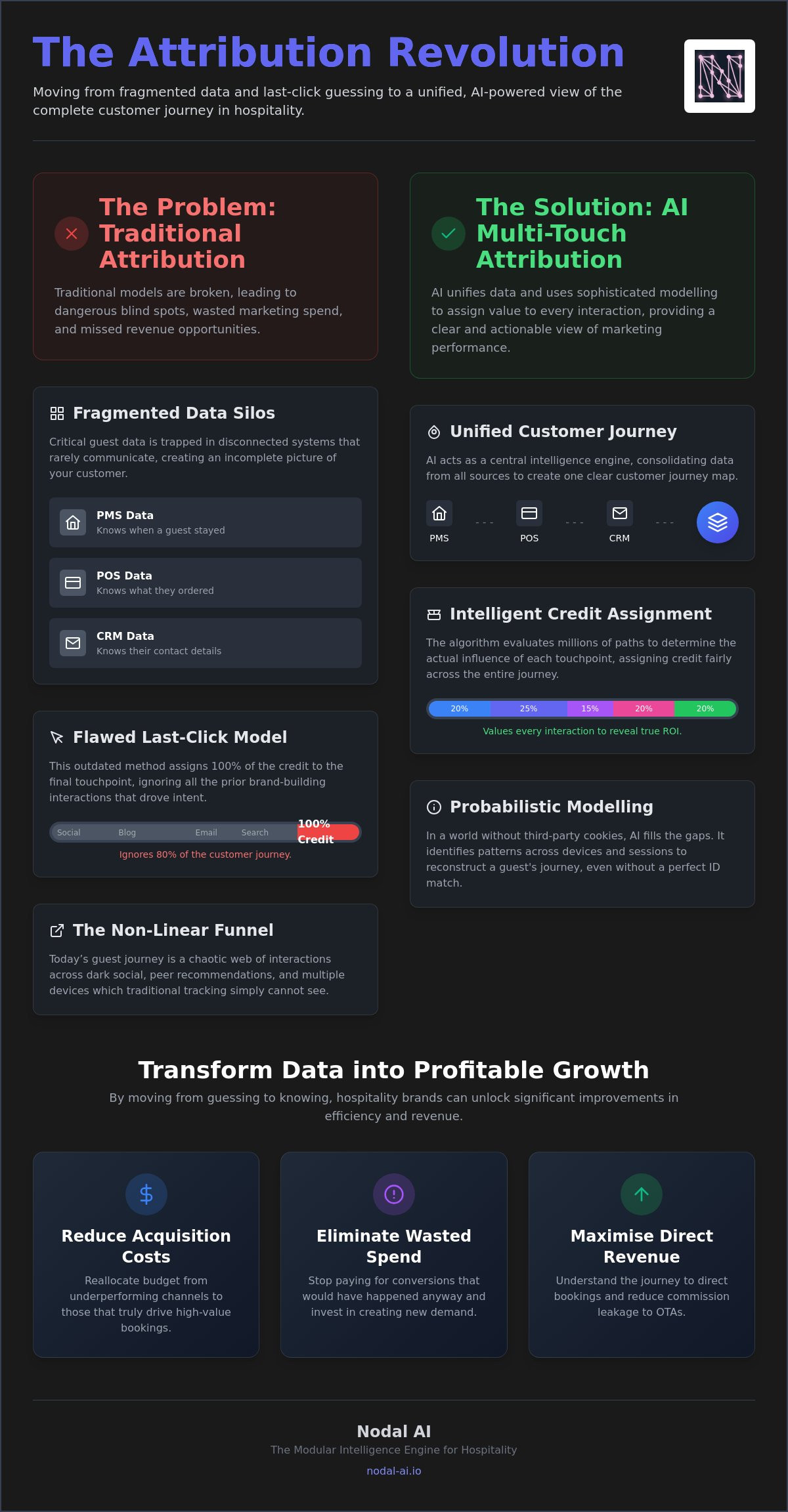
Traditional Marketing attribution is broken. In 2026, relying on last-click data is like trying to understand a complex novel by only reading the final sentence. It overvalues the voucher code site or the brand search ad while ignoring the months of brand building that actually drove the intent. For hospitality leaders, this creates a dangerous blind spot. You see the booking, but you miss the influence. This reliance on outdated models leads to a cycle of over-spending on the wrong channels while your most profitable opportunities remain invisible.
The hospitality sector faces a unique struggle with data fragmentation. Your Property Management System (PMS) knows when a guest stayed; your Point of Sale (POS) knows what they ordered at the bar; and your CRM knows their email address. Yet, these systems rarely communicate in real-time. This disconnect fuels "OTA leakage," a phenomenon where guests discover your brand through your own marketing efforts but ultimately book through a third-party platform because the direct path felt disjointed. Without AI multi-touch attribution, you're essentially subsidising your competitors' commissions with your own marketing budget. You can explore how to bridge these gaps using our modular intelligence features.
The Death of the Linear Funnel
The neat "awareness to purchase" funnel is a relic of the past. Today's guest journey is a chaotic web of podcast mentions, WhatsApp recommendations, and "dark social" interactions that traditional tracking cannot touch. With the 2026 enforcement of stricter GDPR guidelines and the total deprecation of third-party cookies, the old ways of stalking users across the web have ended. We've moved from a world of certain tracking to one of intelligent inference. To survive, brands must shift from tracking every click to understanding the collective impact of every touchpoint.
The Cost of Miscalculated ROI
Misreading your data carries a heavy price tag. When you over-invest in bottom-funnel retargeting, you often pay for bookings that would have happened anyway. This erodes your profit margins and starves your top-funnel brand awareness of the budget it needs to create future demand. Moving from guessing to knowing brings immediate psychological relief. It allows you to trust your spend again. By capturing the "halo effect" of your brand activity, AI multi-touch attribution helps you finally prove that your awareness campaigns are the engine of your growth, not just a line item of waste.
What is AI Multi-Touch Attribution and How Does it Work?
At its core, AI multi-touch attribution is a sophisticated machine-learning approach to credit assignment. It replaces the rigid, manual rules of the past with a dynamic system that learns from every interaction. Instead of a marketer deciding that the first click gets 40% of the credit, the algorithm evaluates millions of paths to determine the actual weight of each touchpoint. This creates a transition from static, backward-looking reporting to a living intelligence engine that evolves alongside your guests' behaviour. It ensures that every marketing pound is held accountable to the actual revenue it generates.
The Nodal Platform acts as a Modular Intelligence Engine, a central hub that personifies your disparate data sources. It treats your PMS, CRM, and website analytics not as separate silos, but as active participants in a unified business process. This engine doesn't just store data; it interprets it, ensuring that every external signal is factored into your performance metrics. For example, AI models can now ingest signals like local weather patterns, flight demand into your city, and major local events. If a sudden rainstorm in London drives a spike in last-minute stays, the AI accounts for this external lift so you don't mistakenly credit your search ads for a weather-driven surge.
To succeed in a landscape defined by privacy and complexity, your organisation needs a strategic roadmap for AI in marketing that prioritises data integrity over simple tracking. This shift allows you to move away from the anxiety of manual data entry and toward the confidence of automated, high-level perspectives.
Probabilistic vs Deterministic Modelling
Deterministic modelling relies on an exact match, such as a logged-in user or a persistent cookie. However, in 2026, these identifiers are increasingly rare due to privacy regulations. Probabilistic modelling uses AI to fill the gaps by identifying patterns across devices and sessions without requiring a perfect ID match. This allows the system to reconstruct a guest's journey even when they switch from a mobile search at breakfast to a desktop booking in the evening. Ultimately, AI multi-touch attribution serves as the cognitive upgrade for performance marketing, turning fragmented signals into a coherent narrative of intent.
Beyond Marketing: Incorporating Operational Data
True ROI remains invisible until you connect your marketing spend to your operational reality. By integrating with PMS platforms like Oracle OPERA or Mews, and pulling data from your POS, you can transform passive records into active growth drivers. This level of integration identifies high-propensity guest segments by analysing historical stay patterns and on-property spend. It allows for Growth Recommendations that go far beyond basic charts. You aren't just seeing what happened; you're being told where to move your budget next for maximum impact. You can book a demo to see these predictive modelling insights in action for your own properties.
Comparing AI Models: Moving Beyond Rigid Rules
Rules-based models are essentially a series of best guesses frozen in time. Whether it's a Linear model that treats every click as equal or a U-Shape model that over-prioritises the extremes, these frameworks lack the cognitive flexibility required for the modern hospitality landscape. They assume that every guest follows a predictable, static path. This approach ignores the reality of fluctuating demand and varied consumer intent. In contrast, AI multi-touch attribution acts as a living system. It doesn't rely on a marketer's intuition from three years ago. Instead, it observes thousands of successful conversions to determine which touchpoints actually moved the needle today.
Custom AI models significantly outperform generic, out-of-the-box solutions because they are built for the specific rhythms of the hospitality sector. A generic model often fails to understand that a luxury hotel booking might have a 60-day lead time with twenty distinct touchpoints, while a bar reservation happens in minutes. By specialising the logic to fit your specific business case, you transform fragmented inputs into a clear, profitable output. Nodal AI serves as this critical bridge, ensuring your data is not just collected but correctly interpreted to drive growth.
The Limitations of Rules-Based Attribution
Assigning a fixed 40% value to a first-touch interaction is an arbitrary strategy that often misleads your budget allocation. It fails to account for the context of the interaction. Was it a high-intent search or a passive social scroll? AI-driven models solve this by adjusting weightings in real-time based on actual performance data. They recognise when a specific channel is losing its influence and reallocate credit accordingly. For a deeper analysis of how these specific models compare and which one fits your portfolio, you can explore our Mastering Marketing Attribution guide, which provides a comprehensive breakdown for the 2026 market.
The Power of Incrementality
The most critical question in performance marketing is one of incrementality: what would have happened if you hadn't spent that pound? Traditional models often take credit for bookings that were already likely to occur due to brand loyalty or organic search. AI identifies the true marketing lift by isolating the touchpoints that actually changed a guest's behaviour. It separates the noise of incidental bookings from the signal of genuine growth. By using predictive modelling on this incremental data, you can forecast future revenue with a level of precision that rule-based systems simply cannot match. This clarity allows you to stop paying for what you already have and start investing in the new guests you've been missing.
Implementing AI Attribution: A Strategic Roadmap
Implementing AI multi-touch attribution is not a simple one-time technical task or a software toggle. It is a fundamental shift in how your organisation values its digital and physical assets. To move from chaotic data to profitable growth, you must follow a structured path that treats your technology stack as a single, living organism. This journey begins with the total removal of ambiguity and ends with the calm confidence of automated, high-level decision-making. By following a strategic roadmap, you transform passive data into an active participant in your business success.
Success in this transition requires a commitment to data integrity. When you treat your data as a cognitive upgrade for the entire organisation, the results manifest as both financial gain and operational efficiency. You move away from the anxiety of manual spreadsheets and toward a streamlined perspective that values every guest interaction correctly. This roadmap involves four critical stages:
- Step 1: Data Audit and Consolidation. Connect your PMS, POS, and CRM systems to create a single source of truth that reflects the entire guest lifecycle.
- Step 2: Mapping the Hospitality Customer Journey. Track every interaction from initial social discovery to the final booking confirmation with absolute precision.
- Step 3: Setting Commercial Goals. Define whether your priority is raw occupancy or high-margin direct bookings to guide the AI logic.
- Step 4: Activating Growth Recommendations. Use real-time prompts to optimise your marketing budget and eliminate areas of wasted spend.
Unifying Your Hospitality Tech Stack
Successful implementation requires seamless integration with the tools you already use. Whether you rely on Cloudbeds for management, SevenRooms for reservations, or Synxis for distribution, your data must flow without friction. Robust data governance is essential here. You need clean, standardised inputs to ensure the intelligence engine produces accurate outputs. The Nodal Platform features are specifically designed for this level of automated data ingestion, removing the manual burden from your internal teams.
From Insights to Action
The true value of AI multi-touch attribution lies in the time it recovers. By replacing manual reporting with automated intelligence, marketing teams can save upwards of 20 hours a week. This allows your staff to stop watching data and start executing strategy. Instead of debating which channel worked, they follow AI prompts that identify immediate opportunities for growth. This transition is most effective when supported by professional onboarding and expert consultancy, ensuring your system is tuned to your specific commercial nuances from day one.
Book a demo to start your roadmap
Maximising Profitability with Nodal AI
The ultimate goal of any modular intelligence engine is to turn passive data into active profit. Nodal AI achieves this by deploying AI multi-touch attribution to identify exactly where your budget is being wasted. By stripping away the ambiguity of fragmented systems, you gain a competitive advantage that goes beyond simple tracking. This is Commercial Intelligence in its purest form: the ability to see the future of your revenue before it even hits your bank account. You move from a reactive state of damage control to a proactive state of market leadership. Identify the leak. Plug the hole. Grow the margin.
In a crowded 2026 market, the brands that thrive are those that hold every marketing pound accountable. While your competitors continue to over-pay for OTA bookings, you can use automated reporting to reclaim your margins. Nodal AI acts as a cognitive upgrade for your organisation, transforming your PMS and CRM records into a roadmap for profitable growth. It is the difference between guessing your way through a budget and executing a precision-engineered strategy that guarantees measurable returns.
Proven Results in Hospitality
The impact of this technology is best seen through real-world performance. For Ovolo Hotels, the implementation of Nodal AI led to a 15.3% reduction in acquisition costs by identifying and eliminating inefficient spend. This clarity allowed for a 24.5% increase in Return on Ad Spend (ROAS), proving that you don't always need to spend more to earn more. Additionally, better guest segmentation driven by our intelligence engine resulted in a 5.5% increase in average booking value. Nodal AI is the partner for hospitality leaders who want to "make more and waste less."
Building for the Future
Predictive modelling allows you to stay ahead of market fluctuations rather than merely reacting to them. By analysing historical patterns and external signals, Nodal AI helps hotels identify "need periods" up to six weeks in advance. This foresight gives your team the time to launch targeted campaigns that fill rooms before the gap becomes a crisis. It turns your data into a protective asset that secures your long-term financial stability. We invite you to book a demo to see your own fragmented data transformed into clear intelligence. For a total commercial upgrade, explore the full capabilities of the Nodal Platform and start your journey toward data-driven growth today.
Take Control of Your Growth Strategy
The transition from fragmented data to profitable growth requires a fundamental shift in perspective. You've seen how legacy systems fail to capture the reality of the modern guest journey. By unifying your tech stack, you replace the anxiety of manual reporting with the calm efficiency of a single customer view. It's time to stop guessing and start leading with clarity.
Our specialised hospitality modular architecture has already delivered a 15.3% reduction in acquisition costs and a 24.5% increase in ROAS for industry leaders. These results represent the financial relief of knowing exactly where your marketing spend generates the most value. Implementing AI multi-touch attribution is the cognitive upgrade your organisation needs to lead the market in 2026.
Stop subsidising OTA commissions and start maximising your direct booking revenue through automated, intelligent decisions. You have the opportunity to turn your passive data into your most active commercial asset. We're ready to help you realise your property's full commercial potential and achieve lasting stability.
Book a Nodal AI demo to unify your data and increase direct bookings
Step into a future where your data works for you. The path to streamlined, high-level perspectives is now open for your organisation to follow.
Frequently Asked Questions
What is the primary difference between AI attribution and standard multi-touch models?
Standard multi-touch models rely on static, human-defined rules that assign fixed percentages to specific clicks. For example, a linear model might give 25% credit to four different touchpoints regardless of their actual influence. In contrast, AI multi-touch attribution uses machine learning to evaluate thousands of guest journeys and determine the actual weight of every interaction. This dynamic approach allows the system to adapt to changing market conditions and guest behaviours in real-time.
How does AI multi-touch attribution handle offline conversions in hospitality?
The system bridges the gap between digital discovery and physical stays by integrating directly with your Property Management System (PMS) and Point of Sale (POS). It uses probabilistic modelling to match digital touchpoints, such as a website visit or an ad click, with the final guest record in your PMS. This allows you to credit a specific social campaign for a high-value dinner reservation or a multi-night stay that was booked over the phone or at the front desk.
Can AI attribution work if our data is currently fragmented across different systems?
Consolidating fragmented data is exactly what the Nodal Platform is designed to do. Our modular intelligence engine acts as a central hub that pulls information from your disparate silos, including your CRM, PMS, and various marketing platforms. By unifying these inputs into a single view, we transform chaotic data into clear, actionable intelligence. You don't need a perfect tech stack to start; the platform creates the order you need to grow.
How long does it typically take to see results from implementing an AI attribution engine?
Most hospitality brands begin to see clear patterns and "quick win" opportunities within the first 30 days of implementation. During this initial phase, the AI identifies obvious areas of wasted spend where channels are claiming credit for bookings they didn't influence. Over a period of three to six months, the AI multi-touch attribution models become increasingly sophisticated as they ingest more conversion data, leading to more precise growth recommendations and long-term ROI lift.
Is AI multi-touch attribution compliant with GDPR and modern privacy standards?
Our platform is built with privacy-by-design principles to ensure full compliance with GDPR, the EU AI Act, and evolving state laws like the CCPA. We focus on probabilistic modelling and aggregate data patterns rather than tracking sensitive personal identifiable information (PII). This allows you to maintain high-level marketing transparency and accuracy without compromising guest privacy or risking regulatory penalties in the complex 2026 legal landscape.
What specific hospitality systems can Nodal AI integrate with for better attribution?
Nodal AI features native integrations with the most widely used systems in the hospitality and F&B sectors. This includes major PMS platforms like Oracle OPERA and Mews, reservation tools like OpenTable and SevenRooms, and property management suites like Cloudbeds. We also connect with distribution systems such as Synxis to ensure that every part of your guest journey, from the first search to the final check-out, is captured in your reporting.
How does predictive modelling differ from historical attribution reporting?
Historical reporting tells you what happened in the past, whereas predictive modelling uses that data to forecast what will happen next. While attribution helps you understand which previous campaigns drove revenue, our predictive tools identify upcoming "need periods" and suggest the best budget allocation to fill those gaps. It shifts your team from a reactive state of looking at last month's charts to a proactive state of securing future occupancy and revenue.
Why is incrementality so important for calculating true marketing ROI?
Incrementality measures the genuine lift your marketing provides by identifying which bookings would not have happened without your ad spend. Many traditional models overvalue bottom-funnel channels by giving credit for guests who were already planning to book directly. By isolating incremental revenue, you can stop paying for "organic" conversions and reallocate that budget toward finding new guests. This is the key to our philosophy of helping you make more while wasting less.


