

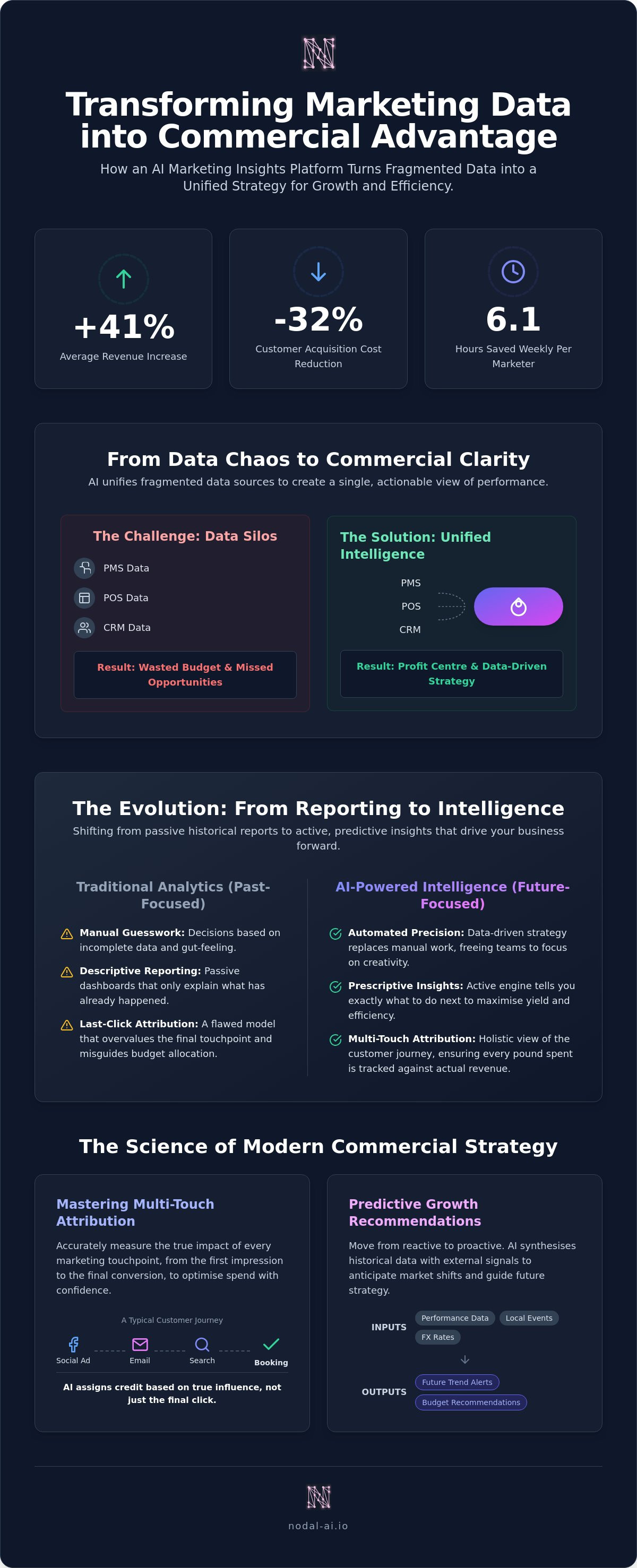
Organisations implementing AI in marketing now report an average revenue increase of 41 per cent alongside a 32 per cent reduction in customer acquisition costs. Despite these gains, you likely feel the weight of fragmented data scattered across your PMS, POS, and CRM systems. It's frustrating to watch your team lose six hours a week to manual reporting. You need an ai marketing insights platform to prove ROI immediately. You understand that data is your most valuable asset, yet it often feels like a silent bystander rather than an active driver of your commercial strategy.
This article shows you how to transform that chaos into a competitive advantage. We will explore how to unify disparate systems to achieve a single, crystalline view of your performance. You'll discover how predictive modelling and automated reporting replace guesswork with precision, allowing you to anticipate market shifts before they happen. By the end, you'll have a clear roadmap to faster decision-making and the commercial efficiency required to lead throughout 2026.
Key Takeaways
- Learn how an ai marketing insights platform acts as a unified intelligence layer, transforming chaotic data into high-value prescriptive actions.
- Master the use of multi-touch attribution and predictive modelling to measure true marketing impact and anticipate future commercial trends with precision.
- Discover why modular architecture provides the agility needed to outpace legacy systems and adapt to the evolving regulatory landscape of 2026.
- Realise the benefits of synchronising fragmented sources like PMS and CRM to achieve a single, transparent view of your entire operational performance.
- Gain insights into the Nodal Platform's ability to drive commercial efficiency, helping your organisation make more and waste less through automated intelligence.
What is an AI Marketing Insights Platform?
An ai marketing insights platform is far more than a simple dashboard or a collection of colourful charts. It acts as a unified intelligence layer, connecting your marketing spend directly to operational outcomes like room bookings or hospitality covers. By integrating Artificial intelligence in marketing, businesses move beyond descriptive analytics that merely explain the past. Instead of asking what happened last month, you receive prescriptive insights that tell you exactly what to do next to maximise yield. This technology breaks down the walled gardens of individual ad platforms, offering a cognitive upgrade that turns your marketing department into a profit centre.
Most traditional tools focus on isolated metrics. When you deploy an ai marketing insights platform, you replace manual guesswork with automated precision. It provides a holistic view of the customer journey, ensuring that every pound spent is tracked against actual revenue. This shift from gut-feeling to data-driven strategy allows your team to focus on high-level creativity while the platform handles the complex heavy lifting of data synthesis.
The Evolution from Analytics to Intelligence
Why Traditional Reporting Fails in 2026
In 2026, relying on last-click attribution is a recipe for commercial stagnation. Customers move across multiple devices and platforms before they ever decide to buy. Data silos, where your PMS doesn't talk to your CRM, create a fragmented view of the customer journey. This fragmentation leads to inaccurate attribution and wasted budget. The rising cost of manual data consolidation makes human error a significant financial risk. When your data is disconnected, your growth is capped. You can explore specific features that address these silos to reclaim control over your commercial performance.
The Science of Predictive Modelling and Multi-Touch Attribution
Measurement in 2026 requires more than a simple tally of clicks. To truly understand commercial impact, you must adopt multi-touch attribution (MTA) as your foundational metric. This approach allows you to see every interaction a guest has with your brand, from the first social media impression to the final booking confirmation. By leveraging an ai marketing insights platform, you move beyond biased, single-point models. You begin to see the future of marketing through the lens of incrementality, identifying which channels actually drive new revenue versus those that merely claim credit for existing demand.
Calculating real marketing ROI depends on your ability to isolate variables and understand true incrementality. It's about knowing exactly what would have happened if you hadn't spent that extra pound. This level of transparency replaces the anxiety of unproven spend with the confidence of measurable returns. When your data sources are unified, your marketing assets transform from passive expenses into active participants in your business growth.
Mastering Multi-Touch Attribution
Simplified models often lead to wasted budget because they ignore the complex reality of the customer journey across various devices. Modern marketing attribution uses sophisticated algorithms to weight each touchpoint based on its actual propensity to convert. This ensures that top-of-funnel activities, which often introduce your brand to new audiences, receive the credit they deserve. AI-driven systems remove the ambiguity of multi-device paths, allowing you to reallocate spend with total confidence. When you stop over-valuing the final click, you start prioritising the interactions that build long-term commercial value.
Predictive Growth Recommendations
Predictive modelling represents the shift from reactive reporting to proactive strategy. By synthesising historical performance with external signals like local events, FX rates, and weather patterns, your platform forecasts future demand with startling accuracy. This transition from static visualisations to actionable predictive modelling outputs enables you to identify 'need periods' weeks in advance. Instead of reacting to a slow weekend after it happens, you can shift budgets to capture high-propensity guest segments before they even start their search. If you're ready to see how these insights apply to your specific data, you can request a platform walkthrough to explore the possibilities.
Evaluating Platforms: Modular Architecture vs. Legacy Systems
Selecting the ideal ai marketing insights platform requires a shift in perspective. Many organisations remain tethered to legacy suites that offer a monolithic, one-size-fits-all approach. These systems often struggle to adapt to the specific nuances of the hospitality sector, leading to rigid workflows and underutilised features. In contrast, a modular intelligence engine allows you to integrate only the data streams that are vital to your current operations. This flexibility is essential for realising the transformative impact of AI in marketing, as it ensures your technology stack remains lean and responsive to market shifts.
Legacy systems often act as data graveyards where information enters but rarely provides actionable value. Modern platforms reverse this trend by acting as active participants in your commercial strategy. They translate complex algorithmic outputs into clear, conversational insights that your entire team can understand. This transparency removes the ambiguity that often plagues enterprise reporting, replacing it with the confidence of a unified perspective across every department.
The Benefits of a Modular Approach
A modular architecture provides the agility needed to outpace traditional competitors. By implementing specific modules, such as Commercial or Operational intelligence, you receive tailored insights that address your most pressing pain points immediately. This approach allows you to start small and scale your data volume as your organisational maturity grows. It effectively reduces software bloat, ensuring you only pay for the intelligence features you actually need to drive revenue. This streamlined methodology turns your technology stack into a high-performance engine rather than a costly administrative burden.
Key Features to Look for in 2026
In 2026, the ability to process data in real time is a baseline requirement. Your chosen ai marketing insights platform must include automated anomaly detection to flag performance deviations before they impact your yield. Look for interfaces that prioritise user experience, allowing commercial leaders to navigate complex data without requiring a background in data science. You can explore the Nodal Platform features to see how modern teams are already automating their reporting workflows. Seamless integration remains the most critical factor. If a platform cannot easily connect with your existing Property Management Systems and enterprise CRM tools, it will simply become another isolated silo that hinders your commercial progress.
Consolidating Fragmented Data Sources for Unified Intelligence
Fragmented data is the primary barrier to commercial clarity. In the hospitality sector, your valuable information is often trapped within isolated silos like your Property Management System (PMS), Point of Sale (POS), and Customer Relationship Management (CRM) tools. An ai marketing insights platform serves as the bridge between these disparate sources, ingesting raw data and transforming it into a unified intelligence stream. The platform automatically cleans and normalises this data, resolving duplicates and correcting inconsistencies that would otherwise lead to flawed decision-making. This process establishes a single source of truth, ensuring that every commercial leader in your organisation is looking at the same verified performance metrics.
Establishing this clarity requires more than just technical connections; it demands a robust data governance framework to maintain integrity over time. By centralising your data, you move from reactive troubleshooting to strategic orchestration. You no longer have to wonder if your marketing spend actually resulted in an on-property dinner reservation or a spa booking. The platform makes these connections automatically, personifying your data and turning it into an active participant in your growth strategy.
Solving the Hospitality Data Problem
Connecting legacy systems like Oracle OPERA or modern cloud solutions like Mews with your digital marketing platforms is the only way to track a guest's complete path. You can finally see the journey from the first social media ad click through to the final checkout bill. This visibility is vital for identifying OTA leakage. When you understand exactly why guests choose third-party booking sites over your direct channels, you can adjust your strategy to reclaim those margins. Unifying these fragmented sources allows you to personalise the booking experience, driving higher direct conversion rates and reducing your reliance on expensive intermediaries.
Predicting Churn and Lifetime Value
Integrated data allows you to build a significantly more accurate customer journey map. By combining historical booking patterns with real-time ancillary spend at the bar or spa, you can calculate the true lifetime value of every guest. This intelligence enables your ai marketing insights platform to identify early warning signs of churn risk, particularly in membership or subscription models. If a high-value guest's engagement drops, the system can trigger prescriptive recommendations to win them back before they disappear. You can book a platform demo to see how this unified intelligence can transform your guest retention strategy and drive long-term commercial efficiency.
Driving Commercial Performance with the Nodal Platform
Nodal AI acts as the definitive intelligence engine for the global hospitality sector, providing the technical scaffolding required to turn room bookings and guest data into a cognitive upgrade for your entire organisation. While earlier sections explored the mechanics of attribution, this ai marketing insights platform focuses on the practical application of the "Make more, waste less" philosophy. It's a London-based technology designed to help commercial leaders move beyond the anxiety of unproven spend and embrace a culture of measurable, high-value returns. By personifying your passive data, Nodal AI transforms it into an active participant in your growth strategy.
For enterprises seeking a competitive edge, the platform removes the friction associated with manual reporting. It provides a transparent view of performance, allowing you to reallocate resources with total confidence. This shift ensures that your marketing assets are always aligned with your broader commercial objectives, replacing complexity with streamlined, high-level perspectives.
Proven Results in Performance Marketing
The impact of shifting from intuition to automated intelligence is quantifiable. For hotel clients like Ovolo Hotels, the implementation of our modular architecture led to a 15.3 per cent reduction in acquisition costs and a 24.5 per cent increase in ROAS. These results stem from AI-driven audience segmentation that identifies high-propensity guests with surgical precision. Automated growth recommendations ensure that every pound of your paid search budget is optimised for maximum yield, allowing you to capture demand that legacy systems simply cannot see. It's the difference between guessing where your guests come from and knowing exactly how to reach them.
Getting Started with Nodal AI
Transitioning to a data-led culture requires a structured approach to mapping your complex data sources. Our professional onboarding process for London enterprises ensures that systems like Oracle OPERA are seamlessly integrated into your new intelligence layer. We focus on identifying your first "quick win" within weeks, typically by using predictive insights to uncover hidden revenue opportunities in your current booking funnel. If you're ready to see how the Nodal Platform can synchronise your operations, we invite you to book a demo to begin your journey toward commercial mastery.
Master Your Commercial Future with Unified Intelligence
The transition from fragmented silos to a unified intelligence layer is no longer a luxury; it's a commercial necessity. By implementing an ai marketing insights platform, you transform passive data into active participants in your business growth. This shift replaces the anxiety of manual, tedious reporting with the confidence of streamlined, high-level perspectives. You have the power to move beyond reactive analytics and embrace predictive precision, ensuring every pound of your marketing spend drives measurable returns.
Nodal AI's modular, hospitality-first architecture is already delivering significant value for industry leaders. Our partners have realised a 24.5 per cent increase in ROAS and a 15.3 per cent reduction in acquisition costs through our intelligence engine. These results prove that when you connect your PMS, POS, and CRM systems, growth becomes inevitable. You possess the tools to outpace the competition and lead your sector with total clarity. The complexity of the modern market doesn't have to be a barrier; instead, let it be the catalyst for your next phase of commercial efficiency.
Book a Nodal AI demo to transform your marketing data and start your journey toward commercial mastery today. Your future-facing strategy begins with a single, intelligent connection.
Frequently Asked Questions
What is an AI marketing insights platform?
An ai marketing insights platform is a unified intelligence layer that synchronises fragmented data from your PMS, POS, and CRM systems. It replaces manual reporting with automated, prescriptive insights that guide your commercial strategy. This technology transforms passive data into an active participant in your business, allowing you to move from simply observing past events to predicting future growth with total clarity.
How does an AI insights platform differ from standard Google Analytics?
Standard tools like Google Analytics focus primarily on website traffic and digital interactions in isolation. An ai marketing insights platform goes much further by linking that digital intent to actual operational outcomes like room revenue and ancillary spend. It provides a single source of truth that accounts for the entire customer journey, offering a level of attribution clarity that isolated web analytics cannot match.
Can an AI platform help reduce our reliance on OTAs?
Yes, these platforms are designed to reclaim margins by identifying the exact touchpoints where guests migrate to third-party sites. By understanding the booking behaviour across all your integrated systems, you can optimise your direct channels to offer a more personalised and competitive experience. This intelligence helps you target high-propensity guests more effectively, reducing your dependence on expensive intermediaries and driving higher direct conversion rates.
How long does it take to integrate our existing PMS and CRM data?
The integration process is highly structured and depends on the specific systems you use, such as Oracle OPERA or other enterprise-level cloud solutions. While mapping complex data requires precision, a modular architecture allows for the rapid synchronisation of core sources. Most organisations begin to realise actionable insights and identify initial "quick win" opportunities within the first month of professional onboarding.
Is an AI marketing insights platform suitable for smaller hotel groups?
Absolutely. Modular intelligence engines are particularly beneficial for smaller groups because they allow you to scale your data volume as your organisation matures. You don't need a massive internal data science team to benefit from high-level perspectives. You can start with the specific features you need today and expand your capabilities as your commercial requirements evolve, ensuring you only pay for the intelligence you use.
What are the security implications of connecting all our data sources?
Security is a foundational priority for any enterprise-ready system. Modern platforms operate within strict data governance frameworks to ensure compliance with global regulations, such as the EU AI Act. By centralising your data through a secure intelligence layer, you actually reduce the risk of human error and unauthorised access associated with manual spreadsheet management and fragmented data storage. For organisations managing large-scale integrations, consulting experts in MDR services Dubai can further strengthen your defensive posture against evolving cyber threats.
Does the platform provide specific recommendations or just data?
The platform provides prescriptive recommendations that tell you exactly what actions to take next. Rather than leaving you to interpret a static dashboard, the intelligence engine identifies performance gaps and suggests specific budget reallocations or audience shifts. This proactive approach replaces the anxiety of guesswork with the confidence of data-backed strategy, allowing your team to focus on high-level execution.
How does predictive modelling help with marketing budget planning?
Predictive modelling uses historical performance and external signals to forecast future demand periods with startling accuracy. This allows you to plan your marketing budget with precision, shifting spend to capture demand before your competitors even realise it exists. It replaces reactive, last-minute discounting with a proactive strategy that maximises yield and ensures long-term commercial efficiency.


