
By 2026, the gap between hotels that merely collect data and those that command it has become a defining commercial chasm. You likely feel the weight of this daily while you juggle disconnected reports from your PMS, POS, and CRM systems. It is exhausting to spend hours on manual reporting only to realise you still cannot pin down which marketing channels actually drive your direct bookings. You know the answers are hidden within your tech stack. They remain just out of reach, buried under layers of fragmentation and manual effort.
This strategic framework changes your trajectory. You will discover how to transform these chaotic inputs into precise data-driven growth recommendations that fuel measurable revenue and operational efficiency. We will explore how to establish a single view of your performance, allowing you to reduce OTA leakage and deploy predictive insights for low-occupancy periods. Prepare to move beyond the experimental phase of analytics. It is time to adopt a streamlined, high-level perspective that turns your passive data into your most active commercial partner.
Key Takeaways
- Shift from traditional reporting to predictive insights to understand exactly what actions to take next for commercial success.
- Master the use of integrated systems to generate data-driven growth recommendations that unify fragmented internal data with external market signals.
- Identify hidden performance trends and optimise marketing spend through the power of multi-touch attribution and machine learning.
- Build a resilient roadmap for growth by auditing data silos and establishing a governance framework that ensures long-term stability and compliance.
- Reduce acquisition costs and eliminate OTA leakage by transforming passive data into active, high-value commercial intelligence.
The Shift from Passive Analytics to Active Growth Recommendations
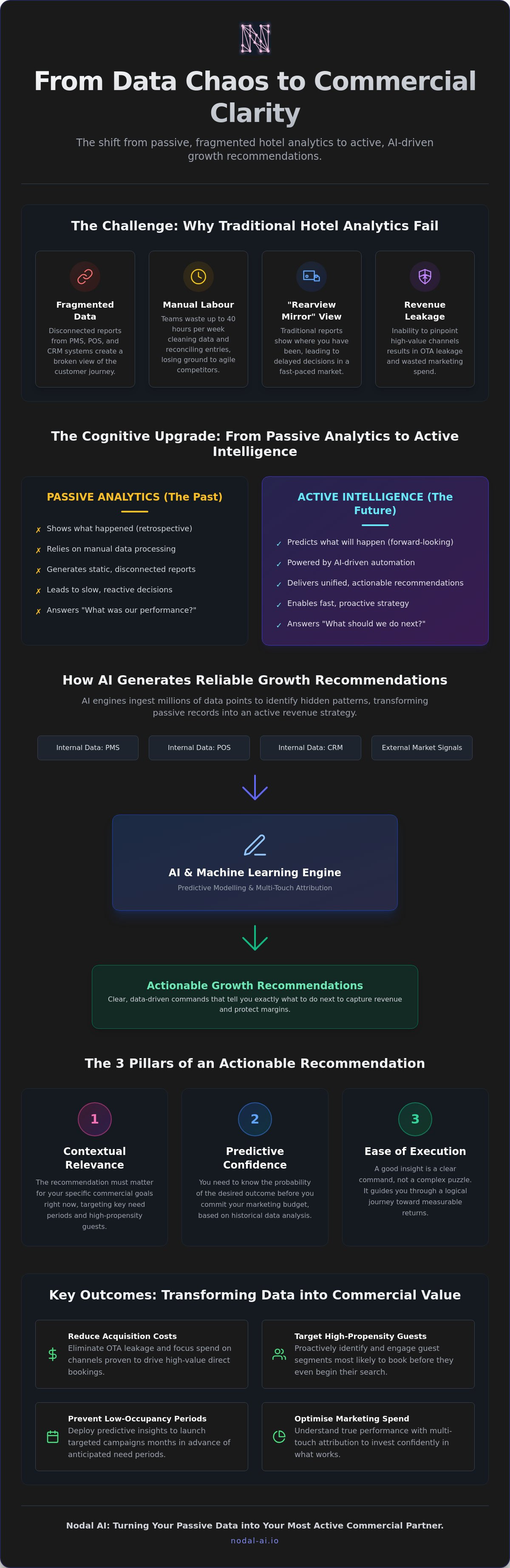
The hospitality landscape in 2026 has no room for guesswork. While global technology spending has climbed to $5.6 trillion, many commercial leaders still find themselves drowning in disconnected spreadsheets. You must shift your focus from passive analytics to active growth recommendations. This isn't just a technical update; it's a fundamental change in how you operate. Traditional reporting is a rearview mirror. It shows you where you have been. In contrast, data-driven growth recommendations act as a GPS. They provide automated, predictive insights that tell you exactly what to do next to capture revenue and protect your margins.
We view this shift as a cognitive upgrade for your entire organisation. Manual data processing is no longer sustainable. Marketing leaders now expect AI-driven automation to more than double by 2028, according to Gartner research. If your team is still spending forty hours a week cleaning PMS data or reconciling POS entries, you are losing ground to more agile competitors. You need commercial intelligence that unifies fragmented sources into a single, high-value output. This allows you to stop wondering "what happened" and start executing on "what's next" with total confidence. It is the only way to truly make more and waste less.
Why Traditional Dashboards Fail to Drive Growth
Data fragmentation is the primary reason traditional dashboards fail. When your PMS, POS, and CRM systems exist in silos, your view of the customer journey is broken. You end up chasing vanity metrics like "total reach" or "impressions" that often obscure the path to actual revenue. This leads to delayed decision-making. In a fast-paced market, a delay of even forty-eight hours can mean the difference between a full house and empty rooms. Without a unified view, you are essentially flying blind while looking at a map of where you were yesterday.
The Anatomy of an Actionable Growth Recommendation
To be effective, data-informed decision-making must be built on three distinct pillars. First, contextual relevance. The recommendation must matter for your specific commercial goals right now. Second, predictive confidence. You need to know the probability of the desired outcome before you commit your marketing budget. Finally, ease of execution. A good insight is a command, not a puzzle. It should guide you through a logical journey toward measurable returns. You can explore how these pillars are integrated into modern systems by reviewing the Nodal Platform features. True data-driven growth recommendations replace the anxiety of manual labour with the clarity of streamlined, high-level perspectives.
How AI Engines Generate Reliable Growth Recommendations
Intuition is a liability in a market defined by rapid shifts. In 2026, AI engines transform raw data into data-driven growth recommendations by identifying patterns that escape human observation. Machine learning algorithms digest millions of data points from your integrated systems, surfacing hidden performance trends that standard reporting tools miss. This process moves your organisation from the anxiety of best guesses to the confidence of algorithmic certainty. By ingesting years of historical data, these engines learn your property's unique DNA, ensuring that every insight is grounded in your specific commercial reality.
The advantages of data-driven decision-making are clear. Companies that rely on these automated insights act with greater speed and precision than those stuck in manual cycles. Accuracy depends on the depth of historical ingestion. When an engine understands your past seasonal trends and booking behaviours, it can pinpoint exactly where your next opportunity lies. It transforms passive records into active participants in your revenue strategy, providing a cognitive upgrade that allows you to scale without adding headcount.
The Power of Predictive Modelling
Predictive modelling allows you to stop reacting to low occupancy and start preventing it. AI identifies high-propensity guest segments before they even begin their search. It predicts "need periods" with high accuracy, allowing you to deploy targeted campaigns months in advance. This proactive stance ensures you are always ahead of the curve, capturing demand while competitors are still looking at last week's spreadsheets. For a deeper look at the technology, explore our guide on predictive modelling.
Multi-Touch Attribution: Tracking the Real Value
Last-click models are dangerous. They credit the final touchpoint while ignoring the five or six interactions that actually built the intent. This leads to poor data-driven growth recommendations that waste budget on the wrong channels. Multi-touch attribution maps the entire customer journey, assigning value where it is actually earned. Whether it is an initial social media discovery or a mid-funnel email, you see the true influence of every pound spent. You can master this strategy by reading our definitive guide for 2026 on marketing attribution.
If you want to see how this intelligence unifies your specific tech stack, you can examine our platform features to understand the modular architecture in action. Moving from intuition to evidence is the first step toward total commercial clarity.
Beyond Internal Data: Integrating External Signals for Competitive Edge
Your internal property management system (PMS) and point-of-sale (POS) data tell a compelling story about your past, but they only represent half of the commercial equation. Relying solely on internal metrics is like trying to navigate a ship by only looking at the engine room. To achieve total clarity, you must integrate external signals into your strategic framework. These signals, ranging from flight demand and local events to fluctuating FX rates, provide the necessary context to refine your data-driven growth recommendations. Without this outside-in perspective, you risk making decisions based on a partial truth.
The transition from inward-looking analytics to outward-facing intelligence is a hallmark of a mature economic growth model for the data economy. In this environment, data functions as an active asset that bridges the gap between your property and the global market. Weather patterns also play a critical role, as they dictate booking lead times and ancillary spend. A sudden forecast of sunshine in London can trigger a surge in last-minute terrace bookings, while a rainy week might shift demand toward indoor wellness services. By personifying these external factors, you transform them from uncontrollable variables into active participants in your revenue strategy.
Capitalising on Local Events and Tourism Trends
Local events act as powerful catalysts for city-wide demand. Whether it is a major sporting final or a global tech conference, these events create specific "need periods" that you must identify long before they appear in your occupancy reports. You can use ai marketing analytics to process these external data points in real time. This allows you to adjust your pricing and marketing spend dynamically. Instead of reacting to a surge in demand, you anticipate it, ensuring your property is positioned to capture the highest-value bookings while competitors are still catching up.
Economic Signals: FX Rates and Global Demand
Economic signals like currency strength directly impact international guest demographics. When the pound weakens against the dollar, your property becomes more attractive to the North American market. You should tailor your promotions to these high-value markets based on real-time FX rates. This level of precision allows you to optimise ad spend for regions with the highest booking propensity. By aligning your commercial strategy with global economic shifts, you ensure your data-driven growth recommendations are always grounded in the most current market reality. It is the difference between general outreach and surgical precision.
Building Your Roadmap for Data-Driven Decision Making
Transforming your vision into a measurable commercial reality requires a structured path. It is not enough to simply possess data; you must command it through a rigorous roadmap. Start by auditing your current data sources to identify the silos that prevent a total view of your performance. Establishing a robust data governance framework is equally critical in 2026. With the enforcement of transparency duties under the EU AI Act and evolving regional privacy laws, your framework ensures that data-driven growth recommendations are both compliant and high-quality. This structure replaces the anxiety of ambiguity with the certainty of protected, reliable assets.
Step 1: Consolidate Your Fragmented Tech Stack
Fragmentation is the enemy of efficiency. You need to integrate your PMS, POS, and CRM into a single source of truth to eliminate the friction of disconnected reporting. Real-time data flow is non-negotiable for accuracy. When your systems talk to each other instantly, your data-driven growth recommendations reflect the current pulse of your business rather than a week-old snapshot. You can see how we handle these complex connections by exploring our modular platform features. This integration is the foundation of cognitive upgrades across your organisation.
Step 2: Prioritise High-Impact Recommendations
Not all insights carry the same commercial weight. You should focus your initial efforts on direct booking growth to combat the persistent drain of OTA commissions. This is where the most immediate revenue gains are found. For instance, hospitality leaders like Ovolo Hotels have achieved a 15.3% reduction in acquisition costs by prioritising direct channels. You should also identify churn risks in your membership models before they impact your long-term stability. By using customer journey mapping, you can personalise offers that resonate with high-value guests at the exact moment they are ready to book.
If you are ready to stop managing spreadsheets and start managing revenue, you can book a demo of the Nodal Platform to see how we unify your commercial intelligence.
Nodal AI: Transforming Fragmented Hospitality Data into Commercial Intelligence
Generic growth tools often fail because they lack the specialist knowledge required to navigate the hospitality sector's unique tech stack. While other platforms offer surface-level analytics, the Nodal Platform operates as a modular intelligence engine specifically designed for hotels, restaurants, and wellness centres. We understand that your data is currently trapped in silos across Oracle OPERA, Mews, or Cloudbeds. Our mission is to liberate that information, transforming it into data-driven growth recommendations that fuel your bottom line. We operate under a simple but powerful philosophy: make more and waste less.
This approach delivers measurable returns that go far beyond vanity metrics. For instance, our partnership with Ovolo Hotels resulted in a 15.3% reduction in acquisition costs, proving that precision beats volume every time. By unifying your fragmented systems, we replace the anxiety of manual reporting with the relief of automated, high-level perspectives. You gain a partner that is obsessed with your financial performance and long-term stability. With our London-based team providing expert support and global implementation, you are never left to navigate complex data challenges alone.
Modular Solutions for Hotels, QSR, and Wellness
Our architecture is built around specific use cases to ensure immediate relevance. The Demand module focuses on reducing OTA leakage and improving direct revenue, while the Operational module provides predictive modelling for staff utilisation and inventory management. This modularity means you can address your most pressing pain points first without a total system overhaul. By personifying your passive assets, we turn your occupancy data and guest history into active participants in your commercial strategy. It is the cognitive upgrade your organisation needs to stay competitive in 2026.
Get Started with Strategic Growth Recommendations
The journey from chaotic data to commercial clarity is streamlined and effortless. Our onboarding process moves rapidly from technical setup to the delivery of custom dashboards tailored to your specific goals. Our AI consultancy works alongside you to ensure your data-driven growth recommendations are executed with surgical precision. We don't just provide software; we provide a roadmap for sustained growth. If you are ready to see how our intelligence engine can unify your tech stack and drive measurable revenue, you should book a demo today and experience the future of hospitality intelligence.
Command Your Commercial Future
The era of fragmented data and manual guesswork is over. You now possess a strategic framework to unify your PMS, POS, and CRM systems into a single source of truth. By integrating external market signals with your internal intelligence, you can deploy data-driven growth recommendations that anticipate shifts before they impact your occupancy. This transition replaces the anxiety of reactive fixes with the confidence of proactive, algorithmic certainty. It is the cognitive upgrade your organisation needs to thrive in 2026.
Our results demonstrate the power of this streamlined perspective. We have delivered a 15.3% reduction in acquisition costs and a 24.5% increase in ROAS for our partners. These achievements, alongside our Gold at the Performance Marketing Awards, reflect our commitment to total commercial clarity and measurable returns. It is time to stop managing spreadsheets and start mastering your revenue. Book a Nodal AI Demo to transform your property's trajectory today. Your data is finally ready to work for you.
Frequently Asked Questions
What are data-driven growth recommendations?
Data-driven growth recommendations are automated, predictive insights that translate raw information from your PMS, POS, and CRM into specific commercial actions. Unlike traditional reports that only describe past performance, these recommendations guide you on exactly how to capture future revenue and improve operational efficiency. They act as a cognitive upgrade for your organisation, turning chaotic inputs into high-value outputs that drive immediate business impact.
How does AI help in identifying growth opportunities for hotels?
AI identifies hidden performance trends by processing millions of data points simultaneously across disconnected systems. It uncovers high-propensity guest segments and predicts periods of low occupancy before they occur. This allows your team to deploy proactive strategies rather than reacting to empty rooms after the fact, ensuring you are always positioned to capture the highest-value demand with total confidence.
Can data-driven recommendations help reduce OTA commissions?
Yes. By identifying specific channels that drive direct bookings, these insights help you reduce OTA leakage. Our partners have achieved a 15.3% reduction in acquisition costs by using data-driven growth recommendations to prioritise high-value direct traffic over expensive third-party platforms. This shift directly improves your commercial margins and long-term financial stability while reducing dependency on external booking engines.
What kind of data do I need to get started with predictive modelling?
You primarily need historical data from your core property management and point-of-sale systems. The Nodal Platform ingests this information along with CRM data to build a comprehensive view of your guest journey. Deeper historical ingestion ensures your predictive models are grounded in your property's unique commercial DNA, leading to more accurate and reliable forecasts that reflect your specific market position.
How long does it take to see results from data-driven strategies?
You can expect to see actionable intelligence within weeks of completing the technical setup. While the initial integration is rapid, the accuracy of the insights compounds over time. A continuous feedback loop refines the recommendations as the system learns more about your specific market dynamics, resulting in a documented 24.5% increase in ROAS for many of our hospitality partners.
Is my data secure when using an AI analytics platform?
Security is a foundational priority for any enterprise-ready platform. Our systems are designed to comply with the EU AI Act and evolving regional privacy laws, such as the Texas Responsible Artificial Intelligence Governance Act. For comprehensive protection, many organisations integrate solutions from specialists like CyberOne to safeguard their commercial assets, ensuring data remains a secure and private advantage while maintaining total transparency and compliance.
Do I need a data scientist to understand these growth recommendations?
No technical specialisation is required to benefit from these insights. We designed our platform to be an empowering tool for commercial leaders, replacing the anxiety of manual labour with streamlined, high-level perspectives. The interface provides clear, actionable commands that allow your existing team to drive measurable returns without deep technical training or the need for an expensive in-house data science department.
How do external signals like weather affect marketing recommendations?
External signals like weather patterns and FX rates act as active participants in your commercial strategy. AI processes these signals to adjust your data-driven growth recommendations in real time. For example, a sudden shift in local weather can trigger spend recommendations for specific ancillary services or adjust your digital ad targeting to match anticipated demand spikes before they materialise in your bookings.


