

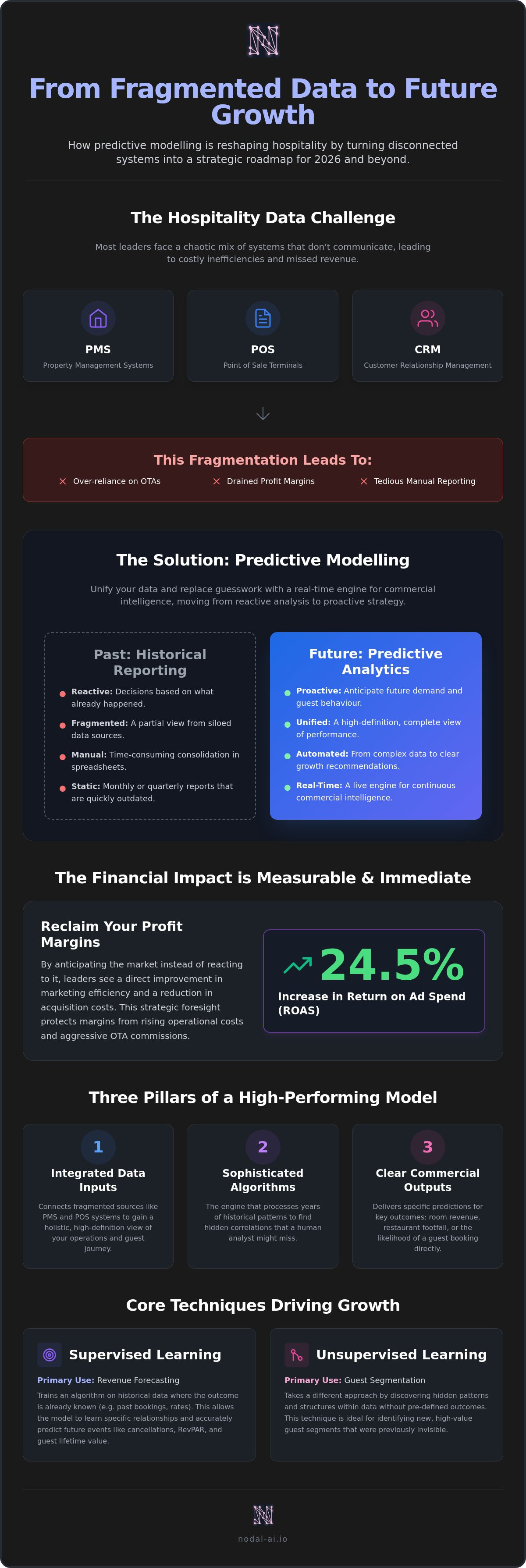
Is your data a passive asset or a commercial engine? For most hospitality leaders, the reality is a chaotic mix of PMS, POS, and CRM systems that refuse to communicate, leaving you over-reliant on expensive OTA channels. It's a cycle of manual reporting and missed opportunities during low-occupancy windows that drains your margins. Predictive modelling breaks this cycle by transforming fragmented data into a strategic roadmap for 2026. You can finally stop reacting to the market and start anticipating it.
We recognise the frustration of manual data consolidation and the anxiety of rising commission costs. This guide reveals how to utilise the Nodal Platform to synchronise your systems and drive direct revenue. You'll discover a clear framework to improve your return on ad spend (ROAS) and automate commercial insights without the need for tedious manual spreadsheets. We'll explore how to achieve measurable results, such as the 24.5% increase in ROAS seen by industry leaders, by turning historical patterns into future certainty.
Key Takeaways
- Connect disparate data sources to build a high-definition, unified view of your commercial performance.
- Replace static reporting with predictive modelling to anticipate guest behaviour and future demand windows with precision.
- Deploy a strategic framework that reduces guest acquisition costs and elevates your Return on Ad Spend (ROAS).
- Automate the path from complex system inputs to clear growth recommendations that optimise your direct revenue.
- Identify low-occupancy periods in advance to reduce OTA dependency and protect your profit margins.
What is Predictive Modelling? Moving from Statistics to Commercial Intelligence
Data is only as valuable as the decisions it inspires. In its simplest form, What is Predictive Modelling? refers to the use of statistical techniques and historical data to identify the likelihood of future outcomes. However, as we move through 2026, the definition has shifted. It's no longer an academic exercise or a static report generated once a month. Instead, it has become a real-time engine for commercial intelligence that allows hospitality leaders to see around corners.
The hospitality industry faces a unique set of challenges that standard analytics often fail to address. Your data isn't just in one place; it's scattered across Property Management Systems (PMS), Point of Sale (POS) terminals, and CRM databases. Without a way to bridge these gaps, you're left with fragments of a guest's story. Modern predictive tools use AI to automate the transition from this raw, chaotic data into specific growth recommendations. This automation removes the manual burden from your team, allowing them to focus on execution rather than spreadsheet management.
The Core Components of a Modern Predictive Model
A high-performing model relies on three fundamental pillars to deliver results. First, it requires integrated data inputs. By connecting fragmented sources like your PMS and POS systems, the model gains a holistic view of your operations. Second, it employs sophisticated statistical algorithms. These act as the engine, processing years of historical patterns to find hidden correlations that a human analyst might miss. Finally, the model produces clear output variables. These aren't just abstract numbers; they're predictions for specific commercial outcomes, such as room revenue, restaurant footfall, or the likelihood of a guest booking directly.
Why Predictive Modelling Matters for 2026 Margins
Profit margins are currently under significant pressure from rising operational costs and aggressive third-party commission structures. Smarter demand forecasting is your primary shield against this erosion. By using predictive modelling, you can identify early signs of low-occupancy windows months before they occur. This foresight allows you to adjust your strategy early, deploying targeted campaigns that drive direct bookings rather than relying on last-minute OTA fire sales.
The financial impact of this shift is measurable and immediate. When you stop reacting to the market and start anticipating it, your acquisition costs drop. For instance, organisations utilising these advanced analytics have seen a 24.5% increase in Return on Ad Spend (ROAS). This isn't just about being more efficient; it's about reclaiming your profit margins and ensuring your marketing budget works harder for every pound spent.
Core Techniques: Supervised and Unsupervised Learning for Growth
To turn raw data into a competitive advantage, you must understand the engines driving your insights. Modern predictive modelling relies on two primary methodologies: supervised and unsupervised learning. While they serve different commercial purposes, their integration is what allows a business to move from reactive reporting to proactive growth. By deploying these techniques, you can transform your Property Management System (PMS) from a passive database into an active participant in your revenue strategy.
Supervised Learning for Revenue Forecasting
Supervised learning is the foundation of accurate demand forecasting. It works by training an algorithm on historical data where the outcome is already known, such as past booking dates, room rates, and final revenue. This allows the model to learn the specific relationship between inputs and results. Supervised learning in hospitality revenue management involves training an algorithm on historical booking outcomes to predict specific future events such as cancellations or revenue per available room (RevPAR).
Regression models, a subset of supervised learning, are particularly effective for calculating guest lifetime value and booking propensity. By analysing the traits of your most profitable guests, the model can identify which new leads are most likely to book directly, helping you prioritise your marketing spend. This precision is a hallmark of The Commercial Shift: Why Predictive Analytics Outperform Historical Reporting, as it replaces guesswork with statistical certainty.
Unsupervised Learning for Guest Segmentation
Unsupervised learning takes a different approach by discovering hidden patterns in your data without pre-defined labels. It's about discovery rather than prediction. Clustering algorithms can group guests based on complex behaviours, such as stay length, ancillary service usage, and spending habits at the POS. This provides a level of nuance that traditional demographic segmentation simply cannot match.
These insights are vital for advanced customer journey mapping. When you understand the unique clusters within your audience, you can tailor your brand planning to meet their specific needs. If you're ready to see how these clusters drive profit, exploring a modular intelligence engine can reveal the untapped potential within your current database.
Incorporating External Signals for Enhanced Accuracy
In 2026, internal data is no longer enough. High-performance models now integrate external signals to sharpen their accuracy. Factors such as FX rates, weather patterns, and local events act as leading indicators for hotel occupancy. For large-scale resorts and property developments, you can also explore Drone Mapping and Photogrammetry Services to gather precise aerial data that informs physical asset management alongside commercial trends. By monitoring flight demand and tourism trends, your predictive modelling can adjust its recommendations in real-time, ensuring you remain competitive even as market conditions shift. This holistic view ensures that your commercial intelligence remains grounded in the reality of the global travel market.
The Commercial Shift: Why Predictive Analytics Outperform Historical Reporting
Historical reporting is a rear-view mirror; it documents past successes and failures but offers no guidance for the road ahead. For years, hospitality leaders have relied on descriptive analytics to understand what happened last month or last quarter. While this data is accurate, it is inherently reactive. By the time a report identifies a dip in occupancy, the opportunity to rectify it has already passed. Predictive modelling transforms this dynamic by shifting the focus from hindsight to foresight, allowing you to anticipate market shifts before they impact your bottom line.
The transition from fragmented reporting to a single view of performance is a cognitive upgrade for your entire organisation. Instead of wasting hours reconciling conflicting data from your PMS, POS, and CRM, your team can access a unified commercial truth. This clarity replaces the anxiety of manual data entry with the confidence of high-level perspective. Automated growth recommendations act as a partner in your decision-making process, suggesting the most profitable path forward without requiring deep technical specialisation from your marketing staff.
Identifying and Solving Need Periods
One of the most significant advantages of this shift is the ability to spot occupancy gaps with surgical precision. High-performance models can identify "need periods" up to six weeks in advance, giving your team the runway needed to take action. Rather than relying on broad, expensive discounts, you can shift your marketing spend dynamically to target specific high-value segments during these low-demand windows. This proactive approach ensures your rooms remain full without sacrificing your average daily rate (ADR).
The results of this foresight are tangible. For example, Ovolo Hotels utilised ai marketing analytics to bridge the gap between fragmented data and profitable growth. By anticipating demand shifts and automating their response, they achieved a 24.5% increase in Return on Ad Spend (ROAS). This isn't just about efficiency; it's about reclaiming control over your inventory and reducing the need for last-minute fire sales on third-party platforms.
Optimising Ad Spend and Acquisition Costs
Predictive insights also allow for the radical optimisation of your digital marketing budget. By predicting which channels will deliver the highest quality direct bookings, you can stop wasting capital on low-propensity segments that do not convert. Algorithm-driven audience targeting ensures your message reaches the right guest at the exact moment they are ready to book. This precision led to a 15.3% reduction in acquisition costs for industry leaders, effectively turning marketing from a cost centre into a high-yield investment. When you stop guessing and start predicting, every pound in your budget works harder for your profit margins.
Implementing Predictive Models: A Roadmap for Hospitality Leaders
Moving from a state of data fragmentation to predictive maturity is not an overnight transformation. It requires a structured approach that begins with a cold, hard look at your current ecosystem. Most hospitality brands suffer from siloed information where the PMS, POS, and CRM systems operate as independent islands. To build a successful predictive modelling strategy, you must first bridge these gaps. Start by auditing your core systems, such as Oracle OPERA, Mews, or Cloudbeds, to ensure that every touchpoint in the guest journey is being captured and consolidated.
Precision is non-negotiable. For global teams, the foundation of this journey is a robust data governance framework. Without clear rules on how data is collected, stored, and cleaned, your models will eventually fail. Complexity becomes clarity only when you have a modular intelligence engine capable of translating these diverse inputs into a single, reliable source of truth. By organising your data correctly today, you protect your commercial interests for 2026 and beyond.
Overcoming the Data Fragmentation Challenge
The primary hurdle in technical onboarding is the ingestion of historical data. To train an algorithm effectively, you need a clean history of past performance, yet many legacy systems make extraction difficult. You must implement strategies for unifying data from systems that typically do not communicate, such as your restaurant POS and your front-desk PMS. Remember that the "garbage in, garbage out" rule still applies; if your raw data is inaccurate or incomplete, your predictions will be equally flawed. Prioritising data hygiene during the initial setup ensures that your future growth recommendations are grounded in reality.
Building vs Buying: Finding the Right Partner
Many organisations consider building in-house data science teams to maintain control. However, the hidden costs are often prohibitive. Recruiting, training, and retaining specialised talent can take months, whereas a dedicated platform offers immediate value. When evaluating partners, look for those with hospitality-specific integrations. A generic analytics tool will struggle with the nuances of RevPAR and occupancy windows. You can explore the Nodal Platform features to see how purpose-built integrations for systems like Mews and Oracle OPERA streamline the path to profitability.
Stop wrestling with siloed spreadsheets and start orchestrating a unified commercial strategy. If you are ready to replace manual reporting with automated intelligence, book a tailored demo today to see our predictive modelling engine in action.
Scaling Results with the Nodal Platform: Turning Predictions into Profit
The Nodal Platform operates as a modular intelligence engine, designed to sit at the heart of your commercial operation. It doesn't just collect data; it activates it. By integrating your disparate systems into a unified framework, the platform provides a cognitive upgrade for your entire organisation. This shift allows you to move beyond the limitations of manual reporting, replacing static spreadsheets with dynamic growth recommendations that guide your daily strategy. It is the definitive solution for leaders who require results without the friction of deep technical specialisation.
One of the most powerful features of this engine is Multi-Touch Attribution. In a complex digital environment, understanding the true guest lifecycle is essential for scaling results. You can finally see every interaction a guest has with your brand, from the first social media engagement to the final booking confirmation. This clarity ensures that your predictive modelling remains accurate, as it accounts for the full path to purchase rather than just the last click. The result is a measurable increase in both total bookings and average booking values, as you learn exactly where to invest for maximum impact.
Modular Intelligence for Specific Industry Needs
Every hospitality business has a unique DNA, and the Nodal Platform reflects this through tailored modules. Whether you manage a boutique hotel, a portfolio of serviced apartments, or an exclusive members' club, the engine adapts to your specific commercial requirements. It addresses the granular pain points that generic tools overlook, such as optimising bed yield in high-volume hostels or increasing covers in upscale F&B outlets. This bespoke approach ensures that the insights you receive are always relevant and immediately applicable to your bottom line, transforming your data from a passive asset into an active participant in your success.
Next Steps: From Insights to Action
Transitioning to a culture of data-driven commercial decisions requires more than just new software; it requires a strategic partner. Your journey begins with a professional implementation and onboarding process, where our experts ensure your historical data is ingested correctly and your systems are fully synchronised. We help you move from a state of overwhelm to a state of calm efficiency, where your commercial team is empowered by clarity rather than bogged down by complexity.
The time to stop reacting to market volatility is now. You have the opportunity to turn your data from a passive liability into your most aggressive growth asset. If you are ready to see the engine in action, book a demo with Nodal AI today. Let us show you how to master predictive modelling and protect your profit margins for the years ahead.
Orchestrating Certainty in a Volatile Market
The shift from fragmented data to unified intelligence is no longer a luxury; it's a commercial necessity. By moving away from reactive, historical reporting, you reclaim control over your inventory and your profit margins. Predictive modelling acts as the bridge between current complexity and future growth, allowing your team to anticipate demand with surgical precision.
The Nodal Platform provides this cognitive upgrade through a modular architecture tailored for hotels, QSR, and wellness sectors. As AI-driven predictive technology advances, those in the health space can explore theBand to see how biomarker monitoring is revolutionising personalised wellbeing. With seamless integration into systems like Oracle OPERA, Mews, and Cloudbeds, the path to automation is clear. Our partners have already realised a 24.5% increase in ROAS by transforming their passive data into active commercial engines. Replace the anxiety of manual reporting with the confidence of high-level perspective.
Book a discovery call to see how Nodal AI can scale your direct revenue and start your journey toward frictionless progress today.
Frequently Asked Questions
What is the primary difference between predictive modelling and predictive analytics?
Predictive modelling is the specific mathematical process of building a statistical engine to forecast future outcomes. Predictive analytics, by contrast, is the broader discipline that encompasses the tools, technologies, and business strategies used to interpret those models. While modelling creates the underlying algorithm, analytics applies those insights to drive commercial growth and operational efficiency across your organisation.
How does predictive modelling help in reducing OTA leakage for hotels?
It reduces OTA leakage by identifying high-propensity direct bookers before they reach third-party platforms. By anticipating demand windows up to six weeks in advance, the Nodal Platform allows you to deploy targeted performance marketing analytics to capture guests directly. This strategy shifts the focus from reactive discounts to proactive acquisition, ensuring you protect your margins from excessive commission costs.
Can predictive models work with fragmented data from different PMS and POS systems?
Yes, modern platforms are specifically designed to unify fragmented data from disparate PMS and POS systems. The Nodal Platform integrates with legacy and modern systems like Oracle OPERA and Mews to create a single source of truth. This connectivity transforms isolated data points into a cohesive commercial narrative, removing the manual burden of consolidating spreadsheets across different departments and locations.
What external signals are most important for hospitality demand forecasting?
The most critical external signals for 2026 include flight demand, weather patterns, and local event schedules. These indicators act as leading signals that influence guest behaviour long before a booking is made. By incorporating these signals into your predictive modelling, you gain a more accurate forecast of future occupancy, allowing you to adjust pricing and marketing spend in real-time based on global tourism trends.
Is predictive modelling compliant with GDPR and other data privacy regulations?
Yes, reputable predictive solutions are built with data privacy at their core and fully comply with GDPR and other regional regulations. The process focuses on pattern recognition and aggregated data rather than individual personal identifiers. By using secure, encrypted environments and data anonymisation techniques, the Nodal Platform ensures your commercial intelligence remains compliant while protecting guest trust and institutional assets.
How long does it typically take to see a return on investment from predictive modelling?
You typically see immediate operational returns through automated reporting and reduced manual labour within the first month. Commercial ROI, such as increased direct revenue and reduced acquisition costs, usually scales within three to six months as the models ingest more historical data. This timeframe allows the algorithms to refine their accuracy and deliver increasingly precise growth recommendations for your specific market.
Do I need a dedicated team of data scientists to use the Nodal Platform?
No, you don't need a dedicated team of data scientists to benefit from the Nodal Platform. The system is designed as an accessible cognitive upgrade that translates complex statistical outputs into clear, actionable growth recommendations. It empowers your existing commercial and marketing teams to make high-level, data-driven decisions without requiring deep technical specialisation or advanced mathematical training.
What is the difference between supervised and unsupervised learning in guest segmentation?
Supervised learning uses historical data with known outcomes to predict specific guest actions, such as the likelihood of a cancellation. Unsupervised learning, however, discovers hidden patterns and clusters within your database without pre-defined labels. This allows you to identify unique guest segments based on complex spending habits and stay patterns that traditional demographic reporting would likely miss.


