

Did you realise that every time a guest books through an Online Travel Agency, you could be losing up to 25% of that revenue to commission fees? While international visitor spending is projected to reach $2.1 trillion in 2026, many hospitality leaders are watching their profit margins erode because they cannot prove which marketing efforts actually drive direct results. It is a frustrating reality when your most valuable data remains trapped in silos like your PMS and CRM, leaving the true ROI of your brand awareness campaigns a complete mystery.
We understand the overwhelm of managing disconnected systems while trying to justify every pound of your budget. This guide will empower you to master marketing experiment analysis, providing the clarity you need to eliminate wasted ad spend and maximise direct booking revenue across your entire portfolio. We will walk through a precise framework for experiment analysis that turns chaotic data into high-value commercial outcomes, ensuring your marketing budget works as hard as your team does. By the end of this guide, you will have the tools to replace manual guesswork with the confidence of a streamlined, data-driven strategy.
Key Takeaways
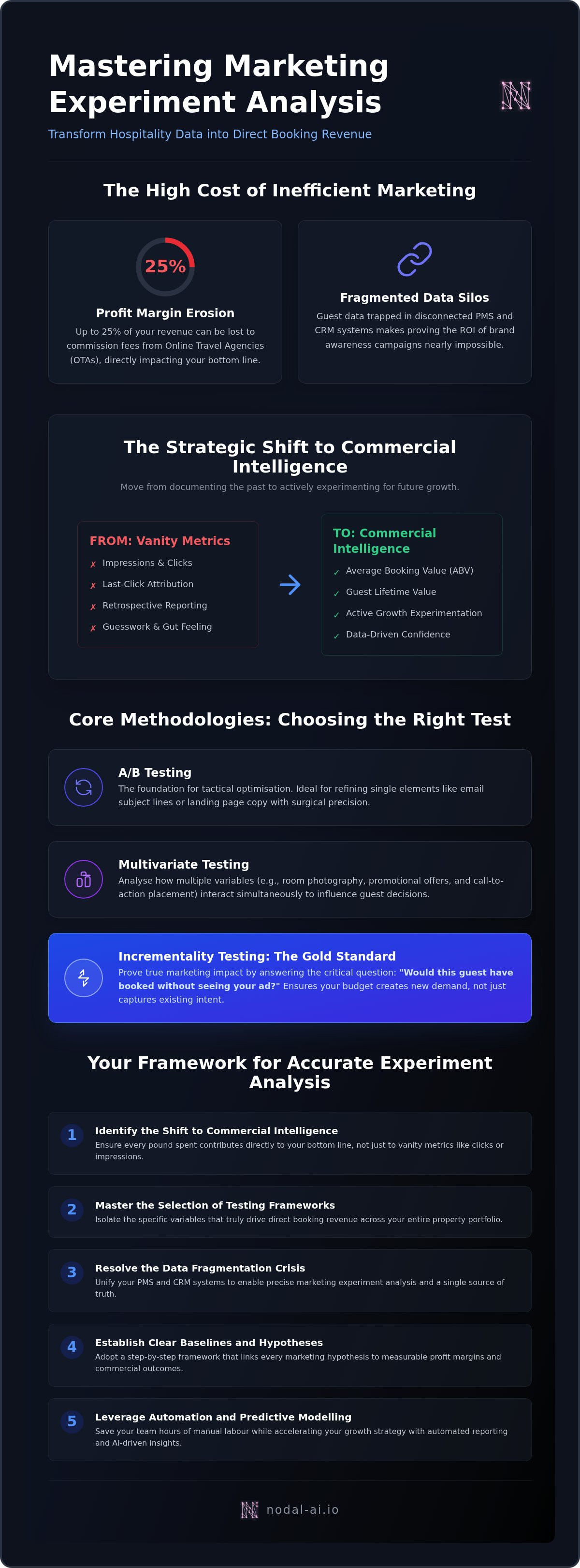
- Identify the shift from vanity metrics to commercial intelligence to ensure every pound spent contributes to your bottom line.
- Master the selection of testing frameworks to isolate variables that truly drive direct booking revenue across your portfolio.
- Resolve the data fragmentation crisis by unifying your PMS and CRM systems for precise marketing experiment analysis.
- Adopt a step-by-step framework that establishes clear baselines and links every marketing hypothesis to measurable profit margins.
- Leverage automated reporting and predictive modelling to save your team hours of manual labour while accelerating your growth strategy.
The Critical Role of Marketing Experiment Analysis in Hospitality
In a market where international visitor spending is projected to reach $2.1 trillion in 2026, the margin for error has never been thinner. Relying on gut feeling is no longer a viable strategy for hospitality leaders; today, it is a commercial liability. High inflation and rising operational costs demand a shift toward precise marketing experiment analysis. While vanity metrics like impressions or clicks might look impressive in a monthly report, they often mask a deeper issue: the erosion of profit through high OTA commissions. You must look beyond the surface to find the true drivers of revenue.
True commercial intelligence requires a move away from retrospective reporting. Instead of merely documenting what occurred last quarter, forward-thinking brands embrace active growth experimentation. This approach transforms marketing from a cost centre into a predictable revenue engine. By testing specific variables, you can isolate exactly which campaigns drive direct bookings and which merely subsidise the 15-25% commission rates charged by third-party platforms. Establishing a solid foundation in marketing experimentation allows your team to stop guessing and start scaling what works. It's about turning chaotic data points into a clear, actionable roadmap for your entire portfolio.
Moving Beyond the Last-Click Attribution Trap
Many hotels fall into the trap of last-click attribution, which over-credits the final touchpoint of a guest's journey. This flawed model often leads to over-investing in brand search while ignoring the upper-funnel efforts that actually created the demand. If your marketing experiment analysis only looks at the final click, you risk simply shifting demand that already existed rather than generating new interest. Transitioning to a multi-touch perspective ensures you value every interaction, from the first social media discovery to the final booking engine visit. This clarity is essential for identifying the true incrementality of your spend.
Defining Success: KPIs That Impact the Bottom Line
To protect your profit margins, you must align your KPIs with actual commercial outcomes. Success is not just about a lower Cost per Acquisition (CPA); it's about ensuring that acquisition costs don't outpace the revenue generated. Focus on metrics that move the needle:
- Average Booking Value (ABV): Track how experiments influence the total spend per guest rather than just the volume of bookings.
- Guest Lifetime Value: Measure the long-term impact of direct guests versus one-time OTA bookers.
- Footfall and Covers: For upscale F&B locations, connect digital ad spend directly to physical restaurant performance.
Core Methodologies: Comparing Testing Frameworks
A/B testing serves as the foundational bedrock for tactical channel optimisation. It allows you to refine specific elements, such as email subject lines or landing page copy, with surgical precision. However, for a hospitality portfolio, multivariate testing offers a more sophisticated perspective. It enables you to analyse how multiple variables, such as room photography, promotional offers, and call-to-action placement, interact simultaneously to influence a guest's decision. Without a robust control group, your marketing experiment analysis risks becoming a collection of isolated successes that fail to scale across diverse properties.
To move beyond tactical wins, you must embrace methodologies that quantify true commercial value. This requires a transition from simply measuring activity to measuring incrementality. By isolating the impact of specific marketing interventions against a control group, you can ensure that your budget is creating new demand rather than just over-crediting guests who were already planning to book. This level of clarity replaces the anxiety of manual data tracking with the confidence of a streamlined, enterprise-ready strategy.
The Power of Incrementality Testing
Incrementality testing is the gold standard for proving true marketing impact. It answers the critical question: would this guest have booked without seeing your ad? By using geo-lift testing, you can measure the specific impact of local awareness campaigns by comparing performance in similar geographical regions where the ad was not shown. This methodology ensures that your marketing spend efficiency is tied to actual growth. It provides the cognitive upgrade needed to turn passive data into active commercial power, allowing you to realise a significant reduction in wasted spend.
Integrating External Signals into Your Analysis
In hospitality, your experiments do not exist in a vacuum. External signals, such as weather patterns, FX rates, and local events, must be treated as active experiment variables. For example, a sudden drop in flight demand can skew the results of an international booking campaign if not accounted for in your baseline. You must adjust your hypotheses based on real-time seasonality and tourism trends to ensure your conclusions are sound. As AI is transforming modern marketing, the ability to synthesise these disparate sources becomes a competitive advantage. To see how these complex variables can be unified into a single perspective, you might explore the modular features of a modern intelligence engine. This approach ensures your marketing experiment analysis remains accurate, even in a volatile global market.
Solving the Hospitality Data Fragmentation Problem
Data silos are the silent killers of marketing efficiency. According to research from Cloudbeds (2026), 67% of independent hotels identify managing separate, disconnected systems as a major operational difficulty. When your guest data is trapped in separate PMS, POS, and CRM systems, your marketing experiment analysis will inevitably produce false positives. You might credit a digital campaign for a booking that was actually driven by a previous loyalty interaction; or worse, you may fail to see how a specific ad influenced high-value on-property spend. This lack of transparency leads to wasted budget and missed opportunities for direct revenue.
Modular intelligence engines bridge this gap by consolidating chaotic inputs into a single, unified view of performance. This transformation is not just a technical luxury; it is a commercial necessity. By turning passive data assets into active participants in your business process, you replace the anxiety of manual data reconciliation with high-level commercial clarity. A unified data layer ensures that every experiment is grounded in reality, allowing you to scale your hospitality portfolio with the confidence of an expert who has mastered future-facing analytics.
Connecting PMS and POS Data to Marketing Spend
Validate your digital campaign success by mapping the guest journey from the initial ad click to the final checkout. Integrating data from operational systems like Oracle OPERA or Mews allows you to see the full picture of guest behaviour. For QSR and F&B operators, this means analysing the dine-in versus delivery mix to understand how marketing influences different revenue streams. This granular level of detail ensures that your marketing experiment analysis accounts for the total value of a guest stay, rather than just the initial room rate. It provides the cognitive upgrade needed to see which channels are truly driving the most valuable direct bookings right now.
Building a Unified Guest Profile for Better Segmentation
Consolidate data from platforms like HubSpot or Revinate to build a comprehensive understanding of your audience without the friction of manual labour. Identifying high-propensity segments is the fastest way to reduce wasted ad spend and drive direct bookings. Leverage customer journey data to refine your experiment hypotheses and target guests with personalised offers based on their past preferences. This approach allows your organisation to move from reactive reporting to a state of predictive growth; ensuring your marketing remains competitive and obsessed with measurable returns in a volatile 2026 market.
A Step-by-Step Framework for Accurate Experiment Analysis
A rigorous framework is the bridge between chaotic data and commercial clarity. Without a structured methodology, your marketing experiment analysis remains tactical and disconnected from your broader business goals. You must move from reactive guesswork to a repeatable process that identifies true growth drivers across your portfolio. This cognitive upgrade ensures that every marketing pound is an investment in measurable revenue rather than a shot in the dark. It is the difference between surviving on thin margins and thriving through data-led precision.
Step 1 to 3: The Pre-Experiment Phase
Success begins before the first ad goes live. Start by establishing a baseline using predictive modelling to set realistic expectations based on historical performance. This allows you to differentiate between organic trends and the actual impact of your intervention. Next, formulate a commercial hypothesis that links directly to net margin or revenue. Instead of testing for clicks, ask if a specific offer will increase your direct booking share during a defined "need period" of low occupancy. Finally, organise your tracking infrastructure. Ensure UTM parameters and tracking codes are correctly mapped to your PMS and CRM to prevent data leakage. This preparation turns your passive data assets into active participants in your growth strategy; replacing complexity with a streamlined path to results.
Step 4 to 5: Analysis and Insight Generation
Execute your test with strict duration and volume parameters to ensure statistical significance. A comprehensive marketing experiment analysis requires you to look beyond the initial booking. Use multi-touch attribution to calculate the true ROAS by including ancillary spend from your POS systems, such as restaurant covers or spa treatments. This level of detail helps you identify which promotions generated incremental revenue rather than simply shifting demand from OTAs to direct channels. For instance, you might discover that a specific brand awareness campaign didn't just drive a room booking, but also increased F&B spend by 15.3% for a specific guest segment. Conclude by translating these complex data points into clear growth recommendations for your stakeholders. They need to realise exactly how these insights will protect profit margins and streamline future spend while reducing the manual burden on your marketing team.
Book a demo to see our experiment framework in action
Leveraging AI for Scalable Commercial Intelligence
Artificial intelligence acts as the cognitive upgrade your organisation needs to transition from manual data entry to high-level strategic growth. While traditional methods of marketing experiment analysis often require hours of painstaking manual labour, AI-driven systems automate these complex processes. This shift allows your commercial teams to save 20 or more hours per week; time that is better spent on creative strategy and guest experience. By turning passive data into active intelligence, you replace the friction of fragmented reporting with a streamlined flow of actionable insights.
The impact of this technology is not theoretical. For example, Ovolo Hotels achieved a 24.5% increase in ROAS by utilising AI to identify high-value growth opportunities that were previously hidden within their data. Machine learning also plays a protective role in your portfolio by identifying churn risk within membership models. It detects subtle patterns in guest behaviour that human analysis might overlook, allowing you to intervene before a loyal customer is lost. This level of precision ensures that your marketing remains competitive and obsessed with measurable returns.
Automated Reporting and Real-Time Insights
Replace the anxiety of manual spreadsheets with a modular intelligence engine that provides total clarity across your portfolio. Instead of waiting for month-end reports to realise a campaign has failed, you can access real-time insights that guide immediate optimisation. You can set up automated alerts to identify early signs of need periods over the next six weeks, ensuring your team can react with precision. Discover how the Nodal Platform features consolidate disparate data sources into a single, high-value output. This automation removes the ambiguity from your commercial performance, allowing you to lead with confidence.
The Future of Experimentation: Predictive Modelling
Predictive modelling represents the next frontier in marketing experiment analysis. Rather than testing in the live market and risking your budget, AI allows you to simulate experiment outcomes before you spend a single pound. This forward-thinking approach uses historical data to predict how specific guest segments will respond to various promotional triggers. You can optimise your ad spend by targeting high-propensity guests who are most likely to book directly, further reducing your reliance on high-commission OTAs. If you are ready to transform your data into a predictive growth engine, book a demo with Nodal AI to see our platform in action. This is the ultimate tool for hospitality leaders who demand commercial clarity and frictionless progress.
Mastering the Future of Hospitality Growth
The transition from chaotic data silos to a unified intelligence engine is no longer a luxury for hospitality leaders; it is a commercial necessity. By mastering marketing experiment analysis, you replace the anxiety of manual reporting with the relief of high-level commercial clarity. You now have the framework to bridge the gap between your PMS and marketing spend, ensuring every campaign creates true incremental demand rather than merely shifting existing bookings.
Forward-thinking brands have already realised the power of this cognitive upgrade. From achieving a 15.3% reduction in acquisition costs to a 24.5% increase in ROAS, the results of data-led precision are undeniable. This commitment to excellence is why the Nodal Platform was recognised with Gold at the Performance Marketing Awards. It is time to turn your passive data assets into active participants in your business process and lead your portfolio with confidence.
Book a demo to see how Nodal AI transforms hospitality data
Empower your team to move beyond reactive reporting and start building a predictive growth engine that secures your market position for 2026 and beyond.
Frequently Asked Questions
What is the most common mistake in marketing experiment analysis for hotels?
The most common mistake in marketing experiment analysis is over-relying on vanity metrics such as clicks or impressions while ignoring the final booking value. Many hoteliers fail to account for OTA commissions, which leads to a distorted view of profitability. By focusing only on top-of-funnel activity, you risk over-funding channels that don't drive direct revenue. Transitioning to a margin-based analysis ensures your experiments reflect actual commercial growth rather than just increased traffic.
How long should a hospitality marketing experiment run to be statistically significant?
A marketing experiment should typically run for 14 to 30 days to capture a full booking cycle and ensure statistical significance. This duration allows you to account for weekly fluctuations in guest behaviour and varying lead times. For properties with lower traffic, you may need a longer window to reach a reliable volume of data. Always establish a clear baseline before launch to differentiate your results from organic seasonal trends.
Can I analyse marketing experiments if my PMS and Google Ads are not connected?
You can still perform analysis, but manual data reconciliation often leads to errors and significant productivity loss. A modular intelligence engine solves this by unifying data from fragmented systems like Mews or Oracle OPERA with your ad platforms. This connection allows you to track the guest journey from the first click to the final on-property spend. Without this integration, you risk making strategic decisions based on false positives and incomplete performance views.
What is the difference between ROI and incrementality in marketing analysis?
ROI measures the total return on your investment, whereas incrementality identifies the specific revenue that would not have occurred without your marketing intervention. In hospitality, high ROI often masks cannibalised bookings where guests would have booked directly anyway. Focusing on incrementality ensures your budget creates new demand rather than just over-crediting existing paths. This distinction is vital for reducing wasted spend and protecting your profit margins from unnecessary commission costs.
How do external factors like weather affect my experiment results?
External factors act as critical variables that can skew your experiment results if left unmonitored. A sudden heatwave or a drop in flight demand can influence booking behaviour more than your promotional creative. You must integrate these signals into your marketing experiment analysis to maintain accuracy. By treating weather, FX rates, and local events as active data points, you ensure your conclusions are grounded in the reality of the global market.
Which guest segments should I focus on for my first incrementality test?
Focus on high-propensity guest segments who are currently booking through OTAs rather than your direct channel. This group represents the most immediate opportunity to reclaim margin and reduce commission leakage. You might also test your past one-time guests to see which triggers drive repeat direct stays. Identifying these segments through AI-driven audience mapping allows you to optimise your spend and realise a higher percentage of direct booking revenue from day one.
How does multi-touch attribution improve the accuracy of experiment analysis?
Multi-touch attribution improves accuracy by valuing every interaction a guest has with your brand before booking. Traditional last-click models ignore the early discovery phase, often leading you to under-fund the very campaigns that started the guest journey. By mapping the entire path, you gain a high-level perspective on how different channels work together. This transparency replaces the anxiety of manual tracking with the confidence of a streamlined, enterprise-ready growth strategy.


