

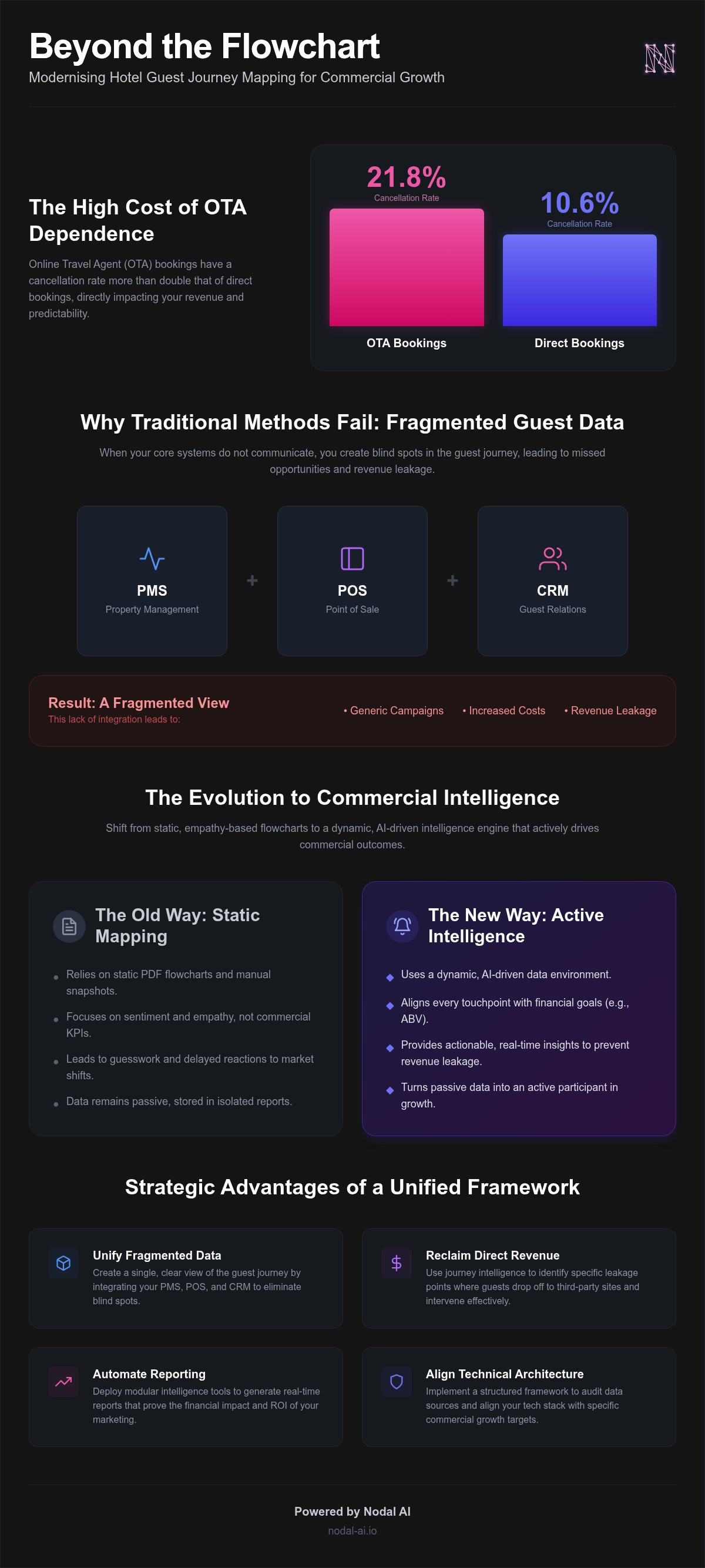
Did you know that OTA bookings carry a 21.8% cancellation rate, while direct bookings stay firm at just 10.6%? You likely feel the weight of this disparity every day as high commission fees and fragmented guest data across your PMS and POS systems make it difficult to protect your margins. It's a common frustration to see high-value guests slip through the cracks because your tech stack cannot keep pace with their behaviour. Traditional customer journey mapping often fails in this environment because it relies on static snapshots rather than live, integrated intelligence.
We are here to help you reclaim control. This guide demonstrates how to transform chaotic data inputs into a unified commercial strategy that drives direct bookings and eliminates revenue leakage. By the end of this article, you will understand how to deploy a modular intelligence engine to create a single view of the guest journey. We will explore how to personalise marketing at scale, reduce acquisition costs, and implement automated reporting that finally proves your marketing impact. It's time to turn your passive data into an active participant in your hotel's growth and realise the full potential of your commercial assets.
Key Takeaways
- Transition from static PDF maps to dynamic, AI-driven environments that transform passive guest data into active commercial intelligence.
- Unify fragmented data across your PMS, POS, and CRM systems to create a single, clear view of the guest and eliminate revenue leakage.
- Reclaim direct revenue by using customer journey mapping to identify specific leakage points where guests drop off to third-party booking sites.
- Implement a structured framework to audit your existing data sources and align your technical architecture with specific commercial growth targets.
- Deploy modular intelligence tools to automate reporting and generate real-time growth recommendations that prove the financial impact of your marketing.
Beyond the Flowchart: Why Customer Journey Mapping Must Evolve
Stop treating your guest journey as a static diagram. In the modern hospitality sector, a colourful flowchart gathering dust in a shared drive is a liability, not an asset. Historically, customer journey mapping was a design exercise used to visualise guest touchpoints through a lens of empathy. While understanding sentiment remains valuable, it is no longer sufficient to drive growth in a market defined by rapid digital shifts and aggressive OTA competition. You must transition from static PDF maps to dynamic, AI-driven data environments that respond to guest behaviour in real time.
Traditional mapping fails because it cannot account for the sheer volume of fragmented data generated by modern travellers. When your strategy relies on manual snapshots, you miss the subtle shifts in the booking window that lead to revenue leakage. Modern mapping is a form of commercial intelligence. It turns chaotic, disconnected inputs into a high-value strategy that identifies exactly where a guest is most likely to convert or depart. By evolving your approach, you replace the anxiety of guesswork with the confidence of integrated, actionable insights.
The Cost of Fragmented Guest Data
Data silos are the silent killers of hotel profitability. When your Property Management System (PMS) doesn't communicate with your Point of Sale (POS) or CRM, you create massive blind spots in the guest lifecycle. You might recognise a guest at check-in, but if you don't know they spent three hours in the spa or preferred a specific vintage at the bar, you lose the opportunity to personalise their next stay. This fragmentation forces your marketing team to work with incomplete profiles, leading to generic campaigns that fail to convert.
The impact of these silos extends to your bottom line. Disconnected systems increase acquisition costs because you are forced to bid on broad keywords rather than targeting high-propensity segments. Manual reporting is simply too slow to keep up with 2026 booking patterns. By the time you realise a segment is underperforming, the opportunity to course-correct has passed. You need a unified view that connects these dots automatically, transforming passive data into an active participant in your business growth.
From Empathy to Commercial Intelligence
It is time to move beyond "what the guest feels" and focus on "what the guest does." While empathy helps design a better lobby, commercial intelligence helps you win the booking. Modern mapping aligns every touchpoint with specific KPIs such as Average Booking Value (ABV) and direct booking conversion rates. This shift allows you to see the guest journey as a series of financial opportunities rather than just a sequence of service moments. You can explore the technical features required to bridge these gaps and ensure your data works as hard as your front-of-house team.
Real-time visibility is the primary differentiator in high-volume hospitality environments. When you can see a guest's path from an initial OTA search to your direct website, you can intervene with personalised offers that stop them from bouncing back to a third party. This level of precision requires a cognitive upgrade for your entire organisation. You aren't just mapping a journey: you are building a modular intelligence engine that eliminates ambiguity and ensures every marketing pound spent delivers a measurable return.
The Architecture of Intelligence: Connecting Fragmented Data Points
Hospitality data is often a chaotic mess of disconnected silos. Your PMS knows when a guest stays, your POS knows what they drink, and your CRM knows their email address, yet these systems rarely communicate effectively. This fragmentation is where revenue leakage occurs. To build a modern strategy for customer journey mapping, you must first construct a technical architecture that bridges these gaps. You are not just collecting data: you are building a modular intelligence engine that turns passive records into active commercial participants.
Unifying the Hospitality Tech Stack
Start by integrating your core operational systems. Whether you use Mews, Stayntouch, or Oracle OPERA, your PMS must serve as the foundation for a wider intelligence ecosystem. Connect this foundation to your POS systems to capture on-property spend in real time. This allows you to move beyond basic room revenue and realise the total lifetime value of every guest. When you link reputation management data with your commercial strategy, you gain the ability to predict which guests are likely to become loyal advocates and which require immediate intervention. You can explore how modular architecture supports these specific hospitality use cases to ensure your stack is fully optimised.
The Role of AI in Connecting the Dots
Artificial intelligence acts as the connective tissue between these disparate sources. Machine learning algorithms scan millions of fragmented touchpoints to identify patterns that a human analyst would inevitably miss. This process automates the identification of high-propensity guest segments, allowing you to target individuals who are most likely to book directly. Nodal AI unifies fragmented data from PMS, POS, and CRM systems into a single view for hospitality brands.
By ingesting historical data, you can move from reactive reporting to predictive journey modelling. This transition allows you to anticipate guest needs before they even realise them. You replace the manual tedium of spreadsheet management with the streamlined efficiency of automated insights. This cognitive upgrade ensures your data is no longer a dormant asset but a driving force for your direct booking strategy. It turns the complexity of your tech stack into a clear, high-level perspective that drives measurable returns.
Strategic Advantages: Reducing OTA Leakage and Driving Direct Bookings
OTA leakage is not an unavoidable cost of doing business. It is a symptom of a visibility gap. When you treat customer journey mapping as a live commercial strategy rather than a static design exercise, you gain the power to identify exactly where potential guests abandon your direct booking engine for third-party platforms. This transition replaces the anxiety of lost commissions with the confidence of a fortified direct channel. By mapping these friction points, you can deploy targeted interventions that keep high-value travellers within your ecosystem.
Predictive modelling further strengthens this position by anticipating guest needs before they even begin their search on an OTA. If your data indicates a guest typically books a wellness retreat in October, you can reach them with a personalised offer in September. This proactive approach eliminates the need for the guest to compare prices elsewhere. The commercial impact of this level of intelligence is significant. For instance, Ovolo Hotels realised a 15.3% reduction in acquisition costs and a 24.5% increase in ROAS by using data to unify their guest view and optimise their commercial strategy.
Identifying and Plugging Revenue Leaks
Success starts with analysing your "need periods." These are the specific windows where your reliance on OTAs typically spikes due to lower organic demand. By using journey data, you can craft promotions that increase total revenue rather than simply shifting existing demand. You can discover Nodal Platform features that help you identify these leakage points and implement automated triggers to recapture bookings. This ensures your marketing spend is always directed toward the most profitable segments and highest-propensity guests.
Maximising Guest Lifetime Value
A guest's value does not end at check-out. Effective customer journey mapping extends deep into the post-stay phase to drive repeat visits and member retention. When you understand the full lifecycle, you can identify opportunities for ancillary spend in areas like spa treatments, wellness services, or F&B outlets. AI-driven audience segmentation allows you to target high-value profiles with surgical precision, ensuring that every communication feels like a personal invitation rather than a generic broadcast. This cognitive upgrade transforms one-time visitors into loyal advocates, securing long-term financial stability and higher lifetime value for your brand.
Implementation Framework: Building Your Data-Driven Journey Map
Building an effective framework for customer journey mapping requires more than just software. It demands a logical sequence of actions that turn fragmented data into commercial results. Start by auditing your existing data sources, specifically your PMS, CRM, GA4, and Meta tracking accounts. You cannot fix what you cannot see. Once you have visibility, define your commercial goals with precision. Whether you aim for a 10% increase in direct bookings or a reduction in acquisition costs, having a concrete numerical anchor ensures your strategy remains focused on measurable returns.
The next step is to integrate these disparate systems into a modular intelligence engine. This technical bridge replaces manual data entry with automated flows, allowing you to see the guest journey as a continuous stream rather than a series of broken links. By consolidating these inputs, you transform your passive data assets into active commercial participants that inform every marketing decision. This integration eliminates the ambiguity of your tech stack and provides the transparency needed to drive long-term stability.
Integrating External Market Signals
Modern hospitality does not exist in a vacuum. To truly contextualise the guest path, you must incorporate external signals like flight demand and local events. These factors dictate the rhythm of your booking windows and allow you to adjust your commercial strategy in real time. For example, fluctuations in FX rates and tourism trends can signal a shift in international demand before it ever appears in your own booking engine.
Weather data also plays a critical role, particularly when mapping footfall for QSR and F&B outlets. When you align your internal data with these external realities, you move from reactive guessing to proactive optimisation. This cognitive upgrade ensures your organisation is always prepared for shifts in market behaviour, turning external volatility into a competitive advantage.
From Insight to Automated Action
Transitioning from manual reporting to automated commercial recommendations is the final piece of the puzzle. Stop wasting hours on spreadsheets and start acting on live growth recommendations that identify high-value opportunities instantly. Set up automated alerts for "need periods" occurring in the next six weeks so your team can intervene before occupancy gaps become permanent. This shift replaces the anxiety of the unknown with the confidence of structured, high-level perspectives.
By automating these processes, you free your team from tedious manual labour and allow them to focus on high-level strategy. You can explore the broader strategic landscape in our sibling article: The Definitive Guide to the Customer Journey. This approach ensures your journey map is a living, breathing engine for profitable growth.
Book a demo to build your journey map
Nodal AI: Transforming Hospitality Insights into Commercial Growth
Fragmented data is the primary barrier to effective customer journey mapping. The Nodal Platform acts as the definitive solution to this complexity by unifying disparate streams from PMS, POS, and CRM systems into a single, cohesive view. We position the platform as a modular intelligence engine that connects these disparate dots, allowing you to move beyond surface-level analytics. By utilising specific Operational, Guest, and Commercial modules, you can tailor the technology to your unique property requirements. This approach ensures you make more and waste less through total data clarity, turning your tech stack from a cost centre into a revenue driver.
Our strategic consultancy services bridge the gap between advanced technology and practical hospitality expertise. We don't just provide a tool: we provide a partnership that understands the nuances of hotel operations. This combination allows you to realise the full potential of your commercial assets while maintaining a focus on the human element of hospitality. You replace the chaos of manual processes with a structured, future-facing strategy that prioritises measurable returns and long-term financial stability.
Empowering Commercial Teams with Clarity
Commercial professionals often face the anxiety of manual reporting and the overwhelm of chaotic inputs. We replace this friction with streamlined, high-level perspectives that allow your team to lead with confidence. Our growth recommendations are designed to save marketing teams over 20 hours per week by automating the discovery of high-value opportunities. This efficiency transforms your staff from data entry clerks into strategic decision-makers who can respond to market shifts instantly. You can book a Nodal AI demo to see these efficiencies in action for your own portfolio.
Proven Results in the Hospitality Sector
The commercial value of this approach is evidenced by our work with Ovolo Hotels, where we achieved a 24.5% increase in ROAS and a 15.3% reduction in acquisition costs. These results demonstrate that customer journey mapping is not just a theoretical exercise; it is a cognitive upgrade for your entire organisation. By combining advanced AI technology with deep hospitality expertise, we turn passive data into an active participant in your commercial growth. You can further enhance your strategic visibility by reading our guide on Mastering Marketing Attribution to ensure every pound of spend is accounted for.
Reclaiming Your Direct Revenue Potential
The transition from fragmented data silos to a unified commercial strategy is no longer a luxury. It is a necessity for survival. By evolving your approach to customer journey mapping, you replace the anxiety of OTA reliance with the confidence of a high-performing direct channel. You now have the framework to turn disconnected touchpoints into a modular intelligence engine that identifies every opportunity for growth in real time.
Our modular hospitality-first architecture delivers immediate clarity, evidenced by a 15.3% reduction in acquisition costs for our partners. Through AI-driven growth recommendations, you can finally eliminate revenue leakage and realise the full commercial potential of your guest data. It is time to stop managing spreadsheets and start leading your organisation with streamlined, high-level perspectives that drive measurable returns.
Book a demo to see how Nodal AI transforms your fragmented data
Take the first step toward a more profitable, data-driven future and secure your brand's long-term stability today.
Frequently Asked Questions
What is customer journey mapping in the hospitality industry?
It is the process of visualising every interaction a guest has with your brand, from initial discovery to post-stay advocacy. In hospitality, this involves connecting digital touchpoints like meta-search and social media with physical experiences such as check-in and on-property spend. By understanding these paths, you can identify friction points and optimise the experience to drive higher lifetime value and increased direct revenue.
How does AI improve the accuracy of customer journey maps?
AI enhances accuracy by processing millions of fragmented data points in real time to identify patterns that manual analysis misses. It eliminates the guesswork of static models by incorporating external signals like flight demand, weather, and local events. This allows hospitality brands to move from speculative flowcharts to dynamic, predictive journey modelling that reflects actual guest behaviour across disparate systems rather than relying on outdated snapshots.
Can I map the guest journey if my data is in multiple systems?
Yes, you can unify fragmented data from your PMS, POS, and CRM into a single view. Nodal AI specialises in connecting these disparate systems, such as Oracle OPERA, Mews, and SevenRooms, to create a cohesive data environment. This integration transforms passive records into active commercial participants, allowing you to see the full guest lifecycle even when the underlying technology stack is highly siloed and disconnected.
How does journey mapping help reduce OTA leakage?
Effective customer journey mapping identifies the specific points where potential guests abandon your direct website to book through a third party. By analysing these leakage points, you can deploy targeted interventions like personalised offers or real-time price comparisons. This strategy helps hospitality brands reclaim control over the guest relationship and significantly reduce high commission costs associated with Online Travel Agencies (OTAs) by securing the direct booking.
What data sources are needed for a hospitality journey map?
A comprehensive map requires data from operational systems (PMS), transaction platforms (POS and booking engines), and marketing channels (GA4, Meta, and Google Ads). Integrating feedback from reputation management tools like ReviewPro also adds critical depth. By combining these internal sources with external signals such as tourism trends and FX rates, you build a modular intelligence engine that provides a 360-degree view of your commercial and operational performance.
How often should a customer journey map be updated?
Traditional maps are updated annually, but modern customer journey mapping should be a live, continuous process. AI-powered platforms automate this by ingesting real-time data, ensuring your insights reflect current booking windows and market volatility. This allows your commercial team to respond to "need periods" or shifts in guest propensity as they happen, rather than relying on outdated quarterly reports that cannot influence your immediate revenue growth.
What is the ROI of customer journey mapping for hotels?
The ROI is measured through increased direct booking contributions and significantly reduced acquisition costs. For example, Ovolo Hotels achieved a 24.5% increase in ROAS and a 15.3% reduction in acquisition costs by using these insights to optimise their marketing spend. Beyond direct revenue, the return includes improved guest retention and higher ancillary spend, as personalised touchpoints drive more value throughout the entire guest lifecycle.


