

In 2026, your guest data is no longer a passive record; it's a high-velocity commercial engine waiting to be ignited. You likely feel the constant pressure of OTA leakage and the frustration of managing data fragmented across 50+ disconnected systems. It's exhausting to chase direct bookings when you can't see the full path to purchase or prove attribution. Implementing advanced customer journey management software changes this dynamic by consolidating every touchpoint into a single, actionable source of truth for guest behaviour.
We'll show you how to turn these chaotic inputs into high-value outputs that reduce your customer acquisition costs and provide predictive insights for low-occupancy periods. You'll learn how to move beyond simplistic last-click models to realise the true ROI of your marketing spend. This guide explores the transition from static mapping to real-time journey orchestration, ensuring your hospitality organisation can optimise every guest interaction. By the end, you'll have a clear roadmap to reclaim your guest relationships and drive direct revenue.
Key Takeaways
- Learn how to transition from static journey mapping to a dynamic model that measures the real-time commercial propensity of every guest.
- Discover how customer journey management software unifies fragmented data from over 50 systems into one actionable, single source of truth.
- Master multi-touch attribution to identify the exact marketing channels driving your direct bookings and significantly reduce acquisition costs.
- Leverage external signals like weather trends and currency fluctuations to create predictive insights that fill rooms during low-occupancy periods.
- Follow a structured roadmap to audit your current data assets and implement a modular intelligence engine designed for measurable revenue growth.
The Evolution of Customer Journey Management Software
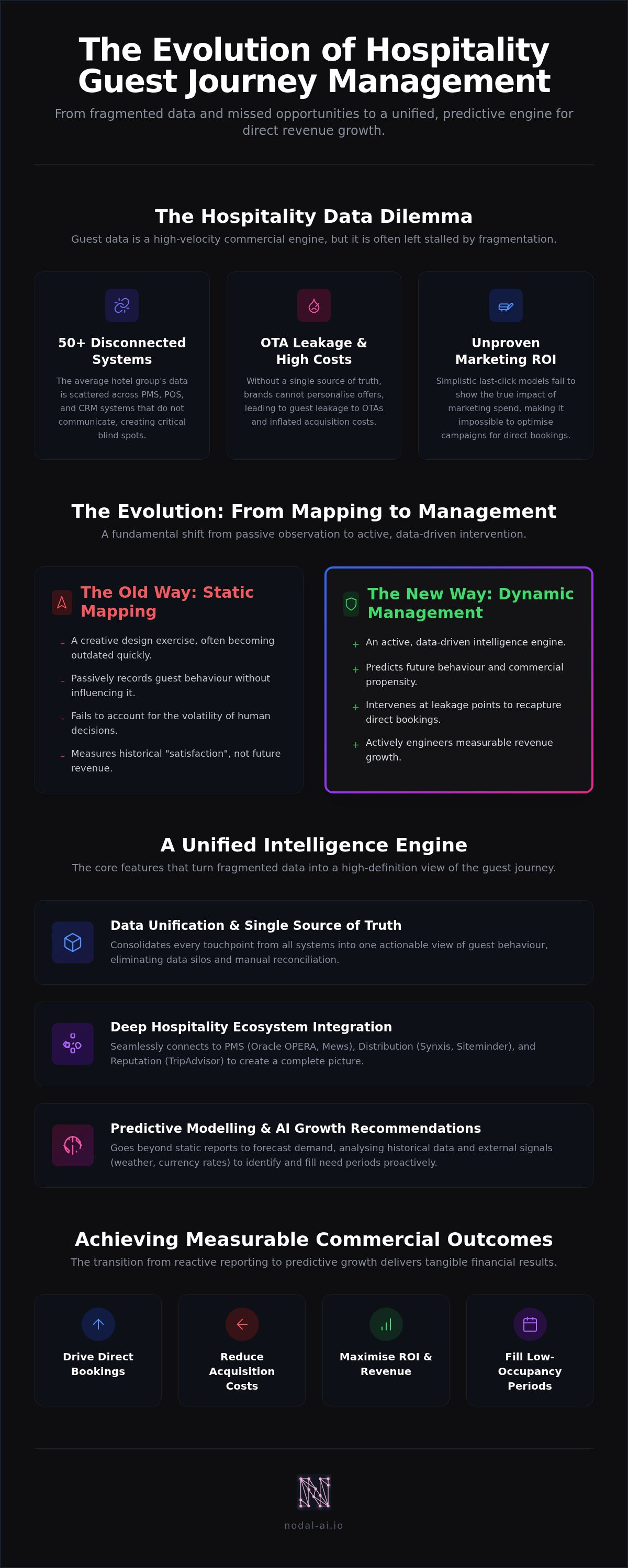
The concept of the customer journey has undergone a radical transformation. In the past, hospitality brands treated journey mapping as a creative design exercise; a static flowchart pinned to a wall that gathered dust while guest behaviour evolved in real time. Today, that approach is obsolete. Modern customer journey management software has redefined the process as an active, data-driven intelligence engine. It no longer just tracks where a guest has been; it predicts where they are going and, crucially, their commercial propensity to book direct. This evolution represents a shift from measuring passive "satisfaction" to engineering active revenue growth.
Mapping vs Managing: Understanding the Difference
Static journey maps fail because they cannot account for the volatility of human behaviour. A guest might visit your website, check a review site, and then disappear for three weeks before booking via an OTA. A map simply records this failure. Journey management, however, intervenes. By using integrated data engines, you can identify these leakage points as they happen. This shift creates a cognitive upgrade for your entire organisation. It aligns your marketing team's spend with the operational reality of your bed yield, ensuring every pound spent is working to capture direct revenue rather than subsidising third-party commissions.
The Cost of Fragmented Data in Hospitality
The average hotel group operates with data scattered across more than 50 systems. Your Property Management System (PMS) knows when they stayed; your Point of Sale (POS) knows what they drank; your CRM knows their birthday. Yet, these systems rarely speak to each other. This fragmentation is the primary driver of OTA dominance. When you cannot see a single source of truth, you cannot personalise the experience or time your offers effectively. This lack of coordination leads to a significant financial drain. Uncoordinated marketing spend often targets the wrong guests at the wrong time, resulting in high acquisition costs and missed opportunities to upsell. Transitioning to a unified view replaces the anxiety of manual data reconciliation with the confidence of streamlined, high-level perspectives. It turns your passive data assets into active participants in your growth strategy, moving your brand from reactive reporting to predictive, AI-driven growth.
Key Features of Enterprise Journey Management Platforms
Modern hospitality leaders require more than a generic dashboard; they need a modular architecture that adapts to their specific commercial goals. High-performing customer journey management software must act as a central nervous system, connecting disparate operational data into a single, high-definition view. This transition from fragmented silos to a unified platform allows you to replace guesswork with precision. By identifying high-value guest profiles through AI-driven audience segmentation, you can focus your marketing spend where it generates the highest return. It's about moving from reactive monthly reports to real-time performance tracking that empowers immediate decision-making. When you can see exactly how a guest moves from initial interest to final booking, you gain the clarity needed to optimise every touchpoint.
Integration with Hospitality Ecosystems
A platform is only as powerful as the data it can ingest. Unlike general-purpose tools, enterprise-grade hospitality solutions must integrate seamlessly with industry-standard systems. This includes connecting operational platforms such as Oracle OPERA, Mews, and Cloudbeds to capture on-property behaviour. It also requires ingesting booking data from distribution engines like Synxis, Travelclick, and Siteminder. By pulling in reputation data from TripAdvisor and Google Reviews, the system can perform sentiment analysis that adds qualitative depth to quantitative booking trends. This level of connectivity ensures that your modular intelligence engine remains fuelled by accurate, real-time information across your entire tech stack. It's a cognitive upgrade that turns passive records into active participants in your business process.
Predictive Modelling and Growth Recommendations
Static reporting belongs in the past. Today, the focus is on forward-looking insights that drive stability. Predictive modelling allows you to forecast demand by analysing historical patterns alongside external signals like FX rates or local event demand. This helps you identify "need periods" well in advance, allowing for proactive adjustments rather than reactive discounts. Research into Summarizing the Mental Customer Journey suggests that guest perception is shaped by complex psychological factors; software that anticipates these needs can balance occupancy with direct revenue growth. Automated reporting should not just present data; it should suggest specific growth actions. For example, it might recommend targeting a specific loyalty segment to fill a low-occupancy weekend. This approach replaces the anxiety of manual forecasting with the confidence of streamlined, high-level perspectives.
Maximising ROI through Multi-Touch Attribution
Last-click attribution is a relic of a simpler era. In hospitality, the guest lifecycle is a winding path across devices, social platforms, and search engines. Relying on the final click before a booking credits the wrong channel and obscures the true drivers of growth. Advanced customer journey management software replaces this narrow view with Multi-Touch Attribution (MTA). By assigning value to every touchpoint, from the initial social media discovery to the final direct booking, you gain total clarity on marketing performance. This perspective allows you to stop over-investing in walled gardens and start recapturing revenue lost to OTA commissions.
Proving Marketing Incrementality
True commercial intelligence distinguishes between promotions that merely shift existing demand and those that create new revenue. Proving incrementality is about understanding if a guest would have booked regardless of a specific ad. By measuring the real impact of paid search and social on direct bookings, you can eliminate wasteful spend. For instance, Ovolo Hotels utilised Nodal's performance marketing analytics to move beyond basic tracking. This strategic shift resulted in a 24.5% increase in ROAS and a 15.3% reduction in acquisition costs. They transformed marketing from a cost centre into a measurable revenue driver.
Audience Segmentation for Ad Spend Efficiency
Efficiency is the byproduct of precision. Identifying high-propensity guest segments allows you to optimise your marketing budget in real time. Instead of broad-spectrum advertising, you can target individuals based on commercial signals such as flight demand or currency fluctuations. This is the "make more, waste less" philosophy in action. It’s a cognitive upgrade for your marketing department, reducing overall spend while simultaneously increasing booking volume. By gaining visibility into the entire journey, you protect your assets and ensure long-term financial stability.
- Identify high-value guest profiles that bypass OTAs and book directly.
- Personalise the guest journey using real-time behaviour data to increase conversion rates.
- Automate reporting to identify and cut underperforming channels before they drain your budget.
To see how these insights apply to your specific portfolio, you can book a demo and witness the power of unified data. Gaining a high-level perspective on your guest behaviour replaces the anxiety of manual data reconciliation with the confidence of streamlined, actionable intelligence.
Implementing Journey Management: A Strategic Roadmap
Transitioning from fragmented data to a unified intelligence engine requires a structured approach. Implementation is not merely a technical task; it's a strategic shift that turns passive records into active participants in your revenue growth. The process begins with a comprehensive audit of your current data sources, including your Property Management System (PMS), CRM, Point of Sale (POS), and digital analytics. This audit reveals the specific gaps where guest leakage occurs. Once identified, you must define commercial KPIs that prioritise direct booking contribution and bed yield over generic vanity metrics. Effective customer journey management software transforms these chaotic inputs into high-value outputs, allowing you to identify exactly where potential revenue is lost to third-party intermediaries.
Overcoming Technical Debt and Fragmentation
Hospitality groups often struggle with legacy systems that don't naturally communicate. Resolving this complexity requires a platform capable of deep integration with industry standards like Oracle OPERA, Mews, or Cloudbeds. Ingesting historical data is essential; without it, predictive modelling lacks the depth needed for accurate demand forecasting. You must decide between a managed implementation, which provides expert guidance to navigate these hurdles, or a self-serve onboarding process. Selecting the right customer journey management software ensures your tech stack becomes a cohesive ecosystem rather than a collection of isolated tools. Configuring custom dashboards for commercial and operational insights allows every stakeholder to see the impact of their decisions in real time.
Aligning Teams for Operational Efficiency
Success depends on breaking down the traditional barriers between marketing, revenue, and operations teams. When these departments work in silos, the guest experience suffers and revenue opportunities vanish. Using shared journey data creates a single source of truth that aligns every department toward a common goal: increasing direct revenue. For example, marketing can adjust spend based on real-time occupancy data, while operations can personalise service based on guest behaviour captured in the CRM. This alignment replaces friction with momentum, ensuring a consistent guest experience across every touchpoint. You can book a demo to see the Nodal Platform in action and realise the full potential of your integrated hospitality data.
Why Nodal AI is the Future of Hospitality Intelligence
Nodal AI stands apart from generic platforms by treating your business as a unique commercial ecosystem rather than a set of abstract data points. While traditional customer journey management software often provides a static view of the past, our modular architecture is built specifically for the high-stakes reality of hospitality. We focus on the "Make more, waste less" philosophy, ensuring every marketing pound is tethered to a concrete return. This approach has delivered proven results for our partners, including a 13.8% increase in bookings and a 5.5% increase in average booking value. By integrating external signals such as weather patterns, FX rate fluctuations, and local event demand, we provide a level of predictive clarity that competitors simply cannot match. It’s a cognitive upgrade that moves your brand from reactive survival to proactive growth.
Industry-Specific Solutions: From Hotels to QSR
Our platform isn't a one-size-fits-all tool. We provide tailored modules designed for the specific nuances of serviced apartments, hostels, and private members clubs. For upscale F&B and QSR locations, we measure footfall and revenue with the same precision we apply to room nights. This flexibility allows you to explore our modular features and select the exact intelligence tools your portfolio requires. Whether you're managing a global hotel group or a boutique members club, Nodal AI connects your fragmented systems into a single, high-performance view. This integration replaces the anxiety of manual data reconciliation with the confidence of streamlined, high-level perspectives.
The Nodal AI Difference: Beyond the Digital Map
The true power of Nodal AI lies in our combination of advanced technology and human expertise. Our data science and AI consultancy teams work alongside the platform to enhance performance, addressing complex challenges like churn risk in membership models or stay extensions in hostels. This ensures your customer journey management software isn't just a functional tool, but a strategic asset that protects your long-term stability. We don't just hand you a dashboard; we provide the strategic roadmap to master future-facing analytics. You can read our definitive guide to the customer journey to understand how mapping for profitable growth will evolve by 2026. By personifying your passive assets and transforming them into active participants in your business process, we ensure your organisation is always one step ahead of the market.
Mastering the Direct Revenue Revolution
The transition from fragmented data silos to a unified intelligence engine is no longer optional for hospitality leaders. By implementing advanced customer journey management software, you replace the anxiety of manual reporting with the confidence of high-level perspectives. You've seen how identifying commercial propensity and mastering multi-touch attribution allows you to recapture revenue lost to OTA leakage. This strategic shift transforms your passive data assets into active participants in your growth strategy; ensuring every marketing pound is optimised for maximum impact.
Our award-winning performance marketing expertise has already delivered a 15.3% reduction in acquisition costs for Ovolo Hotels. With seamless integration across major systems like Oracle OPERA and Mews, the Nodal Platform provides the transparency needed to realise your full commercial potential. It's time to move beyond static maps and embrace a cognitive upgrade for your entire organisation.
Request a personalised demo of the Nodal Platform
Take the first step toward a more profitable and predictable future today.
Frequently Asked Questions
What is customer journey management software?
Customer journey management software is a modular intelligence engine that consolidates fragmented data from PMS, POS, and CRM systems into a single, actionable view. Unlike static mapping, this technology actively orchestrates the guest lifecycle to increase direct bookings and reduce OTA leakage. It transforms passive data into active participants in the business process, providing a cognitive upgrade for hospitality brands looking to reclaim their margins through real-time commercial intelligence.
How does journey software differ from a standard CRM?
A standard CRM acts as a database for guest contact details and history, but it often lacks the commercial context of the wider market. Customer journey management software goes further by integrating operational, demand, and acquisition signals. It doesn't just store data; it orchestrates the entire journey. By connecting booking engines and external signals, it identifies high-propensity segments that a siloed CRM simply cannot detect.
Can this software integrate with legacy PMS systems like Oracle OPERA?
Yes, the Nodal Platform is built to integrate with all major hospitality systems, including legacy platforms like Oracle OPERA and Protel. It also connects seamlessly with modern cloud-based systems such as Mews and Cloudbeds. This connectivity is essential for breaking down data silos. By ingesting both historical and real-time operational data, the software ensures your commercial analysis is grounded in a single, accurate source of truth.
How does multi-touch attribution improve marketing ROI?
Multi-touch attribution improves ROI by assigning value to every guest interaction rather than just the final click. This transparency reveals which channels are truly driving direct bookings and which are merely shifting demand. By identifying and cutting underperforming channels, hospitality brands can significantly reduce their customer acquisition costs. This data-driven approach ensures that marketing spend is focused on the most profitable guest segments and high-value profiles.
What are the benefits of predictive modelling in hospitality?
Predictive modelling allows you to forecast demand and identify early signs of low occupancy or need periods. Instead of reacting to a quiet week with desperate discounts, you can proactively target high-value segments before the gap occurs. This foresight helps you balance occupancy with bed yield. It replaces the anxiety of manual forecasting with the confidence of automated, high-level perspectives on your future revenue performance.
How do external signals like weather affect the customer journey?
External signals like weather, FX rates, and flight demand act as powerful catalysts for guest behaviour. For example, a sudden cold snap might trigger a spike in bookings for spa retreats or indoor attractions. By integrating these signals into your customer journey management software, you can automate personalised offers that resonate with current conditions. This level of hyper-personalisation ensures your brand remains relevant and competitive in a volatile market.
How long does it take to implement a journey management platform?
Implementation timelines vary based on the complexity of your data ecosystem and the number of integrations required. Most hospitality groups can expect a structured onboarding process that includes technical setup, data source connection, and custom dashboard configuration. Nodal AI offers professional implementation and onboarding to manage historical data ingestion. This ensures a frictionless transition from fragmented systems to a unified, high-performance intelligence engine.
Is journey management software suitable for independent hotels or only large chains?
This software is highly effective for both independent properties and large chains due to its modular architecture. Independent hotels benefit from reducing OTA commissions and recapturing direct revenue, which is critical for protecting profit margins. Large groups use it to align teams across multiple locations and properties. Whether you're managing a boutique hotel or a global portfolio, the focus remains on making more and wasting less through commercial intelligence.


