

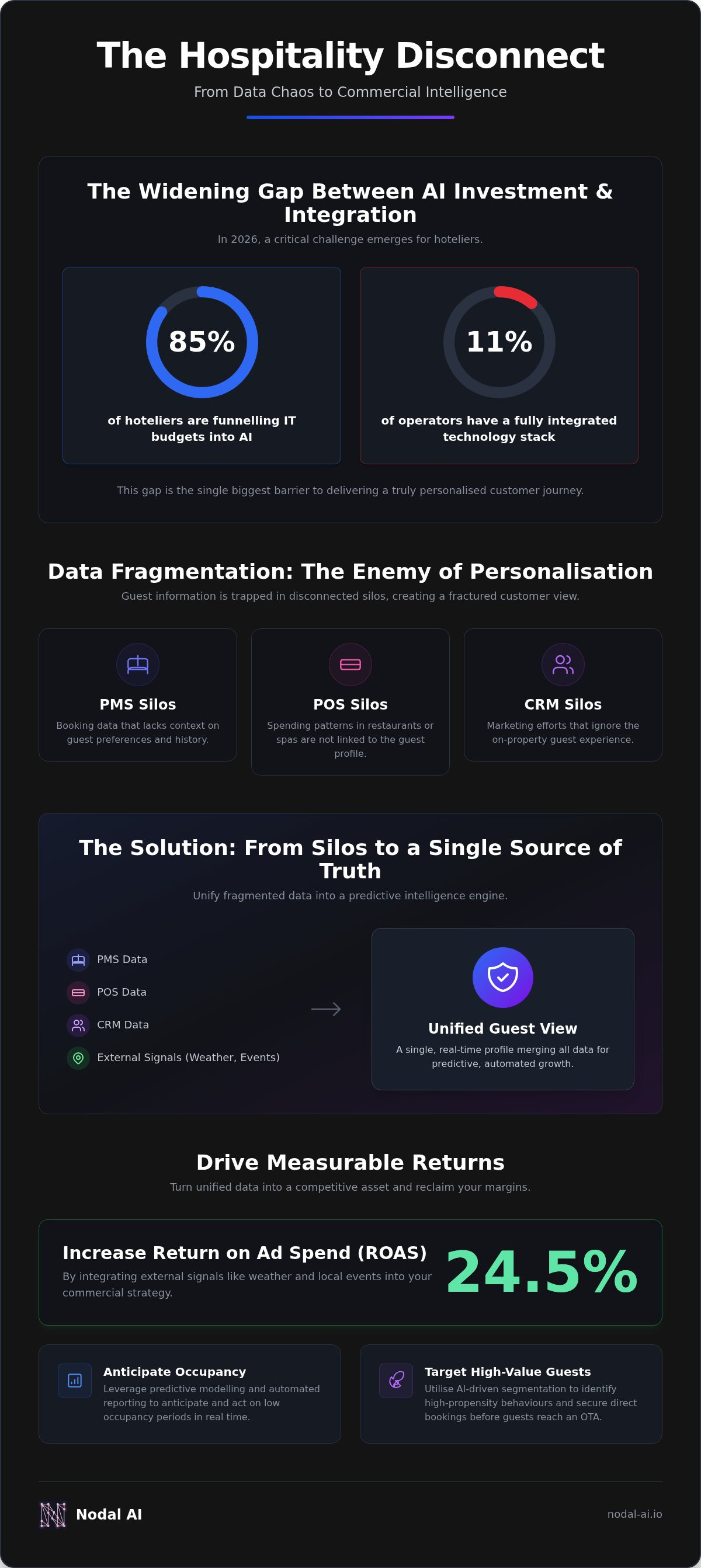
Did you know that while 85 per cent of hoteliers are funneling IT budgets into AI in 2026, only 11 per cent of operators actually have a fully integrated technology stack? This massive gap between investment and integration is the single biggest barrier to delivering a truly personalised customer journey. When your guest data is trapped in silos across your PMS, POS, and CRM, your marketing remains reactive rather than predictive. You're likely feeling the strain of high OTA acquisition costs and the frustration of missing "need periods" because your systems simply don't talk to each other.
We understand the exhaustion of managing chaotic inputs while trying to drive high-value outputs. It's time to stop the manual labor and start leveraging your data as a competitive asset. This article will show you how to unify your fragmented data into a predictive intelligence engine that automates growth and secures direct bookings. You'll discover how to transform passive guest records into active revenue drivers while achieving a single, clear view of your customer.
We'll explore the shift toward hyper-personalisation, the modular architecture needed to reduce OTA leakage, and the specific ways predictive modelling can increase your ROAS by over 24 per cent. It is time to upgrade your organisation's cognitive capabilities and reclaim your margins through streamlined, high-level perspectives.
Key Takeaways
- Unify fragmented data from your PMS, POS, and CRM into a single view of the customer to replace manual tasks with streamlined intelligence.
- Discover how to orchestrate a seamless personalised customer journey that scales across every guest touchpoint while protecting your profit margins.
- Utilise AI-driven segmentation to identify high-propensity guest behaviours and target potential bookings before they reach an OTA.
- Leverage predictive modelling and automated reporting to anticipate low occupancy periods and implement growth recommendations in real time.
- Drive measurable returns, including a 24.5 per cent increase in ROAS, by integrating external signals like weather and local events into your commercial strategy.
Why Data Fragmentation is the Enemy of Personalisation
Data fragmentation isn't just a technical hurdle; it's a direct threat to your bottom line. In most hospitality organisations, guest information is scattered across a Property Management System (PMS), a Point of Sale (POS), and a CRM. These disconnected silos create a fractured view of the guest. When your systems don't talk to each other, you can't possibly deliver a personalised customer journey that feels seamless. Instead of a cohesive strategy, you're left with chaotic inputs that result in missed opportunities and high-value guests feeling like strangers. True Commercial Intelligence requires a shift from managing data to mastering it.
- PMS Silos: Booking data that lacks context on guest preferences and history.
- POS Silos: Spending patterns in restaurants or spas that aren't linked to the central guest profile.
- CRM Silos: Marketing efforts that ignore the on-property reality of the guest experience.
System fragmentation leads to a disjointed guest experience. Imagine a guest who spends thousands in your restaurant but receives a generic "first-timer" discount code the following week. This lack of coordination doesn't just frustrate guests; it erodes your margins. When you don't understand your guests' total value, you can't effectively target them for direct bookings, leaving you vulnerable to OTA leakage and high acquisition costs.
The Cost of the Fragmented Guest View
When booking engines aren't linked to on-property spend, you lose sight of a guest's true Lifetime Value (LTV). This lack of visibility leads to significant margin erosion. Without integrated data, you're forced to rely on manual reporting that is often outdated by the time it reaches your desk. In the competitive 2026 market, manual work is simply too slow. You need to make more and waste less. Fragmented data leads to OTA leakage because you can't identify and reward direct-booking loyalists in real time. Transitioning to a unified model allows you to turn these disjointed data points into a predictive engine for growth.
Moving Beyond the One-Size-Fits-All Approach
Generic email blasts are a relic of the past. McKinsey data shows that 71 per cent of consumers now expect tailored interactions. If you don't provide them, they'll find a brand that does. The shift from broad marketing to intent-based communication requires a deep understanding of the customer experience across every touchpoint. By using customer journey mapping, you can identify exactly where friction occurs. Once you see the full picture, you can replace generic rewards with precision loyalty. This ensures that every touchpoint in the personalised customer journey adds value, reducing your reliance on third-party platforms and securing your direct-booking future.
Unifying the Guest View: From Siloed Systems to Commercial Intelligence
Mastering the personalised customer journey in 2026 requires more than just a standard CRM. It demands a unified guest view. This is a single, real-time profile that merges operational data with marketing signals. To achieve this, you must integrate your core systems. This includes your PMS, such as Mews or Cloudbeds, and your POS, like SevenRooms. Without these connections, your data remains a static record of the past rather than a predictive tool for the future. You are essentially flying blind while your competitors use data to secure the best guests.
A modular architecture is essential for this transformation. By using specific modules for Guest, Commercial, and Operational needs, your business can scale its intelligence engine without the friction of a total system overhaul. Historical data ingestion is equally critical. It provides the necessary context for accurate journey mapping, allowing you to recognise patterns that drive long-term loyalty. When you ingest years of booking history, you transform passive records into active growth recommendations. This process turns a chaotic database into a streamlined commercial asset that works for you.
Connecting the Dots Across Hospitality Systems
Linking PMS data with demand signals from GA4 and Meta allows you to see the guest before they even book. Most hospitality systems operate in isolation; they simply do not communicate. The Nodal Platform serves as the central hub for this unification. It bridges the gap between digital discovery and on-property spend. As you consider the future of personalisation, you must move toward a model where every touchpoint is informed by a complete data set. You can explore these features to see how unified data drives direct revenue.
The Role of External Signals in Journey Accuracy
Static profiles are no longer enough. To truly master the personalised customer journey, you must integrate external signals. Weather patterns, FX rates, and local events significantly influence booking behaviour. For instance, a sudden drop in currency value or a major concert announcement can trigger immediate shifts in guest propensity to book. If flight demand to your region is spiking or tourism trends are shifting, your intelligence engine should react automatically. These external factors transform static guest profiles into dynamic, high-propensity targets. By connecting these dots, you ensure your marketing spend is always aligned with actual guest intent. External signals transform static profiles into dynamic ones by grounding guest intent in the real-world context of their environment.
AI-Driven Segmentation: Identifying High-Propensity Guest Behaviours
Static psychographic profiles are no longer sufficient for the competitive 2026 hospitality market. Modern leaders have moved toward AI-driven audience segmentation as the next frontier of commercial strategy. This approach does not just categorise guests by who they are; it identifies them by what they are likely to do next. By leveraging academic research on data-driven guest segmentation, organisations can now predict guest intent with high accuracy. This allows you to capture high-propensity segments before they even begin their search on an OTA, securing the personalised customer journey at the source.
Predictive modelling allows you to forecast "need periods" (upcoming windows of low occupancy) with high precision. Rather than launching reactive, margin-eroding discounts at the last minute, you receive automated growth recommendations well in advance. These insights enable you to target specific segments based on the external triggers discussed earlier, such as favourable FX rates or weather-driven travel spikes. This ensures your personalised customer journey begins with a highly relevant offer precisely when the guest is most likely to convert. You transform your data from a passive archive into an active engine for proactive growth.
Predicting the Next Sale with Machine Learning
Machine learning moves beyond basic demographics to identify deep behavioural patterns. It is particularly effective at identifying churn risk in membership models, allowing you to intervene before a loyal guest wanders. By using predictive modelling, you can measure guest lifecycle value (LTV) across room extensions and ancillary spend. This intelligence helps you determine which specific promotions actually drive incremental revenue. You stop wasting marketing budget on guests who would have booked anyway, focusing instead on shifting the needle for high-value prospects who require a specific nudge to commit.
Targeting by Property and Guest Segment
Identifying the highest value segments for specific hotel or restaurant sites is a strategic necessity. A corporate-heavy city hotel requires a completely different tactical approach than a leisure-focused boutique property. Using multi-touch attribution allows you to value each segment accurately by tracking their path across every digital channel. You can then optimise your marketing spend by focusing exclusively on segments with the highest booking propensity. This data-driven clarity replaces the anxiety of manual campaign management with the confidence of measurable returns. It ensures that every pound spent is an investment in a guest profile that has a proven history of high-value engagement across your specific portfolio.
Orchestrating the Journey: Delivering Value Across Every Touchpoint
Orchestrating a personalised customer journey requires a fundamental shift from static, one-off campaigns to dynamic lifecycle management. In 2026, the guest experience does not end at the booking confirmation; it merely transitions from the digital discovery phase to the on-property reality. To scale this effectively, you must eliminate the friction that typically occurs between these two worlds. Fragmented systems often cause a breakdown in communication, but unifying your data allows for a seamless handoff from marketing to operations. Automated reporting becomes your primary tool for monitoring this performance, ensuring that every touchpoint is contributing to a reduction in acquisition costs and an increase in direct bookings.
The goal is to replace the anxiety of manual guest tracking with the calm efficiency of a streamlined engine. When your systems are integrated, you can monitor journey performance in real time, identifying exactly where guests drop off or where they engage most deeply. This level of visibility is what allowed Ovolo Hotels to achieve a 15.3 per cent reduction in acquisition costs. By focusing on the entire lifecycle rather than just the initial sale, you turn a single visit into a long-term relationship. This transition from chaotic inputs to high-value outputs is the hallmark of a mature commercial strategy.
Step-by-Step Way to Track and Personalise Campaigns
Mastering orchestration follows a logical, multi-step sequence that guides the user from data to growth. First, define your high-value guest segments using the unified data profiles generated by your intelligence engine. Second, map relevant content and bespoke offers to each specific stage of the guest lifecycle to ensure maximum relevance. Third, deploy automated triggers to reach guests at the exact moment of influence, whether they are in the pre-stay planning phase, currently on-site, or reflecting post-stay. Finally, refine the entire personalised customer journey based on real-time commercial and operational insights to ensure continuous optimisation of your marketing spend.
Balancing Personalisation with Data Privacy
Delivering tailored experiences should never come at the cost of guest security. You must maintain strict GDPR compliance while providing the bespoke service your guests now expect as standard. Transparency in how you collect and use data is not just a legal hurdle; it is a critical tool for building long-term guest trust. Guests are far more likely to share their preferences when they understand the tangible value they receive in return. The Nodal Platform ensures high-level protection of your guest data assets, replacing the risk of fragmented storage with the confidence of enterprise-ready security protocols that protect your most valuable commercial information.
Book a demo to see our orchestration engine in action
Scaling Growth with the Nodal Platform’s Modular Intelligence
The Nodal Platform represents the logical conclusion for hospitality leaders who refuse to settle for fragmented performance. It replaces the anxiety of disconnected systems with a modular intelligence engine designed for rapid, sustainable scale. By organising your data into Operational, Demand, Commercial, and Guest modules, we turn your existing information into a predictive powerhouse. This isn't just a technical upgrade; it's a cognitive upgrade for your entire organisation. The Ovolo Hotels case study serves as a definitive benchmark for this transformation, showing a 15.3 per cent reduction in acquisition costs. You can finally move from the frustration of manual data chaos to the relief of streamlined commercial clarity. We invite you to stop managing tedious inputs and start commanding high-value outputs.
Measurable Returns on Personalisation
Realising a personalised customer journey yields immediate and concrete financial rewards that protect your long-term stability. Hospitality brands using our modular architecture have seen a 24.5 per cent increase in ROAS by targeting high-propensity segments with surgical precision. Additionally, better segmentation has driven a 5.5 per cent increase in average booking value across diverse property portfolios. These results are the direct outcome of how ai marketing analytics unifies disparate signals into a single, actionable perspective. You are no longer guessing which guest might book; you are acting on data that has been transformed from a passive asset into an active participant in your growth strategy. This level of transparency removes the ambiguity that often plagues marketing spend.
Taking the Next Step Toward Commercial Intelligence
The transition to a unified view is designed to be effortless and frictionless. Our onboarding process is fast, professional, and enterprise-ready, ensuring that your team sees results without needing deep technical specialisation. You can explore the full range of Nodal Platform features to understand how each module addresses your specific operational pains. We replace the loss of productivity due to manual labour with the confidence of automated growth recommendations. It's time to secure your margins and outpace the competition with future-facing analytics that work as hard as you do. The path to a truly personalised customer journey starts with a single, strategic decision to consolidate your intelligence. Take control of your data today and book a discovery demo to see the future of hospitality performance.
Command Your Data and Reclaim Your Margins
The transition from fragmented data silos to a unified intelligence engine is a commercial necessity. By integrating your PMS, POS, and CRM systems, you replace the anxiety of manual reporting with the confidence of automated growth. Predictive modelling and external signals transform static profiles into dynamic participants in your strategy. This approach earned Nodal AI Gold in the Performance Marketing Awards and delivered measurable stability for our partners.
Mastering the personalised customer journey allows you to outpace OTA leakage and secure direct bookings with surgical precision. With a proven 24.5 per cent increase in ROAS and a 15.3 per cent reduction in acquisition costs, the path to high-value outputs is clear. It's time to upgrade your organisation's cognitive capabilities and turn your guest data into your most profitable asset.
Book a demo to see how Nodal AI unifies your guest journey
The future of hospitality belongs to those who act on intelligence rather than intuition. Take the next step toward total commercial clarity today.
Frequently Asked Questions
What is a personalized customer journey in the hospitality industry?
It is a data-driven strategy that tailors every guest touchpoint based on individual preferences and historical behaviour. In hospitality, this means using unified data from PMS and POS systems to provide relevant offers at each stage of the guest lifecycle. It moves beyond generic marketing templates to deliver intent-based experiences that encourage direct bookings, increase long-term loyalty, and maximise the total value of every guest visit.
How does AI improve customer journey mapping for hotels and restaurants?
AI automates the analysis of vast datasets to identify patterns that manual reporting often misses. It allows for real-time adjustments to the personalized customer journey by predicting guest intent and identifying friction points. By processing demand signals and external factors like local events, AI-driven mapping ensures that your marketing spend is always aligned with the segments most likely to convert during specific trading periods.
Can I personalize the journey if my data is stored in different systems?
Yes, provided you use a modular intelligence engine to unify those disparate sources. Nodal AI specialises in connecting fragmented systems like Mews, SevenRooms, and HubSpot that typically do not communicate. By consolidating these silos into a single guest view, you can orchestrate a seamless experience across all platforms without needing to replace your existing technology stack or your core operational software.
What are the main benefits of a personalized customer journey for direct bookings?
The primary benefit is a significant reduction in OTA leakage and acquisition costs. By delivering highly relevant offers directly to high-propensity segments, you bypass third-party platforms and protect your profit margins. Brands like Ovolo Hotels have seen a 15.3 per cent reduction in acquisition costs and a 24.5 per cent increase in ROAS by implementing these data-driven strategies to secure more direct revenue.
Is it possible to track the ROI of personalization efforts accurately?
Accurate tracking is achieved through multi-touch attribution and automated reporting. These tools allow you to value every guest segment and touchpoint by linking digital discovery to on-property spend. You can measure specific outcomes such as increases in average booking value or total room revenue. This level of transparency removes the ambiguity of marketing spend and provides clear evidence of your organisation's financial performance.
How does predictive modelling help in personalizing the guest experience?
Predictive modelling identifies upcoming "need periods" and guest churn risks before they impact your revenue. It allows you to implement proactive growth recommendations by targeting the right guests with the right offer at the right time. This ensures the personalized customer journey remains relevant even as market conditions shift, using historical patterns to forecast future booking behaviours and potential ancillary spend across your properties.
How do I ensure GDPR compliance while personalizing guest journeys?
Compliance is maintained through transparent data usage and high-level protection of guest data assets. You must ensure that all data ingestion and processing protocols meet strict security standards while providing guests with clear value in exchange for their preferences. Nodal AI prioritises secure, enterprise-ready integrations that safeguard sensitive information, allowing you to deliver bespoke experiences without compromising on privacy or global legal requirements.
What data sources are needed to create a unified guest view?
A complete view requires data from four key areas: operational systems like the PMS, transactional systems like the POS, acquisition channels such as GA4, and guest management tools like the CRM. Integrating these sources allows you to connect digital intent with real-world spending. Incorporating external signals such as weather, FX rates, and local event data further refines this view, transforming static profiles into dynamic commercial assets.


