

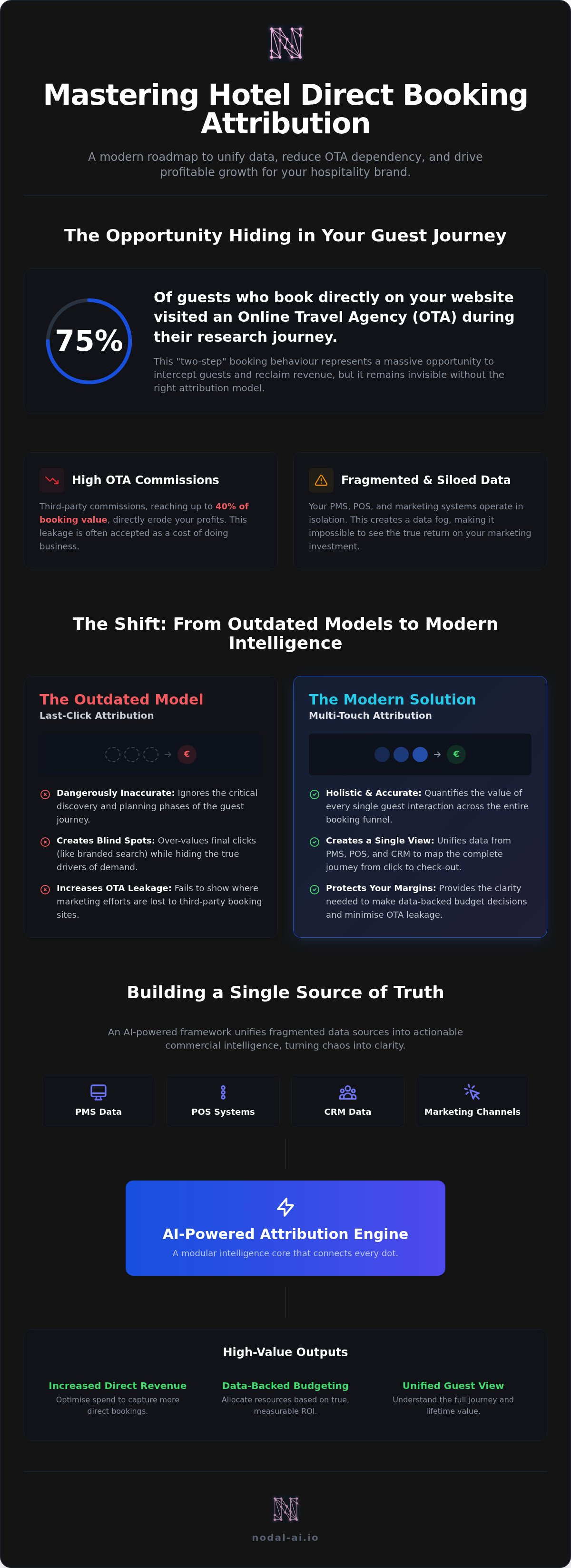
75% of guests who book directly on your website visited an Online Travel Agency during their research journey. This "two-step" booking behaviour represents a massive opportunity, yet most hospitality brands struggle to track it accurately. You likely see the impact of high OTA commissions, which can reach up to 40% of booking value, but feel powerless to prove which marketing channels actually intercepted those guests. Without a robust system for hotel direct booking attribution, fragmented data across your PMS and POS systems creates a fog that obscures your true return on investment.
You understand that every pound spent on third-party commissions is a pound taken from your bottom line. It's time to replace that uncertainty with the clarity of advanced analytics. This guide provides a visionary roadmap to unify your data sources, reduce OTA leakage, and transform chaotic inputs into high-value revenue streams. We'll explore how to build a single view of the guest journey and implement data-backed budget strategies that ensure you make more while wasting less.
Key Takeaways
- Abandon outdated last-click models and adopt Multi-Touch Attribution to accurately quantify the value of every guest interaction across the booking funnel.
- Master the science of hotel direct booking attribution to unify fragmented data from your PMS, POS, and CRM systems into a single, high-level perspective.
- Utilise modular architecture to bridge the gap between initial marketing touchpoints and final direct revenue, effectively minimising OTA leakage and protecting your margins.
- Follow a structured implementation roadmap to transform chaotic data silos into automated, high-value growth recommendations for your entire organisation.
What is Attribution Tracking in the Hospitality Sector?
Attribution tracking is the definitive science of identifying which specific marketing interactions actually drive guest revenue. In the hospitality sector, this goes far beyond simple digital clicks. It's about mapping the entire journey from the first moment of discovery to the final checkout. While generic marketing attribution models might work for standard e-commerce, they often crumble when faced with the unique complexities of travel. Mastering hotel direct booking attribution ensures your marketing spend is a calculated investment rather than a speculative cost.
The hospitality industry operates within a landscape of fragmented data. Your Property Management System (PMS) holds guest stay details, while your Point of Sale (POS) tracks restaurant spend. Meanwhile, your marketing channels generate thousands of digital touchpoints. Without a unified system, these assets remain passive. Effective attribution transforms them into active participants in your business process, connecting the dots between a social media impression and a confirmed room night.
The Role of Commercial Intelligence
Modern attribution serves as a cognitive upgrade for your entire organisation. It replaces the anxiety of manual reporting with the calm efficiency of streamlined, high-level perspectives. By turning chaotic data inputs into high-value growth outputs, you move beyond gut feeling. You no longer need to guess which campaigns are performing. Instead, you gain the clarity required to allocate budgets based on measurable returns. This transition from fragmented noise to strategic clarity allows you to optimise every pound spent on guest acquisition.
Why Traditional Tracking Fails Hotels and Restaurants
Standard tracking tools often fail because they cannot bridge the gap between digital ads and physical property systems. Most analytics platforms lose sight of the guest the moment they navigate away from your website. This creates a blind spot known as OTA leakage, where tracking simply stops at the third-party site. You might be driving the traffic, but the Online Travel Agency (OTA) claims the credit and the commission.
To reclaim your margins, you need a unified view of the customer journey. Traditional methods struggle to calculate the true average booking value because they don't account for the disconnect between a booking engine and the actual stay recorded in the PMS. A modular intelligence engine solves this by unifying data from sources like Mews, Opera, or OpenTable. This integration allows you to see the full picture, identifying exactly where direct revenue is being lost and where it can be won back.
Modern Attribution Models: Moving Beyond the Last Click
Relying on last-click attribution is like giving all the credit for a goal to the striker while ignoring the midfield play that made it possible. For years, this outdated model has skewed marketing ROI by ignoring the complex reality of the guest journey. In 2026, high-performing hospitality brands have moved toward Multi-Touch Attribution (MTA) to capture every interaction that leads to a stay. This shift provides the transparency needed to reclaim revenue from third-party channels and perfect your hotel direct booking attribution strategy. It transforms your data from a passive list of clicks into an active participant in your commercial growth.
Beyond just tracking clicks, modern systems now use AI-driven insights to predict high-propensity guest segments. By analysing historical patterns, you can identify which visitors are likely to upgrade their room or book a table at your restaurant before they even arrive. This level of predictive modelling allows you to track the full visitor lifecycle, from initial ticketing to physical attendance and post-stay advocacy. It replaces the anxiety of manual data entry with the confidence of a high-level perspective, ensuring you capture the true value of every guest relationship.
The Problem with Last-Click Bias
Last-click models are fundamentally biased because they ignore the critical discovery and planning phases. They frequently over-value branded search, rewarding a final click on your hotel name while completely under-valuing the social discovery or display ads that originally put your brand on the traveller's radar. This is particularly dangerous in 2026, where research shows that up to 75% of consumers visit an OTA before booking directly. If you only track the final click, you remain blind to the influencers that actually drive your direct revenue. You lose the ability to see how top-of-funnel content influences ancillary spend and guest extensions during their stay.
Multi-Touch Attribution Explained
MTA offers a more intelligent way to distribute credit across the guest journey. Linear models share credit equally across all touchpoints, while time-decay models prioritise interactions that occur closer to the booking date. Position-based models often focus on the critical first and last interactions, acknowledging the importance of both discovery and conversion. Nodal AI automates these complex reporting structures, turning fragmented data into streamlined growth outputs. For a deeper look at specific methodologies, see our guide on Mastering Marketing Attribution. By implementing these advanced models, you can optimise your automated reporting and ensure your budget is always allocated to the channels with the highest measurable returns.
Comparing Attribution Strategies for Hospitality Growth
Selecting the right framework for hotel direct booking attribution is a strategic decision that determines your commercial trajectory. While first-touch models highlight the power of discovery, they often fail to account for the nurturing required to close a complex booking. Conversely, AI-driven algorithmic models offer a cognitive upgrade by weighing every touchpoint based on its actual contribution to the bottom line. The Nodal Platform generates tailored commercial insights by aligning these models with your specific business goals, ensuring your data works for you rather than against you.
Different hospitality niches require distinct approaches to data. A serviced apartment operator with a 30-day average stay length faces a different customer journey than a local pub group. For long-lead bookings, multi-touch models provide the necessary transparency to justify top-of-funnel spend. For high-frequency transactions, simpler models may suffice. The key is to move from chaotic inputs to high-value outputs by matching the model to the guest's natural behaviour. This ensures you are not just collecting data, but actively using it to reduce acquisition costs across your entire portfolio.
Choosing a Model Based on Guest Lifecycle
Your attribution strategy must mirror the guest lifecycle to be effective. For attractions and experiences where ticketing is the primary goal, first-touch models are often sufficient for identifying the initial spark of interest. For hotels aiming to balance high occupancy with direct revenue, position-based models are the standard. They credit the discovery that started the journey and the final interaction that secured the stay. QSR brands should pivot toward footfall and location-based revenue tracking, ensuring that digital ads are directly linked to physical restaurant visits and real-time sales.
The Impact on Profit Margins
Precision attribution is the most effective weapon against profit margin erosion. When you accurately identify which channels drive direct bookings, you can reduce your reliance on high-commission OTAs. Ovolo Hotels achieved a 15.3% reduction in acquisition costs by implementing these precise tracking methods. This was not just about saving money; it was about reclaiming control over the guest relationship. By using Growth Recommendations, you can optimise your marketing spend in real-time. This ensures every pound is directed toward high-performing segments, replacing the anxiety of wasted budget with the confidence of measurable returns. To see how these insights can scale your brand, book a demo with our expert team today.
Solving Data Fragmentation and OTA Leakage
Data fragmentation is the primary barrier to achieving total clarity in your marketing efforts. In many organisations, the Property Management System (PMS) and the Point of Sale (POS) act as isolated islands, preventing a unified view of the guest journey. This disconnect allows Online Travel Agencies (OTAs) to exploit gaps in your tracking, leading to significant revenue leakage. Mastering hotel direct booking attribution requires a modular architecture that bridges these silos, transforming passive data into active commercial intelligence.
London marketing teams often face the "Walled Garden" problem, where platform-specific data remains trapped within social or search ecosystems. This lack of transparency makes it difficult to identify exactly where potential guests drop off and book through a third party instead. By unifying your digital touchpoints with on-property systems, you can create a framework to pinpoint these leakages. You can see exactly when a guest discovers you on social media but finishes the transaction on an OTA. This allows you to intercept high-intent travellers before they exit your ecosystem, ensuring you protect your margins and drive direct revenue.
Integrating Fragmented Systems
A single view of the customer journey is no longer a luxury; it's an enterprise necessity. Nodal AI connects directly with industry-standard systems to eliminate manual data entry and human error. Common integrations include:
- Oracle OPERA and Mews: Syncing room bookings and guest stay history.
- OpenTable: Linking restaurant reservations to overall guest value.
- CRM Systems: Mapping marketing engagement to long-term loyalty.
Through advanced data science and predictive modelling, we bridge the gap between these disparate sources. Commercial directors gain the relief of automated reporting, replacing fragmented data points with high-level perspectives that guide strategic decision-making and long-term stability.
Incorporating External Signals
True attribution doesn't happen in a vacuum. External factors such as local weather patterns, FX rate fluctuations, and major city events significantly influence guest behaviour. For example, a sudden drop in the value of the pound or a scheduled festival in London can shift booking patterns overnight. Incorporating these signals into your demand forecasting allows you to predict length-of-stay performance with greater accuracy. This level of intelligence is central to the Nodal AI mission of helping hospitality brands make more and waste less. It ensures your budget allocation is always responsive to the real-world conditions affecting your properties, replacing guesswork with data-backed confidence.
Book a demo to unify your hospitality data
Implementing an AI-Powered Attribution Framework
Transforming a fragmented data landscape into a pillar of strategic clarity requires more than just software; it demands a structured framework. Transitioning from manual, tedious tracking to automated precision is the hallmark of a visionary hospitality brand. Implementing a robust system for hotel direct booking attribution replaces the anxiety of guesswork with the calm efficiency of data-backed insights. This process turns your chaotic digital inputs into high-value commercial outputs, ensuring your organisation remains competitive in an increasingly complex market.
Professional onboarding is essential to ensure a seamless integration between your PMS, POS, and digital marketing channels. This technical setup creates the foundation for your cognitive upgrade, linking disparate sources to a final goal of total clarity. By automating these processes, marketing teams frequently save 20 or more hours per week. This reclaimed time allows your staff to focus on high-level strategy and creative growth rather than getting lost in the weeds of spreadsheet reconciliation. The Nodal Platform serves as the logical conclusion for brands seeking operational efficiency and long-term financial stability.
Building Your Data-Driven Strategy
Success begins with a clear customer journey map as your foundation. This allows you to personify your passive assets and turn them into active participants in your business process. For a detailed roadmap, consult The Definitive Guide to the Customer Journey. Once your journey is mapped, use AI-driven audience segmentation to optimise your marketing spend. This ensures you target high-propensity guests with tailored messaging, maximising your impact while adhering to the principle of making more and wasting less.
Measuring Success and ROI
Modern commercial leadership is defined by transparency and the removal of ambiguity. You must monitor key performance indicators such as ROAS and average booking value to quantify the weight of your marketing efforts. Nodal AI features empower you to identify early signs of need periods, such as upcoming low occupancy or dipping restaurant covers, before they affect your bottom line. This proactive approach turns demand forecasting into a significant competitive advantage. To see how this modular intelligence engine can revolutionise your hotel direct booking attribution, book a demo and experience the future of hospitality analytics today.
Reclaim Your Margins with Strategic Intelligence
Mastering the science of hotel direct booking attribution is no longer a luxury for hospitality brands; it's a fundamental requirement for commercial survival. By unifying fragmented data from your PMS and POS systems, you transform chaotic silos into a single, streamlined perspective. This clarity allows you to eliminate OTA leakage and reclaim the direct revenue that belongs to your property. You move from the anxiety of manual reporting to the calm efficiency of high-level commercial intelligence.
Our legacy of excellence includes a 15.3% reduction in acquisition costs for Ovolo Hotels and a 24.5% increase in ROAS. This performance, backed by our team's history of winning Gold in the Performance Marketing Awards, ensures your organisation moves from manual uncertainty to automated growth. It's time to replace the burden of high commissions with the confidence of measurable returns and data-backed budget allocation.
Book a demo of the Nodal Platform today
The future of hospitality belongs to those who realise the power of their own data. Start your journey toward total clarity and superior financial performance now.
Frequently Asked Questions
What is the most accurate attribution model for hotels in 2026?
Multi-touch attribution is the most accurate framework for 2026 because it assigns value to every interaction in the guest journey. Unlike last-click models that overvalue branded search, multi-touch frameworks provide a cognitive upgrade by crediting discovery and planning phases. This high-level perspective ensures you invest in the channels that actually initiate the booking process. It replaces speculative spend with a data-backed roadmap for long-term financial stability and commercial growth.
How does attribution tracking help reduce OTA commission costs?
Strategic attribution reduces OTA commission costs by identifying exactly where direct bookings are lost to third-party platforms. By mapping the "two-step" booking behaviour, you can intercept high-intent travellers before they exit your ecosystem. This precision helped brands like Ovolo Hotels achieve a 15.3% reduction in acquisition costs. It turns passive traffic into direct revenue, ensuring you protect your margins and stop overpaying for guests you have already influenced through your own marketing.
Can attribution tracking work across fragmented systems like PMS and POS?
Yes, the Nodal Platform uses a modular architecture specifically designed to unify fragmented hospitality data. It connects disparate systems like Oracle OPERA, Mews, and OpenTable that typically don't communicate. This integration creates a single view of the customer journey, linking digital marketing touchpoints to physical on-property spend. You gain total clarity across your entire operation, replacing the anxiety of manual data entry with streamlined, automated insights that drive direct revenue.
What are the benefits of AI-powered attribution over traditional methods?
AI-powered attribution offers a cognitive upgrade over traditional methods by incorporating predictive modelling and automated growth recommendations. Traditional methods only report on the past, but AI identifies high-propensity guest segments and early signs of need periods. This allows you to optimise your marketing spend in real-time. You move from chaotic data inputs to high-value outputs, ensuring your organisation remains competitive through future-facing analytics and measurable returns on every campaign.
How do external signals like weather affect marketing attribution results?
External signals like weather, FX rates, and local events are critical because they directly influence demand forecasting and length-of-stay performance. Incorporating these factors into your hotel direct booking attribution ensures your analysis reflects real-world conditions. A sudden drop in the pound or a rainy forecast can shift guest behaviour overnight. By tracking these variables, you make more and waste less, ensuring your budget allocation is always responsive and optimised for current trends.
Is multi-touch attribution compliant with UK privacy regulations?
Multi-touch attribution is fully compliant with UK privacy regulations through the use of server-side tracking and first-party data strategies. As a London-based technology company, Nodal AI prioritises the high-level protection of your assets and guest information. Our platform replaces the reliance on third-party cookies with secure, integrated systems. This ensures your marketing remains effective and transparent without compromising security or falling foul of evolving data protection standards across the hospitality sector.
How much time can marketing teams save with automated attribution reporting?
Marketing teams typically save 20 or more hours per week by implementing automated attribution reporting. This relief comes from eliminating manual data reconciliation across fragmented systems like PMS and CRM platforms. Automated processes turn tedious tasks into streamlined, high-level perspectives. Your team can stop fighting with spreadsheets and start focusing on strategic growth. This operational efficiency is essential for modern hospitality brands looking to scale their direct revenue without increasing their headcount.
Which guest segments generate the highest value for my specific property?
Identifying high-value guest segments requires a unified view of stay history and on-property spend. AI-driven audience segmentation unifies data from your PMS and POS to highlight which travellers generate the highest lifetime value. You might discover that guests from specific geographic regions or those attending local events have a significantly longer stay length. This intelligence allows you to target high-propensity segments, ensuring every marketing pound is spent where it delivers the most impact.


