

Your business intelligence tools tell you what happened last month, but they are silent about what you should do tomorrow. Most leaders feel the weight of fragmented data sources that simply refuse to communicate, leaving teams to spend over 20 hours every week on manual reporting. You likely recognise the frustration of reactive decision-making where you are always one step behind the market. It is time to realise that a dashboard is not a strategy; it is a rear-view mirror.
In this guide, we break down the evolution of the ai analytics platform vs bi tools in 2026. You will discover why traditional business intelligence is no longer enough to manage complex data ecosystems and how AI-driven engines provide the prescriptive insights needed for sustainable growth. We preview how to transition from chaotic manual tasks to a single view of commercial performance, allowing you to automate growth recommendations and reduce acquisition costs through precise attribution. Prepare to turn your passive data into your most active commercial partner and experience the relief of total clarity.
Key Takeaways
- Realise the fundamental shift from historical reporting to prescriptive intelligence, allowing you to move beyond what happened to what you should do next.
- Learn how to bridge the gap between fragmented systems, such as your PMS and marketing data, to achieve a unified view of commercial performance.
- Evaluate the core differences between an ai analytics platform vs bi tools to determine which engine best supports your growth targets in 2026.
- Identify how to replace manual reporting hours with automated growth recommendations that drive measurable increases in ROAS and direct bookings.
- Discover the modular architecture required to solve data fragmentation and reduce acquisition costs across your entire organisation.
Understanding the Shift: What is an AI Analytics Platform vs BI Tools?
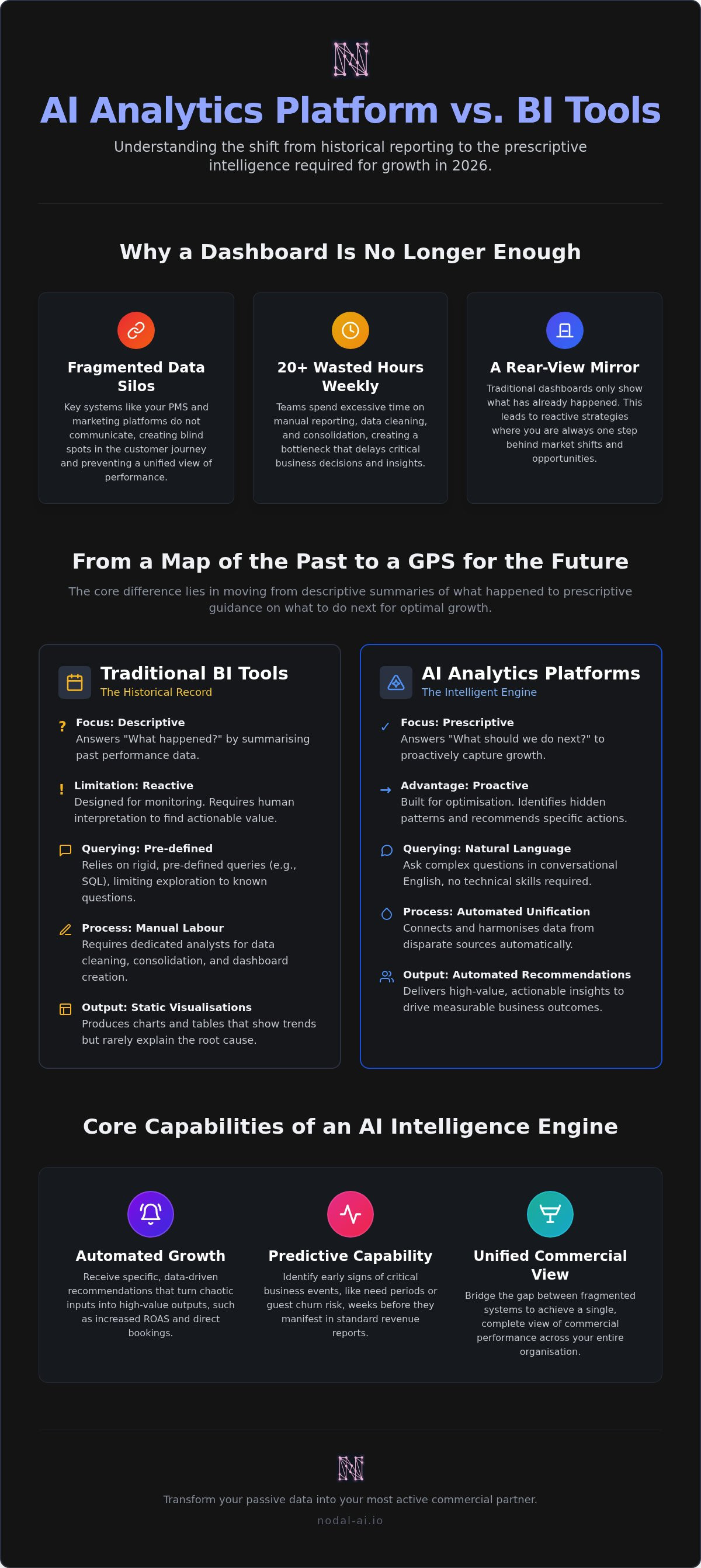
The distinction between an ai analytics platform vs bi tools is the difference between reading a map of where you have been and using a GPS to navigate where you are going. Business intelligence (BI) serves as a historical reporting framework; it organises descriptive data to explain what happened in the past. While this was sufficient a decade ago, the complexity of 2026 requires more than just a summary of previous performance. Modern AI analytics platforms act as modular intelligence engines. They don't just report; they use machine learning to provide prescriptive insights that tell you exactly how to capture growth.
The fundamental shift here is from reactive to proactive strategy. BI is designed for monitoring, providing a snapshot of performance that requires human interpretation to find value. In contrast, AI analytics platforms are built for optimisation. They identify patterns that the human eye might miss, shifting your focus from "what went wrong" to "what should we do next". This transition replaces the anxiety of manual data digging with the confidence of high-level perspectives.
The Core Characteristics of Traditional BI
Traditional BI relies heavily on structured data and pre-defined queries. It creates a rigid environment where you can only find answers to questions you already knew to ask. This approach often leads to a data bottleneck because manual dashboard creation requires dedicated analysts to translate raw inputs into visuals. These static visualisations show trends, such as declining occupancy or rising costs, but they rarely explain the underlying cause. You are left with a clear picture of the problem but no automated path to the solution.
The Rise of AI-Powered Intelligence Engines
An AI-powered intelligence engine represents a cognitive upgrade for your entire organisation. It moves the needle from simple monitoring to active performance optimisation. These platforms solve the primary pain point of 2026: fragmented data. By automating data ingestion from disparate sources, such as your PMS, POS, and CRM, they create a unified view of commercial performance. Explore our modular features to see how this intelligence engine connects your systems.
- Natural Language Processing: Query your data using conversational English without needing SQL or technical specialisation.
- Predictive Capability: Identify early signs of need periods or guest churn risk weeks before they manifest in your revenue reports.
- Automated Growth: Receive specific recommendations that turn chaotic inputs into high-value outputs.
While BI tools help you keep score, an AI analytics platform helps you win the game. It transforms your data from a passive asset into an active participant in your business process, ensuring you make more and waste less.
The Architecture of Clarity: Unifying Fragmented Data Silos
For many hospitality leaders, the biggest hurdle to growth isn't a lack of data; it's the fact that their systems don't speak the same language. Your Property Management System (PMS) like Oracle OPERA or Mews often operates in a vacuum, completely disconnected from your performance marketing data. This fragmentation creates a blind spot where commercial teams cannot see the full customer journey. When evaluating an ai analytics platform vs bi tools, the ability to bridge these silos becomes the deciding factor for operational success.
Why Traditional BI Struggles with System Fragmentation
Traditional BI tools are notoriously rigid. They suffer from the "garbage in, garbage out" problem because they require a perfectly clean, centralised data warehouse before they can generate a single chart. This leads to high costs in manual data cleaning and consolidation, often forcing teams to waste hours every week just to make sense of the numbers. The core difference in the ai analytics platform vs bi tools debate lies in how they handle these messy, unmanaged environments. Standard BI also fails to account for critical nuances like OTA leakage or precise direct booking attribution. It shows you the volume of bookings but misses the "why" behind the source.
Nodal’s Modular Approach to Data Integration
Modern AI in analytics bypasses these structural limitations. Instead of waiting for a perfect data warehouse, it uses machine learning to map complex customer journeys across disparate touchpoints. By employing a modular architecture, you can deploy specific intelligence for Demand, Commercial, or Guest behaviour. This creates a single view of performance that transcends departmental silos and eliminates the need for manual cross-referencing between POS and CRM systems.
True clarity also requires looking outside your own organisation. An AI-driven engine integrates external signals, such as local events, FX rates, and weather patterns, directly into its analysis. This allows you to understand how a sudden currency shift or a local festival impacts your demand in real time. Exploring how these specific modules connect your disparate data points can help you understand how to transform passive assets into active commercial strategies. This cognitive upgrade ensures that your team is no longer reacting to last month’s siloed reports but is instead architecting future returns.
Descriptive vs Prescriptive: Which Drives More Revenue?
In the debate of ai analytics platform vs bi tools, the ultimate winner is determined by how quickly insights turn into bankable returns. While traditional business intelligence provides a map of where your organisation has been, an AI-driven engine provides the instructions for where it needs to go. The shift from descriptive to prescriptive analytics marks the transition from merely observing your data to actively commanding it. Prescriptive analytics is the bridge between data and action. It replaces the "wait and see" approach with a "know and execute" strategy that directly impacts your bottom line.
BI: The "What Happened" Perspective
Traditional BI systems are excellent at tracking monthly KPIs and historical cost trends. They give you a clear view of your performance in the rear-view mirror. However, they often leave you with more questions than answers. You might realise that revenue is down for the quarter, but your BI dashboard won't necessarily pinpoint the specific channel causing the drop or explain why it is happening. This limitation is particularly visible in digital attribution. Most BI tools rely on "last-click" models that ignore the complexity of a multi-channel world, leading to misallocated budgets and missed opportunities. You see the result, but the cause remains shrouded in ambiguity.
AI: The "What to Do Next" Framework
An AI analytics platform moves beyond the "what" to deliver the "how". By leveraging machine learning, these systems identify high-propensity guest segments that are most likely to convert, allowing you to optimise your marketing spend with surgical precision. Instead of a static chart, you receive automated reporting that highlights early signs of low occupancy in the next six weeks. This foresight allows you to act before the problem manifests in your bank account.
The prescriptive nature of AI provides specific advice on which promotions are genuinely increasing revenue rather than simply shifting demand from one period to another. This level of intelligence is explored further in our guide to predictive modelling, which details how to turn fragmented historical data into a forward-looking growth engine. By surfacing offers to users predicted to convert, you reduce acquisition costs and improve guest loyalty simultaneously. You stop wasting resources on broad campaigns and start investing in high-value outcomes. This cognitive upgrade ensures your team spends less time debating the meaning of a chart and more time executing strategies that drive measurable revenue growth.
Evaluating Your Tech Stack: When to Move Beyond BI
Identifying the exact moment your current infrastructure becomes a bottleneck is critical for maintaining commercial momentum. Many leaders find themselves at a crossroads where their existing business intelligence setup no longer provides the speed or depth required for 2026. The choice between an ai analytics platform vs bi tools often comes down to how much manual labour you are willing to tolerate. If your data remains trapped in silos, it is time to realise that your tech stack needs a cognitive upgrade to stay competitive.
Signs You Have Outgrown Your BI Tool
The most obvious symptom of an outdated stack is the loss of productivity. When your commercial team spends 20 or more hours every week building reports rather than executing strategy, the tool has become a burden. You might also notice that decision-makers are beginning to ignore dashboards entirely. This happens when the data is perceived as too old or too vague to be useful. If you cannot accurately measure the ROI of multi-channel marketing campaigns, your BI tool is failing to provide the transparency you need to scale. You are essentially flying blind while looking at a map from last month.
The Strategic Advantage of Multi-Touch Attribution
Walled gardens and complex digital paths make traditional attribution nearly impossible for standard BI. Moving beyond last-click models is essential to understand the true guest lifecycle. An AI-powered platform excels here by implementing advanced marketing attribution, which directly reduces acquisition costs. For instance, Ovolo Hotels achieved a 15.3% reduction in acquisition costs by gaining clarity on their high-value direct bookings. This level of insight identifies the revenue that OTAs often obscure, allowing you to reclaim your margins and optimise your spend in real time.
Transitioning from IT-heavy maintenance to self-service AI intelligence requires a robust data governance framework to ensure accuracy and trust. This framework acts as a bridge, turning chaotic inputs into high-value outputs without requiring deep technical specialisation from your staff. By empowering your team with automated growth recommendations, you replace the anxiety of manual tasks with the confidence of streamlined perspectives. It is a fundamental shift from maintaining systems to mastering returns, ensuring that every data point becomes an active participant in your business growth.
Book a demo to see how the Nodal Platform can upgrade your intelligence
Nodal AI: Connecting the Dots Across Commercial Performance
The Nodal Platform provides the final piece of the puzzle for organisations struggling with data fragmentation. While the technical debate of ai analytics platform vs bi tools often focuses on processing power, the real value lies in commercial outcomes. Nodal acts as a modular intelligence engine designed to eliminate margin pressure and solve the disconnect between your PMS, POS, and CRM systems. Our mission is simple: make more, waste less. By consolidating your intelligence into a single, high-level perspective, you turn chaotic data points into a streamlined growth engine that works for you rather than against you.
The specific features of the Nodal Platform allow you to move from passive observation to active command. By utilising multi-touch attribution and automated reporting, you gain the transparency needed to reduce OTA leakage and drive direct bookings. This modular architecture is specifically tailored for hospitality, with dedicated modules for Operational, Demand, and Guest intelligence. This cognitive upgrade ensures that your commercial decisions are no longer based on last month's reactive reports but on real-time prescriptive insights that identify exactly where your next guest is coming from.
Real-World Impact: The Ovolo Hotels Success Story
Concrete proof of this transformation is found in the Ovolo Hotels success story. By moving beyond the limitations of traditional BI and adopting Nodal’s intelligence, the group achieved a 15.3% reduction in acquisition costs. This was not just a minor tweak; it was a fundamental shift in how they managed their demand across a complex portfolio. They realised a 24.5% increase in ROAS by identifying high-propensity guest segments that were previously hidden in fragmented silos. Beyond the financial returns, the team experienced the profound relief of saving significant manual labour hours on reporting, allowing them to focus entirely on high-value strategy and creative guest experiences.
Future-Proofing Your Organisation
The landscape of 2026 demands strategic clarity. Moving from unmanaged, siloed data to an integrated intelligence engine is no longer optional for those seeking long-term stability and competitive advantage. Nodal offers the AI consultancy and modular architecture required to navigate this shift effortlessly, ensuring your technology stack remains a driver of profit rather than a source of confusion. It is time to replace the anxiety of manual reporting with the confidence of automated growth recommendations. We invite you to book a demo to see how our modular architecture can transform your commercial performance and turn your data into your most active commercial partner.
Architecting Your Commercial Future with Prescriptive Intelligence
Traditional business intelligence has served its purpose as a historical record, but the complexity of 2026 requires a more active partner. By choosing an ai analytics platform vs bi tools, you transition from reactive monitoring to proactive optimisation. You gain the ability to unify fragmented data across your PMS and CRM, turning passive assets into a modular architecture designed specifically for the hospitality sector.
The shift toward a cognitive upgrade delivers measurable returns. You can realise a 15.3% reduction in acquisition costs while significantly reducing OTA leakage and improving direct booking contributions. This is the relief of moving from manual, tedious tasks to the confidence of automated growth recommendations.
Book a Nodal AI demo today to transform your fragmented data into profitable growth
It is time to replace the anxiety of data silos with the clarity of consolidated intelligence. Start your journey toward high-value outputs and lead your organisation with the certainty that only prescriptive analytics can provide.
Frequently Asked Questions
How does an AI analytics platform differ from a standard BI tool?
An AI analytics platform provides prescriptive recommendations while a standard BI tool offers historical, descriptive reporting. While BI tells you what happened, AI identifies the underlying causes and suggests specific actions for growth. This is the core distinction in the ai analytics platform vs bi tools debate. AI platforms use machine learning to automate insights, removing the need for manual dashboard interpretation and enabling faster, more accurate commercial decisions for your entire organisation.
Can an AI platform integrate with my existing PMS and POS systems?
Yes, the Nodal Platform is designed to connect with a wide range of operational systems, including Oracle OPERA, Mews, and Synxis. It unifies data from fragmented sources that typically don't communicate, such as your Property Management System and Point of Sale. By consolidating these disparate data points, the platform creates a single view of performance. This allows you to track the full guest lifecycle from initial acquisition through to on-property spend.
Is an AI analytics platform difficult to implement for a hospitality business?
Implementation is a streamlined process managed through professional onboarding and technical setup. Because of its modular architecture, the platform can be configured for your specific hospitality use case, whether you operate a hotel, hostel, or upscale restaurant. This structure reduces complexity by focusing on the modules you need most, such as Demand or Guest intelligence. You receive a cognitive upgrade for your organisation without the anxiety of a long or difficult technical overhaul.
What is the ROI of switching from BI to an AI-driven intelligence engine?
Switching to an AI-driven engine delivers measurable financial returns by optimising commercial performance and operational efficiency. It provides the clarity needed to reduce acquisition costs and improve direct booking contributions significantly. By identifying high-propensity segments and reducing OTA leakage, the platform ensures every pound spent on marketing generates a higher return. This transition replaces the anxiety of manual data cleaning with the confidence of automated recommendations, resulting in a cognitive upgrade for your organisation.
How does Nodal AI handle data from "walled gardens" like Meta and Google?
Nodal AI uses advanced multi-touch attribution to bridge the gap between "walled gardens" like Meta and Google. Traditional BI often fails here by relying on last-click models, but an AI analytics platform maps the complex customer journey across search, social, and direct channels. This transparency allows you to see which campaigns are driving the most valuable direct bookings. It ensures your marketing spend is always allocated to the highest-performing audience segments.
Do I need a team of data scientists to use an AI analytics platform?
You don't need a team of data scientists to benefit from the Nodal Platform. The system is built for empowering accessibility, providing clear growth recommendations and automated reporting that anyone on your commercial team can use. While we offer data science expertise as part of our consultancy, the platform itself provides a user-friendly interface. It translates complex technical data into high-value outputs, allowing you to manage your intelligence without needing deep technical specialisation.
Which guest segments should I be targeting to improve my direct booking ratio?
AI-driven audience segmentation identifies high-propensity guest segments that are most likely to book directly. By analysing historical data and external signals, the platform pinpoints which users generate the highest value for your specific property. Targeting these segments allows you to reduce OTA leakage and increase direct booking contributions. This precision ensures your marketing budget is spent on capturing the most profitable guests rather than broad, inefficient audience groups that waste your margin.
How can AI help identify churn risk in membership-based models?
AI identifies churn risk by detecting subtle patterns in member behaviour before they decide to leave. By analysing engagement levels, property spend, and visit frequency, the platform surfaces early signs of dissatisfaction or disengagement. This predictive modelling allows you to intervene with personalised offers or targeted promotions to retain members. You move from reactive membership management to a proactive strategy that secures long-term stability and maximises the lifetime value of your membership model.


