

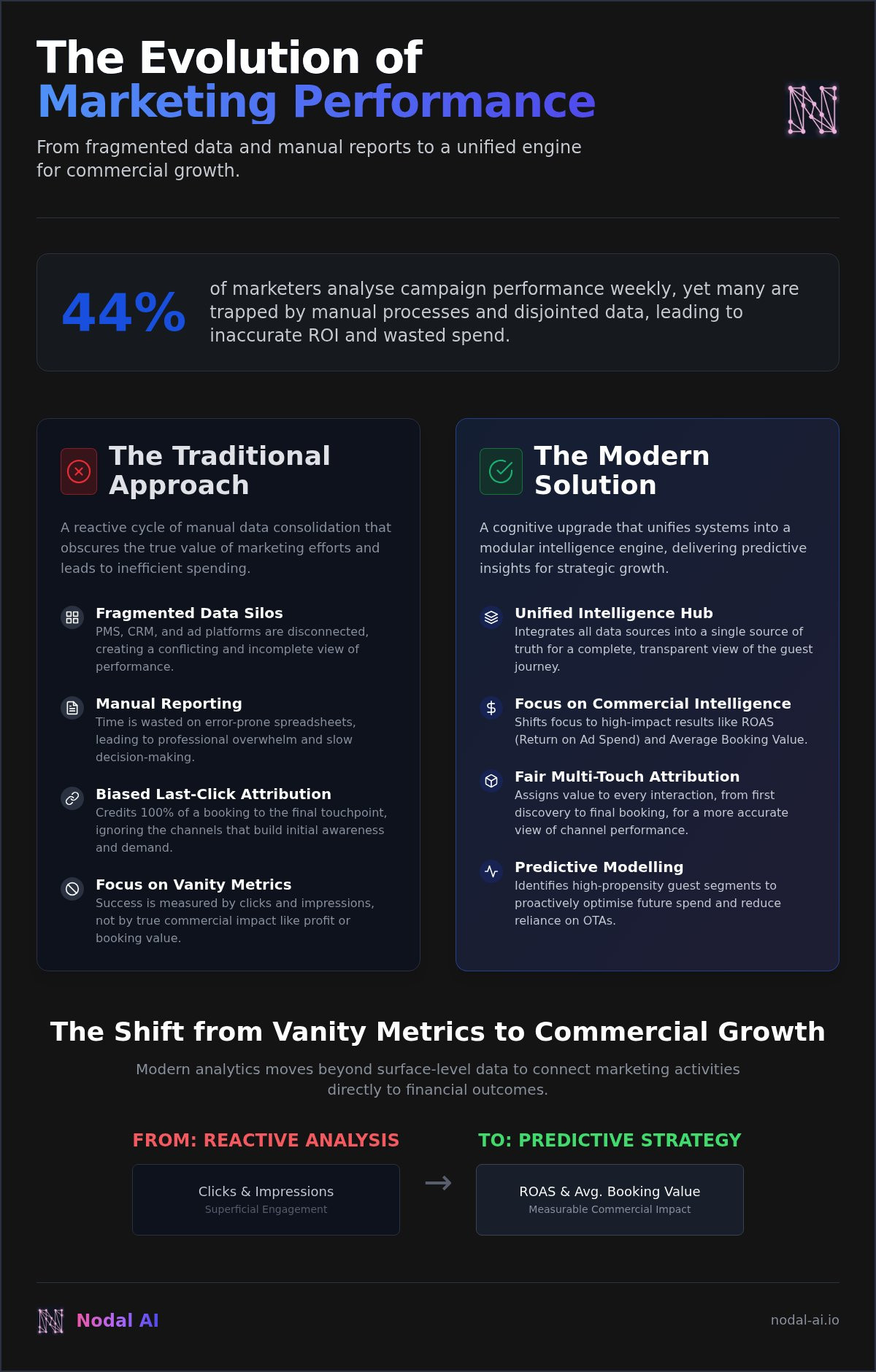
According to the 2026 HubSpot State of Marketing Report, 44% of marketers now analyse campaign performance every single week, yet most remain trapped in a cycle of manual data consolidation. You likely recognise the frustration of staring at conflicting reports where your PMS, CRM, and ad platforms refuse to align. This fragmentation makes effective marketing campaign performance tracking nearly impossible, often resulting in inaccurate ROI reporting and wasted spend on low-propensity segments. It is time to stop treating your data as a passive archive and start viewing it as a cognitive upgrade for your entire commercial strategy.
Modern growth is not about collecting more metrics; it is about connecting disparate inputs to clear financial outcomes. You deserve a single, transparent view of your revenue data that removes the bias of last-click attribution and highlights exactly where OTA leakage occurs. In this guide, you will learn how to unify your hospitality systems, move toward multi-touch attribution, and deploy predictive insights to optimise future spend. We will show you how to transform chaotic data points into a streamlined engine for commercial growth, ensuring your marketing budget works harder and stays focused on measurable returns.
Key Takeaways
- Shift from biased last-click models to multi-touch attribution to accurately value every touchpoint in the guest journey.
- Optimise your marketing campaign performance tracking by integrating disparate data sources into a unified, automated reporting framework.
- Replace vanity metrics with commercial intelligence to focus your strategy on high-impact results like ROAS and Average Booking Value.
- Deploy predictive modelling to identify high-propensity guest segments and proactively reduce reliance on expensive OTA channels.
- Realise significant efficiency gains through a modular intelligence engine that turns chaotic inputs into actionable growth recommendations.
Beyond the Last Click: Why Traditional Campaign Tracking Fails
Effective marketing campaign performance tracking is far more than a simple tally of clicks or isolated conversions. It is a holistic commercial process that bridges the gap between initial guest awareness and final revenue. For too long, the hospitality sector has relied on last-click attribution models, which credit 100% of a booking to the final touchpoint. This approach is fundamentally flawed. It ignores the complex, multi-stage journey a guest takes, from initial inspiration on social media to final confirmation. By oversimplifying this path, brands inadvertently devalue the very channels that build demand, leading to skewed budgets and missed growth opportunities.
The Problem with Fragmented Hospitality Data
Data fragmentation is the silent killer of marketing efficiency. When your PMS, CRM, and ad platforms exist in separate silos, they fail to communicate, leaving you with a disjointed view of the customer. This lack of integration forces teams into the tedious cycle of manual reporting. It is a process that is not only slow but inherently prone to human error. Relying on spreadsheets to connect the dots creates a sense of professional overwhelm and anxiety, especially when you're forced to make high-stakes decisions based on incomplete intelligence. This fragmentation also facilitates OTA leakage. Without robust conversion tracking that links guest profiles to specific ad interactions, it becomes difficult to prove the value of direct channels. The result is a steady erosion of margins as bookings slip away to third-party platforms.
The Evolution to Multi-Touch Attribution
The transition to multi-touch attribution represents a cognitive upgrade for the modern marketing team. It provides a fairer, more transparent view of channel value by recognising the critical role of "assist" channels. A guest's journey is rarely linear; they might interact with your brand five or six times before committing to a stay. Multi-touch models assign value to every interaction, from the first discovery ad to the final booking prompt. This shift allows you to move beyond intuition and start making decisions rooted in commercial reality. By identifying which touchpoints truly influence guest behaviour, you can eliminate wasted spend on low-propensity segments and reallocate capital toward the high-value paths that drive direct, profitable growth. It's about replacing the chaos of fragmented data with the clarity of integrated intelligence, ensuring every pound spent is an investment in measurable success.
The Architecture of Modern Performance Marketing Analytics
The architecture of modern marketing campaign performance tracking requires a modular intelligence engine that unifies fragmented data into a cohesive commercial strategy. Traditional systems often act as passive repositories; however, an AI-powered platform transforms these into active participants in your business growth. By integrating operational data from your PMS with commercial signals from CRM and ad platforms, you create a single source of truth. This automated reporting eliminates the anxiety of manual data entry, replacing tedious spreadsheets with high-level perspectives that guide your decision making.
We are seeing a profound shift from descriptive analytics, which merely summarise the past, toward predictive modelling. This allows you to anticipate guest behaviour rather than simply reacting to it. While basic trackers focus on Top Advertising Metrics like click-through rates, a sophisticated architecture prioritises commercial intelligence. You can explore how integrated features turn these complex inputs into high-value outputs. This cognitive upgrade ensures that your marketing campaign performance tracking remains forward-facing and obsessed with measurable returns.
Modular Intelligence for Specific Use Cases
A one size fits all approach fails in the nuanced world of hospitality. Whether you manage a boutique hotel, a high energy hostel, or an exclusive private members club, your data architecture must be modular. This flexibility allows you to scale your analytics as your organisation evolves, ensuring you can map complex customer journeys with absolute precision. By tailoring the intelligence engine to your specific sector, you replace generic assumptions with sector specific growth recommendations. This modularity ensures your technology grows alongside your commercial ambitions.
Integrating External Signals for Total Clarity
True clarity comes from looking beyond your internal systems. Modern performance marketing analytics must account for external variables like weather patterns, FX rates, and local event schedules. For instance, a sudden surge in flight demand or a favourable shift in currency exchange can significantly influence booking propensity. Integrating these external signals allows for agile spend adjustments, ensuring your budget is always directed toward the most profitable opportunities. This level of optimisation ensures you make more while wasting less, transforming your marketing from a cost centre into a powerful engine for commercial stability. By connecting internal performance with external reality, you achieve total transparency in your spend.
Measuring What Matters: Commercial Intelligence vs Vanity Metrics
Measuring success through clicks and impressions is a legacy habit that modern hospitality leaders must outgrow. While vanity metrics provide a surface-level sense of activity, they rarely correlate with property-level profitability. Sophisticated marketing campaign performance tracking prioritises commercial intelligence, which links every pound of spend to concrete outcomes like Average Booking Value (ABV) and Return on Ad Spend (ROAS). For instance, our clients have seen a 24.5% increase in ROAS by shifting their focus from simple traffic to high-value conversion data. This transition replaces the anxiety of uncertain returns with the confidence of measurable growth.
By linking campaign spend to site-specific trading periods, you can ensure that your marketing budget supports the property when it needs it most. It is no longer enough to track conversions in a vacuum; you must understand how those conversions align with your actual occupancy and bed yield. This level of transparency allows you to stop wasting spend on periods where you are already at capacity and instead focus on filling need periods with high-propensity guests. You can book a demo to see how these operational signals are unified within a single intelligence engine.
The Direct Booking Focus
Identify which channels drive the most valuable direct bookings to reduce your reliance on high-commission OTA platforms. Every direct booking captured represents a significant win for your profit margins, as it removes the 15 to 25% commission fee typically charged by third-party sites. By analysing the customer journey with precision, you can see exactly which touchpoints lead to a direct reservation. This clarity empowers you to double down on the most efficient paths, effectively reducing OTA leakage and reclaiming control over your guest relationships. Focus on the metrics that impact the bottom line, rather than those that simply look good on a slide deck.
Operational Metrics for Hospitality Leaders
In hostel environments, tracking stay extensions is vital for maximising bed yield. When a marketing campaign encourages a guest to stay an extra night, the acquisition cost for that additional revenue is effectively zero. Similarly, for upscale F&B or QSR operators, analysing the delivery versus dine-in mix provides essential intelligence for staff scheduling and inventory management. By identifying early signs of need periods through integrated marketing campaign performance tracking, you can trigger targeted campaigns that solve operational challenges before they impact your results. This approach turns your marketing department into a proactive partner in property management, ensuring every campaign serves a specific commercial purpose.
Building a Data-Driven Tracking Framework for Strategic Growth
Transitioning from manual data entry to an automated marketing campaign performance tracking framework is the ultimate relief for overstretched teams. By consolidating disparate sources into a single, unified view, you replace the anxiety of fragmented reporting with the confidence of high-level perspectives. This shift allows you to implement AI-driven audience segmentation, identifying high-propensity guests with surgical precision. Automating these processes can save marketing teams 20 or more hours per month, freeing up time for strategic thinking. Instead of chasing numbers, your team can finally focus on applying growth recommendations to optimise spend in real time.
Step 1: Data Source Consolidation
The foundation of any robust framework is the integration of your core systems. You must map existing platforms, including Oracle OPERA, Mews, and HubSpot, to ensure a seamless flow of information between your PMS and guest database. Accurate trend analysis requires the ingestion of historical data; without this context, your insights remain surface-level. Establish a robust data governance framework to maintain accuracy across all touchpoints. This structure ensures that your commercial intelligence remains untainted by duplicate entries or mismatched guest profiles, providing a transparent and secure foundation for every decision you make.
Step 2: Implementing Advanced Attribution
Select an attribution model that reflects the actual complexity of your guest journey. Standard models often fail because they ignore the multi-stage nature of hospitality bookings. You should use sophisticated marketing attribution to weight each touchpoint correctly, ensuring "assist" channels receive the credit they deserve for driving awareness. For deeper mapping of these interactions, refer to our comprehensive customer journey guide. By weighting interactions accurately, you can identify the high-value paths that lead directly to revenue growth, allowing you to scale your most successful campaigns with confidence.
Step 3: Predictive Optimisation
The final stage of the framework involves moving beyond what happened to what will happen next. Use predictive modelling to forecast upcoming demand periods and occupancy gaps. This foresight allows you to adjust ad spend based on predicted revenue targets rather than historical averages. By focussing on high-value guest segments, you maximise lifetime value and ensure your budget is always directed toward the most profitable opportunities. This proactive approach ensures you make more while wasting less, securing your organisation's long-term commercial stability. It transforms your data from a passive archive into an active driver of future growth.
Book a demo to see the Nodal Platform in action
Scaling Growth with the Nodal Platform: A New Era of Performance
The Nodal Platform represents the definitive cognitive upgrade for modern hospitality organisations. It moves your team beyond the limitations of manual marketing campaign performance tracking by transforming passive data assets into active participants in your commercial strategy. This shift from chaotic inputs to high-value outputs is not just theoretical; it is a proven path to stability. For example, Ovolo Hotels achieved a 15.3% reduction in acquisition costs by leveraging our modular intelligence engine. Our "Make more, waste less" philosophy ensures that every pound of your marketing budget is tethered to concrete business outcomes, replacing the anxiety of wasted spend with the confidence of streamlined, high-level perspectives.
Transforming Raw Data into Actionable Intelligence
Experience the profound relief that comes from abandoning chaotic spreadsheets in favour of clear, intuitive dashboards. The Nodal Platform unifies your fragmented systems, providing a high-level perspective that was previously impossible to achieve through manual workarounds. Instead of spending days merging rows of data, your team receives automated growth recommendations that identify immediate opportunities for revenue optimisation. These insights allow you to act with speed and precision, ensuring your strategy remains agile in a competitive market. You can explore Nodal features to see how this modular architecture adapts to your specific organisational needs, whether you are managing a single boutique property or a global multi-location brand.
The Future of Performance Marketing
The landscape of 2026 demands a proactive approach to system fragmentation. As the role of ai marketing analytics becomes central to commercial success, the competitive advantage will belong to those who can turn complexity into clarity. Data-driven decision making is no longer a luxury; it is the foundation of long-term commercial stability. By adopting a unified framework for marketing campaign performance tracking, you protect your margins from OTA leakage and ensure your brand remains a visionary leader in its sector. The transition from fragmented data to commercial intelligence is the final step in mastering your guest journey. It is time to replace manual labour with automated expertise and invite your organisation to benefit from the future of intelligent growth.
Mastering the Transition to Commercial Intelligence
The transition from fragmented data to a unified intelligence engine is the only way to secure long-term commercial stability in a competitive market. By replacing biased last-click models with sophisticated multi-touch attribution, you gain the transparency needed to reclaim direct bookings and significantly reduce OTA leakage. This shift replaces the anxiety of manual reporting with the confidence of high-level perspectives.
Effective marketing campaign performance tracking ensures that every pound of spend is directed toward high-propensity guest segments and measurable revenue growth. Our London-based team combines global hospitality experience with technical expertise to help you master this complexity. We have already helped performance marketing clients achieve a 24.5% increase in ROAS through the strategic consolidation of PMS, POS, and CRM data.
Book a demo to see the Nodal Platform in action
You now have the framework to turn your passive data into an active participant in your business process. Embrace this cognitive upgrade and lead your organisation into a new era of predictive, profitable growth.
Frequently Asked Questions
Which channels are driving the most valuable direct bookings right now?
Identifying the most valuable direct booking channels requires moving beyond surface-level clicks to deep commercial intelligence. By using the Nodal Platform, you can see which specific interactions lead to a direct reservation, effectively reducing OTA leakage. This level of transparency allows you to weight touchpoints correctly and double down on the high-performing paths that drive your most profitable revenue. It's about replacing guesswork with a data-driven strategy that prioritises direct contributions.
How can I track campaign performance across multiple hotel locations?
Tracking performance across multiple locations is achieved through the strategic consolidation of site-specific data into a single, unified view. Our modular architecture unifies fragmented systems like your PMS and POS across every property in your portfolio. This enables you to compare site performance, identify trading periods by site, and understand how the delivery versus dine-in mix affects margins. It transforms chaotic inputs into a streamlined perspective for multi-location hospitality brands.
What is the difference between multi-touch attribution and last-click?
Last-click attribution credits the final interaction before a booking, while multi-touch attribution recognises every touchpoint in the guest journey. Last-click is fundamentally biased because it ignores the awareness and consideration stages that build demand. By adopting a multi-touch model, you gain a fairer view of channel value, including "assist" channels. This cognitive upgrade ensures your marketing campaign performance tracking reflects the actual complexity of how guests decide to book.
How does weather and flight data affect my marketing ROI?
Weather patterns and flight demand are powerful external signals that significantly influence guest booking propensity and campaign timing. Integrating these variables into your analysis allows for more agile spend adjustments, ensuring your budget is deployed when external conditions are most favourable. This proactive approach helps you fill "need periods" more effectively and maximises ROI by aligning your marketing activity with real-world demand drivers like local events and tourism trends.
Can I integrate my existing PMS and CRM with a performance platform?
You can absolutely integrate existing operational systems like Oracle OPERA, Mews, and Salesforce with the Nodal Platform. Our modular intelligence engine is designed to ingest data from disparate sources that typically don't communicate, such as your PMS, CRM, and booking engines. This technical setup includes historical data ingestion, ensuring your trend analysis is accurate from day one. It provides the relief of total clarity across your entire tech stack.
How much time can automated reporting save my marketing team?
Automated reporting can save your marketing team 20 or more hours per month by eliminating the need for manual data entry and spreadsheet consolidation. This shift replaces the anxiety of tedious tasks with the confidence of high-level perspectives. By freeing your team from the burden of data collection, they can focus on applying growth recommendations and strategic planning. It's a cognitive upgrade that turns your department into a proactive driver of revenue.
What are the best metrics for measuring hospitality campaign success?
The best metrics for hospitality success are commercial intelligence markers like Average Booking Value (ABV), ROAS, and direct booking contribution. Unlike vanity metrics such as clicks or impressions, these figures correlate directly with property-level profitability and margin stability. Sophisticated marketing campaign performance tracking also looks at operational outcomes, such as how stay extensions affect bed yield. Focussing on these results ensures your marketing budget is an investment in measurable commercial growth.
How do I identify churn risk in my membership or loyalty models?
Identifying churn risk in membership or loyalty models requires AI-driven audience segmentation and predictive modelling. By analysing guest behaviour patterns, you can detect early signs of waning engagement or shifting demand before they impact your revenue. This foresight allows you to trigger targeted campaigns and loyalty incentives to retain high-value members. It transforms your data from a passive archive into an active tool for protecting your long-term commercial stability and guest relationships.


