

Why are you still paying high OTA commissions while your most valuable commercial data remains trapped in fragmented legacy systems? You likely recognise the exhaustion of losing over 20 hours every week to manual reporting, only to find your profit margins eroding under the weight of leakage and inefficiency. It is a common struggle for hospitality leaders who feel overwhelmed by chaotic inputs and lack a clear, high-level perspective on their performance.
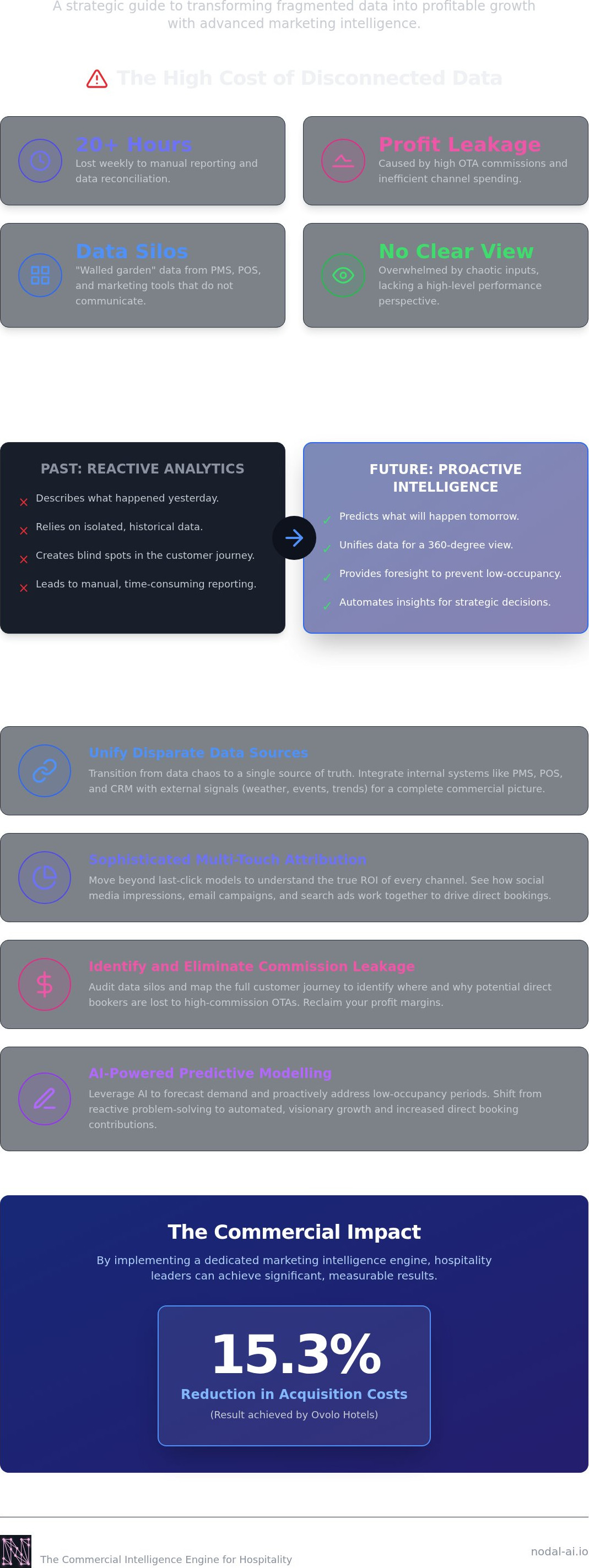
This strategic guide for 2026 demonstrates how to reclaim your margins by implementing advanced marketing intelligence software. We promise to show you how to turn these disparate data sources into a single, unified view of marketing and revenue performance. By the end of this article, you will understand how to utilise predictive modelling to fill low-occupancy periods and increase direct booking contributions. We will examine the modular architecture required to achieve results like the 15.3% reduction in acquisition costs seen by Ovolo Hotels. Prepare to transition from manual tasks to automated, visionary growth.
Key Takeaways
- Transition from reactive analytics to proactive commercial intelligence by unifying fragmented data into a single, high-level perspective.
- Deploy advanced marketing intelligence software to identify the true ROI of every channel through sophisticated multi-touch attribution.
- Prioritise industry-specific modular architecture over generic enterprise tools to ensure seamless integration with PMS and POS systems.
- Reclaim profit margins by auditing data silos and mapping the customer journey to identify and eliminate OTA commission leakage.
- Utilise predictive modelling and external signals to proactively address low-occupancy periods and increase direct booking contributions.
The Evolution of Marketing Intelligence Software in 2026
The definition of Marketing intelligence (MI) has shifted from simple data collection to a modular intelligence engine. In 2026, modern marketing intelligence software is no longer a luxury; it's a commercial necessity. It unifies fragmented inputs from PMS, POS, and digital channels to drive proactive commercial decisions. While legacy systems left you buried in spreadsheets, today's software transforms those passive assets into active participants in your business growth through specialised integrated features.
The primary challenge in 2026 is the sheer volume of specialised tools. Marketers are drowning in "walled garden" data that doesn't talk to each other. This fragmentation erodes profit margins and forces teams into manual reporting cycles that can consume 20 or more hours per week. Generic enterprise platforms often fail here because they lack the industry-specific logic needed to solve complex revenue challenges. They might track a lead, but they don't understand OTA commission leakage or predictive occupancy mapping for a boutique hotel. You need a system that translates technical metrics into commercial outcomes.
Why Analytics Alone is No Longer Enough
Standard analytics tell you what happened yesterday. They describe the past. Intelligence, however, predicts what will happen tomorrow. In a multi-channel world, relying on descriptive analytics creates a blind spot. You see the booking, but you miss the path taken to get there. True commercial clarity comes from seeing the entire journey. It's the difference between knowing you had a low-occupancy weekend and having the foresight to prevent it through targeted, direct-booking campaigns. Relying on isolated data points is a risk your margins can no longer afford.
The Role of AI in Modern Marketing Intelligence
Artificial intelligence serves as the engine for this evolution. It automates the tedious cleansing and harmonisation of disparate data sets, a task that previously required deep technical specialisation. For fast-moving sectors like hospitality, real-time processing is non-negotiable. You need to know how a shift in demand affects your ROAS right now, not next Tuesday. Advanced systems now leverage agentic AI to manage routine customer engagements, shifting the focus from channel-based campaigns to autonomous guidance. This ensures every decision is backed by commercial logic rather than guesswork. AI-driven intelligence acts as the essential bridge between raw data and profitable action.
Core Capabilities of an Intelligent Marketing Engine
An intelligent engine is defined by its ability to transform raw, disconnected inputs into high-value commercial outputs. To achieve this, advanced marketing intelligence software must move beyond simple dashboarding. It requires a robust architecture that prioritises real-time integration and forward-facing logic. This transformation replaces the anxiety of manual reporting with the confidence of a streamlined, high-level perspective. By focusing on the core capabilities below, hospitality leaders can turn data from a burden into a competitive advantage.
Unifying Disparate Data Sources
The foundation of commercial clarity is the consolidation of fragmented data into a single, unified view. In 2026, a 360-degree guest view is only possible when you bridge the gap between operational and marketing systems. Nodal AI facilitates this by connecting core platforms such as Mews, Oracle OPERA, and Salesforce. This integration ensures that guest behaviour in your CRM matches the transaction data in your POS and the booking details in your PMS. It creates a seamless flow of information that removes the silos typically found in legacy hospitality stacks.
Beyond internal data, the engine must ingest external signals to provide context. Factors like local weather patterns, regional tourism trends, and major events are no longer background noise; they are active variables in your commercial strategy. By layering these external insights over your internal performance data, you gain a transparent understanding of why demand fluctuates. This removes the ambiguity of gut-feeling decisions and replaces it with data-driven certainty. It allows you to see the "why" behind the numbers, not just the "what".
From Attribution to Predictive Modelling
Traditional last-click models are insufficient for the complex guest journeys of 2026. You must identify the true value of every channel through sophisticated multi-touch attribution. This allows you to see how a social media impression three weeks ago influenced a direct booking today. It gives credit where it is due, ensuring your budget is allocated to the channels that actually drive profit. For a deeper technical exploration of these methods, you can read our guide on Mastering Marketing Attribution.
While attribution clarifies the past, predictive modelling secures the future. It forecasts demand and identifies need periods before they become occupancy crises. This allows revenue teams to shift from reactive discounting to proactive growth strategies. By automating these recommendations, you reclaim the 20 or more hours usually lost to manual reporting. This shift ensures your team spends less time building spreadsheets and more time executing high-impact strategies. If you are ready to see how these modules work in tandem, you can book a demo of the Nodal Platform today.
Choosing the Right Software: Generic vs Industry-Specific
Selecting the right marketing intelligence software is a high-stakes decision that defines your commercial trajectory. You face a choice between broad enterprise utility and industry-specific precision. While global platforms offer a sense of security, they often lack the granular logic required to manage hospitality data silos. A visionary leader understands that efficiency comes from tools built to speak the language of their specific sector. Moving from a generic tool to a specialised engine is the first step toward reclaiming your commercial clarity.
The Pitfalls of Generic Enterprise Tools
Broad enterprise platforms like Salesforce are designed to serve every industry from manufacturing to retail. This "one size fits all" approach frequently leads to high customisation costs and lengthy implementation periods. Mapping a complex hospitality customer journey in a generic system is an uphill battle. These tools struggle to account for the nuances of multi-channel bookings, often resulting in significant OTA leakage. When your software doesn't prioritise direct booking contributions, your profit margins suffer. You end up paying for features you don't need while lacking the ones that drive real revenue.
The total cost of ownership for these generic tools is often higher than it appears on the initial invoice. Beyond the seat licences, you must factor in the cost of specialist consultants to build the bridges between your PMS and the platform. This complexity creates friction, slowing down your ability to respond to market shifts. It turns what should be a streamlined process into a manual, tedious burden for your marketing team.
The Advantage of Modular Hospitality Intelligence
In contrast, a modular architecture allows you to scale your intelligence capabilities alongside your business growth. This approach replaces the anxiety of a massive, monolithic rollout with the calm efficiency of targeted upgrades. By choosing a system designed for hospitality, you ensure that every data point from your PMS and POS is handled with commercial intent. It transforms passive assets into active participants in your revenue strategy.
Explore the full list of Nodal features to see how this modularity works in practice. For instance, the Guest and Operational modules are built to unify fragmented guest profiles and operational metrics without the need for expensive custom coding. This specialised focus is supported by our London-based expert consultancy, providing UK-based brands with the local support and strategic guidance they need. This combination of SaaS efficiency and expert partnership ensures a rapid onboarding process and a measurable return on investment. You gain a cognitive upgrade for your entire organisation, moving from chaotic inputs to high-value commercial clarity.
Implementing Intelligence to Reclaim Profit Margins
Execution is the bridge between technical potential and commercial reality. Once you have selected the right marketing intelligence software, you must follow a structured path to activation. This process replaces the anxiety of guesswork with the calm efficiency of data-driven certainty. By following these five strategic steps, you can transform your legacy stack into a high-performance revenue engine that protects your margins from inefficiency.
- Step 1: Audit your data silos. Identify every point where guest information is trapped, specifically within your PMS and POS systems. You must recognise these critical integration points to ensure a frictionless flow of data.
- Step 2: Map the customer journey. Visualise every touchpoint from the first digital search to the physical check-out. This clarity allows you to see where you are losing potential direct bookings to third-party platforms.
- Step 3: Set up automated reporting. Stop the manual cycle of data cleansing. Automation allows your team to reclaim valuable hours and focus on high-level strategic growth instead of spreadsheet maintenance.
- Step 4: Use predictive insights. Analyse your demand forecasts to optimise ad spend. By identifying future need periods early, you can reduce waste and allocate budget only where it drives the highest return.
- Step 5: Refine audience segments. Deploy AI-driven propensity modelling to identify guests most likely to book direct. Continuously updating these segments ensures your marketing remains personal and profitable.
Reducing OTA Leakage and Boosting Direct Bookings
Reclaiming your profit margins requires a relentless focus on direct booking contributions. Intelligence allows you to identify which specific channels drive your most valuable guests right now. By understanding these patterns, you can strategically shift demand away from high-commission third-party platforms that erode your bottom line. This is not just a theoretical goal; it is a proven commercial outcome. For example, Ovolo Hotels achieved a 15.3% reduction in acquisition costs by using intelligence to prioritise direct guest relationships over OTA dependency. You can stop the drain on your margins by making your data work for you, not against you.
Scaling Operational Efficiency with Automated Reporting
Modern marketing teams often lose over 20 hours per week to the manual labour of reporting. This is a significant drain on productivity that prevents your experts from performing the high-level analysis you hired them for. Transitioning to automated reporting changes the internal narrative from "reporting on the past" to "optimising the future." It provides a streamlined perspective that makes growth feel inevitable rather than accidental. To understand how this efficiency scales into long-term success, explore our guide on Predictive Modelling. This shift ensures your organisation remains competitive and forward-thinking in a volatile market.
Book a demo of the Nodal Platform to reclaim your margins
Nodal AI: The Commercial Intelligence Engine for Hospitality
Nodal AI positions itself as the visionary leader for hospitality brands seeking to move beyond the limitations of fragmented data. As a London-based partner, we understand that true growth requires more than just a functional tool; it requires a cognitive upgrade for your entire organisation. Our marketing intelligence software is engineered to turn chaotic inputs into high-value commercial outcomes, replacing the anxiety of manual reporting with the confidence of streamlined, high-level perspectives. We invite you to transition from the burden of legacy systems to the relief of total commercial clarity.
The platform prioritises direct booking contributions by integrating external signals, such as weather patterns and local event schedules, with your internal PMS and POS data. This specific focus allows you to reclaim profit margins that are typically eroded by high OTA commissions and inefficient ad spend. The impact is both concrete and measurable. Alongside the 15.3% reduction in acquisition costs mentioned earlier, our approach has delivered a 24.5% increase in ROAS for Ovolo Hotels. We transform your data from a passive asset into an active, competitive participant in your commercial success.
Tailored Insights for Hotels, QSRs, and Wellness
Nodal AI addresses the specific challenges inherent to different hospitality niches with modular precision. Whether you are managing guest extensions in a hostel or tracking covers and average transaction values in a QSR environment, the platform provides the granular clarity needed for profitable action. Our AI-driven audience segmentation identifies high-propensity guests in real time, allowing you to target the individuals most likely to book direct. This level of precision removes the ambiguity of broad marketing campaigns and replaces it with the calm efficiency of a dedicated problem-solver persona. It ensures that every marketing pound is spent with the intent of maximising guest lifetime value.
Start Your Journey to Commercial Clarity
The transition from complexity to growth is a structured journey that begins with a professional implementation. Our onboarding process combines the technical power of the Nodal Platform with the strategic expertise of our London-based consultancy. We do not just provide software; we provide a partnership that prioritises measurable returns and long-term financial stability. This collaborative approach ensures that your team is empowered to use predictive modelling and automated reporting features from the very first day. You can finally stop the manual, tedious tasks that drain your productivity and start leading your brand with visionary authority. It is time to reclaim your margins and secure your position as a forward-thinking leader in the 2026 market.
Book a demo to see the Nodal Platform in action
Secure Your Commercial Future with Predictive Intelligence
The transition from fragmented data to commercial clarity is the defining challenge for hospitality leaders in 2026. By choosing specialised marketing intelligence software, you replace the anxiety of manual reporting with a streamlined, high-level perspective. You have seen how modular architecture unifies disparate systems like Mews, Oracle OPERA, and Salesforce to protect your profit margins. This isn't just about technical integration; it's about empowering your team to move from reactive analysis to proactive, visionary growth.
Our London-based expert consultancy ensures your implementation is both seamless and strategically sound. With proven results like the 24.5% increase in ROAS for Ovolo Hotels, the path to measurable returns is clear. You can finally transform your passive data into an active participant in your revenue strategy. It's time to lead with confidence and reclaim the hours lost to tedious tasks.
Book a demo of the Nodal Platform
The future of your brand depends on the intelligence you deploy today. We look forward to helping you master your data and achieve total commercial clarity.
Frequently Asked Questions
What is the difference between marketing analytics and marketing intelligence?
Marketing analytics focuses on descriptive data about past performance, whereas marketing intelligence software provides the cognitive upgrade needed to drive proactive commercial decisions. While analytics might show a drop in website traffic, intelligence identifies the underlying cause and recommends a specific course of action. It unifies disparate data sources to transform passive assets into active participants in your business growth. This shift moves your team from reactive reporting to visionary leadership.
How does marketing intelligence software help reduce OTA commissions?
This technology reduces OTA dependency by identifying exactly which digital touchpoints lead to high-value direct bookings. By mapping the full customer journey, you can see where guests are dropping off to third-party platforms and intervene with targeted, direct-only offers. This strategy helped Nodal AI clients achieve a 13.8% increase in bookings while simultaneously lowering overall acquisition costs. It shifts the power balance back to the property owner by prioritising direct guest relationships.
Can Nodal AI integrate with my existing PMS and POS systems?
Nodal AI is built to connect seamlessly with leading hospitality systems including Mews, Oracle OPERA, Cloudbeds, and Stayntouch. Beyond operational systems, the platform integrates with POS tools like SevenRooms and OpenTable, alongside CRM systems such as Salesforce and HubSpot. This modular architecture ensures that fragmented data from your booking engine and reputation management tools is unified into a single, transparent view. Professional implementation ensures these integrations are configured to your specific requirements.
How much time can my team save with automated reporting?
Marketing teams typically reclaim over 20 hours per week by transitioning from manual data cleansing to automated reporting. This automation removes the burden of tedious spreadsheet maintenance, allowing your experts to focus on high-level strategy and revenue optimisation. By replacing manual inputs with real-time data processing, you eliminate human error and ensure your commercial decisions are based on the most current information available. This efficiency effectively provides your organisation with a cognitive upgrade.
What industries benefit most from industry-specific marketing intelligence?
While the platform is modular, it provides the most value to sectors with complex data silos such as hotels, Quick Service Restaurants (QSR), and wellness brands. Hostels benefit from understanding ancillary spend and stay extensions, while upscale F&B venues use it to improve covers and average spend per head. Any hospitality business facing margin pressure from third-party platforms or fragmented guest profiles will find that industry-specific intelligence offers a significant competitive advantage.
Is predictive modelling reliable for forecasting occupancy and revenue?
Predictive modelling is highly reliable when it incorporates both internal historical data and external signals such as weather, flight demand, and tourism trends. Nodal AI uses these variables to forecast occupancy and revenue with high precision, identifying need periods up to six weeks in advance. This foresight allows you to shift from reactive discounting to proactive demand generation. It provides the commercial clarity needed to secure your profit margins against market volatility and economic shifts.
How does marketing intelligence software handle data privacy and GDPR compliance?
Modern marketing intelligence software is built with privacy-first principles to ensure compliance with the Data (Use and Access) Act 2025. The platform manages data subject rights efficiently, including the requirement to perform a reasonable and proportionate search for information when responding to DSARs. By prioritising first-party data strategies, Nodal AI helps you move away from risky third-party data dependency. This approach ensures your marketing remains effective while upholding the highest standards of data protection and transparency.
What is the typical ROI for implementing a marketing intelligence platform?
The ROI of implementing an intelligence platform is measured through increased direct booking contributions and improved operational efficiency. Clients often see a 5.5% increase in average booking value alongside significant gains in paid search revenue. By identifying and eliminating waste in your ad spend, the platform pays for itself through reclaimed margins and reduced OTA leakage. It transforms your marketing from a cost centre into a high-performance engine for long-term financial stability and growth.


