

47% of B2B marketing teams are now using b2b multi touch attribution, yet fewer than 40% report having a mature framework in place. You likely feel the daily friction of managing a cycle that involves eight or more touchpoints across a fragmented buying committee. It's frustrating to watch ad spend disappear into a digital black hole because your CRM and operational systems refuse to speak the same language. You deserve the confidence that comes from knowing exactly which channel triggered a conversion and which one merely wasted your budget.
This definitive guide will show you how to master these complexities to gain a single, crystal-clear view of your marketing performance. We'll help you move from chaotic data inputs to high-value commercial outputs. You'll learn how to reconcile fragmented data silos into a unified intelligence engine and assign precise value to every interaction. We'll explore how to use predictive modelling to ensure your growth recommendations are backed by hard evidence, turning your marketing department into a predictable engine for profitable growth in 2026.
Key Takeaways
- Learn why traditional last-click models fail to capture the complexity of the 2026 buyer journey and how to bridge the gap between marketing and sales data.
- Master the core frameworks of b2b multi touch attribution to ensure every touchpoint in the buying committee is accurately valued and credited.
- Discover how to unify fragmented systems into a single view of performance, effectively eliminating the blind spots caused by data silos and offline transactions.
- Follow a step-by-step strategy to audit your data and implement a framework that prioritises direct revenue and long-term member retention.
- Realise significant commercial gains by turning chaotic inputs into actionable growth recommendations that can increase your return on ad spend.
The Evolution of Attribution: Why Last-Click Fails the B2B Journey
In the high-stakes world of enterprise growth, b2b multi touch attribution has evolved from a luxury to a commercial necessity. It is the sophisticated process of assigning revenue credit to every interaction across a complex buyer journey. While simple models once sufficed, the modern landscape demands a deeper understanding of Marketing Attribution to quantify how each touchpoint influences the final deal. Relying on outdated methods is no longer a viable strategy for those obsessed with measurable returns.
The fundamental problem with last-click attribution is its inherent bias. It ignores the months of nurturing, education, and trust-building that occur before a prospect finally converts. By rewarding only the final handshake, you risk over-investing in bottom-funnel channels while starving the very discovery platforms that build your pipeline. This misattribution carries a heavy commercial cost; it leads to skewed budgets and missed opportunities for long-term stability.
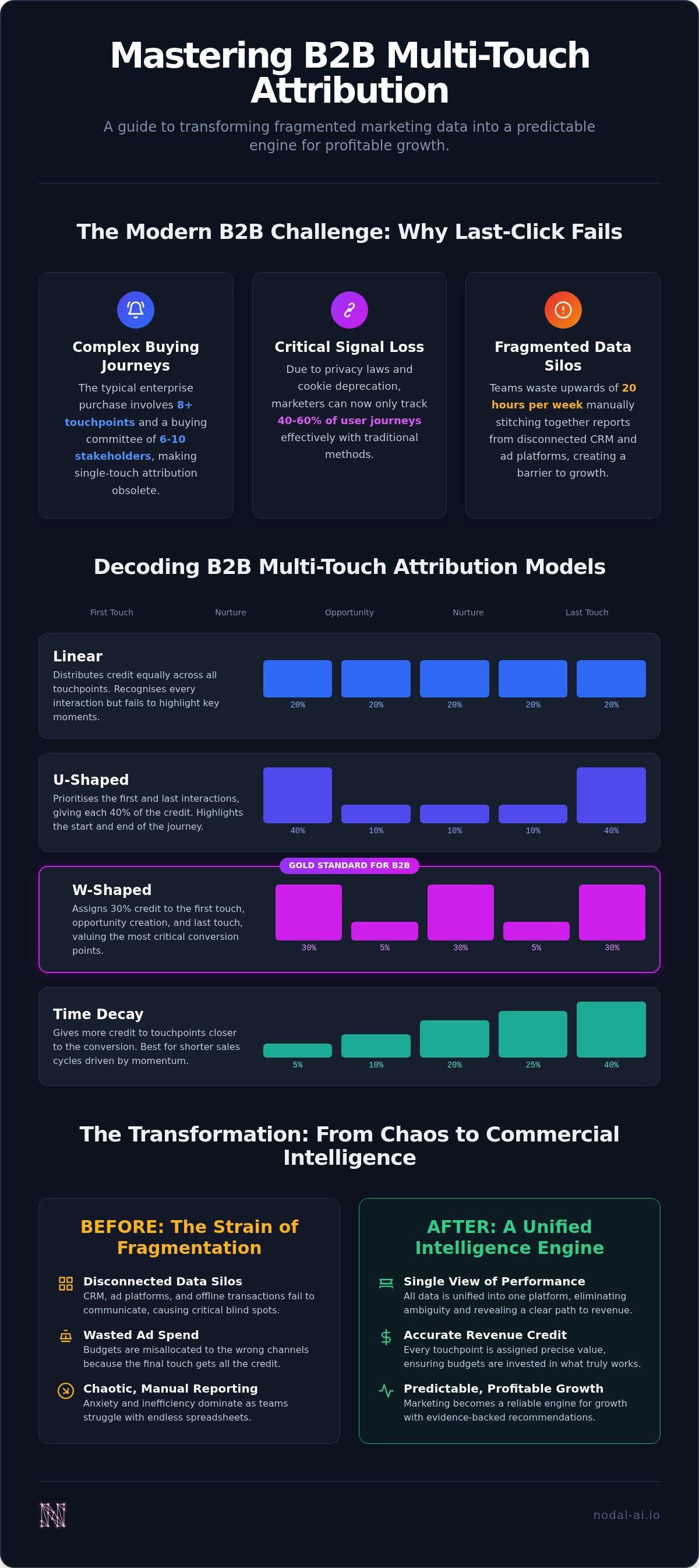
By 2026, the shift toward multi-touch frameworks has become mandatory due to significant signal loss. With the expansion of state-level privacy laws and the transition away from third-party cookies, marketers can now only track roughly 40-60% of user journeys effectively. Old-school tracking is obsolete. You must adopt a more resilient, hybrid measurement strategy that unifies fragmented data into a single, transparent view of performance.
The Complexity of the B2B Buying Committee
B2B sales do not happen in isolation. You aren't just selling to an individual; you're selling to an entire account. A typical enterprise purchase involves a committee of six to ten stakeholders, including technical evaluators, procurement specialists, and C-suite decision makers. Each participant interacts with different content across various devices. Your attribution model must account for these cross-role interactions to reveal the true story of how an account moves from initial curiosity to a closed contract.
From Fragmented Data to Strategic Clarity
Many marketing teams still endure the anxiety of manual reporting. They waste upwards of 20 hours every week stitching together disparate spreadsheets from CRM and ad platforms. This manual labour is a drain on productivity and a barrier to growth. It is time to replace chaotic data inputs with high-value commercial outputs. By integrating your systems through the Nodal Platform: Transform Fragmented Marketing Data into Profitable Decisions, you can eliminate ambiguity and lead your organisation with absolute confidence.
Decoding B2B Multi-Touch Attribution Models: Which One Wins?
Selecting the right framework is not about finding a perfect truth; it's about finding the most useful lens for your specific sales cycle. The b2b multi touch attribution landscape offers several distinct paths to clarity, each with its own logic for assigning value. Understanding these models allows you to move beyond guesswork and begin allocating your budget based on actual performance data.
- Linear Attribution: This model gives equal credit to every touchpoint. While it's a fair approach that recognises every interaction, it often misleads by failing to highlight the high-impact moments that truly drive a deal forward.
- U-Shaped Attribution: This prioritises the first and last touchpoints, typically giving them 40% credit each. It's excellent for identifying what starts the journey and what finally closes it, though it often neglects the complex mid-funnel nurturing.
- W-Shaped Attribution: Often considered the gold standard for B2B, this model adds a third peak of credit for the "opportunity creation" stage. It respects the reality of the buying committee by rewarding the touchpoints that turn a lead into a genuine sales opportunity.
- Time Decay: This rewards interactions that happen closest to the sale. It's a pragmatic choice for shorter sales cycles where momentum is the primary driver of conversion.
The evolution of attribution models has moved us away from simple last-click logic toward frameworks that respect the long-term nature of enterprise deals. You must choose a model that aligns with your commercial goals rather than one that simply provides the easiest reporting.
Choosing the Right Model for Your Sales Cycle
Your typical lead-to-close duration should dictate your choice. If your sales cycle spans six months or more, a simple linear approach will likely hide your most profitable channels. You need a model that ties every touchpoint directly to pipeline value and annual recurring revenue (ARR). Standard models often fail because they treat every click as an isolated event. In reality, your technical evaluator might download a whitepaper while the CFO views a retargeting ad weeks later. A custom model ensures these disparate actions are unified into a single, coherent story of growth. You can explore how specific tools manage these connections by reviewing the Nodal feature set to see how they align with your needs.
The Role of AI in Model Selection
Static rules are increasingly insufficient for the modern professional. AI-powered weighting replaces fixed percentages with dynamic analysis that adjusts based on actual conversion probability. By using Predictive Modelling: Transforming Fragmented Data into Future Growth, you can anticipate which touchpoint patterns will lead to the highest value outcomes. This transition from historical reporting to forward-facing intelligence allows you to optimise your spend in real time. It replaces the anxiety of "maybe" with the confidence of "will," ensuring your b2b multi touch attribution strategy is a cognitive upgrade for your entire marketing organisation.
The Data Fragmentation Challenge: Connecting the Dots Across Siloed Systems
Data fragmentation is the silent killer of marketing ROI. While many platforms claim to offer a unified view, the reality is often a collection of disconnected silos where marketing, sales, and operational data rarely speak the same language. This friction creates a sense of overwhelm for professionals who need results without deep technical specialisation. Standard b2b multi touch attribution often hits a wall because it cannot see beyond the digital click. It misses offline transactions, phone enquiries, or specific booking engine data. This lack of transparency leads to inaccurate reporting and wasted spend.
A modular intelligence engine acts as the connective tissue between these fragmented systems. It unifies disparate sources to generate commercial insights that were previously hidden. In the hospitality sector, this visibility is crucial for reducing OTA leakage; by identifying where revenue is being lost to third-party commissions, you can reallocate budget to the channels that deliver the highest direct value. By understanding the full journey, brands can drive more direct bookings and improve their ROAS. This shift replaces the anxiety of manual, tedious tasks with the confidence of streamlined, high-level perspectives.
Integrating Operational and Commercial Data
Total clarity requires deep integration with core operational systems. For hospitality B2B journeys, this means connecting with platforms like Oracle OPERA, Mews, or Cloudbeds. When you link POS data from sources like OpenTable or SevenRooms, you finally see the full guest value. You can track the exact impact of a LinkedIn ad on a physical booking or order. This level of integration ensures that your marketing performance analytics are tethered to concrete business outcomes and long-term stability. If you are ready to unify your data systems, you can begin transforming these passive assets into active participants in your growth strategy.
Leveraging External Signals for Accuracy
True intelligence goes beyond internal records. Your framework should incorporate external signals such as weather patterns, FX rates, and local events. These signals help identify "need periods" for occupancy, allowing you to adjust your strategy dynamically. By treating these external factors as active participants in your growth strategy, you transform passive data assets into high-value outputs. This proactive approach ensures you are always ahead of the curve, making your organisation more competitive and obsessed with measurable returns. It is the transition from reactive reporting to predictive command that defines a visionary leader.
Implementing a Multi-Touch Framework: A Step-by-Step Strategy
Transitioning from fragmented reporting to a robust b2b multi touch attribution framework requires a disciplined, logical roadmap. It is not enough to simply collect data; you must organise it into a coherent intelligence engine that guides your commercial decisions. This process replaces the anxiety of manual spreadsheets with the calm efficiency of automated, high-level perspectives. By following a structured implementation, you can turn chaotic inputs into the high-value outputs your organisation demands.
- Step 1: Audit your current data sources. Identify the biggest gaps in your current tracking. This "broken data" phase is where you surface the silos that prevent a unified view of the buyer journey.
- Step 2: Define your core commercial goals. Clarity starts with intent. Decide if your priority is increasing direct revenue, improving member retention, or reducing acquisition costs.
- Step 3: Select an attribution model. Choose a framework that aligns with your buying committee structure. If your deals involve multiple stakeholders, a W-shaped or custom model is often the most effective lens.
- Step 4: Centralise data using an AI-powered platform. Move your disparate data points into a single view. This removes the ambiguity of system silos and creates a frictionless path to insight.
- Step 5: Continuously reconcile and validate. Your data must match your bank account. Regularly check your attribution reports against actual revenue to ensure your growth recommendations remain accurate.
Mapping the Customer Journey
Success depends on visualising the entire path from initial awareness to loyal customer. You need to see how technical evaluators and decision makers interact with your brand at different stages. Effective mapping allows you to identify "churn risk" patterns before they result in lost revenue. By understanding these signals, you can intervene with targeted growth recommendations that protect your ARR. For a deeper dive into this process, explore The Definitive Guide to the Customer Journey: Mapping for Profitable Growth in 2026.
Overcoming Common Implementation Hurdles
Implementation often faces resistance from "Walled Gardens" like Google and Meta, which limit the flow of granular data. You must also maintain strict GDPR compliance while seeking deep tracking insights. These hurdles are not roadblocks; they are simply complexities that require a sophisticated problem-solver. Managing historical data ingestion is another critical step, as it provides the immediate context needed to identify long-term trends. Transforming these passive records into active participants in your strategy ensures you aren't just looking backward, but preparing for future growth.
Book a demo to start your implementation journey
Driving Commercial Intelligence with Nodal AI: Beyond Standard Attribution
The Nodal Platform goes beyond the limitations of standard tracking. It functions as a modular intelligence engine that unifies data from fragmented systems to generate genuine commercial insights. This is where b2b multi touch attribution stops being a technical burden and becomes a powerful driver of profitable growth. By turning chaotic inputs into high-value outputs, you can replace the anxiety of manual reporting with the confidence of a streamlined, enterprise-ready perspective.
Real-world impact is the ultimate proof of value. Ovolo Hotels achieved a 24.5% increase in Return on Ad Spend (ROAS) and a 15.3% reduction in acquisition costs by leveraging Nodal's unified view. They moved away from system silos and began treating their data as an active participant in their business process. This transformation allowed them to make more and waste less, providing a concrete weight to their marketing investments and ensuring long-term stability.
Efficiency is a primary signature of the Nodal experience. Automated reporting saves marketing teams more than 20 hours of manual labour every week. You no longer need to spend days stitching together spreadsheets from CRM and ad platforms. Instead, you can make faster decisions by identifying early signs of low occupancy or sudden demand shifts in real time. This frictionless progress ensures your organisation remains competitive and obsessed with measurable returns.
Customised Insights for Hospitality and Beyond
Nodal offers specialised modules designed for Hotels, Private Members' Clubs, and QSR environments. By using advanced AI segmentation, you can identify high-propensity guest segments that are most likely to convert. This precision has allowed partners to reduce their total spend by 3.6% while simultaneously increasing their average booking value. It's a cognitive upgrade that ensures your budget is always allocated to the most profitable opportunities, removing the ambiguity that often plagues complex B2B journeys.
Your Partner in Strategic Growth
Transitioning from intuition-based marketing to a data-driven commercial strategy is essential for success in 2026. AI-driven audience segmentation ensures your ad spend is always efficient, targeting users based on historical touchpoint patterns and external demand signals like local events or weather changes. Nodal acts as a highly capable partner, protecting your assets and guiding you through a logical journey toward total clarity. It's time to master your future-facing analytics and reclaim your productivity.
Book a demo to see the Nodal Platform in action
Master Your Commercial Future
The transition from fragmented data to strategic clarity is no longer optional. By mastering b2b multi touch attribution, you replace the anxiety of manual reporting with the confidence of a unified intelligence engine. You now understand how consolidating PMS, CRM, and POS data transforms passive records into active participants in your growth strategy. This cognitive upgrade allows you to identify high-propensity segments and eliminate the ambiguity that leads to wasted ad spend. It's the difference between guessing where your revenue comes from and knowing exactly how to scale it.
Our hospitality partners have already realised the benefits of this shift, including a 24.5% increase in ROAS. As a winner of Gold in the Performance Marketing Awards, Nodal AI is your highly capable partner in navigating these complexities. We help you move from chaotic inputs to high-value commercial outputs with ease. It is time to lead your organisation with absolute transparency and secure the measurable returns you deserve.
Make more and waste less: Book your Nodal AI demo today
Take the first step toward a more profitable and predictable tomorrow by reclaiming your time and your budget.
Frequently Asked Questions
What is the difference between single-touch and multi-touch attribution?
Single-touch attribution assigns 100% of the credit to one interaction, usually the first or last click. This approach fails to account for the six to eight touchpoints typically found in a B2B journey. In contrast, b2b multi touch attribution distributes revenue credit across every interaction. It provides a transparent view of the full account journey, ensuring that early awareness efforts and mid-funnel nurturing receive the commercial recognition they deserve.
Why is multi-touch attribution essential for B2B companies in 2026?
By 2026, signal loss from cookie deprecation and stricter privacy laws means marketers can only effectively track 40 to 60% of user journeys. Multi-touch frameworks are essential because they move beyond individual clicks to consolidate fragmented data from CRM and operational systems. This holistic approach allows businesses to identify high-propensity segments and adjust strategies in real time. It replaces the anxiety of manual tracking with the confidence of a unified, enterprise-ready perspective.
How does multi-touch attribution help in calculating true marketing ROI?
Multi-touch frameworks calculate ROI by connecting marketing spend directly to bottom-line revenue across disparate systems. Instead of guessing which ad worked, you see the exact journey from a LinkedIn click to a physical booking or order. Nodal AI helps partners achieve significant gains, such as the 24.5% increase in ROAS seen with Ovolo Hotels. By unifying PMS, POS, and CRM data, you can finally eliminate wasted spend and focus on high-value growth.
Can multi-touch attribution track offline conversions or phone calls?
Yes, sophisticated platforms can track offline interactions by integrating with operational systems like Oracle OPERA or SevenRooms. By connecting unique identifiers across digital and physical touchpoints, you can link a phone enquiry or an in-person booking back to the original marketing source. This level of integration ensures that "dark funnel" activities become active participants in your commercial strategy. It provides total clarity on how your digital efforts drive physical revenue.
What are the most common challenges when implementing B2B attribution?
The primary challenge is data fragmentation across siloed systems that don't communicate. Many organisations struggle with the "broken data" phase where CRM, PMS, and ad platform metrics conflict. Other hurdles include navigating "Walled Gardens" like Google or Meta and managing historical data ingestion. Overcoming these requires a modular intelligence engine that can bridge the gap between fragmented inputs and high-value outputs, transforming chaotic data into actionable growth recommendations.
How does AI improve the accuracy of attribution modelling?
AI improves accuracy by replacing static, rule-based weighting with dynamic analysis. It uses predictive modelling to anticipate which touchpoint patterns will lead to the highest value outcomes based on historical data. AI can also reconcile data from multiple models to provide a more resilient measurement strategy. This cognitive upgrade allows you to identify early signs of demand shifts or occupancy needs, ensuring your budget is always optimised for maximum returns.
Is multi-touch attribution compliant with GDPR and privacy regulations?
Modern b2b multi touch attribution is designed to be privacy-first and fully compliant with GDPR and US state-level laws. By prioritising first-party data collection and using privacy-preserving APIs, organisations can map journeys without compromising user consent. Nodal AI acts as a protective partner, ensuring that your tracking remains granular while adhering to the latest regulatory requirements. This approach replaces the risk of non-compliance with the security of a future-facing analytics framework.
How long does it typically take to see results from a new attribution model?
While initial data integration can happen quickly, most organisations begin to see actionable insights within the first 30 to 60 days. This period allows the platform to ingest historical data and begin identifying significant trends in your customer journey. Early results often include identifying wasted spend or "OTA leakage" that can be corrected immediately. Over time, the model becomes more accurate as AI learns from your specific commercial cycles and guest behaviours.


