

What if your most expensive marketing campaigns are actually subsidising guests who were already planning to stay with you? It's a frustrating reality for many hoteliers who find their budgets swallowed by high OTA commissions while direct bookings remain stagnant. You likely feel the daily pressure of managing fragmented data across your PMS, POS, and booking engine. This constant manual reconciliation creates a fog of uncertainty that makes it nearly impossible to predict low-occupancy periods or calculate your true return on investment.
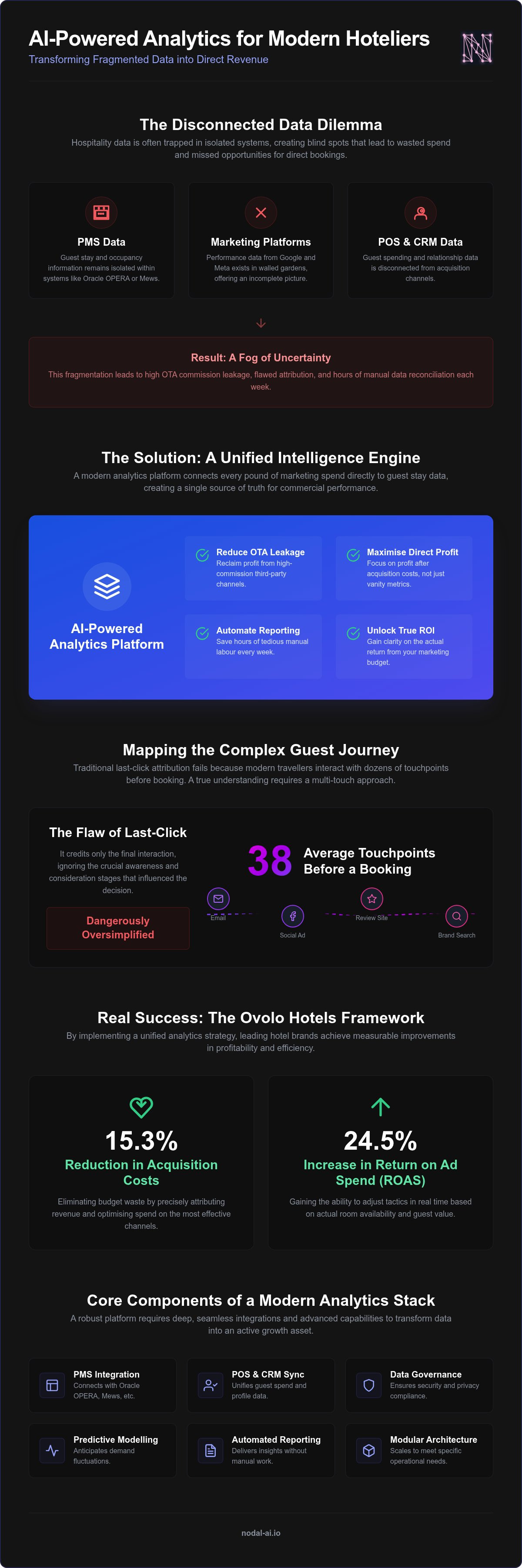
We understand that you need clarity, not more complexity. By implementing a sophisticated hotel marketing analytics platform, you can transform these chaotic data points into a single source of truth for your commercial performance. This guide reveals how to unify your hospitality ecosystem into an AI-powered view that reduces OTA leakage and maximises direct booking profit. You'll discover how brands like Ovolo Hotels achieved a 15.3% reduction in acquisition costs and a 24.5% increase in ROAS. We'll explore the shift toward first-party data strategies and show you how automated reporting can save your team hours of tedious manual labour every single week.
Key Takeaways
- Transform fragmented data into a unified commercial intelligence engine that prioritises direct profit over simple reporting.
- Map the 38-touchpoint guest journey to accurately attribute revenue and move beyond the limitations of last-click models.
- Select a hotel marketing analytics platform that utilises modular architecture to scale with your specific operational needs.
- Use automated growth recommendations to eliminate budget waste and reclaim profit from high-commission third-party channels.
- Realise measurable success by following the framework that helped Ovolo Hotels achieve a 15.3% reduction in acquisition costs.
What is a Hotel Marketing Analytics Platform in 2026?
In 2026, a hotel marketing analytics platform is no longer a luxury for large global chains; it is a fundamental requirement for any property serious about direct revenue. It functions as a unified intelligence engine that strips away the guesswork by connecting every pound of marketing spend directly to guest stay data. This transition marks the evolution from basic reporting to true Commercial Intelligence. Instead of looking at vanity metrics like clicks or impressions, you focus on the profit that remains after acquisition costs are settled. By integrating your revenue management strategies with live marketing performance, you gain the ability to adjust your tactics in real time based on actual room availability and guest value.
The Shift from Fragmented Data to Unified Intelligence
Traditionally, hospitality data has been trapped in isolated silos. Marketing teams look at Google Ads and Meta performance, while operations teams live inside the Property Management System (PMS). This fragmentation creates a massive blind spot where OTA leakage thrives. You often find yourself paying high commissions to third parties for guests who might have booked directly if your data was synchronised. Achieving a single view of performance allows you to see the entire guest journey in one place. It turns chaotic inputs into high-value outputs, providing the clarity needed to reclaim your margins. When you unify these sources, you move from reactive troubleshooting to proactive growth, ensuring that your marketing budget is always working to fill your most profitable dates.
Core Components of a Modern Hospitality Analytics Stack
A robust analytics stack requires deep integration with your core systems to be effective. This includes seamless connections with your PMS (such as Oracle OPERA or Mews), Point of Sale (POS) systems like OpenTable, and your guest CRM. By automating data ingestion, you eliminate the manual errors and the hours of tedious labour that plague traditional spreadsheets. Modern platforms also incorporate advanced features like predictive modelling to anticipate demand fluctuations before they impact your occupancy. For global brands, a strong data governance framework ensures that this information remains secure and compliant with evolving privacy laws. This structure allows your team to focus on high-level strategy rather than data entry, transforming your data from a passive asset into an active participant in your business growth. Ultimately, a hotel marketing analytics platform acts as the essential bridge between guest intent and operational revenue.
Solving the Attribution Puzzle: Tracking the 38 Touchpoints
The guest journey is no longer a straight line; it is a complex web of discovery and validation. Research indicates that modern travellers interact with an average of 38 touchpoints before they finally commit to a booking. For any hotel marketing analytics platform, capturing this fragmented path is the difference between true growth and wasted spend. Most hotels still rely on last-click attribution, which is a dangerous oversimplification. It credits the final interaction (often a brand search) while completely ignoring the social media awareness or email campaigns that sparked the initial interest. To move beyond these basics, you must implement multi-touch attribution (MTA). This approach assigns equitable value to every interaction, from the first Instagram ad to the final pre-stay email. For a deeper dive into these methodologies, explore our mastering marketing attribution guide.
Academic institutions like Boston University recognise the critical nature of this data evolution, offering a specific Revenue Management & Analytics concentration to prepare leaders for a data-driven landscape. This professional focus confirms that modern hospitality success relies on the ability to interpret complex data streams rather than just managing room inventory.
Why Traditional Analytics Fail the Hospitality Sector
Traditional analytics often hit a wall because of Walled Gardens. Google and Meta don't share data freely, leaving you with a partial picture of your marketing impact. Luxury travel further complicates this with long sales cycles that easily exceed standard 30-day cookie windows. Implementing a dedicated hotel marketing analytics platform allows you to bridge these gaps by moving data processing from the browser to the server. This server-side tracking is essential to bypass browser restrictions and ad blockers, ensuring you maintain a persistent and accurate view of the guest throughout their entire decision-making process.
Mapping the Guest Journey for Direct Booking Growth
Mapping the guest journey allows you to identify high-propensity segments and tailor your spend accordingly. It is about understanding incrementality; you need to know which bookings would not have happened without your specific marketing intervention. By identifying these patterns, you can stop spending on guests who would have booked anyway and refocus your budget on capturing new audiences. The Nodal Platform empowers organisations to map complex guest journeys with precision, turning passive data into active growth strategies. To see how this clarity can transform your direct revenue, you might want to arrange a personal walkthrough of our modular engine.
Evaluation Criteria: How to Choose the Right Platform
Selecting the right hotel marketing analytics platform requires a shift in perspective. You are not merely buying a dashboard; you are investing in a commercial intelligence engine. To ensure the platform delivers long-term value, your evaluation framework must prioritise three critical pillars: modularity, integration depth, and predictive capability. A truly effective system does more than just aggregate historical figures. It turns passive data into active growth by identifying patterns that the human eye might miss. Without these capabilities, you risk remaining trapped in a reactive cycle of manual reporting and missed opportunities.
Modular architecture is particularly vital because it allows the technology to adapt to your specific property type. A city-centre hostel focusing on high-volume, short-stay guests has vastly different data requirements than a luxury resort catering to long-stay international travellers. By choosing a modular system, you can select specific operational, demand, or guest modules that fit your current needs while leaving room for future expansion. This flexibility ensures you only pay for the features that drive your specific profit goals. To accurately forecast future occupancy, a platform must incorporate flight demand data, as air travel intent typically serves as a leading indicator for hotel bookings by several weeks.
The Power of External Demand Signals
Most traditional tools focus entirely on internal data, yet your hotel does not exist in a vacuum. External signals like local events, FX rates, and weather patterns significantly influence guest behaviour. If a major conference is announced or a local festival expands, your marketing spend should automatically pivot to capture that surge. Similarly, fluctuations in FX rates can make your property more attractive to specific international markets, requiring a rapid shift in ad targeting. Even weather data provides a tactical advantage. When a sudden downpour is forecasted, a sophisticated platform can trigger automated promotions for spa treatments or F&B services, capturing revenue that might otherwise be lost to the rain. You can explore these advanced intelligence features to see how external signals transform your commercial outlook.
Integration Depth: Beyond Simple API Connections
There is a vast difference between surface-level dashboards and deep data science modelling. A high-performing platform must communicate directly with your Revenue Management Systems (RMS), such as Duetto or IDeaS, to align marketing spend with pricing strategy. This deep integration ensures that you aren't wasting budget on dates that are already at peak occupancy. Furthermore, the ingestion of historical data is essential for accurate year-over-year comparisons. Without this historical context, it is impossible to determine if your current growth is a result of effective strategy or merely a broader market trend. If you are ready to see how these integrations can streamline your operations, book a demonstration with our expert team.
Strategic Implementation: From Insights to Direct Revenue
Stop relying on historical spreadsheets that are outdated before they are even finished. Transitioning to a modern hotel marketing analytics platform allows you to replace manual labour with automated precision. This roadmap begins with consolidating your data streams to create a foundation for Growth Recommendations. These actionable insights identify exactly which channels are underperforming, allowing you to shift your budget toward high-yield direct sources instantly. It turns a chaotic mess of tabs into a streamlined path toward profitability.
The most significant shift comes from moving your focus forward. By using predictive modelling, you can identify "need periods" up to six weeks in advance. This early warning system gives your marketing team enough lead time to launch targeted campaigns before occupancy dips occur. You no longer have to react to a quiet week after it has already started. Instead, you can influence the outcome by filling those gaps with high-value direct bookings while your competitors are still looking at last month's reports.
Reducing OTA Leakage through Targeted Direct Campaigns
Identifying which guests are most likely to book direct is a core function of AI-driven audience segmentation. Instead of a broad, expensive approach, you can target segments based on their historical behaviour and specific propensity for direct interaction. This precision significantly lowers your acquisition costs. You must also look beyond the initial room rate and account for the full guest value. This includes on-property ancillary spend, such as spa treatments, bar revenue, or dining. Direct bookers generally show higher loyalty and spend more across your facilities, making them the most valuable assets in your portfolio.
Automated Reporting for Commercial Teams
Efficiency is the ultimate byproduct of automation. Commercial teams often save 20 or more hours every week by eliminating the need to manually build cross-property portfolio reports. Real-time alerts now notify you immediately of occupancy or RevPAR dips, enabling instant tactical adjustments across the organisation. This system also allows you to standardise KPIs across different property types within your group. Whether you manage a boutique hotel or a large-scale resort, you can ensure every property is measured against the same rigorous commercial standards.
Book a demo to automate your commercial reporting
Connecting the Dots with Nodal AI: The Future of Hospitality
Nodal AI is not just another reporting tool; it is a cognitive upgrade for your entire organisation. As a modular intelligence engine designed by hospitality experts, the Nodal Platform turns fragmented signals into a coherent commercial strategy. We believe in a "Make More, Waste Less" philosophy. This means shifting the focus from vanity top-line revenue toward the actual profit margins that sustain your business. By using our hotel marketing analytics platform, you can finally see the single view of performance across your organisation, ensuring every marketing pound is spent with purpose.
The results of this approach are measurable and significant. For instance, Ovolo Hotels utilised our engine to achieve a 15.3% reduction in acquisition costs while simultaneously seeing a 24.5% increase in ROAS. These numbers represent the relief of knowing your budget is no longer leaking into inefficient channels. We help you reclaim your direct booking profit by identifying the exact moment to pivot your spend, replacing the anxiety of manual tasks with the confidence of streamlined, high-level perspectives.
Why UK Hospitality Leaders Trust Nodal AI
UK brands face unique challenges, from specific seasonal demand to regional economic shifts. Our London-based team provides deep local expertise that generic global platforms simply cannot match. We combine sophisticated SaaS technology with high-level strategic marketing consultancy; this ensures you have a capable partner rather than just a software provider. Our staff's expertise is further validated by our Gold award in Performance Marketing, confirming our status as a visionary leader in the sector.
Next Steps: Transforming Your Data into a Strategic Asset
Moving from fragmented data to a single source of truth is a streamlined journey with Nodal AI. Our onboarding process is designed for efficiency, guiding you from the initial technical setup to the configuration of custom dashboards that reflect your specific KPIs. We encourage you to explore Nodal Platform features to see how our modular architecture can be tailored to your property. Start connecting the dots across your hospitality performance today to replace manual labour with automated growth.
To see how we can optimise your specific commercial engine, book a demo for a tailored commercial audit.
Master Your Commercial Future
The transition from manual reporting to automated commercial intelligence is no longer optional for hotels seeking to reclaim their margins. You've seen how a unified hotel marketing analytics platform turns fragmented data into a strategic asset, allowing you to track the 38-touchpoint guest journey with absolute precision. By integrating external signals such as flight demand and weather patterns, your team can finally move from reactive troubleshooting to proactive, high-yield growth. This clarity is the foundation for sustainable direct revenue in an increasingly competitive landscape.
Our London-based expertise in hospitality data science ensures your organisation has the support it needs to scale effectively. With custom modules for Commercial, Guest, and Operational insights, the Nodal Platform empowers you to achieve measurable results like the 15.3% reduction in acquisition costs seen by Ovolo Hotels. It's time to replace the anxiety of manual spreadsheets with the confidence of a single source of truth.
Book a demo of the Nodal Platform
Frequently Asked Questions
What is a hotel marketing analytics platform?
A hotel marketing analytics platform is a unified intelligence engine that consolidates data from fragmented systems like your PMS, POS, and booking engines. Unlike standard reporting tools, it focuses on connecting marketing spend directly to guest stay data and operational revenue. This creates a single source of truth for your commercial performance. By transforming chaotic inputs into high-value outputs, it allows your team to make faster, data-driven decisions that increase profit margins and reduce manual labour.
How does a marketing analytics platform help reduce OTA commissions?
The platform reduces OTA commissions by identifying OTA leakage and reclaiming those guests through targeted direct booking strategies. It uses AI-driven audience segmentation to find high-propensity guest segments who are likely to book directly with your property. By understanding the full guest journey across 38 touchpoints, you can optimise your marketing spend to capture bookings on your own website. This strategic shift helped Ovolo Hotels achieve a 15.3% reduction in acquisition costs.
Can I integrate my existing PMS like Oracle OPERA or Mews?
Yes, the Nodal Platform integrates seamlessly with major operational systems including Oracle OPERA, Mews, Cloudbeds, and Stayntouch. These deep integrations ensure that your marketing data is always synchronised with your actual room inventory and guest profiles. By automating this data ingestion, you eliminate the risk of manual errors and save your team hours of tedious reconciliation work every week. This connection is essential for maintaining a real-time view of your commercial performance.
What is the difference between Google Analytics and a specialised hospitality platform?
While Google Analytics tracks website traffic, a specialised hotel marketing analytics platform connects that web data to your internal systems like the PMS and POS. This allows you to track actual stay revenue and on-property spend rather than just clicks or online conversions. It provides a deeper level of commercial intelligence by incorporating hospitality-specific signals like flight demand and local event data, which generic analytics tools simply cannot process or attribute correctly.
How does predictive modelling help with hotel occupancy?
Predictive modelling uses historical data and external demand signals to identify need periods of low occupancy up to six weeks in advance. This early warning system allows your marketing team to launch targeted promotions before the occupancy dip occurs. By anticipating fluctuations in demand, you can fill gaps with high-value direct bookings rather than relying on last-minute OTA discounts. It turns your data into a proactive tool for stabilising your revenue throughout the entire year.
Can the platform track on-property spend like F&B or spa treatments?
Yes, the platform integrates with Point of Sale systems such as OpenTable and SevenRooms to track ancillary revenue. This capability allows you to measure the full guest value by seeing exactly how much stay-related and on-property revenue each marketing channel generates. Whether it is spa utilisation or average spend per head in your restaurant, you can identify which guest segments are most profitable across all your facilities, not just the rooms.
How long does it take to see a return on investment after implementation?
Most organisations begin to realise a return on investment within the first few months as automated reporting saves the team roughly 20 hours of manual work every week. Beyond time savings, the financial impact becomes clear as you optimise marketing spend and reduce OTA reliance. For example, Ovolo Hotels saw a 24.5% increase in ROAS and a 3.6% reduction in overall spend by applying these data-driven growth recommendations to their commercial strategy.
Does the platform support multi-property reporting for hotel groups?
The platform is specifically designed to support multi-property reporting and portfolio-wide analysis for hotel groups. It allows you to standardise KPIs across different property types, from boutique hotels to large-scale resorts, within a single dashboard. Real-time alerts notify you of RevPAR or occupancy dips at specific locations, enabling instant tactical adjustments. This Z-view provides the transparency needed to manage performance across your entire organisation without the complexity of manual data consolidation.


