

Why does your Meta Ads Manager report a 10x return on spend while your property management system shows direct bookings are flat? It is a common frustration for hospitality leaders who realise that platform metrics often exist in a vacuum. When your data is fragmented across different systems, you lose the ability to attribute social spend to specific hotel stays or restaurant covers. This gap creates a sense of overwhelm, leaving you to wonder if your marketing budget is actually driving growth or simply inflating digital egos.
If you want to master how to measure meta ads performance in 2026, you must look beyond the dashboard. This guide promises to move you past basic clicks and into the realm of true commercial impact. We will examine how to unify your first-party data, navigate the new UK location fees, and implement multi-touch attribution that reflects the modern guest journey. By the end of this article, you will have a clear roadmap to replace manual reporting with automated, high-level perspectives that secure your long-term financial performance.
Key Takeaways
- Discover how to measure meta ads performance by integrating first-party data from your PMS and POS systems to reveal actual revenue rather than just platform clicks.
- Understand the limitations of the Meta walled garden and why relying on standard dashboard metrics can lead to misleading commercial conclusions.
- Shift your focus toward high-value guest segments to ensure your social spend creates a direct impact on your bottom line.
- Learn to bridge the gap between social clicks and direct bookings to reduce OTA leakage and reclaim your profit margins.
- Establish a structured data governance framework that replaces manual reporting with automated intelligence for consistent, scalable growth.
Beyond the Dashboard: Why Standard Meta Ads Metrics Often Lie
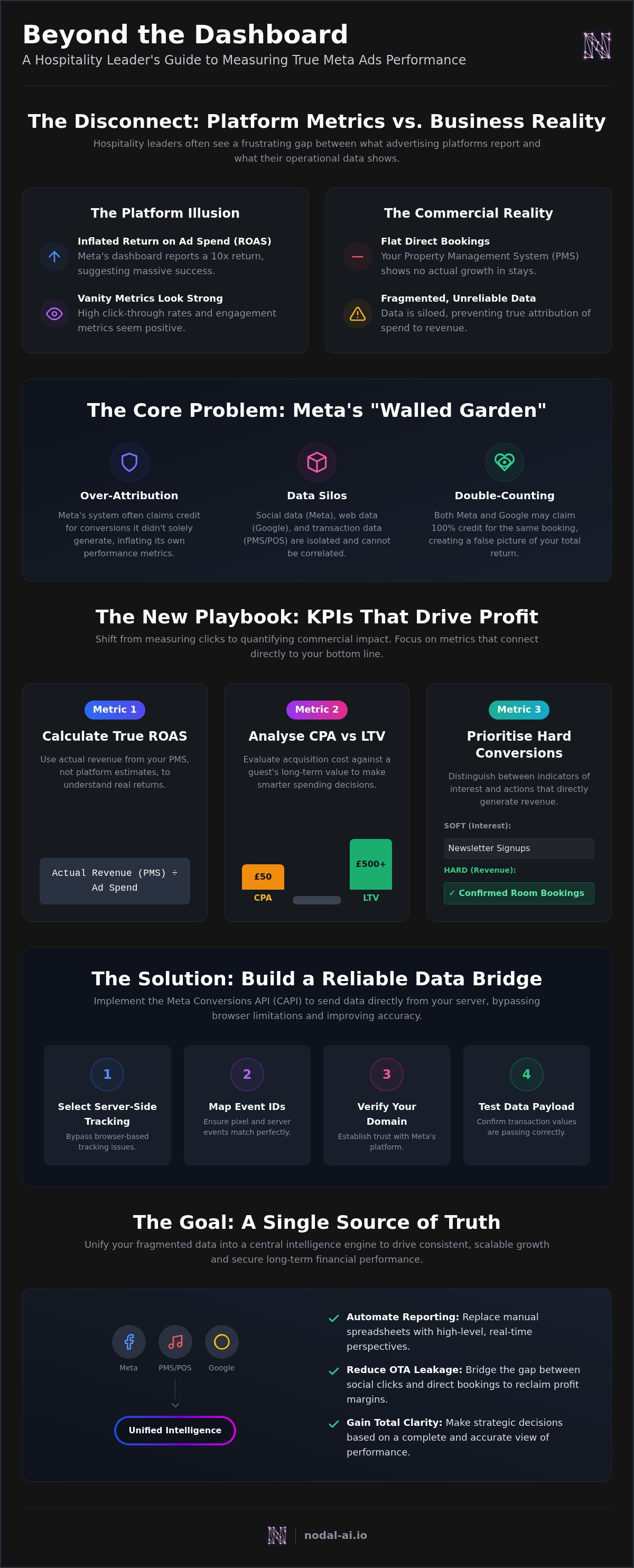
True Meta Ads performance measurement is the rigorous process of quantifying how social spend translates into commercial growth. It is not about counting likes or measuring the velocity of comments. For hospitality leaders, the real objective is to track a guest from their initial interaction on Instagram to a confirmed booking within a Property Management System (PMS). Relying solely on the Meta dashboard provides a distorted view of reality. Meta operates as a walled garden, reporting success based on its own internal data and generous attribution models that often claim credit for revenue it did not solely generate.
The disconnect between a social click and a confirmed stay is the space where marketing budgets vanish. A high click-through rate might suggest a successful campaign, but if those users never reach your checkout page, the metric is commercially hollow. To gain total clarity, you must move toward a single view of performance that synchronises marketing data with operational reality. This shift turns passive reporting into an active strategy for financial stability within the complex digital advertising landscape.
The Problem with Platform-Native Attribution
Standard attribution windows in Meta often over-attribute credit to the platform. By default, Meta may claim a conversion if a user merely viewed an ad within the last 24 hours before booking, even if they were already planning to stay at your property. Since the seismic shifts caused by iOS 14 and subsequent privacy updates, tracking accuracy has degraded further. As of August 2026, new reporting API opt-in requirements for device and frequency data mean that platform-only insights are increasingly fragmented. When you rely on these signals, you risk optimising for the wrong outcomes. You might scale a campaign that generates cheap engagement but fails to produce a single restaurant cover or room night.
Fragmented Data: The Hospitality Industry Challenge
In most hospitality organisations, data sits in isolated silos. Meta holds the social interaction data; Google Analytics tracks the website journey; and the PMS or POS system holds the final transaction. This fragmentation leads to rampant double-counting. Both Meta and Google might claim 100% credit for the same £500 booking, leading to an inflated sense of return that doesn't exist in your bank account. Realise that data fragmentation is the primary barrier to accurate ROI calculation in 2026. Replacing these chaotic inputs with an integrated intelligence engine is the only way to understand how to measure meta ads performance with commercial precision.
The Essential KPIs for Commercial Meta Performance in 2026
Stop measuring success by how many people liked a photo of your lobby. In 2026, the only metrics that matter are those that impact your bottom line directly. You must adopt a "make more, waste less" mindset by identifying high-value guest segments that yield the highest margins. This requires a shift from estimated platform values to actual revenue data pulled from your Property Management System. When you calculate Return on Ad Spend (ROAS) using real transaction figures, you eliminate the ambiguity of the walled garden. It is the only way to understand how to measure meta ads performance with financial integrity. Revenue is the only truth.
Refining your Cost Per Acquisition (CPA) targets is also essential when learning how to measure meta ads performance across different hospitality locations. Your CPA must be viewed through the lens of customer lifetime value (LTV). A £50 acquisition cost might feel expensive for a single dinner cover; however, it is a high-value investment if that guest returns five times a year. By tethering marketing spend to long-term stability, you transform your advertising from a cost centre into a growth engine. Data is binary.
Moving Beyond Clicks to Conversions
Differentiate between soft conversions, such as newsletter signups, and hard conversions like confirmed room bookings. While soft actions indicate interest, they do not pay the bills. Tracking offline actions is equally vital; use location-based signals to attribute restaurant walk-ins to specific social campaigns. To ensure data reliability, implement the Meta Conversions API (CAPI) using this streamlined approach:
- Select a server-side tracking method to bypass browser limitations.
- Map your event IDs to ensure they match your browser pixel data perfectly.
- Verify your domain within the Meta Business Manager to establish trust.
- Test your data payload to confirm that transaction values are passing through correctly.
Understanding Incrementality and Lift
Incrementality is the gold standard for measuring the true causal effects of advertising on guest behaviour. It identifies the bookings that would not have happened without your Meta ads. Running conversion lift tests allows you to isolate the impact of your spend by comparing a test group against a control group of users who did not see your ads. This process reveals the true value of your budget, especially when factoring in external signals like local festival dates or sudden spikes in flight demand. To see how these variables interact with your current strategy, explore our advanced performance marketing analytics to gain deeper commercial insights.
Connecting Social Spend to Direct Revenue and PMS Data
To truly understand how to measure meta ads performance, you must bridge the gap between the social scroll and the physical key card. Most hospitality leaders struggle to understand how to gauge the effectiveness of their advertising because their data is trapped in separate platforms. Linking a Meta click to a specific transaction in your Property Management System (PMS) requires a technical handshake between your ad tracking and your guest records. When these systems communicate, you can see exactly which creative led to a three-night stay or a high-value restaurant booking.
Reducing OTA leakage is the most direct way to improve your campaign results. If a guest discovers your property on Instagram but eventually books through a third-party site, you lose a significant portion of your margin to commission fees. By tracking the full journey, you can identify where guests drop off and incentivise them to book direct. Furthermore, your measurement should include ancillary spend. A guest who books a room via a Meta ad might also spend hundreds on spa treatments or fine dining; capturing this total guest value is essential for mastering marketing attribution in a competitive market.
The Role of Multi-Touch Attribution (MTA)
Realise that last-click attribution is a relic of the past. In hospitality, the booking window is often weeks or even months long; a guest might see five different ads before they finally commit. Multi-touch attribution allows you to map every interaction from the first social impression to the final confirmation. The Nodal Platform consolidates these disparate data points, providing a single, transparent view of how each touchpoint contributes to your revenue. This removal of ambiguity allows you to invest with confidence, knowing exactly which channels are driving your commercial stability.
Integrating Operational Systems
Accurate measurement depends on deep integrations with the tools you use every day. Connecting Meta data to systems like Mews, Cloudbeds, or SevenRooms allows you to see the real-world outcome of every pound spent. Use our predictive modelling to identify which guest segments generate the highest value and adjust your targeting accordingly. This level of integration transforms passive assets into active participants in your growth strategy. Operational data turns marketing spend into commercial intelligence, providing the ultimate answer to how to measure meta ads performance for long-term success.
Building a Measurement Framework for Scalable Growth
Scale requires structure; you cannot manage what you do not measure with consistency. To master how to measure meta ads performance across a global portfolio, you must move beyond manual spreadsheets that are inherently prone to human error. Replace these chaotic inputs with a rigorous framework that connects every ad pound to a specific room night. This transition from manual labour to automated precision is the hallmark of a high-performing marketing organisation. Establish a clear sequence to ensure your data remains an active participant in your growth strategy:
- Consolidate all marketing and revenue data sources into a unified intelligence engine.
- Apply a strict data governance framework to remove duplicates and ensure cleanliness.
- Automate your reporting to provide real-time visibility across all property locations.
- Utilise predictive modelling to forecast commercial outcomes based on historical booking trends.
This structured approach ensures that your reporting remains a source of truth rather than a collection of educated guesses. By implementing automated reporting, you can reclaim hundreds of manual labour hours every month. This newfound efficiency allows your marketing team to focus on high-level strategy while the Nodal Platform handles the technical computation. Once your historical data is unified, you can deploy predictive modelling to forecast future performance with total confidence, placing spend exactly where it will generate the highest return on investment.
Setting Up Your Data Infrastructure
Your infrastructure must act as a cognitive upgrade for your entire business. Connect your Meta accounts, GA4 properties, and your internal PMS and CRM systems into a single intelligence engine. Use consistent UTM parameters to ensure that every click remains identifiable across all channels. This level of transparency is vital for maintaining compliance with evolving data privacy regulations while still capturing the insights necessary for profitable growth.
Measuring Performance by Segment and Location
For hospitality groups with multiple properties, tracking performance at the individual site level is non-negotiable. You must understand how to measure meta ads performance for a boutique city hotel versus a sprawling coastal resort, as the guest behaviour differs significantly. Use cohort analysis to track guest retention and identify the specific creative assets that attract repeat visitors. For a deeper understanding of these touchpoints, refer to our definitive guide to the customer journey.
Book a demo to scale your intelligence
Optimising Meta Performance with Nodal AI Platform
Nodal AI serves as the definitive bridge between your social media spend and your actual revenue systems. By consolidating fragmented marketing and revenue data, the Nodal Platform replaces the anxiety of manual tracking with the confidence of high-level, automated perspectives. The modular architecture ensures that your intelligence capabilities scale alongside your business, whether you manage a single site or a global hospitality group. This unified approach provides the final answer to how to measure meta ads performance with absolute commercial clarity. Complexity is replaced by calm efficiency.
Operational efficiency is achieved when AI-driven insights identify specific "need periods" within your booking calendar. Instead of running generic campaigns, the platform directs your budget toward low-occupancy dates; this ensures that your Meta ads work to fill empty rooms or quiet restaurant shifts. This strategic focus has led to a documented 24.5% increase in ROAS for hospitality clients, transforming advertising from a speculative expense into a precise tool for financial stability. Clear data drives better decisions.
Predictive Modelling and Growth Recommendations
The platform uses predictive modelling to identify high-propensity guest segments, allowing you to reduce wasted spend on audiences unlikely to convert. By incorporating external signals such as local weather patterns and tourism trends into your analysis, Nodal provides growth recommendations that are tethered to real-world conditions. This cognitive upgrade ensures that your strategy remains proactive rather than reactive. To see these integrated systems in action, book a demo and discover how to master your customer journey mapping.
Case Study: Driving Commercial Excellence
The impact of this consolidated intelligence is best illustrated through real-world performance. For Ovolo Hotels, the implementation of our performance marketing analytics led to a 15.3% reduction in acquisition costs. This was achieved by moving beyond the platform-native dashboard and understanding the true commercial impact of every click. Better Meta attribution also supported a 20% increase in paid search revenue, as the business could finally see how social discovery influenced direct search behaviour. The Nodal Platform solves the problem of data fragmentation by turning passive assets into active participants in your commercial growth. It is the essential final step for any organisation looking to master how to measure meta ads performance in 2026.
Securing Commercial Stability through Data Integration
Securing your commercial future requires a cognitive upgrade in how your organisation handles guest data. You have seen how relying on platform-native metrics creates a false sense of security while direct bookings remain flat. By replacing fragmented silos with a modular intelligence engine, you transform passive marketing spend into an active driver of long-term stability. This transition replaces the anxiety of manual reporting with the confidence of high-level perspectives.
Hospitality brands that adopt this unified framework have already realised a 15.3% reduction in acquisition costs and a 24.5% increase in ROAS. Mastering how to measure meta ads performance is no longer a technical hurdle; it is a strategic necessity for any partner obsessed with measurable returns. Shift your focus from chaotic inputs to confirmed revenue and reclaim your operational efficiency today.
Book a demo with Nodal AI to unify your marketing and revenue data
The path from data fragmentation to strategic clarity is now open for your business. Take the final step toward total commercial transparency and lead your organisation into a more profitable and predictable 2026.
Frequently Asked Questions
How can I track Meta ads performance if I have a long booking window?
Track the journey using multi-touch attribution and first-party data integration. Since hospitality guests often research for weeks, a standard 7-day window is insufficient. Connect your ad interactions to a CRM or a unified intelligence platform to maintain visibility over the entire decision-making process. This allows you to credit social ads for a booking that occurs thirty days after the initial click, ensuring your long-term financial performance is accurately recorded.
Why does Meta Ads Manager show more conversions than my Google Analytics?
Meta reports conversions based on its own internal data, including view-through actions where a user saw an ad but did not click. Google Analytics typically relies on last-click referral data, which ignores the early influence of social media. This discrepancy creates a fragmented view of success. To resolve this, you must adopt a single view of performance that synchronises these disparate data sources into one clear commercial perspective.
What is the best attribution model for hospitality marketing in 2026?
The most effective model is a data-driven, multi-touch attribution (MTA) framework. Last-click models are outdated because they ignore the complex nature of the hospitality guest journey. In 2026, you should use a model that assigns weight to every interaction, from the first Instagram Reel to the final booking engine visit. This approach replaces the anxiety of manual tracking with the confidence of high-level, automated insights and growth recommendations.
Can I measure Meta ads performance for offline restaurant visits?
You can attribute physical visits by matching offline transaction data with Meta user profiles. By uploading hashed customer data from your POS system, you can see which restaurant covers were influenced by specific social campaigns. This technical handshake provides a clear answer on how to measure meta ads performance for your F&B outlets. It ensures that your social spend is tethered to actual revenue rather than just digital engagement.
How do I account for OTA leakage when calculating my Meta ROAS?
Account for OTA leakage by comparing your Meta-driven traffic against direct booking confirmation IDs. If your ads generate high traffic but low direct revenue, guests may be booking via third-party sites. Use predictive modelling to identify these drop-off points and implement direct-booking incentives. This level of transparency allows you to calculate a more accurate ROAS that reflects your actual profit margins after accounting for expensive commission costs.
What are the most important Meta ads metrics for hotel owners?
Hotel owners should prioritise Net ROAS, Cost Per Room Night, and the Direct Booking Ratio. While digital metrics like impressions are helpful, they don't reflect operational reality. Focus on the 'Marketing Cost per Booking' to ensure your acquisition strategy remains profitable. Tracking these commercial outcomes allows you to replace chaotic inputs with high-value outputs, providing a cognitive upgrade for your entire revenue management strategy.
How does the Conversions API improve my measurement accuracy?
The Conversions API (CAPI) sends data directly from your server to Meta, bypassing the limitations of browser-based pixels and ad blockers. This server-side connection ensures that your data remains clean and compliant with evolving privacy laws. It is a vital component for anyone learning how to measure meta ads performance with precision. Implementing CAPI reduces signal loss and provides a more stable perspective on your total advertising return on investment.
Is it possible to track the guest journey from a Facebook ad to a PMS booking?
Tracking the journey from a Facebook ad to a PMS booking is possible through deep system integration. By connecting your ad account to a modular intelligence engine, you can map the guest journey across every touchpoint. This creates a transparent link between social discovery and the final transaction in your Property Management System. This integration transforms passive assets into active participants in your business growth, ensuring total commercial clarity.


