

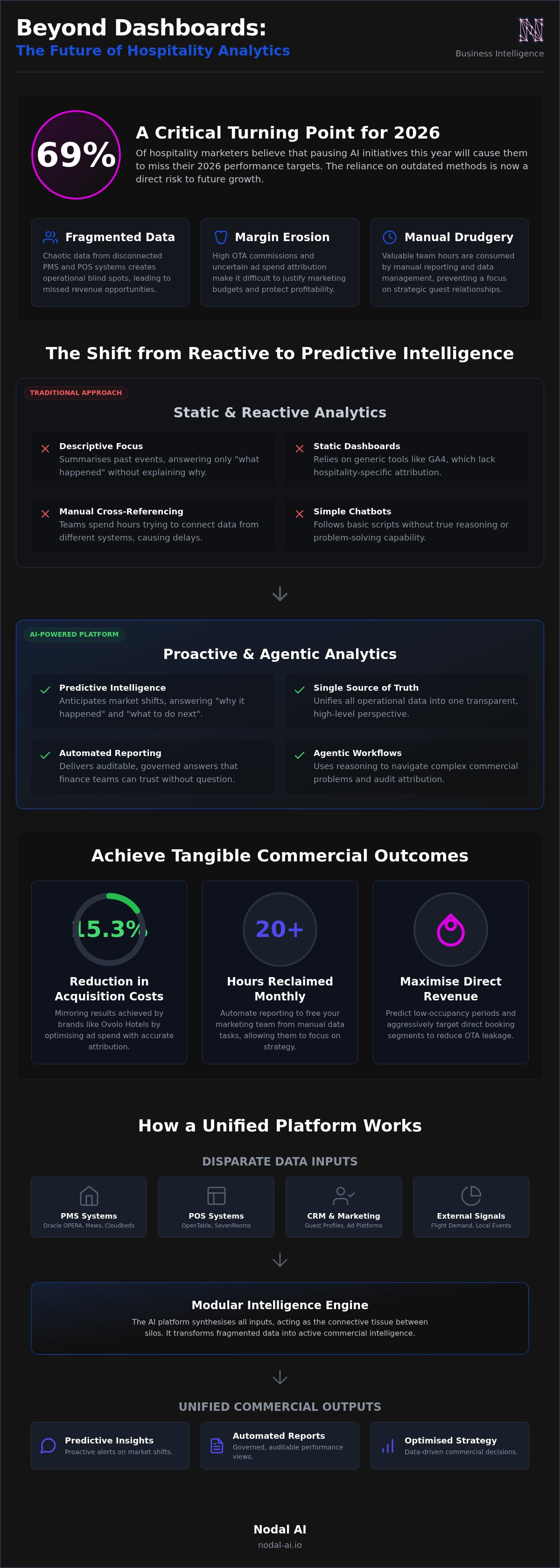
Sixty-nine per cent of hospitality marketers believe that pausing AI initiatives this year will cause them to miss their 2026 targets. You likely recognise the frustration of managing fragmented data across PMS and POS systems while watching OTA commissions erode your margins. It's exhausting to justify ad spend when attribution remains a guessing game and manual reporting consumes your team's most valuable hours.
This guide reveals how a dedicated ai marketing analytics platform unifies these disparate sources into one high-level perspective. We will demonstrate how to transform chaotic inputs into a single source of truth for your commercial performance. You will learn to reduce acquisition costs, mirroring the 15.3% reduction achieved by Ovolo Hotels, and automate reporting to reclaim over 20 hours every month. Discover how to replace manual drudgery with predictive insights that maximise direct revenue during low-occupancy periods. We are moving beyond the pilot phase; it's time to execute a strategy that prioritises first-party data and secures your competitive advantage.
Key Takeaways
- Understand the shift from static dashboards to proactive, agentic analytics to maintain a competitive edge in 2026.
- Unify fragmented operational data from systems such as Oracle OPERA and Mews to create a single, transparent source of truth.
- Deploy a dedicated ai marketing analytics platform to predict low-occupancy periods and aggressively target direct booking segments.
- Leverage modular architecture to choose specific intelligence layers, ensuring your technology scales alongside your commercial ambitions.
- Master the predictive modelling techniques required to minimise OTA commission leakage and maximise your direct revenue streams.
What is an AI Marketing Analytics Platform in 2026?
Defining What is an AI Marketing Analytics Platform in 2026? involves more than just listing software features; it describes a modular intelligence layer that actively unifies your fragmented operational stack. By synthesising inputs from your PMS, POS, and CRM, it creates a transparent view of your entire commercial ecosystem. While traditional tools once only summarised the past, modern platforms utilise agentic analytics to anticipate market shifts before they impact your bottom line. This isn't just about collecting data; it's about transforming that data into a cognitive partner for your business.
Relying on generic solutions like GA4 is no longer sufficient for high-performance hospitality brands. These systems often lack the nuanced attribution required to track a guest journey from an initial search through to a direct booking. A specialised ai marketing analytics platform closes these gaps, eliminating the inaccurate attribution that leads to wasted ad spend. The immediate benefit is a radical reduction in manual labour. Automated reporting reclaims over 20 hours of marketing time every month, allowing your team to stop managing rows of data and start managing guest relationships. You can explore the Nodal Platform features to see how this integration works in practice.
The Shift from Descriptive to Predictive Intelligence
Descriptive analytics focus on the "what," but predictive intelligence focuses on the "why" and the "next." Real-time data processing is now essential for maintaining dynamic pricing that reflects actual demand. Predictive modelling allows you to spot "need periods" far in advance, giving you the lead time to launch targeted campaigns before occupancy drops. It turns your data into an active participant in your revenue strategy, ensuring every room and table is optimised for maximum return. This foresight replaces the anxiety of reactive discounting with the confidence of proactive growth.
Agentic Workflows vs Simple AI Chatbots
Do not confuse agentic workflows with basic chatbots. While a chatbot follows a script, an agentic system uses reasoning to navigate complex commercial problems. These agents can audit multi-touch attribution paths and provide governed answers that your finance team won't question. For an enterprise-ready organisation, this transparency is vital. It replaces the anxiety of manual cross-referencing with the confidence of a streamlined, high-level perspective that is both auditable and actionable. These workflows can even integrate external factors, such as flight demand or local events, to provide a truly comprehensive commercial outlook.
Unifying Fragmented Hospitality Data: The PMS and POS Challenge
Hospitality data is notoriously fragmented. Your marketing team monitors click-through rates while your operations team tracks check-ins; yet, these two worlds rarely communicate. This structural disconnect creates blind spots that lead to wasted ad spend and missed revenue opportunities. A specialised ai marketing analytics platform acts as the connective tissue between these silos, transforming passive data into active commercial intelligence. By integrating directly with PMS providers such as Oracle OPERA, Mews, and Cloudbeds, you gain a transparent view of the entire guest journey from the first digital touchpoint to the final checkout.
Data fragmentation is more than an operational headache; it is a barrier to profitability. Research regarding Unifying Fragmented Hospitality Data: The PMS and POS Challenge demonstrates how AI-driven integration converts friction into a measurable competitive advantage. When you connect transaction data from POS systems like OpenTable or SevenRooms, you can finally calculate the true lifetime value of a guest. This level of clarity allows you to move beyond basic metrics and focus on high-value outputs that drive long-term stability. You can book a demo to see how these disparate sources converge into a single source of truth.
Bridging the Gap Between Marketing and Operations
Guest profiles and revenue data must live in the same view to inform effective strategy. For restaurants, understanding the shift between delivery and dine-in mix is critical for protecting margins. In the hostel sector, tracking ancillary spend and stay extensions provides a more accurate picture of total revenue than simple room rates. A modular architecture allows you to choose the specific intelligence layers your business needs, ensuring that your commercial insights are as unique as your brand.
External Signals: Beyond Your Own Data
Your internal data only tells half the story. To truly optimise performance, your analysis must incorporate external signals such as weather patterns, FX rates, and current flight demand. These factors directly influence booking behaviour and local tourism trends. By processing these signals in real time, you can adjust your ad spend dynamically, targeting travellers when they are most likely to convert. This proactive approach replaces the anxiety of manual adjustments with the confidence of automated, data-driven precision.
Comparing Enterprise AI Marketing Solutions for 2026
Selecting the right enterprise solution requires a fundamental shift in how you evaluate technology. You must prioritise integration depth and predictive accuracy over generic feature lists that fail to account for the unique data fragmentation of the hospitality sector. A monolithic platform often forces your business into a rigid, one-size-fits-all structure that cannot adapt to your specific operational needs. Conversely, a modular ai marketing analytics platform allows you to scale with precision by selecting specific intelligence layers, such as Demand or Guest insights, that align with your current commercial objectives. This flexibility ensures your technology remains a cognitive partner rather than a technical burden.
Industry-specific knowledge is the primary differentiator in 2026. While generic SaaS tools might offer native connectors for social media, they frequently ignore critical external signals like flight demand or local weather patterns. These factors are the lifeblood of hospitality performance and directly influence booking lead times. By choosing a partner that understands these nuances, you replace the anxiety of inaccurate forecasting with the confidence of data-driven growth. For London-based enterprises, the presence of UK-based support and strict adherence to GDPR standards provides an essential layer of security and long-term stability. It is the difference between a cold algorithm and a partner that understands your local market dynamics.
Evaluating Multi-Touch Attribution Capabilities
Understanding the true guest journey requires moving beyond the limitations of last-click models that oversimplify human behaviour. AI identifies high-propensity guest segments by analysing every digital interaction, from the initial discovery phase to the final check-out. This level of clarity allows you to allocate your budget toward the channels that actually drive direct revenue rather than just vanity metrics. To deepen your understanding of these mechanics, consult our guide on Mastering Marketing Attribution. This approach ensures your attribution is both auditable and actionable for your commercial team.
The Importance of Data Governance and Security
High-stakes commercial decisions require auditable and governed answers that your finance team can trust. This is especially vital for private clubs and wellness centres that manage sensitive member data and high-value assets. London-based organisations prefer local data governance standards because they provide the relief that comes from total transparency and compliance. By implementing a secure intelligence layer, you transform passive data into an active, protected participant in your business process. This creates a persona of a capable partner that values the security of your most important commercial assets while delivering measurable returns.
Predictive Modelling: Driving Direct Bookings and Reducing Leakage
Traditional analytics platforms focus on historical reporting, telling you what happened last month or last quarter. While this data is useful, it leaves you reactive. Predictive modelling transforms your strategy by identifying future low-occupancy periods before they impact your bottom line. By deploying a specialised ai marketing analytics platform, you can anticipate shifts in guest behaviour and market demand. This foresight allows you to launch targeted campaigns exactly when they are needed, replacing the anxiety of empty rooms with the confidence of proactive revenue management.
Reducing OTA leakage is one of the most immediate ways to protect your margins. High commission fees often erode the profitability of your best-performing channels. AI-driven insights allow you to identify high-intent guest segments that are likely to book direct if presented with the right incentive. Instead of broad, expensive promotions, you can use predictive data to determine which specific offers will actually increase net revenue. For example, Ovolo Hotels achieved a 13.8% increase in bookings by using these models to refine their targeting and timing. This level of precision ensures that your marketing budget is always working to maximise direct returns.
Customer Journey Mapping for Hospitality
Visualising the guest path from the initial search to the final checkout is essential for identifying friction points. If your direct booking engine is losing potential guests at a specific stage, you need to know why. Mapping this journey allows you to streamline the experience and remove barriers to conversion. You can explore these mechanics further in our Definitive Guide to the Customer Journey, which details how to build a more profitable digital ecosystem in 2026.
Optimising Ad Spend with Growth Recommendations
Growth Recommendations take the guesswork out of paid media by generating tailored suggestions based on real-time performance. This feature within an ai marketing analytics platform allows you to target high-propensity audiences with surgical accuracy, significantly reducing your acquisition costs. By measuring the true ROAS of multi-channel campaigns, you can stop wasting spend on low-performing segments and double down on what works. This systematic approach turns your advertising into a predictable engine for commercial growth, providing the clarity you need to scale with certainty.
Book a demo to see predictive modelling in action
Scaling Performance with Nodal AI: The Modular Intelligence Engine
Nodal AI stands as the visionary choice for London-based hospitality brands seeking to dominate their market through data-driven precision. While generic competitors offer rigid, monolithic structures that struggle with industry-specific data silos, our modular intelligence engine allows you to connect the dots across your unique operational stack. By prioritising clarity over complexity, we turn your passive data into active participants in your growth strategy. This approach ensures that your technology is not just a tool, but a cognitive upgrade for your entire commercial team.
The impact of implementing a specialised ai marketing analytics platform is both immediate and measurable. We have delivered a 15.3% reduction in acquisition costs for partners such as Ovolo Hotels, alongside a 24.5% increase in ROAS across our wider portfolio. Professional implementation and onboarding ensure that your systems, from Oracle OPERA to Cloudbeds, are integrated without friction. This transition from chaotic inputs to high-value outputs creates a sense of momentum, allowing you to focus on high-level strategy rather than manual data entry.
Tailored Solutions for Hotels, QSR, and Wellness
Nodal AI provides specific modules for demand forecasting and member retention, catering to the diverse needs of hotels, Quick Service Restaurants (QSR), and wellness centres. For hostels and attractions, we help you understand full guest value by tracking ancillary spend and stay extensions. In upscale F&B environments, our insights allow you to improve covers and maximise average spend per head. By identifying your most profitable guest segments, you can allocate your resources with the confidence of an expert partner.
The Nodal Advantage: Strategic Clarity
The true Nodal advantage is the relief that comes from possessing a single, trusted source of truth. We transform fragmented data into a streamlined perspective that empowers your team to make high-stakes commercial decisions with certainty. This clarity removes the ambiguity of manual reporting and replaces it with automated, auditable insights. It is time to replace the anxiety of wasted ad spend with the confidence of a platform obsessed with measurable returns.
Schedule a Nodal Platform Demo
Secure Your Commercial Future with Predictive Intelligence
The transition from manual reporting to proactive growth requires a fundamental shift in how you manage operational data. By integrating your PMS and POS systems into a unified ai marketing analytics platform, you replace the anxiety of fragmented silos with the confidence of a single source of truth. You've seen how predictive modelling identifies future occupancy gaps and targets high-intent guests to reduce OTA leakage. This strategy is a proven framework that delivered a 15.3% reduction in acquisition costs for Ovolo Hotels and earned Gold at the Performance Marketing Awards.
Trusted by global luxury brands, the Nodal Platform offers the modular flexibility required to scale your commercial performance with precision. It's time to stop fighting with spreadsheets and start leveraging a cognitive partner that unifies your disparate assets into a measurable engine for growth.
Book a Nodal Platform Demo to Unify Your Data
Take the first step toward total commercial clarity and secure your competitive advantage for 2026 and beyond.
Frequently Asked Questions
What is an AI marketing analytics platform and how does it differ from a dashboard?
An ai marketing analytics platform is an active intelligence layer rather than a passive display tool. While traditional dashboards merely summarise historical data, this platform reasons through complex inputs to suggest proactive commercial moves. It unifies fragmented sources like your PMS and POS to provide a cognitive upgrade for your team. This shift transforms your data from a static record into an active participant in your growth strategy.
How does an AI platform help hospitality businesses reduce OTA commission costs?
The platform identifies high-intent guests who are likely to book direct if presented with the right incentive. By analysing the entire guest journey, the AI recommends specific, data-driven offers to convert users on your own website. This targeted approach reduces your reliance on third-party channels and protects your margins from heavy commission leakage. It replaces expensive, broad discounting with precision targeting that maximises your net revenue.
Can Nodal AI integrate with my existing PMS and POS systems like Mews or Oracle?
Yes, the Nodal Platform provides native integration with industry-standard systems including Oracle OPERA, Mews, and Cloudbeds. It also connects seamlessly to POS systems such as OpenTable and SevenRooms. This ensures that your operational and marketing data converge into a single, transparent source of truth. Our modular architecture allows you to connect these disparate dots without the need for deep technical specialisation or manual data entry.
What is the difference between multi-touch attribution and simple last-click models?
Last-click models only credit the final touchpoint before a booking, which oversimplifies human behaviour. Multi-touch attribution uses AI to weigh every interaction in the guest journey, from the initial discovery phase to the final check-out. This provides a more accurate understanding of which marketing channels actually drive revenue. By moving beyond last-click, you can stop wasting ad spend on low-performing segments and double down on what works.
How does predictive modelling help in forecasting low-occupancy periods?
Predictive modelling analyses historical stay patterns alongside external signals like flight demand and local events to spot "need periods" in advance. This foresight gives you the essential lead time to launch targeted campaigns before occupancy rates drop. It replaces the anxiety of reactive, last-minute discounting with the confidence of proactive revenue management. You can finally anticipate market shifts and adjust your strategy to maintain long-term commercial stability.
Is my data secure and GDPR compliant when using an AI analytics platform?
Data security is a fundamental priority for any enterprise-ready ai marketing analytics platform. Nodal AI adheres strictly to GDPR standards and provides auditable answers for high-stakes commercial decisions. London-based organisations benefit from local data governance that ensures total transparency and the high-level protection of guest assets. This creates a secure environment where you can leverage advanced intelligence without compromising on privacy or regulatory requirements.
How long does the implementation and onboarding process typically take?
Our professional implementation is designed to be streamlined and efficient, ensuring a rapid transition from chaotic data to high-value outputs. While specific timelines depend on the complexity of your technical stack, our onboarding team guides you through every step of the modular setup. We focus on delivering immediate strategic clarity so your team can start seeing measurable returns without lingering on technical hurdles or lengthy integration delays.
What kind of ROAS improvements can hospitality brands expect from AI insights?
Hospitality brands typically see significant and measurable financial returns when using AI-driven insights. For example, our partners have achieved a 24.5% increase in ROAS and a 15.3% reduction in acquisition costs. These results are possible because the platform identifies high-propensity audiences with surgical precision. By optimising your spend based on true performance data, you can achieve a higher return on every pound invested in your marketing campaigns.


