

What if your PMS, POS, and CRM stopped acting like strangers and started working as a single, high-performance sales team? You likely feel the daily friction of data fragmentation, watching guest insights vanish into disconnected silos while OTA commissions erode your margins. Deploying a sophisticated marketing data integration platform is no longer a technical luxury; it is a commercial necessity to reclaim control of your strategy in 2026. You need a single source of truth that replaces manual reporting anxiety with the calm efficiency of automated intelligence.
We recognise the challenge of synchronising systems while staying compliant with the Data (Use and Access) Act 2025. This guide shows you how to transform chaotic inputs into a commercial engine that drives direct bookings and maximises profit. You will learn to implement modular architectures that deliver measurable gains, such as the 15.3% reduction in acquisition costs and 24.5% increase in ROAS seen by Ovolo Hotels. We will detail how to automate your reporting and use predictive modelling to identify low-occupancy periods, ensuring your organisation remains competitive and stays ahead of the curve.
Key Takeaways
- Discover how to transition from basic data pulling to an AI-powered marketing data integration platform that acts as a cognitive upgrade for your entire organisation.
- Learn to replace manual exports with automated pipelines that harmonise guest data across PMS, POS, and CRM systems for total transparency.
- Master the use of predictive modelling to identify low-occupancy periods before they occur, allowing you to deploy targeted strategies that reduce OTA leakage.
- Follow a structured framework to audit your current data stack and align your technical requirements with concrete commercial goals such as direct booking growth.
- Understand how integrating external signals like weather and flight demand can transform passive data into an active commercial intelligence engine.
What is a Marketing Data Integration Platform in 2026?
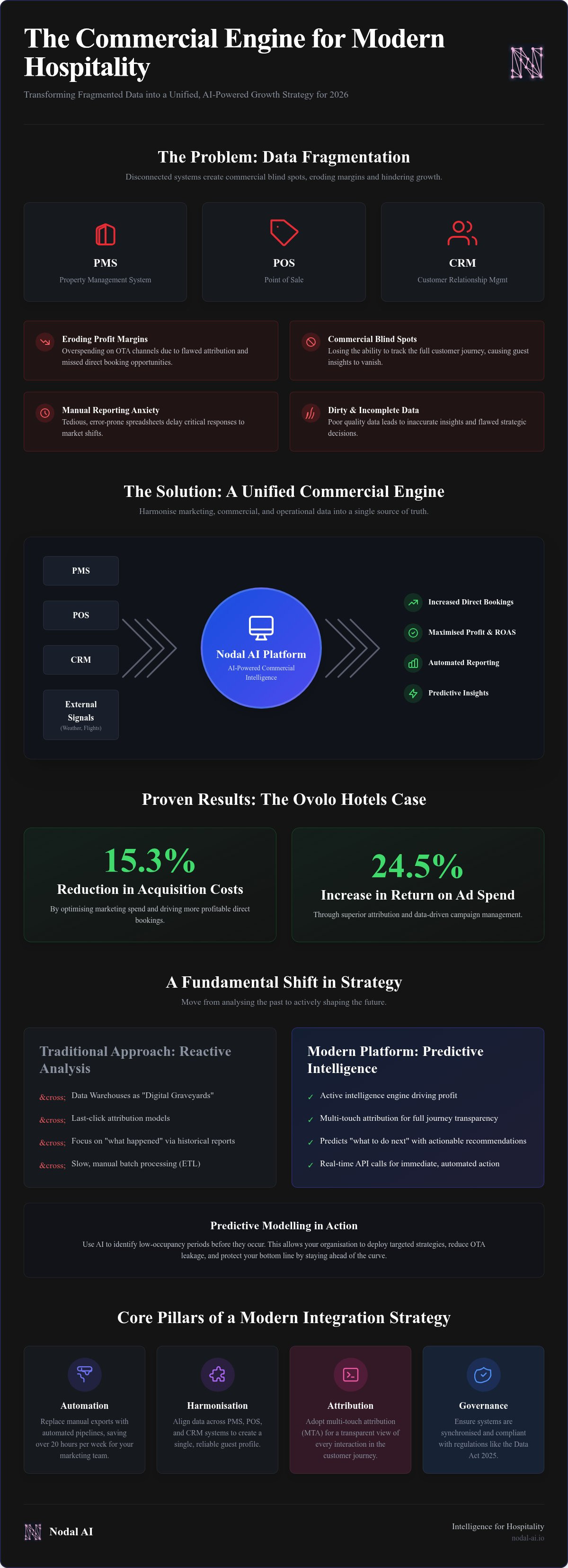
In 2026, a marketing data integration platform is far more than a digital pipe connecting two apps. It serves as a centralised commercial engine that harmonises fragmented marketing, commercial, and operational data into a single, cohesive narrative. Data integration has evolved from simple batch transfers to real-time intelligence that understands the specific context of a hospitality booking or a QSR transaction. This technology transforms chaotic, disconnected inputs into high-value growth recommendations that protect your bottom line. It represents a fundamental shift from passive data collection to active, AI-powered commercial intelligence.
The Problem of Data Fragmentation
Disconnected CRM, PMS, and booking engines create massive commercial blind spots for modern operators. When your Property Management System doesn't talk to your performance marketing tools, you lose the ability to track the full customer journey. This fragmentation is particularly damaging for hospitality and QSR brands where guest data frequently lives in isolated silos. Dirty data leads to flawed attribution, causing you to overspend on expensive OTA channels while missing prime direct booking opportunities. Manual reporting isn't just tedious; it erodes your profit margins by introducing human error and delaying critical responses to market shifts. You cannot afford to wait for a weekly spreadsheet when occupancy is dipping today.
From Data Warehousing to Intelligence Engines
Traditional data warehouses often act as digital graveyards where information goes to be stored but never used. Modern commercial intelligence requires more than just storage; it demands an active engine capable of orchestrating autonomous workflows. Modular architecture is the standard in 2026, allowing brands to plug in specific hospitality use cases without rebuilding their entire technical stack. The Nodal Platform connects these dots by personifying your passive data assets. It turns them into active participants that recommend specific actions to improve ROAS and operational efficiency.
By integrating external signals like weather patterns or flight demand, this new generation of platforms moves beyond the "what happened" to tell you "what to do next." This shift ensures your data is no longer a cost centre but a primary profit driver. Check our modular features to see how this intelligence works in practice. This approach replaces the anxiety of manual tasks with the confidence of a streamlined, high-level perspective on your entire commercial estate.
Core Features of a Modern Integration Strategy
Building a robust marketing data integration platform requires moving beyond simple connections. It involves creating a living ecosystem where information flows seamlessly between your front-end marketing and back-end operations. To achieve this, you must prioritise four pillars: automation, harmonisation, attribution, and governance. By following marketing data integration best practices, you can ensure your commercial engine remains both agile and accurate. This foundation allows you to stop reacting to historical reports and start influencing future guest behaviour.
Technical Integration Methods: API vs ETL
Choose your integration method based on the speed your business demands. Real-time API calls allow for immediate action, such as triggering a personalised welcome email the moment a guest checks in. In contrast, batch processing (ETL) is often better suited for deep, historical analysis of large datasets. Hospitality systems like Oracle OPERA or Mews present unique challenges because they house complex, non-standardised booking data. You need specialised connectors that understand these nuances to avoid data corruption. Implementing automated reporting within this framework can save your marketing team over 20 hours per week, allowing them to focus on strategy rather than manual spreadsheet management.
Effective data harmonisation ensures that a "booking" recorded in your PMS perfectly aligns with a "guest" profile in your CRM. Without this alignment, your performance marketing analytics will remain fragmented and unreliable. Move away from outdated last-click models and adopt multi-touch attribution (MTA). This approach gives you a transparent view of every interaction, from the first social media impression to the final direct booking. You can explore our modular features to see how these technical connections drive measurable profit.
Unified Customer Journey Mapping
Your data integration strategy must serve the guest experience. By connecting the dots from the initial ad click to the final on-property spend, you gain a high-level perspective on your most valuable audiences. Integrated CRM data allows you to identify high-propensity guest segments who are likely to book directly, helping you reduce expensive OTA leakage. Use these customer journey insights to optimise your spend and deliver hyper-personalised offers that resonate with individual preferences.
Finally, never overlook security. In 2026, maintaining GDPR compliance and adhering to the Data (Use and Access) Act 2025 is non-negotiable. With the ICO empowered to impose fines of up to £17.5 million, your platform must offer robust consent tracking and secure data handling. This protective layer ensures your commercial assets remain safe while you scale your growth operations with confidence.
Beyond the Plumbing: Predictive Modelling and ROI
Connecting your systems is a prerequisite, not a strategy. A modern marketing data integration platform must do more than move data; it must interpret it. While many technical solutions focus on the plumbing, true commercial value lies in the intelligence layered on top. This is the difference between seeing a drop in occupancy and predicting one three weeks in advance. You need to move from "what happened" to "what should we do" to maintain a competitive edge in 2026. This transition replaces the anxiety of manual reporting with the confidence of forward-looking strategy.
The Role of Predictive Modelling
Historical data is a mirror; predictive modelling is a lens. By analysing past booking patterns alongside current market velocity, you can transform static records into future revenue. This foresight is vital for serviced apartments and private members’ clubs where demand fluctuations are often subtle but significant. Identifying guest segments with the highest lifetime value (LTV) allows you to allocate your budget where it generates the most durable profit. Rather than chasing one-off transactions, you invest in the individuals who drive long-term stability.
This intelligence allows you to identify "need periods" long before they manifest as empty rooms or quiet tables. When the platform spots a low-occupancy trend, it delivers Growth Recommendations that advise on specific channel adjustments. You can then prioritise direct booking channels to reduce OTA leakage, ensuring you don't pay high commissions for guests you could have captured yourself. This proactive stance is exactly how Ovolo Hotels achieved a 15.3% reduction in acquisition costs and a 24.5% increase in ROAS.
External Signals: The Missing Piece of Integration
Internal data only tells half the story. To achieve total clarity, your platform must ingest external signals such as weather forecasts, FX rates, and flight demand. A sudden spike in flight searches from a specific region is a signal to ramp up targeted ad spend immediately. Conversely, poor weather might negatively impact QSR footfall, suggesting a shift in focus toward delivery platforms or app-based loyalty rewards. Local events and tourism trends are not just background noise; they are variables that dictate ad spend efficiency. Integrating these signals ensures your marketing remains tethered to the real world, turning external volatility into a competitive advantage for the entire organisation.
How to Choose and Implement Your Platform
Selecting a marketing data integration platform is a strategic pivot rather than a simple software purchase. Start by auditing your existing technical stack to identify the specific requirements of your PMS, POS, and CRM. This audit reveals the hidden gaps where guest data currently leaks and where manual errors are most likely to occur. Once you have a clear map of your systems, define your primary commercial objectives. You might focus on direct booking growth, maximising ROAS, or improving guest retention. A platform that cannot align with these specific outcomes is merely an expensive distraction; it must serve your commercial goals directly and without ambiguity.
Evaluate modularity with a forward-thinking mindset. Your organisation will evolve, and your intelligence engine must be capable of growing alongside it. Look for a solution that allows you to add specific hospitality use cases without a total system overhaul. Professional implementation and London-based expert support are non-negotiable for complex environments. This ensures your team moves quickly from technical setup to realising actual value, replacing the anxiety of manual tasks with the confidence of high-level perspectives. A successful rollout turns your data into an active participant in your business growth.
Assessing Technical Compatibility
Your chosen solution must play well with others. Check for native integrations with industry-standard guest management tools and enterprise CRMs to ensure guest data flows without friction between your marketing and operations. Verify that the platform can handle historical data ingestion, which is essential for performing accurate cohort analysis and understanding long-term guest trends. Evaluate the Nodal Platform features for scalability to ensure your cognitive upgrade remains effective as you scale your operations across multiple properties or regions.
Measuring Success and ROI
Implementation is only successful if it is measurable. Set clear benchmarks for acquisition cost reduction and ROAS improvement from day one. This allows you to aim for the 15.3% reduction in acquisition costs and 24.5% increase in ROAS achieved by Ovolo Hotels. You should track the specific contribution of direct bookings to your total revenue mix to quantify the reduction in OTA leakage. This data-driven approach turns your marketing spend into a predictable investment rather than a speculative cost. Seeing how these features translate into a concrete implementation roadmap is the final step in your selection process, providing you with a clear path toward total commercial clarity.
The Nodal AI Advantage: Intelligence for Hospitality
Nodal AI is not just another technical vendor; it is a strategic partner for the experience economy. Our marketing data integration platform is built specifically for the nuances of hospitality and QSR. We understand that a booking is not just a transaction but a guest relationship that requires nurturing through every touchpoint. By deploying a modular intelligence engine, you can activate specific commercial use cases that larger, generic platforms often ignore. This specialised focus has already delivered a 15.3% reduction in acquisition costs and a 24.5% increase in ROAS for our partners. Our London-based expertise ensures you receive strategic ai marketing analytics consultancy that transforms your organisation into a data-led powerhouse.
Case Study: Ovolo Hotels
The transformation of Ovolo Hotels serves as a definitive blueprint for data consolidation. By unifying their fragmented systems into a single source of truth, they achieved a 20% increase in paid search revenue. This was not achieved by simply spending more; in fact, a 3.6% reduction in overall spend led to a 13.8% increase in total bookings. The platform identified high-value guest segments that were previously hidden, resulting in a 5.5% increase in average booking value. These results demonstrate the power of moving from chaotic manual reporting to streamlined, automated intelligence. It replaces the anxiety of wasted budget with the confidence of measurable, high-level returns.
Tailored Solutions for Diverse Sectors
The Nodal Platform adapts to the unique demands of your specific sector. For serviced apartments and hostels, we provide demand forecasting that allows you to adjust pricing and marketing spend in real time. Upscale F&B and QSR brands benefit from measuring footfall and order mix, ensuring marketing efforts drive physical traffic and high-margin sales. Private members’ clubs and wellness centres use our intelligence to improve member retention by identifying waning engagement before it leads to cancellations.
Every feature is designed to turn your passive data assets into active participants in your commercial strategy. We remove the ambiguity of performance marketing, providing a cognitive upgrade that allows your team to focus on growth. Whether you are managing a single boutique property or a global QSR franchise, our modular architecture ensures the platform scales with your ambition. This is the future of commercial intelligence: clear, actionable, and obsessed with your profit margins.
Future-Proof Your Commercial Strategy
The transition from fragmented data silos to a unified intelligence engine is the defining commercial shift of 2026. By implementing a specialised marketing data integration platform, you replace the anxiety of manual reporting with the calm efficiency of automated, predictive insights. You have seen how a modular architecture turns passive assets into active profit drivers, allowing you to identify need periods before they occur and reclaim revenue from expensive OTA channels.
Our work with Ovolo Hotels, which resulted in a 15.3% reduction in acquisition costs, demonstrates the tangible value of this industry-specific approach. This expertise earned us Gold in the Performance Marketing Awards, reinforcing our position as a visionary leader in hospitality intelligence. You now have the roadmap to move beyond simple data plumbing and toward true commercial mastery. The opportunity to organise your operations and maximise your profit margins is within reach.
Book a demo to see how Nodal AI can transform your commercial data
Take the first step toward total clarity and watch your organisation evolve into a high-performance engine. We are ready to help you navigate this transformation with precision and confidence.
Frequently Asked Questions
What is a marketing data integration platform and how does it work?
A marketing data integration platform is a centralised engine that harmonises fragmented data sources into a single, cohesive narrative. It works by connecting to your CRM, PMS, and web analytics to create a single source of truth for your commercial team. By automating data pipelines, it removes the need for manual exports and provides real-time visibility into your performance. This allows you to make decisions based on high-value intelligence rather than fragmented guesses.
Why is data integration critical for hospitality and hotel brands?
Hospitality brands face unique challenges because guest data is often trapped in disconnected silos like property management systems and restaurant POS terminals. Integration is essential to understand the true lifetime value of a guest and to track on-property spend across different locations. Without it, you cannot accurately measure the ROI of your marketing campaigns or identify the specific audiences that drive direct bookings, leading to profit margin erosion.
Can Nodal AI integrate with my existing PMS and POS systems?
Yes, the Nodal Platform is built with a modular architecture specifically designed to connect with hospitality-standard systems such as Oracle OPERA, Mews, and various POS solutions. We use specialised connectors to ensure data harmonisation across these complex datasets. This technical compatibility allows your existing tools to become active participants in your commercial strategy, providing the cognitive upgrade your organisation needs to scale efficiently and securely in 2026.
How does predictive modelling help in reducing marketing waste?
Predictive modelling identifies future demand patterns by analysing historical booking data and external signals like flight demand or weather. By forecasting "need periods" in advance, you can adjust your ad spend to target specific occupancy gaps rather than running generic campaigns. This proactive approach ensures your budget is only deployed when and where it is most likely to generate a return, significantly reducing acquisition costs and protecting your margins.
What is the difference between multi-touch attribution and last-click models?
Last-click models give all the credit for a booking to the final interaction, which ignores the complex reality of the guest journey. In contrast, multi-touch attribution assigns value to every touchpoint, from the first social media impression to the final direct click. This provides a transparent view of which channels are actually driving awareness and conversion, allowing you to optimise your marketing mix with total confidence in your attribution data.
How long does it take to implement a marketing data integration platform?
Implementation timelines vary based on the complexity of your technical stack, but most organisations see initial value within weeks rather than months. Our expert team manages the technical onboarding to ensure a frictionless transition from fragmented systems to an integrated intelligence engine. We prioritise the most critical data sources first, such as your PMS and CRM, to deliver automated reporting and immediate commercial clarity while the full system scales.
Will this platform help us reduce our reliance on OTAs like Booking.com?
Reducing OTA leakage is a primary objective of our platform. By unifying your guest data, you can identify high-propensity audiences and target them with personalised direct booking offers. This strategy shifts the balance of power away from third-party intermediaries and back to your brand. With better attribution and predictive insights, you can invest more effectively in your own channels to protect your profit margins and own the guest relationship entirely.
Is Nodal AI compliant with GDPR and other data privacy regulations?
Security and governance are core pillars of our service. Nodal AI is fully compliant with the UK GDPR and the Data (Use and Access) Act 2025, which came into force on 5 February 2026. We provide robust consent tracking and secure data handling to protect your commercial assets. Our platform ensures your marketing remains compliant across multiple jurisdictions, giving you the peace of mind to scale your growth operations without legal ambiguity.


