

The debate surrounding marketing mix modelling vs multi touch attribution is often framed as a choice between two rivals, but this is a false dichotomy that might be costing your organisation direct bookings. You likely spend over 20 hours every week manually reconciling fragmented data between booking engines like Synxis and your marketing tools. It's a significant drain on productivity. High OTA leakage continues to erode your profit margins and obscure your true commercial performance.
This guide promises to help you master these complexities to unify your commercial data and drive profitable growth, helping you make more and waste less. You'll learn how to synchronise these methodologies within a modular intelligence engine to turn chaotic inputs into high-value outputs. We will explore how to automate complex reporting tasks and use AI-driven growth recommendations to increase your ROAS. By the end, you'll understand how to replace the anxiety of fragmented metrics with a streamlined, unified view of your entire commercial performance.
Key Takeaways
- Understand why the debate of marketing mix modeling vs multi touch attribution is evolving into a unified approach that synchronises tactical precision with strategic clarity.
- Learn how to deploy multi-touch attribution as a tactical tool to map individual guest journeys and identify high-propensity segments for immediate optimisation.
- Discover the power of marketing mix modelling to provide a resilient, macro-level view of performance that remains accurate despite privacy changes and identifier loss.
- Identify the steps to bridge the gap between operational data and marketing spend by connecting your PMS and CRM into a single modular intelligence engine.
- Master the ability to automate complex reporting and use AI-driven growth recommendations to reduce OTA leakage while significantly increasing your ROAS.
The State of Performance Measurement: Why Traditional Models are Evolving
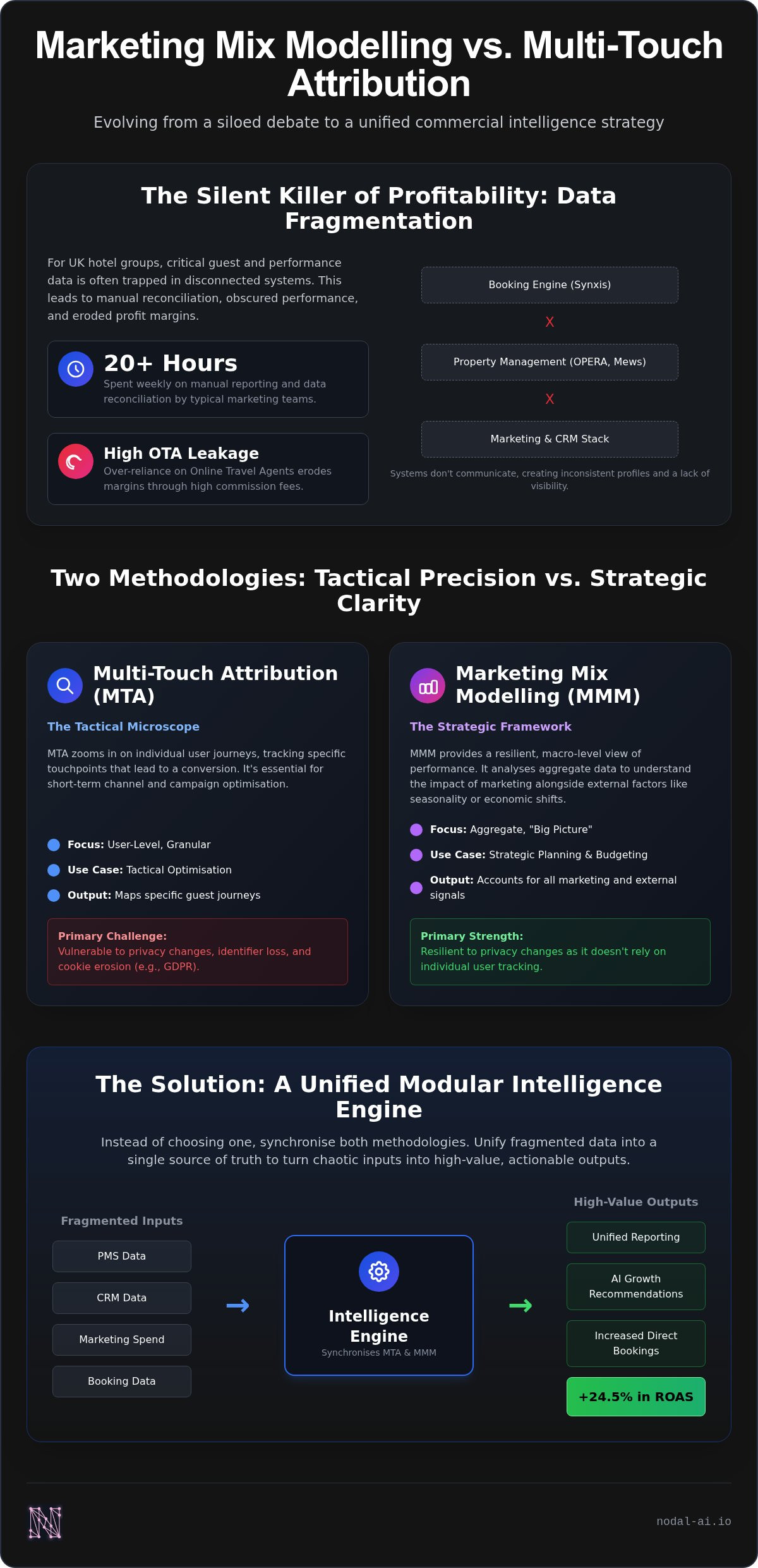
The way we measure marketing performance has shifted from a luxury to a survival mechanism. In the hospitality sector, the debate regarding marketing mix modeling vs multi touch attribution often treats these tools as competing ideologies. This is a mistake. Multi-touch attribution (MTA) remains a vital tactical tool for mapping individual user journeys. It tells you exactly which ad a guest clicked before booking. Conversely, Marketing Mix Modeling (MMM) serves as a strategic framework for aggregate analysis. It looks at the big picture, accounting for external signals like seasonality or economic shifts.
Privacy regulations have fundamentally altered this landscape. With the erosion of third-party cookies and stricter GDPR compliance, relying solely on user-level tracking is no longer viable. This shift has forced a move toward robust first-party data strategies. Successful brands have abandoned siloed reporting in favour of a unified view that respects privacy while maintaining commercial clarity.
The Fragmentation Problem in UK Hospitality
Data fragmentation is the silent killer of profitability for UK hotel groups. Critical guest information often remains trapped within systems like Oracle OPERA or Mews. When these systems don't talk to your marketing stack, you lose visibility. For London marketing teams, this disconnect results in over 20 hours of manual reporting every week. This disconnect manifests in several ways:
- Manual data exports that are out of date by the time they are reviewed.
- Inconsistent guest profiles across different booking platforms.
- A lack of visibility into the true cost of acquisition per channel.
Without a clear view, brands often over-rely on OTA data. This dependency erodes margins through high commission fees and creates a feedback loop where you're paying to acquire guests you should already own.
Moving Toward Commercial Intelligence
The solution lies in moving beyond basic spreadsheets toward a modular intelligence engine. This modern standard connects your PMS, POS, and CRM data into a single source of truth. By unifying marketing and operational data, you can finally see the true impact of every pound spent, helping your brand make more and waste less. This transition from fragmented reporting to commercial intelligence is essential for driving direct bookings and protecting your bottom line. For those looking to deepen their understanding of these frameworks, our Mastering Marketing Attribution guide provides the foundational context needed to navigate this transition effectively. Mastering the balance of marketing mix modeling vs multi touch attribution is the first step toward that clarity.
Multi-Touch Attribution (MTA): Precision Tracking for Tactical Optimisation
MTA acts as a tactical microscope for your digital ecosystem. It allows you to zoom in on individual interactions to understand which specific digital levers drive a conversion. While the choice of marketing mix modeling vs multi touch attribution often depends on your specific commercial goals, MTA is indispensable for short-term channel optimisation. By identifying high-propensity guest segments, you can allocate spend toward users most likely to book directly rather than through an expensive third-party distributor.
Integrating data from your enterprise CRM systems with your marketing stack transforms passive leads into active participants in your growth strategy. This level of granularity enables marketers to make micro-adjustments that significantly improve campaign efficiency. For instance, brands using integrated performance analytics often realise a 24.5% increase in ROAS by identifying and doubling down on the specific touchpoints that lead to high-value bookings. It is the most effective way to make more and waste less while maintaining a competitive edge in a crowded market.
Most generic attribution tools fail because they ignore the operational heart of a hotel: the Property Management System (PMS). True precision requires connecting marketing touchpoints directly to booking data within Oracle OPERA or Mews. This bridge ensures you aren't just tracking digital noise but actual revenue-generating stays. It replaces the anxiety of manual data reconciliation with the confidence of a single, verified performance view. Balancing marketing mix modeling vs multi touch attribution at this level is what separates market leaders from those struggling with fragmented data silos.
Mapping the Guest Journey in 2026
Modern booking paths are rarely linear. A guest might see an Instagram ad on their phone, research on a laptop, and finally book via a retargeting email. AI-powered MTA identifies this complex path to a direct booking by assigning value to early brand awareness touchpoints that traditional last-click models completely ignore. Cross-device tracking is essential here, as hospitality bookings often involve longer consideration phases and multiple devices across the guest lifecycle.
The Limitations of Standalone MTA
MTA is not without its challenges. Cookie depreciation and privacy-first browsing have made user-level tracking less reliable than in previous years. MTA also struggles to account for offline signals, such as word-of-mouth or local events, which can heavily influence hotel occupancy. It ignores macro-economic trends like FX rate fluctuations or flight demand. To understand how to navigate these complexities, explore our Customer Journey guide for deeper mapping insights.
If you want to see how these insights look in a live environment, you can explore our modular platform features to see how we unify these disparate data sources.
Marketing Mix Modelling (MMM): Strategic Clarity and External Signals
Marketing Mix Modelling (MMM) operates as a strategic telescope, providing a macro-perspective that individual tracking often misses. By analysing historical and aggregate data, MMM reveals the true drivers of revenue across all channels, including offline sources. The primary advantage in the current climate is its resilience. Because it doesn't rely on cookies or individual user IDs, it remains unaffected by the ongoing erosion of digital identifiers. When comparing marketing mix modeling vs multi touch attribution, MMM stands out as the essential tool for long-term budget efficiency and strategic planning.
For hospitality leaders, the real power lies in modelling 'need periods'. These are the specific windows where occupancy naturally sags. MMM allows you to identify these gaps months in advance, enabling you to deploy marketing capital where it will have the highest marginal impact. It ensures you aren't just spending money when you're already full, but rather driving demand when your rooms are empty. This approach is fundamental to the goal of helping brands make more and waste less.
Integrating External Signals for Hospitality Success
Traditional analytics often ignore the world outside your booking engine. A modular intelligence engine integrates external signals like flight demand and local events to explain sudden spikes or dips in performance. For international guest acquisition, tracking FX rates is critical; a weak pound can drive a surge in US or European bookings that has nothing to do with your latest ad campaign. Similarly, weather patterns significantly influence F&B footfall for QSR brands. Integrating these variables allows you to separate marketing performance from environmental luck and refine your commercial strategy accordingly.
Proactive Growth Recommendations via MMM
We are seeing a fundamental shift from reactive reporting to predictive modelling. Instead of asking what happened last month, you should be asking what will happen next quarter. AI-driven models identify where spend is being wasted in the marketing mix, allowing you to reallocate funds toward higher-performing channels. This proactive approach helps you anticipate market shifts before they occur. To understand the technology behind these forecasts, our Predictive Modelling pillar offers deep technical insights into transforming fragmented data into future growth.
Marketing Mix Modelling vs Multi-Touch Attribution: The 2026 Comparison
Comparing marketing mix modeling vs multi touch attribution requires understanding their distinct roles in your commercial stack. MTA relies on granular user-level logs to track every digital footprint. It offers real-time speed for immediate adjustments. Conversely, MMM uses aggregate history to provide long-term accuracy. It doesn't care about individual clicks; it cares about the total impact of your marketing investment across the entire business cycle.
The data requirements for these methodologies differ significantly. MTA needs a constant stream of event-level data, which is increasingly difficult to maintain in a privacy-first world. MMM is more robust, requiring only broad sales and spend figures. However, the most successful hospitality brands have moved beyond this binary choice. They use a hybrid approach to achieve total clarity. This modular intelligence engine synchronises tactical precision with strategic foresight, transforming passive data into active growth and providing a cognitive upgrade for your entire organisation.
When to Prioritise MTA Over MMM
Use MTA when you need to act fast. It is the perfect tool for day-to-day campaign adjustments and refined keyword bidding. If you are testing new creative assets or launching a fresh social media channel, MTA tells you what is working within hours. Use it to identify and reward the specific channels driving your direct bookings in the immediate term. It helps you optimise your digital spend with surgical precision, ensuring you don't waste capital on low-performing segments.
When to Lead with MMM
Lead with MMM for your big-picture decisions. It is essential for annual budget planning and seasonal allocation across your portfolio. When you need to measure the impact of offline media, such as a local billboard campaign or a major brand initiative, MMM provides the necessary context. It is also the only reliable way to understand how external economic factors, like shifting FX rates or travel trends, are influencing your total revenue. It turns global complexity into local opportunity.
Book a demo to see our unified measurement platform in action
The Nodal Platform: Unifying Fragmented Data into Commercial Intelligence
The Nodal Platform serves as the central nervous system for hospitality brands seeking to resolve the data chaos mentioned throughout this guide. By establishing a direct connection between your PMS and your marketing stack, Nodal AI allows you to move beyond the narrow debate of marketing mix modeling vs multi touch attribution. This integration ensures that every commercial decision is backed by a unified view of performance. It transforms your disparate data points into high-value outputs, providing the clarity required to drive profitable growth.
The results of this unified perspective are significant. Beyond the reduction in acquisition costs already discussed, Nodal AI has helped brands like Ovolo Hotels achieve a 24.5% increase in ROAS through smarter budget allocation. By synchronising operational reality with marketing spend, the Nodal Platform replaces manual guesswork with predictive clarity. This shift replaces the anxiety of fragmented reporting with the confidence of a streamlined, high-level perspective. If you are ready to see how your own data can work harder, you should book a demo to unify your performance metrics today.
Modular Architecture for Specific Hospitality Needs
Every hospitality group has a unique footprint, whether you are managing boutique hotels, global hostels, or QSR brands. The Nodal Platform configures specific modules to meet these diverse operational requirements, ensuring a single view of the full guest lifecycle. Our London-based data scientists provide the strategic support needed to navigate technical complexities, ensuring your modular intelligence engine remains perfectly tuned to your commercial goals. This is more than a tool; it is a cognitive upgrade for your entire organisation.
Make More, Waste Less: The Path to Direct Booking Growth
Efficiency is the primary driver of modern profitability. The Nodal Platform automates complex reporting tasks, saving marketing teams over 20 hours per week. This time is better spent on high-level strategy rather than manual data reconciliation. By providing a clear picture of marketing mix modeling vs multi touch attribution in one dashboard, Nodal AI helps you identify and plug OTA leakage. This allows you to reclaim guest relationships and scale your direct revenue. Transform your fragmented data into a competitive advantage and start making more while wasting less today.
Mastering the Future of Commercial Intelligence
Mastering the balance of marketing mix modeling vs multi touch attribution is no longer a theoretical exercise; it is a commercial necessity. By integrating tactical precision with strategic foresight, you can finally eliminate the data silos that protect OTA dominance and erode your margins. Brands that embrace this unified approach have seen transformative results, including a 24.5% increase in ROAS and a 15.3% reduction in acquisition costs. This represents the critical transition from reactive reporting to proactive commercial intelligence.
You don't have to choose between granular tracking and long-term clarity. Our modular intelligence platform turns your fragmented systems into a single, high-value output. It's time to replace the burden of manual reporting with the confidence of automated growth recommendations. By unifying your PMS, POS, and marketing data, you create a cognitive upgrade for your entire organisation that ensures you stay competitive in an evolving landscape.
Book a personalised demo with Nodal AI today
Frequently Asked Questions
What is the difference between multi-touch attribution and marketing mix modelling?
Multi-touch attribution is a tactical tool that tracks individual guest interactions to optimise specific digital campaigns. Conversely, marketing mix modelling uses aggregate data to evaluate the total impact of your marketing investment. Think of attribution as a microscope for digital touchpoints and modelling as a telescope for long-term strategic trends. This distinction is vital when deciding between marketing mix modeling vs multi touch attribution for your hotel portfolio.
How do modern MTA tools handle the loss of third-party cookies in 2026?
Modern tools bypass cookie reliance by prioritising first-party data and server-side tracking. By connecting directly to your PMS and CRM, you capture verified guest interactions without needing invasive third-party identifiers. This transition ensures your performance measurement remains robust despite evolving privacy regulations. It replaces the anxiety of data loss with a secure, future-proof methodology that respects guest privacy while maintaining total commercial visibility across all channels.
Can the Nodal Platform integrate directly with Oracle OPERA or Mews?
Yes, the Nodal Platform features a modular architecture that connects directly with Oracle OPERA, Mews, and other leading PMS providers. This integration bridges the gap between your operational data and marketing spend. By unifying these disparate sources, you eliminate manual reporting tasks and gain a single view of performance. It transforms your PMS from a passive database into an active driver of commercial intelligence and direct booking growth.
Is marketing mix modelling better for long-term strategic planning?
Marketing mix modelling is the superior choice for long-term planning because it accounts for macro-economic signals and seasonal trends. It evaluates the impact of offline media and external factors like FX rates or flight demand. While attribution handles the daily specifics, modelling provides the strategic clarity needed for annual budget cycles. It allows you to model future performance and identify the optimal channel mix to remain profitable.
How does multi-touch attribution help in reducing acquisition costs?
Multi-touch attribution reduces acquisition costs by identifying the specific touchpoints that drive high-propensity guests to book directly. By understanding the exact path to a conversion, you can reallocate budget away from low-performing keywords and social channels. This granular optimisation ensures every pound spent is working toward a direct booking. It helps you make more and waste less by surgically removing waste from your tactical marketing execution.
What are external signals and why should they be included in my model?
External signals are non-marketing variables that influence your revenue, such as local events, weather patterns, and flight demand. Including these in your model is essential to separate marketing success from environmental luck. For example, a spike in bookings might be driven by a weak pound rather than a specific ad campaign. Accounting for these signals ensures your performance analysis is accurate and your growth recommendations are grounded in reality.
How long does it take to implement a unified measurement platform?
Implementation timelines vary based on the complexity of your data stack, but our modular engine is designed for rapid deployment. By using pre-built connectors for systems like Mews and GA4, we streamline the integration process. Most hospitality brands begin seeing actionable insights within weeks rather than months. Our London-based team manages the technical heavy lifting, replacing the anxiety of complex setups with a structured journey toward total clarity.
Do I need both MTA and MMM to measure marketing ROI accurately?
Using both methodologies is the only way to achieve total clarity in the current landscape. This hybrid approach, often called Unified Measurement, combines the tactical precision of attribution with the strategic depth of modelling. It ensures you aren't ignoring offline signals or macro trends while still maintaining the ability to optimise daily campaigns. Synchronising marketing mix modeling vs multi touch attribution allows you to drive profitable growth across the entire lifecycle.


