

While major Online Travel Agencies (OTAs) claim up to 30% of your revenue in commission fees, the real cost to your hotel is the invisible data lost every time a guest books through a third party. Automated customer journey mapping turns this fragmented loss into a strategic advantage by unifying every touchpoint into a single, actionable view. It is no longer enough to simply react to guest behaviour; you must anticipate it to remain competitive in a landscape increasingly defined by real-time precision.
You likely feel the daily pressure of managing disparate systems like Oracle OPERA and Synxis, only to find your manual reports are outdated before they even reach your desk. This complexity creates a sense of overwhelm that stalls growth. We promise to show you how to turn siloed guest data into a real-time revenue engine using AI-driven journey automation. By the end of this guide, you will understand how to achieve a single view of the guest lifecycle, reduce acquisition costs, and secure predictable growth. We will examine the shift from static mapping to live orchestration and highlight how leaders like Ovolo Hotels achieved a 15.3% reduction in acquisition costs by reclaiming their data and optimising their digital guest journey.
Key Takeaways
- Replace static, historical maps with real-time synchronisation to capture the full complexity of modern multi-channel guest behaviour.
- Unify fragmented data from disconnected systems like Oracle OPERA, Mews, and Synxis to create a single, comprehensive view of every guest interaction.
- Transition to automated customer journey mapping to eliminate manual reporting and replace anecdotal evidence with precise, data-driven insights.
- Implement a structured five-step framework to audit existing data silos and align your automation strategy with specific commercial growth targets.
- Leverage the Nodal Platform to transform chaotic inputs into high-value outputs, following the success of Ovolo Hotels in reducing acquisition costs by 15.3%.
What is Automated Customer Journey Mapping in 2026?
In 2026, a customer journey map is no longer a static diagram pinned to a boardroom wall. Automated customer journey mapping represents the real-time synchronisation of every guest touchpoint into a living, breathing data engine. Traditional, manual customer journey mapping has become a historical artefact. These old methods fail to capture the chaotic, multi-channel behaviour of modern travellers who switch between apps, search engines, and direct sites in seconds. AI acts as the central nervous system in this new paradigm. It sifts through mountains of raw data to identify actionable patterns that human analysts would inevitably miss. This process elevates mapping from a creative exercise to a source of pure commercial intelligence: a cognitive upgrade for your entire organisation that trades ambiguity for mathematical certainty.
The Shift from Visualisation to Execution
Modern mapping is a matter of data processing, not just drawing boxes on a screen. While manual workshops produce snapshots that become outdated within weeks, automated maps update in real-time as a guest interacts with your brand. This evolution ensures your marketing remains relevant. By leveraging advanced platform features, you move from passive observation to active execution. You stop wondering where guests go and start directing where they should go next. This shift replaces the anxiety of manual, tedious tasks with the confidence of a streamlined, high-level perspective.
Core Technologies: Machine Learning and Predictive Analytics
Machine learning provides the engine for this transformation. Natural language processing (NLP) interprets the nuances of guest feedback across reviews and social media to gauge sentiment instantly. Simultaneously, predictive modelling forecasts future guest actions by analysing historical trends. Predictive analytics serves as a precision tool for identifying high-propensity guest segments before they even book. These technologies work in the background to simplify complex inputs, allowing you to focus on high-value outputs. By automating the identification of these segments, you realise a more efficient path to predictable revenue growth without needing deep technical specialisation.
Connecting the Dots: How AI Unifies Fragmented Hospitality Data
The hospitality industry suffers from a chronic fragmentation problem. Guest data remains trapped in isolated silos; Property Management Systems (PMS), Point of Sale (POS) terminals, and Customer Relationship Management (CRM) platforms operate as independent islands. This lack of communication makes it impossible to track the full lifecycle of a guest. Automated customer journey mapping solves this by creating a unified data layer. Through a modular architecture, you can seamlessly connect disparate sources like Oracle OPERA, Mews, or Synxis. This transformation allows you to see the guest as a single entity rather than a series of disconnected transactions.
Beyond internal data, the Nodal Platform integrates external signals to provide a 360-degree view. By factoring in local events, weather patterns, and the latest 2026 flight demand integration capabilities, you gain a deeper understanding of why guests book. This contextual intelligence is vital for reducing OTA leakage. When you understand the specific direct booking path, you can bypass the 15% to 30% commission rates typically charged by major Online Travel Agencies. There are significant Benefits of Combining Customer Journey Mapping With AI, particularly in how it replaces guesswork with precise operational data.
Bridging the Gap Between Marketing and Operations
True growth occurs when marketing spend connects directly to operational revenue. In traditional setups, a Google Ads campaign exists in a vacuum. With automated mapping, you can trace a click on an ad directly to a room booking in your PMS and subsequent spend in the hotel bar or spa. This visibility allows you to calculate the total guest value with absolute clarity. Nodal AI acts as the modular intelligence engine that bridges these disparate sources, turning chaotic inputs into high-value outputs. If you want to see this in action, you can book a demo to explore your own data potential.
AI-Driven Audience Segmentation
AI does more than just organise data; it identifies high-value guest segments based on historical stay patterns and behavioural nuances. By analysing which guests drive the highest long-term value, the system can automatically target high-propensity lookalikes in your marketing campaigns. This precision reduces wasted spend and improves Return on Ad Spend (ROAS). You can explore these capabilities further on the Nodal Platform. This approach helped Ovolo Hotels achieve a 15.3% reduction in acquisition costs, proving that integrated intelligence is the most effective lever for hospitality growth.
Automated vs. Manual Journey Mapping: A Commercial Comparison
Manual workshops often rely on the loudest voice in the room rather than the reality of the guest's digital footprint. While these sessions consume dozens of billable hours, the resulting maps are static and speculative. In contrast, automated customer journey mapping transforms passive data into an active commercial asset. It replaces anecdotal evidence from staff with a continuous, high-fidelity stream of truth. This shift allows you to move beyond the guesswork of what we think happened to a precise understanding of what is happening now. By mapping journeys to multi-touch attribution, businesses have realised a 24.5% increase in ROAS, as they finally see the commercial value of every interaction across the guest lifecycle.
The Real Cost of Inaccurate Mapping
Inaccurate mapping is more than a strategic flaw; it is a financial drain. Manual maps frequently succumb to the last-click fallacy, where the final booking source receives 100% of the credit. This leads to wasted ad spend on low-converting channels while starving the early touchpoints that actually drive demand. Automated systems solve this by identifying every influence along the path to purchase. For a deeper analysis of these mechanics, consult our guide on Mastering Marketing Attribution. This level of clarity ensures your budget is deployed where it generates the highest return, rather than where it is easiest to measure.
Efficiency Gains for Marketing Teams
Efficiency is the byproduct of removing manual friction. Your marketing team likely spends hundreds of hours every year consolidating data from disparate spreadsheets. Automated customer journey mapping reclaims this time, allowing your experts to focus on strategy and growth recommendations rather than administrative labour. By replacing manual reporting with automated data streams, organisations have seen a 3.6% reduction in overall spend while simultaneously increasing total bookings. This transition creates a sense of momentum. It replaces the anxiety of outdated reports with the confidence of real-time insights, mirroring the success seen at Ovolo Hotels where acquisition costs were slashed through better data visibility and streamlined processes.
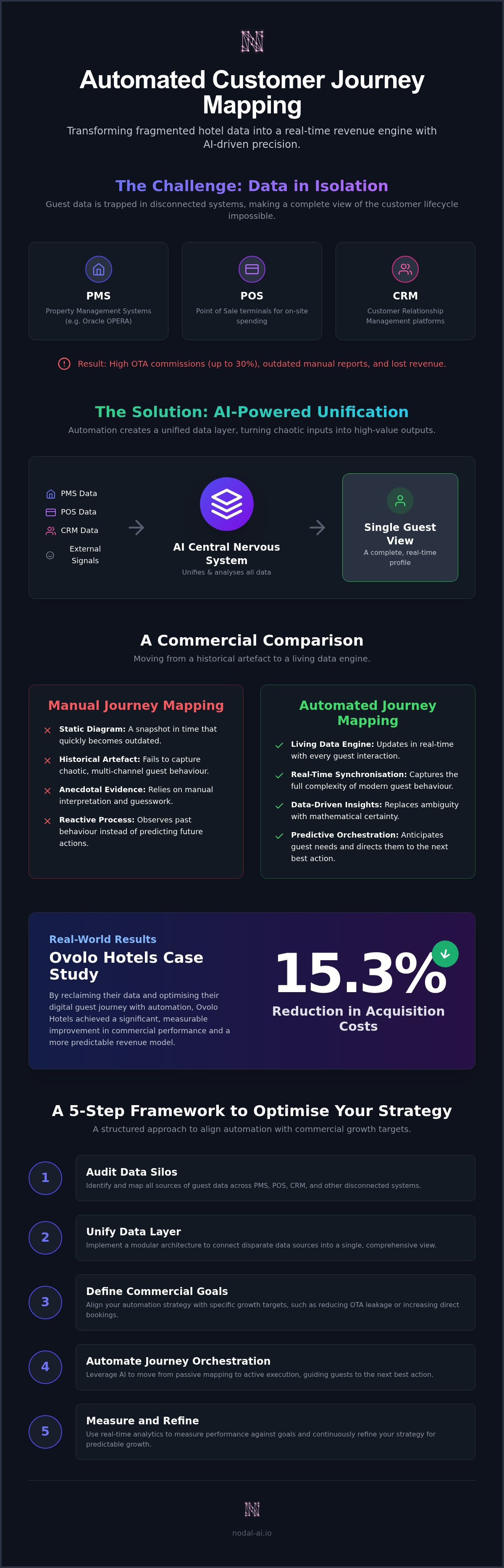
A 5-Step Framework to Optimise Your Automated Journey Strategy
Execution is the primary differentiator between brands that merely collect data and those that convert it into growth. Moving from fragmented silos to a unified engine requires a structured, logical approach. Automated customer journey mapping provides the framework to scale your operations from a single property to a global brand. By following these five steps, you can replace manual friction with a streamlined path to predictable revenue.
- Step 1: Audit your current data silos. Uncover where guest information is hidden, specifically within your PMS, POS, and booking engines. This audit identifies the gaps that cause OTA leakage.
- Step 2: Define your commercial goals. Align your strategy with specific outcomes, such as increasing direct bookings by 10% or improving member retention for your wellness facilities.
- Step 3: Implement a modular intelligence engine. Use a platform to ingest and clean fragmented data. This ensures your insights are based on high-fidelity truth rather than chaotic inputs.
- Step 4: Use AI to identify "need periods." Leverage predictive modelling to pinpoint upcoming low-occupancy dates and target high-propensity guest segments who are most likely to book.
- Step 5: Continuously iterate. Use growth recommendations to refine your touchpoints in real-time. This creates a cycle of frictionless progress and measurable returns.
Identifying High-Value Touchpoints
Determining which channels drive the most valuable direct bookings is essential for budget optimisation. You must look beyond the initial click to track the entire visitor lifecycle value, especially for attractions and experiences where repeat visits are vital. By understanding these patterns, you can allocate spend to the touchpoints that offer the highest long-term stability. For a deeper dive into these techniques, consult The Definitive Guide to the Customer Journey for specific mapping templates tailored to hospitality.
Predicting and Preventing Churn
Automated mapping serves as an early warning system for membership models. For private members clubs and wellness spas, the platform identifies subtle shifts in behaviour that signal a guest is likely to churn. AI can then trigger personalised offers during a specific "need period" to re-engage the individual before they leave. This proactive approach transforms passive assets into active participants in your retention strategy. It replaces the anxiety of losing profitable segments with the confidence of automated, protective measures.
Book a demo to start your data audit
Driving Direct Bookings with Nodal AI Platform
The Nodal Platform acts as the definitive partner for hospitality brands seeking to reclaim their guest relationships. By transforming chaotic, fragmented inputs into high-value commercial outputs, we provide the clarity required to navigate an increasingly complex digital landscape. Automated customer journey mapping is the core engine of this transformation. It allows you to identify exactly where your marketing spend is working and where it is being swallowed by inefficient, low-margin channels. This level of forensic insight solves the persistent problem of profit margin erosion; it replaces the anxiety of rising OTA commissions with the confidence of a direct, data-driven strategy. Our brand promise is simple: make more, waste less. We invite you to move beyond the limitations of manual reporting and embrace a cognitive upgrade for your entire organisation.
Modular Intelligence for Every Hospitality Use Case
The Nodal Platform features a modular architecture designed to scale alongside your business. Whether you manage a single boutique hotel, a high-volume hostel, or a global Quick Service Restaurant (QSR) chain, our tailored modules adapt to your specific operational nuances. We integrate seamlessly with legacy systems like Oracle OPERA and modern platforms like Mews to provide growth recommendations that are both relevant and actionable. This flexibility ensures that as your brand expands from a single property to a global luxury brand, your intelligence engine grows in sophistication. This streamlined approach allows you to maintain high-level perspectives without needing deep technical specialisation. You can Book a Demo today to see how our platform can be customised for your unique portfolio.
Real-World Success: The Ovolo Hotels Case Study
The impact of our technology is best illustrated through the concrete results achieved by Ovolo Hotels. By moving away from fragmented data silos and adopting our integrated approach, they realised a 15.3% reduction in acquisition costs. This was not merely a result of better visualisation; it was driven by aggressive data consolidation and precise growth recommendations. The project delivered a 13.8% increase in total bookings and a 20% increase in paid search revenue. These figures represent a significant shift in commercial performance, enabling the group to reduce OTA leakage significantly while improving their overall Return on Ad Spend (ROAS). By using automated customer journey mapping, Ovolo Hotels transformed their marketing from a passive cost centre into an active, predictable revenue engine that continues to drive long-term stability.
Reclaim Your Revenue Engine with Real-Time Intelligence
Transitioning from fragmented silos to a unified intelligence layer is the definitive path to hospitality growth. By implementing automated customer journey mapping, you replace the anxiety of manual reporting with the confidence of mathematical certainty. This cognitive upgrade allows you to track the full guest lifecycle across every interaction, identifying high-value touchpoints that traditional, static methods simply cannot see. You move from a state of reactive confusion to one of proactive, strategic command over your revenue streams.
Global luxury hospitality brands are already using these integrated insights to secure their financial future. These industry leaders have realised a 15.3% reduction in acquisition costs and a 24.5% increase in ROAS by transforming chaotic inputs into high-value commercial outputs. Reclaiming your data is no longer a technical choice; it is a competitive necessity for maintaining long-term stability and reducing reliance on high-commission channels.
Book a demo of the Nodal AI Platform
Take the first step toward a more efficient, profitable operation today and watch your direct bookings thrive under the power of real-time intelligence.
Frequently Asked Questions
What is the difference between customer journey mapping and automated mapping?
Traditional mapping is a static, manual visualisation of hypothetical guest paths, whereas automated customer journey mapping is a dynamic, data-driven process that synchronises real-time touchpoints. While manual maps become outdated instantly, automated versions update continuously as guests interact with your brand. This transition replaces guesswork with mathematical certainty; it allows operators to see actual behaviour rather than relying on staff anecdotes or outdated workshops that fail to capture multi-channel complexity.
How does AI help in mapping the customer journey for hotels?
AI acts as a central nervous system that sifts through massive volumes of siloed data to identify actionable patterns in guest behaviour. It unifies information from your PMS and CRM to create a single view of the guest lifecycle. By automating the identification of high-propensity segments, AI allows hotels to deliver hyper-personalised offers at scale. This intelligent orchestration ensures that every marketing pound is spent targeting the individuals most likely to convert into profitable stays.
Can automated journey mapping integrate with legacy systems like Oracle OPERA?
Modern platforms are specifically designed to bridge the gap between legacy infrastructure and future-facing analytics. The Nodal Platform integrates directly with established systems like Oracle OPERA, Mews, and Synxis to ingest and clean fragmented data. This modular connectivity ensures that technical debt does not hinder your growth. By unifying these disparate sources, you transform passive assets into active participants in your commercial strategy without requiring a total system overhaul or deep technical specialisation.
How does automated mapping improve Return on Ad Spend (ROAS)?
Automated mapping improves ROAS by replacing the last-click fallacy with precise multi-touch attribution. It reveals exactly which channels influence a booking, allowing you to reallocate budget from low-performing ads to high-value touchpoints. By understanding the full path to purchase, you eliminate wasted spend on channels that don't drive real revenue. This clarity ensures your marketing budget is deployed with surgical precision; it replaces the anxiety of inefficient spend with the confidence of measurable returns.
What are the benefits of using a modular architecture for data analytics?
A modular architecture provides the flexibility to scale your data strategy from a single property to a global brand. It allows you to connect specific data sources as needed, ensuring the platform evolves alongside your operational requirements. This approach removes the complexity of rigid, all-in-one systems that often fail to meet niche hospitality needs. It offers long-term stability by allowing you to swap or add integrations without disrupting your entire intelligence engine or causing productivity loss.
How long does it take to implement an automated journey mapping tool?
While timelines vary based on the complexity of your data ecosystem, initial integration typically takes a few weeks rather than months. The process begins with a data audit to identify silos, followed by the connection of key systems like your PMS and booking engine. Because the platform is built for modularity, you can start seeing preliminary insights quickly. This phased approach ensures a smooth transition without overwhelming your internal teams or disrupting the daily operations of your hotel.
Does automated journey mapping help in reducing OTA commissions?
Yes, automated customer journey mapping is a primary tool for reducing OTA leakage by strengthening the direct booking path. By understanding exactly when and why a guest chooses a third-party site, you can intervene with personalised, direct-only incentives. This strategy helps reclaim the commission fees typically lost to third parties, which often range from 15% to 30%. Reclaiming this direct relationship ensures that you own both the guest data and the resulting profit margins.
What external data signals can be integrated into a hospitality journey map?
The platform integrates a variety of external signals to provide a 360-degree view of the guest journey. These include local event schedules, weather patterns, and real-time flight demand data. By factoring in these environmental variables, you can predict "need periods" and adjust your marketing strategy accordingly. This contextual intelligence allows you to anticipate shifts in demand and tailor your offers to the specific motivations driving travel intent, ensuring your brand remains relevant at every touchpoint.


