

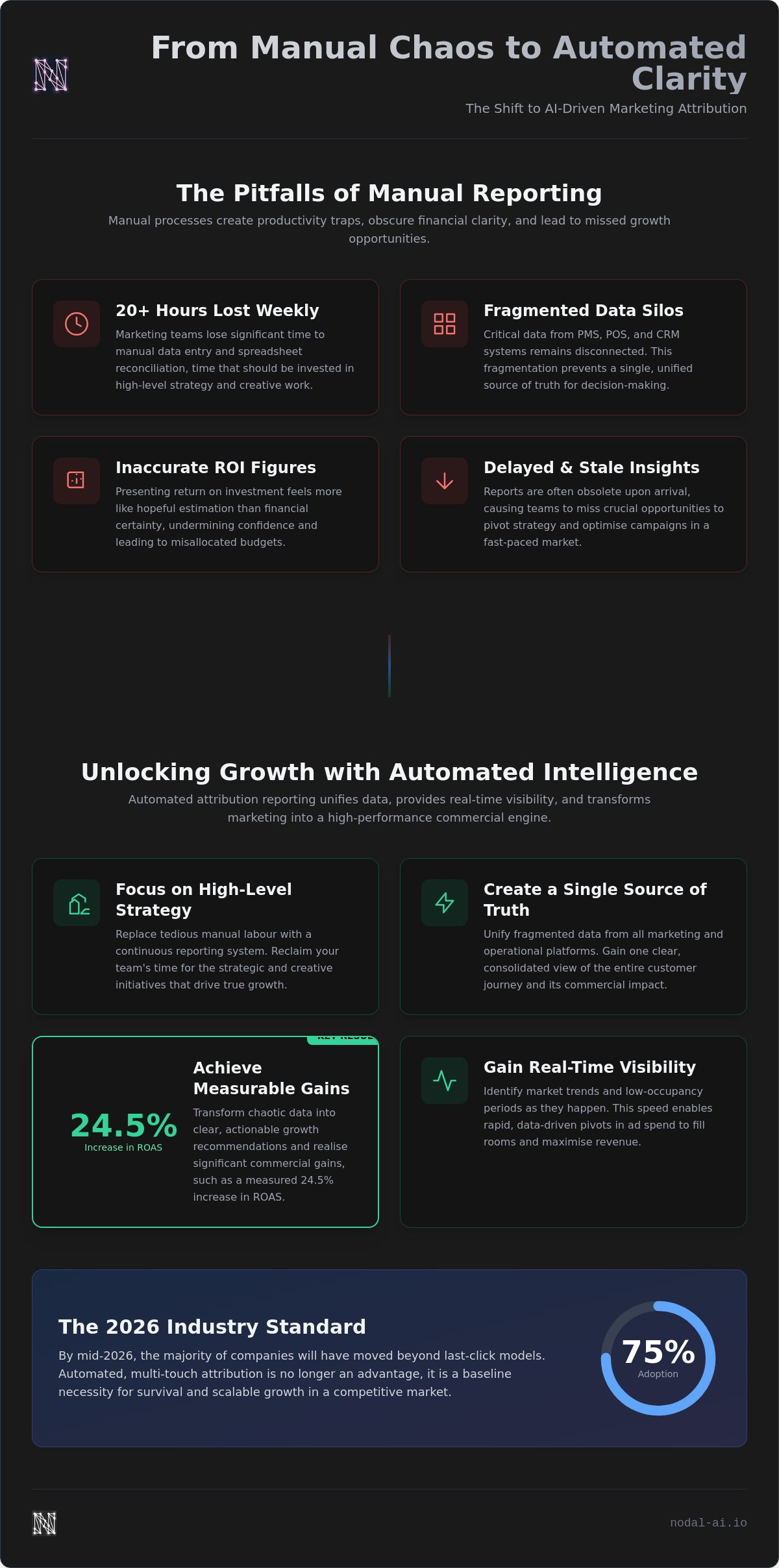
What if the twenty hours your team spends every month reconciling spreadsheets could be reclaimed for high-level strategy? By mid-2026, 75% of companies have transitioned to multi-touch models, yet many leaders still feel buried under fragmented data from disparate POS and CRM systems. You likely recognise the anxiety of presenting ROI figures that feel more like hopeful estimates than financial certainties. It is exhausting to manage the gap between marketing spend and actual guest revenue when your sources refuse to communicate.
This guide reveals how to bridge that gap by implementing automated attribution reporting to replace manual labour with AI-driven precision. You will learn how to unify chaotic inputs into a single source of truth, providing the clarity needed to drive profitable growth. We will examine the path to achieving real-time visibility and predictive insights that transform your marketing from a cost centre into a high-performance commercial engine. Prepare to replace the friction of manual reconciliation with the confidence of scalable marketing intelligence.
Key Takeaways
- Reclaim twenty hours of weekly productivity by replacing manual labour with a streamlined, continuous reporting system.
- Unify fragmented data from PMS and POS sources into a single source of truth through automated attribution reporting.
- Transition from restrictive last-click models to multi-touch attribution to capture the full value of the modern guest journey.
- Audit and standardise your digital data ecosystem to ensure every marketing pound is tracked with absolute precision.
- Realise measurable commercial gains, such as a 24.5% increase in ROAS, by transforming chaotic data into clear growth recommendations.
The Evolution of Marketing Attribution: Why Manual Reporting Fails in 2026
Marketing attribution is no longer a static monthly exercise. In 2026, automated attribution reporting stands as a system that continuously tracks and processes performance data without human intervention. It transforms passive data into active intelligence. For many London marketing teams, the alternative is a productivity trap. Industry observations suggest these teams lose over 20 hours a week to manual data entry; time that should be spent on creative strategy rather than cell reconciliation. When you rely on human hands to move data from one sheet to another, you aren't just losing time. You're losing accuracy.
Manual reports are often obsolete by the time they reach your inbox. A week in the high-velocity hospitality sector is an eternity. If you wait until Friday to see Monday's performance, you've already missed the opportunity to pivot. This delay creates a dangerous blind spot. Decisions based on stale data are essentially guesses disguised as strategy. To move forward, you must understand the various Marketing attribution models available and how they function within a modern, integrated tech stack. Fragmented data remains the primary barrier to a clear ROI. When your PMS, POS, and CRM systems exist in silos, your marketing spend remains disconnected from actual revenue.
The Hidden Cost of the Spreadsheet Culture
Spreadsheets are where growth goes to die. Manual reconciliation across Google Ads, Meta, and LinkedIn is notoriously error-prone. One broken formula can distort your entire quarterly outlook, leading to wasted budget or missed targets. This fragmentation creates a specific danger: OTA leakage. Without a clear view of the guest journey, you risk cutting ad spend that actually drives direct bookings, inadvertently pushing guests toward high-commission third-party platforms. The mental load on marketing managers is immense. They lack a single source of truth, leaving them to manage ambiguity instead of driving performance. Replace this chaos with a streamlined perspective that offers relief and total clarity.
London Marketing Dynamics: The Need for Speed
The UK hospitality market is exceptionally competitive. Real-time insights are no longer a luxury; they are a baseline necessity for survival. Automated attribution reporting allows your team to identify "need periods" or low occupancy trends as they happen. This speed enables rapid pivots in ad spend to fill rooms when it matters most. Over the last few years, the role of marketing attribution has shifted. It's moved from a complex analytical project to a fundamental requirement for any brand serious about scalable growth. Don't let manual processes anchor your potential. Embrace the speed of automation to secure your competitive edge in a demanding market.
The Architecture of Automated Attribution Reporting: From Data Gaps to Clarity
Building a resilient marketing strategy requires more than just a surface level dashboard. It demands a modular intelligence engine capable of bridging the chasm between fragmented inputs and actionable growth. In 2026, automated attribution reporting functions as the central nervous system of your commercial operation. It doesn't just collect data; it actively cleans and unifies inputs from complex sources like your Property Management System (PMS) and Point of Sale (POS) hardware. This sophisticated architecture allows you to maintain a single commercial view of the entire visitor lifecycle, moving beyond simple click tracking to high level audience intelligence.
Unifying Disparate Data Sources
Bridging the gap between marketing platforms like TikTok or GA4 and operational systems such as Mews or Cloudbeds is the first step toward total transparency. To achieve this, your reporting must integrate external signals, including local events, weather patterns, and flight demand, to provide context to your performance. By leveraging these insights to make data-driven marketing decisions, brands can finally align their digital spend with physical revenue. Data consolidation is the process of merging fragmented datasets from marketing and operational platforms into a unified warehouse for analysis. This process removes the ambiguity that often plagues hospitality marketing, ensuring your ROI figures are based on realised revenue rather than projected leads.
Standard tracking often fails because it ignores the complexities of the guest journey. For instance, a guest might discover your hotel on Instagram, research via a third party site, and eventually book directly after seeing a retargeting ad. Without a unified architecture, these touchpoints remain disconnected. A robust system ensures that every interaction is accounted for, allowing you to identify exactly which channel deserves the credit for the final booking. If you are ready to see this architecture in action, you can book a demo to explore your specific data needs.
The Power of Modular Intelligence
Modular intelligence allows you to configure your reporting environment based on specific business needs. A "one size fits all" approach inevitably fails for complex businesses; a hostel group requires different data signals than an upscale F&B venue or a wellness retreat. By utilising distinct modules for operational data, demand signals, and guest behaviour, you can create a bespoke intelligence layer that scales with your organisation. Explore the Nodal Platform features to see how this modularity creates a cognitive upgrade for your entire commercial team.
This architectural shift enables a move from reactive tracking to AI-driven audience segmentation. Instead of looking at who visited your site last month, you can identify which segments are likely to book during upcoming "need periods" or low occupancy windows. It transforms your data from a passive historical record into an active participant in your growth strategy, providing the clarity needed to outpace the competition in a demanding market.
Choosing the Right Attribution Models for Hospitality and High-Growth Brands
Last-click attribution is a relic of a simpler era. In the complex landscape of 2026, relying on the final touchpoint to justify your entire marketing budget is a strategic error. It ignores the intricate web of discovery, research, and consideration that defines the modern guest journey. By the time a guest makes a direct booking, they have likely interacted with your brand across five or more channels. If you only credit the last click, you risk starving the top-of-funnel activities that actually fuel your pipeline. Transitioning to automated attribution reporting allows you to see the full picture, ensuring every pound spent is accounted for throughout the funnel.
Multi-Touch Attribution vs Predictive Modelling
Multi-touch attribution (MTA) provides the granular detail needed to understand complex paths to purchase. Linear models distribute credit equally across all touchpoints, while U-shaped models prioritise the discovery and conversion phases. W-shaped models go further by highlighting the mid-funnel interactions that keep your brand top-of-mind during the research phase. However, even the most detailed historical report is still looking in the rear-view mirror. This is where predictive modelling becomes essential. It uses historical data to identify high-propensity guest segments before they even start their search.
London enterprises are rapidly moving away from reactive reporting. Instead of asking what happened last month, leaders now demand proactive growth recommendations. They want to know where to deploy capital next week to maximise occupancy. By combining MTA with predictive insights, you move from a state of uncertainty to one of calculated confidence. You aren't just tracking the past; you are engineering the future of your commercial performance.
Measuring What Matters: Beyond Vanity Metrics
Stop obsessing over click-through rates and impressions. These vanity metrics provide a false sense of security while masking underlying inefficiencies. To drive profitable growth, shift your focus to Return on Ad Spend (ROAS) and average booking value. Use automated attribution reporting to track incrementality, which measures whether a marketing interaction actually caused a booking or if that guest would have booked regardless. This distinction is vital for protecting your margins.
- Identify High-Value Channels: Determine which platforms drive the highest average booking value rather than just the highest volume.
- Optimise for Direct Bookings: Use attribution data to reduce reliance on high-commission OTAs by strengthening your direct-to-consumer path.
- Validate Spend: Ensure every channel contributes to new revenue rather than just claiming credit for existing demand.
This framework ensures your marketing remains a high-performance engine. By matching the right attribution model to your specific commercial goals, you replace guesswork with precision. You gain the clarity needed to scale your brand with absolute certainty.
Implementing Automation: A Roadmap to Data-Driven Decisions
Transitioning from manual chaos to a streamlined intelligence layer requires a logical, multi-step journey. You cannot build a single source of truth on a foundation of fragmented inputs. The first step involves a comprehensive audit of your current data ecosystem to identify exactly where information is lost between platforms. Once these fragmentation points are clear, you must standardise your naming conventions. Consistent UTM parameters across all digital channels act as the universal language for automated attribution reporting, ensuring every click is categorised with absolute precision.
The Technical Foundation: UTMs and Server-Side Tracking
Consistent naming conventions are not just a preference; they are the essential language of any automated system. Without them, your reporting engine cannot distinguish between a high-intent social lead and a casual browser. In the cookie-less environment of 2026, browser-based tracking is no longer sufficient. Implementing server-side tracking allows you to bypass these restrictions and capture every conversion event directly from your server. Research indicates that server-side tracking can increase data accuracy by up to 20 percent compared to traditional client-side methods. Such a shift ensures your ROAS figures are based on reality rather than incomplete browser signals.
Capturing the data is only half the battle. To realise the full potential of your marketing spend, you must connect your CRM, PMS, and POS systems to a central analytics platform. Connecting these systems transforms passive operational data into active commercial intelligence. Finally, move beyond the static dashboard. Set up automated visualisations that surface specific growth recommendations rather than just raw numbers. Following this roadmap turns your data into a competitive asset that guides your brand toward profitable expansion.
Aligning Commercial and Marketing Teams
True commercial intelligence requires breaking down the silos that typically separate marketing from operations. When everyone looks at the same source of truth, the friction of disagreement disappears. Use your automated attribution reporting to drive weekly trading meetings and performance reviews. Instead of debating whose data is correct, your team can focus on how to optimise ad spend for the upcoming weekend. Fostering this alignment creates a sense of momentum and simplicity, making growth feel inevitable rather than accidental. If you are ready to see how this implementation is managed by experts, book a demo to begin your transformation.
Beyond the Dashboard: How Nodal AI Transforms Attribution into Profit
Data is only valuable when it dictates action. In 2026, the Nodal Platform moves beyond simple visualisation to act as a cognitive upgrade for your entire commercial team. It turns passive assets into active participants in your growth strategy. By implementing automated attribution reporting, you move from a state of manual uncertainty to a state of calculated precision. This transition replaces the anxiety of fragmented data with the confidence of high-level perspective, allowing you to focus on high-value outputs rather than tedious reconciliation.
Consider the measurable impact on Ovolo Hotels. By leveraging Nodal, they realised a 15.3% reduction in acquisition costs alongside a 24.5% increase in ROAS. These aren't just abstract numbers; they represent a fundamental shift in commercial efficiency. The platform identifies early signs of "need periods" before they impact your revenue, allowing you to optimise ad spend dynamically. It ensures you fill rooms during low occupancy windows without wasting budget on peak dates where demand is already secured. A 100 percent modular architecture ensures these insights are tailored specifically to your business, whether you manage a boutique hotel, a restaurant group, or a major attraction.
Real-World Results in Hospitality
Success in the hospitality sector requires a "make more, waste less" philosophy, especially in the competitive UK market. One global luxury brand achieved a 19 percent increase in room bookings by acting on Nodal-driven insights. When you combine this volume with a 5.5 percent increase in average booking value, the impact on total profit margins is transformative. Automated attribution reporting provides the transparency needed to protect your assets and scale your brand with absolute certainty. It removes the ambiguity of marketing spend, ensuring every pound contributes to the bottom line.
Future-Proofing Your Growth Stack
The transition to AI marketing analytics is the essential upgrade for any organization serious about 2026 and beyond. A unified data governance framework ensures that your intelligence remains consistent as you scale. It provides a long-term foundation for predictive modelling and real-time decision making. Don't let fragmented data anchor your potential or drain your resources. Command your commercial future by transforming your data into a strategic asset. Replace the friction of the past with the frictionless progress of automated intelligence today.
Command Your Commercial Intelligence in 2026
The era of manual data entry is over. Reclaiming twenty hours of productivity every week transforms a marketing team from a cost centre into a strategic powerhouse. By unifying fragmented sources like PMS and POS data, you replace chaotic spreadsheets with a single source of truth. Implementing automated attribution reporting isn't just about efficiency; it's about the confidence that comes from absolute clarity. You now have the roadmap to move from reactive tracking to proactive growth recommendations.
Realise the same high-level results seen by industry leaders who have already modernised their tech stack. Ovolo Hotels achieved a 15.3% reduction in acquisition costs and a 24.5% increase in ROAS using these methods. Our commitment to precision recently earned us Gold in the Performance Marketing Awards, proving that modular intelligence drives measurable profit. Replace the anxiety of manual reconciliation with the relief of streamlined perspectives and start commanding your commercial future.
Book a demo to see how Nodal AI can automate your reporting and drive growth. Start your journey toward frictionless progress today and turn your data into your most competitive asset.
Frequently Asked Questions
What is automated attribution reporting?
Automated attribution reporting is a technology-driven system that unifies marketing and operational data to assign credit for conversions without manual intervention. It replaces the need for human data entry by continuously syncing with platforms like Google Ads, Meta, and your PMS. This provides a real-time, transparent view of how every marketing pound contributes to your revenue. It transforms chaotic inputs into high-value outputs for better commercial clarity.
How does automated reporting save time for marketing teams?
It eliminates the need for manual data reconciliation across multiple spreadsheets, which often consumes dozens of hours every month. By automating the extraction and cleaning of data from sources like Mews or Oracle OPERA, your team can focus on high-level strategy and creative optimisation. This shift moves your staff from being data collectors to becoming commercial decision-makers. It replaces the anxiety of manual tasks with the confidence of streamlined perspectives.
Can automated attribution work with legacy PMS or POS systems?
Yes, modern platforms are designed with modular intelligence to connect with both cloud-based and legacy operational systems. Through custom API integrations or secure data exports, the system can ingest fragmented information from older hardware. This ensures that even established businesses can achieve a single source of truth without needing to overhaul their entire physical infrastructure. It provides a cognitive upgrade for organisations that still rely on traditional on-site systems.
What is the difference between multi-touch and last-click attribution?
Last-click attribution gives 100 percent of the credit to the final interaction before a booking, whereas multi-touch attribution (MTA) distributes credit across the entire guest journey. MTA recognises the value of discovery on social media and research on search engines. It provides a more accurate reflection of how different channels work together to drive final revenue. This model allows for a more stable and long-term view of your commercial performance.
How does AI improve the accuracy of attribution reports?
AI uses advanced algorithms to identify patterns in guest behaviour that human analysis might miss. It can account for seasonality, local demand signals, and external factors like flight trends to provide context to your performance. This results in automated attribution reporting that is predictive rather than just historical, allowing for more precise budget allocation. It helps you identify future growth opportunities by turning passive data into active intelligence.
Why is server-side tracking important for automated reporting in 2026?
Server-side tracking is essential for capturing data that browser-based cookies often miss due to increasing privacy restrictions and ad-blockers. By sending data directly from your server to your analytics platform, you ensure a higher level of data integrity. This method is vital for maintaining an accurate view of your ROI in a landscape where traditional tracking signals are increasingly degraded. It ensures your reporting remains transparent and free from ambiguity.
How much does it cost to implement an automated attribution platform?
Costs vary significantly based on the complexity of your data ecosystem and the number of integrations required. While some tools offer entry-level pricing for smaller brands, enterprise-level solutions are typically customised to the scale of the organisation. You should evaluate the investment based on the potential increase in ROAS and the significant reduction in manual labour costs. Choosing a platform is about finding a partner that understands your specific commercial goals.
What are growth recommendations in the context of marketing analytics?
Growth recommendations are actionable insights generated by AI that suggest specific changes to your marketing strategy to improve performance. Instead of just showing you what happened, the system might recommend shifting budget to a specific channel during a low-occupancy window. These insights act as a cognitive upgrade, helping you make faster and more profitable commercial decisions. It allows you to move from reactive reporting toward proactive, data-driven growth.


