

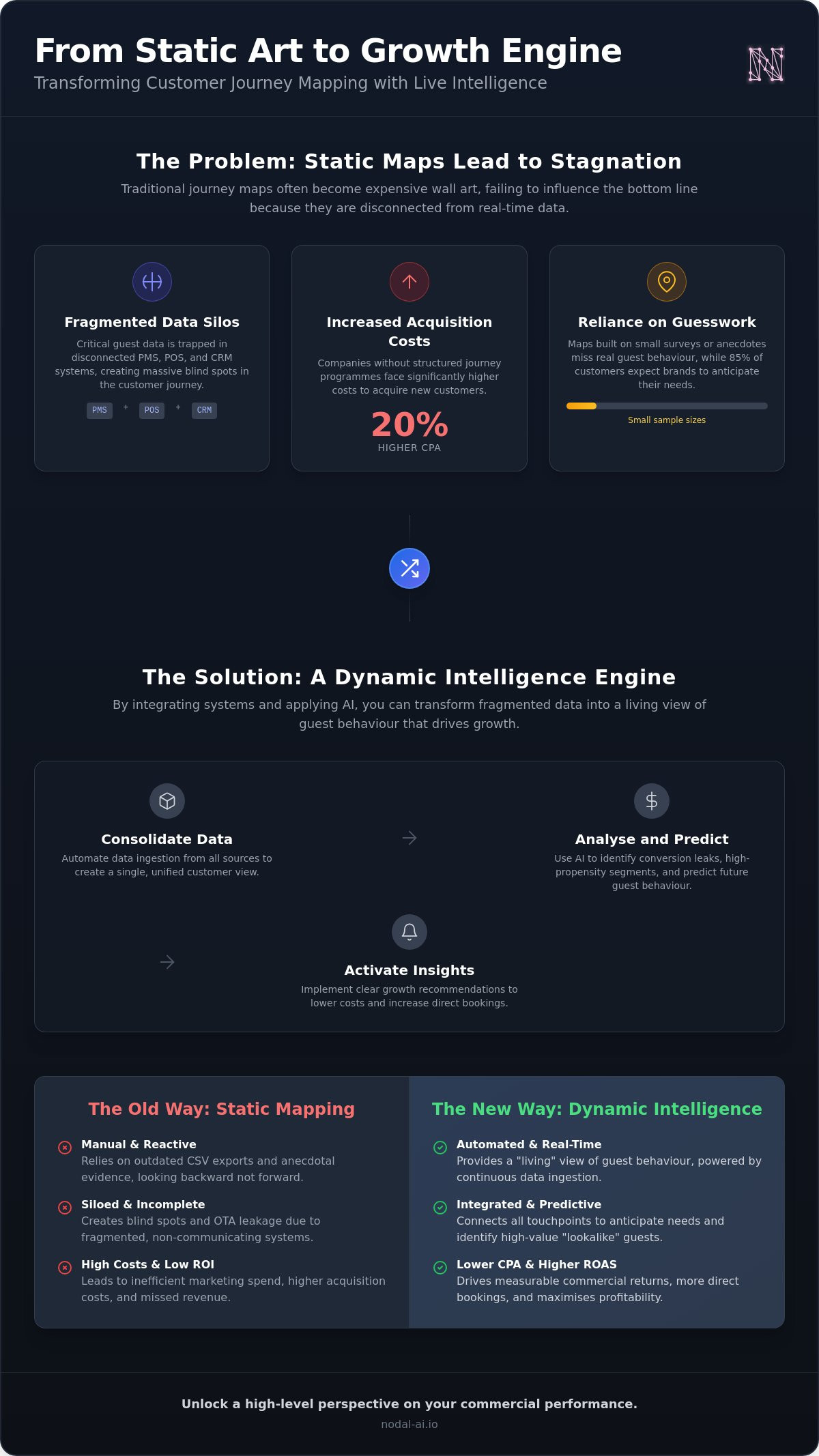
Industry benchmarks show that companies operating without mapped journeys face 20% higher customer acquisition costs than those with structured programmes. You likely have a journey map already; however, if it exists only as a static visual, it is failing to drive revenue. The primary hurdle for hospitality leaders is getting actionable insights from customer journey maps when data remains trapped behind siloed PMS, POS, and CRM systems. It is time to stop viewing these maps as art projects and start treating them as tactical growth engines.
We recognise the frustration of trying to calculate multi-touch attribution across complex paths while your data remains fragmented. You need a clear, high-level perspective that replaces manual guesswork with streamlined precision. This article reveals how to transform chaotic inputs into a live intelligence engine that identifies conversion leaks and predicts high-value guest behaviours. We will explore how to integrate your systems to lower your cost per acquisition, increase direct bookings, and implement growth recommendations based on real-time analytics.
Key Takeaways
- Move beyond static art projects by connecting siloed data from your PMS and POS systems to create a dynamic, real-time view of guest behaviour.
- Master the process of getting actionable insights from customer journey maps to pinpoint exactly where conversion leaks are costing your business direct bookings.
- Discover how predictive modelling and AI isolate high-propensity segments, allowing you to target "lookalike" guests with surgical precision.
- Implement a structured framework to bridge the gap between operational data and acquisition channels, resulting in a lower cost per acquisition and higher ROAS.
- Realise the potential of a modular intelligence engine to transform fragmented data into clear growth recommendations and measurable commercial returns.
The Problem with Static Customer Journey Mapping
Most customer journey maps are snapshots of the past. They look impressive in a boardroom presentation, but they often end up as expensive wall art that fails to influence the bottom line. This stagnation creates analysis paralysis. Marketing teams spend months debating a hypothetical path while missing the actual behaviour occurring in real time. When you rely on manual mapping, you are essentially driving by looking in the rear-view mirror. You see where your guests were, but you have no clarity on where they are going next.
The danger lies in the source of your information. Many organisations still rely on anecdotal evidence or small survey samples to build their maps. This is a gamble. In a market where 85% of customers expect brands to anticipate their needs, a sample size of fifty survey responses is insufficient. You need hard transaction data to move the needle. True growth comes from getting actionable insights from customer journey maps that are powered by live data rather than creative guesswork.
The High Cost of Fragmented Data Silos
Data fragmentation is the silent killer of hospitality margins. When legacy systems like Oracle OPERA or Mews don't communicate with your CRM or GA4, you create massive blind spots. This gap is exactly where OTA leakage occurs. A guest might start their search on your website, but if the journey feels disjointed or impersonal, they'll revert to a third-party distributor. This costs you a significant percentage of your margin in commissions. To understand the foundational principles of how to bridge these gaps, you should consult The Definitive Guide to the Customer Journey. Resolving these silos turns passive data into a tactical advantage.
Moving Beyond the Awareness to Loyalty Linear Model
The old linear funnel is dead. Modern guest journeys, particularly in the experience and wellness sectors, are chaotic and non-linear. A guest's path to purchase is influenced by a web of external signals, such as local events, weather patterns, or fluctuating FX rates. This complexity is why the broader customer experience must be viewed through the lens of commercial intelligence. We are seeing a necessary shift from descriptive mapping, which merely explains what happened, to prescriptive mapping, which tells you exactly what to do next to secure the booking. By evolving your approach, you replace the anxiety of manual tasks with the confidence of a streamlined, high-level perspective on guest behaviour.
Consolidating Fragmented Data to Build a Living Journey View
Turning a static diagram into a growth engine requires a shift in perspective. You must stop treating your mapping as a creative exercise and start treating it as a technical integration challenge. While many leaders understand customer journey map basics, few successfully bridge the gap between operational systems and marketing channels. By 2026, 85% of customers expect brands to anticipate their needs before they express them, yet 86% of companies with multiple CX tools report siloed data. Prioritising the consolidation of these systems is the first step toward getting actionable insights from customer journey maps that actually move the needle.
Manual data exports are the enemy of agility. If your team spends hours downloading CSV files to update a spreadsheet, your insights are already outdated by the time they are reviewed. Automated data ingestion ensures that your journey view remains "living" and responsive. This real-time visibility allows you to identify "need periods" through integrated demand forecasting. Instead of reacting to a drop in occupancy after it happens, you can see the trend forming and adjust your performance marketing spend instantly. Getting actionable insights from customer journey maps is only possible when your data flows without friction.
Technical Integrations: The Foundation of Insight
To build a comprehensive single customer view, you must connect every touchpoint. This includes your PMS, CRM, booking engines, and reputation feedback platforms. A modular intelligence engine acts as the "brain" of your organisation, stitching these disparate sources together to identify repeat guests and high-value segments. You can explore how to achieve this level of transparency by reviewing the Nodal Platform features. This connectivity replaces the anxiety of fragmented systems with the relief of a unified perspective.
The Role of Multi-Touch Attribution
Relying on last-click attribution is a strategic mistake that undervalues your top-of-funnel efforts. Modern guests might interact with your brand six or seven times before booking. Multi-touch attribution provides a fair view of marketing ROI across the entire guest lifecycle, allowing you to justify spend on early-stage awareness. We recommend mastering marketing attribution to ensure your budget is allocated where it actually drives growth. If you are ready to see how consolidated data can lower your acquisition costs, you might want to book a demo to see the engine in action.
Identifying High-Propensity Segments and Conversion Leaks
Identifying profit opportunities requires a departure from reactive analysis. While many brands rely on survey-based intent, true commercial intelligence depends on observed transaction history. By deploying AI to analyse your existing high-value guests, you can build "lookalike" profiles that target high-propensity segments with surgical precision. This is a core component of getting actionable insights from customer journey maps; it moves you away from generic marketing toward high-yield acquisition. You are no longer guessing who might book; you are identifying who is statistically most likely to convert.
Conversion leaks are often hidden in plain sight. Guests frequently drop out of the direct booking funnel at specific friction points, leading to OTA leakage that erodes your profit margins. By pinpointing these drop-off zones, you can implement immediate fixes that preserve your direct booking contribution. Beyond the initial booking, you must also analyse stay extensions and ancillary spend to understand the full guest lifecycle value. This comprehensive view ensures that every touchpoint is an active participant in your revenue growth, turning passive data into a cognitive upgrade for your entire organisation.
Predictive Modelling vs Reactive Reporting
Traditional reporting tells you what happened last month, which is a post-mortem rather than a strategy. Predictive modelling transforms this passive data into a forward-looking engine. It forecasts future demand and identifies guests at risk of churn, which is particularly vital for membership-based wellness services or subscription models. It replaces the anxiety of manual tasks with the confidence of a streamlined, high-level perspective. For a deeper technical exploration of these capabilities, see our Predictive Modelling guide.
Spotting the Early Signs of Need Periods
Journey data allows you to identify low-occupancy windows at least six weeks in advance. This foresight gives you the breathing room to match specific promotions to the right guest segments without resorting to blanket discounts. The goal is to increase total revenue rather than simply shifting demand from one week to the next. Getting actionable insights from customer journey maps ensures that your promotional strategy remains protective of your brand's value while filling the gaps in your calendar. This proactive approach is what separates visionary leaders from those stuck in a cycle of reactive discounting.
A Strategic Framework for Extracting Insights from Your Journey Data
Transforming a static map into a growth engine requires a disciplined, multi-step framework. You must move beyond simple visualisations and adopt a structured approach that prioritises commercial outcomes over aesthetic clarity. By following a logical sequence, you ensure that every data point serves a specific business goal. This process is the key to getting actionable insights from customer journey maps that actually impact your bottom line. Follow these five steps to turn your journey data into a live intelligence engine:
- Step 1: Define clear commercial objectives. Start with a specific target, such as increasing direct bookings by 10% or reducing OTA commissions by 15.3% as seen in successful hospitality models.
- Step 2: Map consolidated data points to journey stages. Link your PMS and POS data to specific touchpoints to identify where friction occurs.
- Step 3: Apply AI-driven segmentation. Identify your most profitable guest personas based on historical transaction behaviour rather than generic surveys.
- Step 4: Generate automated growth recommendations. Use your intelligence engine to highlight specific gaps in the funnel that require immediate intervention.
- Step 5: Execute and iterate. Use real-time performance analytics to refine your strategy daily, replacing manual guesswork with streamlined precision.
Aligning Journey Insights with Financial Performance
Every improvement in the guest journey must be tethered to financial metrics like RevPAR or Average Spend per Head. Actionable insights are data-driven conclusions that lead directly to a measurable change in commercial strategy. This alignment allows you to "Make More, Waste Less" by optimising your performance marketing spend for high-propensity audiences. When you realise exactly which touchpoints drive the highest return, you can stop the anxiety of manual reporting and focus on high-level growth. Getting actionable insights from customer journey maps ensures that your marketing budget is an investment in measurable returns rather than a sunk cost.
In the same way that Mighty Mentors WA provides personalised mentoring to help individuals navigate their own unique paths, hospitality leaders must use data to provide a guided, frictionless journey for their guests.
Reducing Friction in the Guest Experience
Technical hurdles in your booking engine often lead to abandoned carts and lost revenue. By identifying these friction points, you can reclaim guests who would otherwise leak to OTAs. Integrating sentiment analysis from reputation feedback platforms like Google Reviews or TripAdvisor provides a qualitative layer to your quantitative data. Automated reporting plays a vital role here; it can save marketing teams 20 or more hours per week on manual analysis. This efficiency allows your team to focus on strategic execution rather than data entry. If you are ready to see how a structured framework can transform your data, book a demo to explore our modular intelligence engine.
Scaling Commercial Intelligence with Nodal AI
Success in 2026 requires more than just understanding your guests; it requires the ability to outpace the market through superior data orchestration. Nodal AI provides the modular intelligence engine that connects your disparate systems, such as your PMS, POS, and CRM, to solve the chronic problem of margin erosion. By transforming fragmented data into strategic clarity, we replace the anxiety of manual reporting with the confidence of a high-level perspective. This is the ultimate evolution of getting actionable insights from customer journey maps, where your data is no longer a passive record but an active participant in your commercial growth.
The transition from manual mapping to automated growth recommendations represents a fundamental shift in how hospitality brands operate. When your data sources are unified, the Nodal Platform identifies conversion leaks and predictive behaviours in real time. For instance, Ovolo Hotels achieved a 15.3% reduction in acquisition costs by leveraging our intelligence engine to refine their guest journey. This level of precision is only possible when you stop viewing your journey map as a static diagram and start treating it as a dynamic engine. Getting actionable insights from customer journey maps becomes an effortless process once the underlying data science is automated.
Modular Solutions for Every Hospitality Use Case
Nodal is designed to scale across the entire hospitality spectrum, including hotels, quick-service restaurants (QSR), wellness centres, and attractions. Our modular architecture ensures that you only deploy the features you need, whether that is multi-touch attribution or predictive modelling. The onboarding process is streamlined to ensure rapid time-to-value, allowing your team to realise measurable returns without deep technical specialisation. We personify your data, turning silent transaction records into vocal advocates for your next strategic move. This cognitive upgrade allows your organisation to remain competitive and forward-thinking in an increasingly complex digital landscape.
To complement these data-driven insights with high-impact physical touchpoints, Zoney offers professional solutions for your premises. You can explore One-time hardware and software license sales to find flexible digital signage and media player options that integrate with your guest journey strategy.
Book a Demo to See Your Data in Action
The complexity of modern guest behaviour does not have to be overwhelming. You can replace the tedious manual tasks of your marketing team with a streamlined, automated workflow that delivers clear growth recommendations. Our London-based expert team provides specialised support to ensure your implementation is seamless and effective. We invite you to see how your disparate data sources can be unified into a single, high-value intelligence engine. Book a demo with Nodal AI to start transforming your guest journey today and secure the direct bookings your brand deserves.
Transform Your Guest Journey into a Tactical Growth Engine
Static maps are snapshots of the past. To lead in 2026, you must evolve toward a live intelligence engine that connects your PMS, POS, and CRM systems. By bridging these fragmented data silos, you replace the anxiety of manual guesswork with the confidence of streamlined, high-level perspectives. We've seen how this shift allow leading global hospitality brands to identify conversion leaks and target high-propensity segments with surgical precision. This transition helps you optimise your performance marketing spend and ensures your budget is an investment in measurable returns.
Getting actionable insights from customer journey maps is the primary driver for achieving a 15.3% reduction in acquisition costs and a 24.5% increase in ROAS. You already possess the necessary data; you simply require the modular brain to connect it and reveal the path forward. It's time to stop viewing your journey maps as art projects and start treating them as active, revenue-generating participants in your commercial strategy. The transition from complexity to growth is inevitable once you have the right intelligence tools in place.
Book a demo to see how Nodal AI turns your guest data into growth. The future of guest intelligence is waiting for you to take the first step toward total clarity.
Frequently Asked Questions
What makes a customer journey insight "actionable"?
An insight is actionable when it leads directly to a measurable change in commercial strategy. It replaces vague observations with specific, data-driven recommendations that improve financial performance. For example, identifying a specific drop-off point in your booking engine allows you to fix a technical hurdle and immediately reclaim lost revenue. It turns a passive observation into a tactical growth engine.
How does AI improve the accuracy of customer journey mapping?
AI removes the reliance on anecdotal evidence and small survey samples by analysing hard transaction data in real time. It identifies patterns and lookalike behaviours that human analysis often misses. This shift turns a static visual into a dynamic engine that predicts high-value guest behaviours with surgical precision, allowing for more accurate growth recommendations and reduced acquisition costs.
Can I get insights if my data is stored in several different systems?
Yes, you can achieve strategic clarity by using a modular intelligence engine to bridge disparate systems. Fragmented data in your PMS, POS, and CRM often creates blind spots, but technical integration unifies these sources. This process is essential for getting actionable insights from customer journey maps by creating a single customer view across all touchpoints.
What is the difference between a journey map and a customer experience report?
A journey map is a tactical tool that tracks the specific path a guest takes, while a customer experience report provides a broader qualitative overview of satisfaction. Maps focus on commercial friction and conversion points. Reports often look at descriptive history; however, modern mapping focuses on prescriptive actions to drive future revenue and reduce OTA leakage.
How long does it take to see results from AI-driven journey analysis?
Initial results, such as identifying conversion leaks or OTA leakage points, are often visible within the first thirty days of implementation. As the system ingests more historical data, the predictive modelling becomes increasingly accurate. This allows you to forecast demand and identify low-occupancy windows six weeks in advance, leading to rapid improvements in ROAS and direct bookings.
Which hospitality systems can be integrated into a journey map?
Essential data sources include Property Management Systems (PMS), Point of Sale (POS), Customer Relationship Management (CRM), and booking engines. You should also integrate reputation feedback platforms and performance marketing analytics. Unifying these disparate sources transforms passive assets into active participants in your growth strategy, providing total transparency across the entire guest lifecycle.
How do I measure the ROI of my customer journey mapping efforts?
You measure ROI by tracking specific financial metrics such as Revenue Per Available Room (RevPAR), Average Spend per Head, and cost per acquisition. A successful programme should lead to a measurable increase in direct booking contributions and a higher return on ad spend. These concrete weightings prove how getting actionable insights from customer journey maps impacts your bottom line.
What are the most common mistakes when interpreting journey data?
The most common mistake is relying on last-click attribution, which undervalues early-stage awareness touchpoints. Another error is treating the journey as a linear path rather than a complex, non-linear experience. Finally, many teams suffer from analysis paralysis by focusing on descriptive data regarding what happened instead of prescriptive growth recommendations regarding what to do next.


