

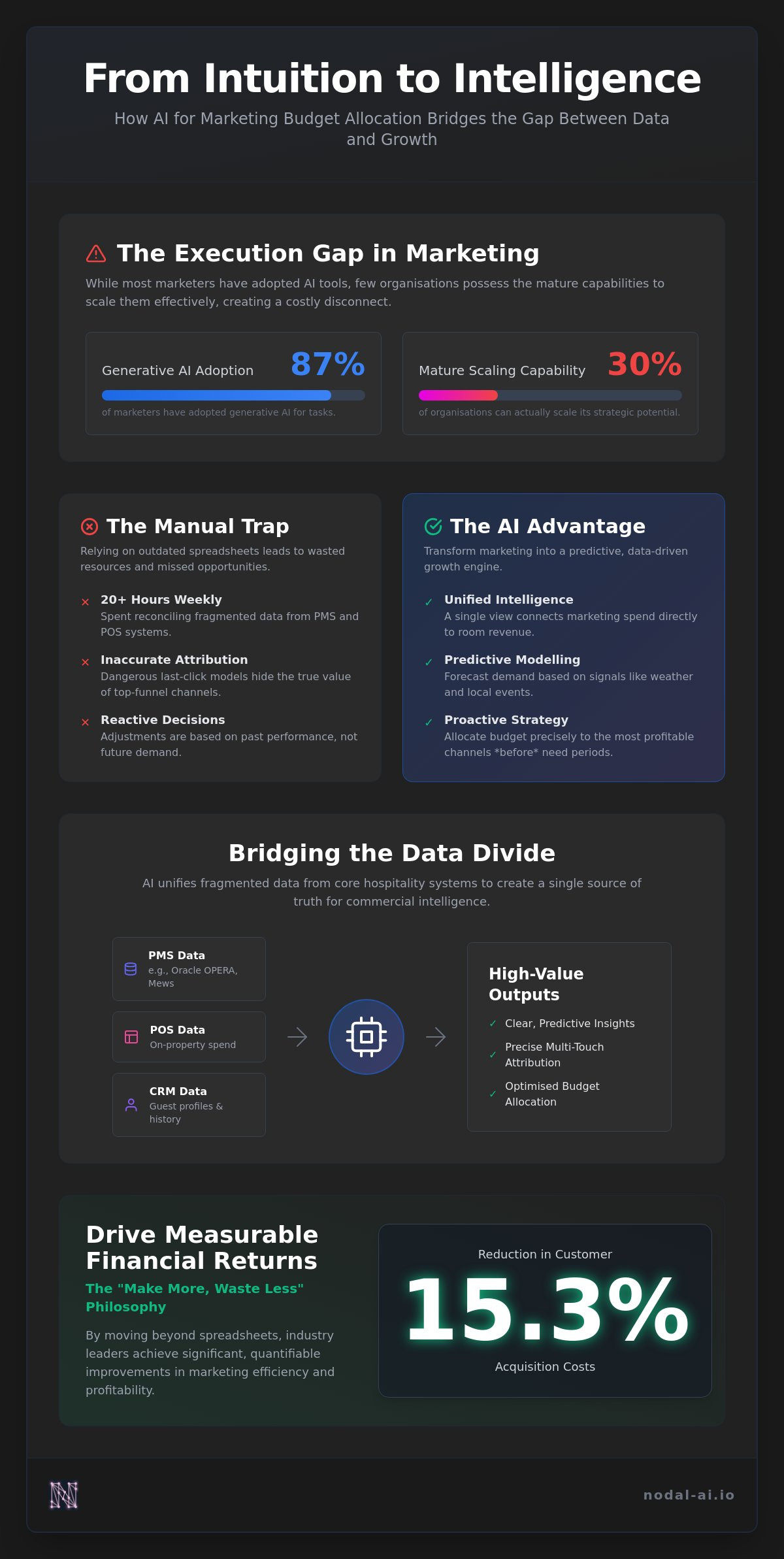
Did you realise that while 87% of marketers have adopted generative AI, only 30% of organisations actually possess the mature capabilities needed to scale it? Most teams are still trapped in the execution gap, using advanced tools to perform basic tasks while their core financial decisions remain tethered to manual spreadsheets. You likely feel the weight of this disconnect every week. It is exhausting to spend 20 plus hours reconciling fragmented data from PMS and POS systems, only to end up with inaccurate attribution that leads to wasted spend.
This article demonstrates how to bridge that gap using ai for marketing budget allocation to transform chaotic inputs into high-value growth. Learn how to move beyond manual reporting and utilise predictive commercial intelligence to allocate your resources with total precision. We will explore how a unified view of performance can finally reduce your customer acquisition costs and provide clear, predictive insights for future need periods.
Key Takeaways
- Transform your marketing from an intuition-led expense into a data-driven growth engine by moving beyond manual spreadsheets to a strategic intelligence layer.
- Eliminate the fragmentation trap by integrating PMS and POS data, ensuring every pound spent on marketing is directly tethered to actual room revenue.
- Utilise predictive modelling to forecast demand periods based on external signals like weather and local events, allowing you to allocate spend before the need arises.
- Implement a structured framework for ai for marketing budget allocation that starts with a comprehensive audit of existing data silos and customer journey mapping.
- Drive measurable financial returns by adopting the "make more, waste less" philosophy, mirroring the 15.3% reduction in acquisition costs achieved by industry leaders.
Beyond Spreadsheets: The Shift to AI for Marketing Budget Allocation
Static spreadsheets are the silent killer of hospitality margins. They capture what happened last week, not what will happen tomorrow. In 2026, relying on intuition is a high-risk strategy that leads to wasted spend and missed opportunities. By treating ai for marketing budget allocation as a strategic commercial intelligence layer, leaders can move from reactive adjustments to proactive growth. This shift represents the "Make more, waste less" philosophy. It is about ensuring every pound is working at its maximum potential. Manual reporting often takes up 20 plus hours a week; even then, it remains prone to human error and data latency. This delay creates a gap between market shifts and your response, resulting in significant margin erosion.
The Evolution of Commercial Intelligence
The industry has moved past simple generative tools that just write copy or create images. The new standard involves complex analytical engines that personify your passive data, turning it into an active participant in your business strategy. Modern ai marketing analytics allow for sophisticated Marketing Mix Modelling (MMM). This statistical approach provides a granular view of how different channels interact and contribute to the final sale. This is not just about automation; it is a cognitive upgrade for your entire marketing department. It replaces the "black box" of traditional advertising with a transparent, evidence-based roadmap. By transforming chaotic inputs into high-value outputs, you gain the confidence to scale your most profitable channels with total precision.
Why London Enterprises are Prioritising Unified Data
London's hospitality sector faces unique pressures, from rising operational costs to the final disappearance of third-party cookies. Traditional budget planning is no longer viable in a post-cookie landscape where attribution is increasingly difficult to track. Enterprises are now prioritising unified data because fragmented systems like Oracle OPERA and Mews create blind spots that hide true ROI. A single view of the truth has become a competitive necessity. It allows performance leaders to see exactly where demand is coming from and adjust their ai for marketing budget allocation in real-time. This level of clarity replaces the anxiety of manual reporting with the confidence of measurable, strategic growth. When data flows seamlessly between systems, the transition from complexity to growth feel inevitable. You are no longer just managing a budget; you are orchestrating a growth engine.
For UK-based enterprises looking to implement these advanced capabilities, partnering with a premium AI-powered agency like Scale IT UK can provide the technical expertise needed to bridge the gap between fragmented data and strategic growth.
Solving Fragmentation: Connecting PMS and POS Data for Precise Spend
Hospitality data is often trapped in a fragmentation trap where critical revenue information sits isolated in systems like Oracle OPERA or Mews. Marketing teams see ad spend on one screen and room bookings on another, but the two rarely meet. This disconnect makes it impossible to see the true impact of your investment. By implementing ai for marketing budget allocation, you create a digital bridge between these silos. The AI ingests data from your Property Management System (PMS) and Point of Sale (POS) to reveal exactly which campaigns drove high-value bookings. It's no longer about guessing. You can see the direct line from a specific social ad to a three-night stay and a dinner at the hotel restaurant.
Connecting your CRM data directly to ad platform bidding strategies creates a powerful feedback loop. When your ad platforms know which leads turned into high-spending guests, they can optimise in real-time to find more people like them. This level of integration is essential for multi-touch attribution, ensuring your budget flows toward the channels that actually move the needle on your bottom line. It turns your data from a passive record of the past into an active driver of future revenue.
The Death of Last-Click in Hospitality
Last-click models are dangerous because they oversimplify the complex guest journey. If a guest sees an ad on Monday, reads a review on Wednesday, and clicks a brand ad to book on Friday, last-click gives all the credit to Friday. This leads to overspending on brand search while starving the channels that actually introduced the guest to your property. AI identifies these high-value touchpoints across the entire journey. It measures incrementality, which is the true measure of budget success; it asks if the booking would have happened without that specific ad. This clarity allows you to stop wasting money on "guaranteed" bookings and start investing in new growth.
Automating Multi-Source Reporting
Manual reporting is a significant productivity drain, often consuming over 20 hours per week for marketing managers. AI eliminates this burden through real-time data ingestion from disparate technical sources. Instead of waiting for a weekly wrap-up, you get a live view of performance. This speed is vital during critical need periods when occupancy is low and you must react instantly to market shifts. Faster decision-making saves your margin from erosion. If you're ready to see how unified data can transform your returns, you can explore the Nodal platform to start your journey toward total clarity.
Predictive Modelling: Forecasting Demand to Optimise Marketing ROI
Historical data only tells you where you have been. To win in 2026, you must know where the market is going before your competitors do. This is where predictive modelling becomes the cornerstone of your commercial strategy. By analysing patterns beyond your own booking engine, AI identifies "need periods" up to six weeks in advance. This foresight allows you to shift your ai for marketing budget allocation toward high-propensity segments while prices are still low. You move from a reactive state of panic spending to fill rooms to a proactive state of strategic growth. It is the difference between chasing the market and leading it.
Integrating External Signals for Accuracy
Standard analytics often ignore the world outside your hotel walls. However, external signals like local events, flight demand, and even fluctuating FX rates significantly impact guest behaviour. AI processes these complex variables instantly, providing a level of accuracy that manual teams simply cannot match. For instance, if flight demand from New York to London spikes for a specific weekend, the system can automatically suggest an increase in spend on targeted ads for that demographic. This ensures you are capturing high-value guests when they are most likely to book, rather than wasting budget on broad, untargeted campaigns during low-occupancy troughs. The technology turns these external signals into active growth drivers for your portfolio.
Growth Recommendations vs. Simple Automation
There is a vital distinction between tools that simply move money and those that provide genuine strategy. Simple automation might reallocate spend based on yesterday's performance, but ai for marketing budget allocation driven by growth recommendations focuses on bed yield and long-term margins. These systems act as a cognitive partner, suggesting shifts that protect your bottom line. They don't just automate tasks; they elevate your decision-making. By combining human expertise with machine-led predictive insights, you create a frictionless path to profitability. This synergy ensures that while the technology handles the complex calculations, your team remains focused on high-level commercial goals and creative execution, such as delivering world-class events with LivewireAV.
A Framework for Implementing an AI Marketing Budget Stack
Deploying a high-performance technology stack requires a logical, multi-step journey. You cannot simply layer technology over broken processes; you must first build a foundation of clarity. Success in ai for marketing budget allocation depends entirely on the strength of your underlying data infrastructure. By following a structured implementation framework, you replace fragmented chaos with a streamlined growth engine that identifies value in real-time.
- Step 1: Audit existing data silos. Begin by identifying where your revenue and guest data live. This includes your PMS (such as Oracle OPERA or Mews), CRM systems, and various ad platforms.
- Step 2: Map the customer journey. Visualise every touchpoint to identify the key conversion drivers that actually influence a booking decision.
- Step 3: Deploy a modular intelligence engine. Use a central layer to connect disparate data points, transforming passive records into active commercial insights.
- Step 4: Establish a data governance framework. Ensure accuracy by setting strict standards for how data is collected, cleaned, and processed across the organisation.
- Step 5: Transition to real-time reallocation. Move away from fixed monthly cycles and start shifting your budget based on live commercial signals and demand forecasts.
The Importance of a Modular Architecture
Hospitality groups require flexibility that off-the-shelf software rarely provides. A modular architecture allows you to isolate specific functions, such as operational efficiency, demand forecasting, and guest behaviour analysis. This approach ensures you can add new data sources as your business scales without rebuilding your entire system. It provides the agility needed to respond to sudden market shifts. You can see these principles in action by exploring the Nodal Platform features, which are designed specifically for the complex needs of modern hospitality leaders.
Addressing GDPR and Data Security
In 2026, UK-compliant data processing is a non-negotiable requirement for any enterprise. High-level protection of guest assets is essential for maintaining brand trust and avoiding regulatory hurdles. Advanced ai for marketing budget allocation systems now utilise sophisticated techniques to anonymise guest data. This allows you to maintain marketing precision and personalised targeting without compromising individual privacy. Professional onboarding plays a critical role here, ensuring that your technical compliance is airtight from day one. This creates a secure environment where data-driven growth and privacy coexist perfectly. If you are ready to revolutionise your commercial strategy with total security, book a demo with Nodal today to see our intelligence layer in action.
Nodal AI: Driving Measurable Returns for Performance Leaders
Nodal AI acts as the essential commercial intelligence layer for the modern hospitality group. While generic tools offer broad automation, Nodal provides a modular architecture specifically designed to navigate the unique complexities of PMS and POS data integration. By unifying these fragmented sources, performance leaders gain the clarity needed for precise ai for marketing budget allocation. This level of transparency replaces the anxiety of manual reporting with the confidence of measurable, strategic growth. It is about turning your data from a passive record into an active participant in your revenue strategy.
The results speak for themselves. Ovolo Hotels achieved a 15.3% reduction in acquisition costs by leveraging Nodal's insights. Simultaneously, they saw a 24.5% increase in ROAS through a unified view of their marketing performance. This "Make more, waste less" approach ensures that every pound spent is working to drive direct bookings rather than being lost to inefficient channels. By connecting systems like Oracle OPERA and Mews directly to your marketing stack, you eliminate the blind spots that traditionally lead to wasted spend. You are no longer guessing which campaigns work; you are operating with total precision.
Case Study: Real-World Commercial Impact
A global luxury brand recently utilised Nodal to transform their commercial results, achieving a significant 8% increase in room revenue. This growth was driven by Nodal's ability to identify and reduce OTA leakage through smarter, data-driven budget shifts. By understanding the true customer journey, the brand could prioritise direct channels that offer higher margins. Additionally, the marketing team reclaimed over 20 hours per week. Automated reporting replaced the tedious manual reconciliation of spreadsheets, allowing the team to focus on high-level strategy rather than data entry. This transformation illustrates how resolving complexity leads directly to higher-value outputs.
The Future of Your Marketing Strategy
The shift from fragmented data to strategic commercial clarity is no longer optional. In a competitive market, the ability to see your entire performance in a single, actionable view is a decisive advantage. You can move beyond the limitations of last-click attribution and start making decisions based on predictive modelling and real-time insights. This is the ultimate cognitive upgrade for your organisation. It replaces the sense of overwhelm with a streamlined, effortless user experience. If you are ready to transform your ai for marketing budget allocation and drive measurable growth, book a demo with Nodal AI today. Experience the relief that comes from total clarity and start your journey toward a more profitable future.
Strategic Growth: Your Path to Commercial Clarity in 2026
The transition from manual spreadsheets to a unified intelligence layer is no longer a luxury for hospitality leaders; it is a competitive necessity. By connecting your PMS and POS data, you replace the anxiety of fragmented reporting with the confidence of measurable growth. We have explored how predictive modelling identifies need periods weeks in advance, allowing you to move beyond reactive spending and embrace a proactive commercial strategy. This shift empowers your team to focus on high-level decision-making rather than tedious data reconciliation.
Implementing ai for marketing budget allocation ensures every pound is working toward a direct booking. The results are undeniable. Partners like Ovolo Hotels have seen a 15.3% reduction in acquisition costs and a 24.5% increase in ROAS. This commitment to precision is why Nodal secured Gold in the Performance Marketing Awards. You don't have to navigate the complexity of the modern landscape alone. It is time to turn your passive data into your most active growth driver.
Book a personalised demo of the Nodal Platform to start your journey toward total clarity. Your future growth is waiting.
Frequently Asked Questions
How does AI improve marketing budget allocation for hotels?
AI improves ai for marketing budget allocation by connecting siloed data from systems like Oracle OPERA or Mews directly to your marketing spend. This allows hotel leaders to see which specific campaigns drive high-value room revenue and restaurant sales. By using predictive insights, the system automatically shifts budget toward high-propensity guest segments before need periods arise, replacing manual guesswork with total precision.
Can AI marketing tools help reduce our dependency on OTAs?
AI tools reduce OTA dependency by identifying and prioritising the touchpoints that lead to direct bookings. By mapping the guest journey and using multi-touch attribution, the platform reveals where guests are leaking to third-party sites. You can then allocate more budget to the specific search terms or social ads that capture guests early, ensuring a higher bed yield and significantly improved margins.
Is AI budget allocation compliant with GDPR and UK data laws?
Professional platforms are fully compliant with GDPR and UK data protection standards. These systems utilise data anonymisation techniques to process guest information without compromising individual privacy. By working with a UK-based provider, you ensure that your data governance framework meets all local regulatory requirements while still delivering the high-level marketing precision required for strategic growth.
What is the difference between MMM and AI-driven attribution?
Marketing Mix Modeling (MMM) provides a high-level, statistical view of how various channels contribute to overall sales over time. In contrast, AI-driven attribution offers granular, real-time insights into specific guest journeys. While MMM helps with long-term ai for marketing budget allocation, AI attribution allows for immediate adjustments to active campaigns, providing a comprehensive cognitive upgrade for your commercial team.
How long does it take to see ROI from an AI budget tool?
Most hospitality groups begin seeing actionable insights within the first four weeks of implementation. Significant ROI, such as the 24.5% increase in ROAS achieved by partners like Ovolo Hotels, typically materialises within the first full quarter. As the predictive modelling engine ingests more historical data, the accuracy of its growth recommendations improves, leading to a measurable and sustained reduction in acquisition costs.
Do we need a data scientist to use a predictive modelling platform?
You don't need a dedicated data scientist to benefit from these platforms. The underlying technology handles the complex integrations and algorithmic processing, presenting your team with clear, actionable growth recommendations. It is designed for performance leaders and marketing managers who need high-value outputs without requiring deep technical specialisation. The user experience is streamlined to turn chaotic inputs into effortless commercial clarity.
Can AI handle fragmented data from legacy PMS systems?
Modern AI platforms are specifically built to ingest fragmented data from legacy Property Management Systems. Whether you use Oracle OPERA, Mews, or a combination of older POS systems, a modular architecture acts as a universal intelligence layer. It unifies these disparate sources into a single view; this resolves the complexity of historical data silos and turns passive assets into active participants in your business strategy.
What are the main benefits of automated marketing reporting?
The primary benefit is the elimination of manual labour, saving marketing teams over 20 hours per week. Automated reporting provides a live, transparent view of performance across all channels, allowing for faster decision-making during critical need periods. This shift from reactive to proactive management ensures that your commercial strategy remains agile, helping you avoid the margin erosion caused by delayed or inaccurate data.


