

Did you know that customer acquisition costs have surged by 222% over the last five years? It is a staggering figure that highlights a painful truth for the modern hospitality leader: the old model of constant recruitment is no longer sustainable. You likely realise that your most profitable opportunities are already sitting in your database, yet they remain locked behind fragmented systems like your PMS, POS, and CRM. These data silos create a persistent fog that makes it nearly impossible to distinguish a high-value repeat guest from a one-time visitor.
This guide provides the clarity you need to move forward. You will discover how to use advanced customer retention analytics to transform chaotic guest inputs into predictable, high-value revenue. By leveraging the Nodal Platform, you can finally achieve a single view of the customer journey and significantly reduce your reliance on expensive third-party aggregators. We will explore how predictive modelling and AI-driven insights empower your organisation to drive direct bookings and secure long-term commercial stability. It is time to replace the anxiety of manual data mining with the calm efficiency of automated growth recommendations and measurable returns.
Key Takeaways
- Move beyond basic churn rates by adopting lifecycle intelligence that anticipates guest needs before they arise.
- Master customer retention analytics by unifying fragmented data from PMS and POS systems into a single, actionable view of the guest journey.
- Prioritise high-impact metrics like Net Revenue Retention and Guest Propensity Scores to accurately identify your most valuable repeat visitors.
- Follow a structured framework to clean guest profiles and eliminate the data silos that currently fuel reliance on expensive third-party aggregators.
- Deploy predictive modelling to achieve measurable commercial results, such as a 15.3% reduction in acquisition costs and enhanced direct booking revenue.
What is Customer Retention Analytics and Why is it Critical in 2026?
Data is no longer a passive record of the past; it is the architect of your future revenue. At its core, customer retention analytics is the sophisticated process of using internal data to decipher exactly why guests return or why they choose a competitor. It moves beyond the surface-level tracking of stay dates to uncover the psychological and financial drivers behind guest loyalty. In a world where every booking counts, understanding these patterns is the difference between a thriving brand and one lost in the noise of the digital marketplace.
The urgency of this intelligence has reached a peak in 2026. With the full enforcement of the Indiana Consumer Data Protection Act and the final phase-out of third-party cookies, your reliance on external tracking has become a liability. You must now look inward. Customer retention is now a survival metric because the economic reality is undeniable: acquiring a new customer is up to 25 times more expensive than keeping an existing one. Research from Bain & Company shows that a mere 5% increase in retention can boost profits by 25% to 95%. When acquisition costs have surged by 222% over five years, prioritising your existing database is the only logical path to commercial stability.
The Evolution of Retention Intelligence
We have moved past the era of reactive reporting. Traditional systems told you who left; modern customer retention analytics tells you who is about to leave and how to stop them. This shift toward lifecycle intelligence replaces manual, tedious tasks with automated foresight. By using the Nodal Platform, you transform fragmented guest data into active participants in your growth strategy. This cognitive upgrade provides total clarity, allowing you to intervene with precision before a guest churns. It replaces the anxiety of guesswork with the confidence of high-level perspective.
Retention in the Hospitality and Leisure Sector
Hospitality requires a unique analytical lens that extends far beyond the initial booking. You must track on-property spend and ancillary revenue alongside visit frequency to calculate a guest's true value. Whether it is a spa treatment, a dinner at your flagship restaurant, or a late checkout, every interaction is a data point. Unifying these disparate sources from systems like Oracle OPERA or Mews creates a single view of the customer journey. This visibility is vital to drive direct bookings and eliminate the revenue leakage caused by heavy OTA commissions. Stop letting third-party aggregators own your guest relationships and start reclaiming your margins through consolidated intelligence.
The Mechanics of Predictive Customer Retention Analytics
Traditional reporting is a rear-view mirror. It shows you where you've been, but it offers little guidance on the road ahead. To secure profitable loyalty in 2026, you must deploy a modular intelligence engine that connects disparate data sources. This infrastructure replaces the chaos of manual data entry with the calm efficiency of automated insights. By integrating external signals like weather patterns, local festivals, and regional tourism trends, your customer retention analytics becomes a proactive tool for revenue protection. It identifies "need periods" before they arrive, allowing you to fill rooms with high-propensity guests rather than relying on last-minute OTA discounts. This level of foresight transforms your marketing from a shot in the dark into a precision-guided strategy.
The complexity of this process often overwhelms traditional marketing teams. However, as Customer Retention Analytics Explained highlights, the goal is to create a seamless loop between data collection and guest engagement. When your systems talk to each other, you gain the ability to identify churn risks with surgical precision. This connectivity ensures that no guest falls through the cracks due to a lack of visibility.
Consolidating Fragmented Data Sources
Your guest data currently lives in silos. Oracle OPERA holds the booking, OpenTable tracks the dining preference, and Mews manages the on-property experience. Fragmented inputs lead to fragmented experiences. You need a single view of the customer journey to drive direct bookings and reclaim your margins. The Nodal Platform features allow you to unify these disparate sources, transforming chaotic guest history into high-value strategic outputs. This consolidation removes ambiguity, ensuring your team focuses on guests who offer the highest lifetime value. When you bridge these gaps, you stop guessing and start growing.
Moving from Descriptive to Predictive Models
Descriptive models tell you that a guest didn't return. Predictive models tell you they're likely to churn before it happens. This distinction is the foundation of modern customer retention analytics. By using predictive modelling, you can anticipate future guest behaviour based on historical patterns and real-time triggers. Machine learning identifies segments with the highest propensity to book, allowing you to automate growth recommendations and personalised offers. This approach allows you to target the right guest at the exact moment they're ready to book. It's not just about data; it's about a cognitive upgrade for your entire organisation that prioritises long-term commercial stability over short-term gains.
If you're ready to replace manual reporting with predictive clarity, book a demo of our modular intelligence engine today.
Key Metrics: Measuring What Truly Matters for Loyalty
Vanity metrics like total web traffic or social media engagement are distractions that cloud your commercial vision. To achieve true growth, you must replace these surface-level figures with high-value commercial insights. Implementing sophisticated customer retention analytics allows your organisation to transition from a state of data chaos to one of total clarity. You need to focus on metrics that impact the bottom line: Churn Rate, Repeat Purchase Rate, and Customer Lifetime Value (CLV). However, as you refine your customer retention strategies, you must also adopt more advanced indicators like Net Revenue Retention (NRR) and Guest Propensity Scores. These act as a cognitive upgrade for your team, providing the intelligence needed to secure long-term stability.
Net Revenue Retention is particularly vital in 2026. It measures the revenue growth generated from your existing guest base after accounting for upgrades, ancillary spend, and churn. While occupancy rates tell you how full your rooms are, NRR tells you how healthy your business actually is. Combine this with Guest Propensity Scores, which use machine learning to predict the likelihood of a guest booking a specific package. This foresight allows you to prioritise high-value guests and automate personalised offers, ensuring that your marketing efforts are always tethered to concrete financial performance.
Customer Lifetime Value (CLV) vs. Acquisition Cost
Customer Lifetime Value represents the total net profit a guest generates across their entire relationship with your brand, encompassing room stays, dining, spa services, and all other ancillary spend. For a look at the types of health and wellness products that often complement these services, click here.
Cohort Analysis: Identifying the "A-ha" Moment
Stop viewing your guests as a monolithic block and start grouping them by their first interaction or booking type. Using cohort analysis reveals the specific behaviours that lead to long-term loyalty. It allows you to identify the "A-ha" moment: the specific experience or touchpoint that transforms a one-time visitor into a repeat guest. When you combine this with multi-touch attribution, you gain a streamlined perspective on the entire path to retention. This removal of ambiguity empowers you to double down on what works, turning passive guest assets into active participants in your commercial success.
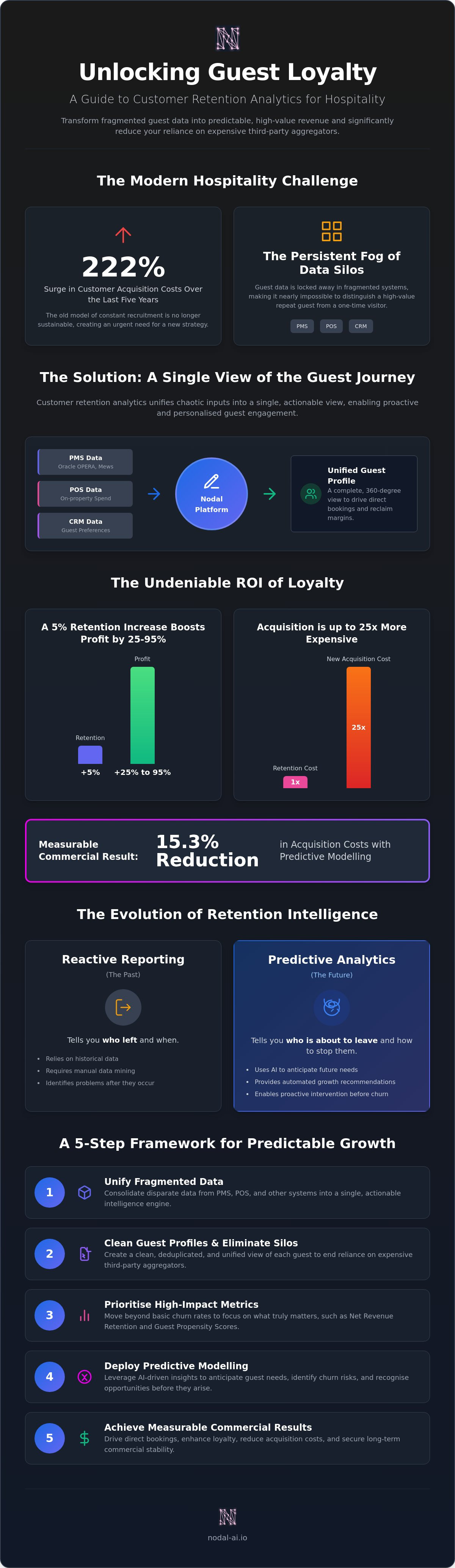
A 5-Step Framework for Implementing Retention Analytics
Executing a successful strategy for customer retention analytics requires a move from fragmented chaos to a structured, modular approach. It is not about a single software installation; it is about building a cognitive engine that powers your entire commercial operation. By following this five-step framework, you can replace the anxiety of manual data mining with a streamlined path toward predictable revenue.
- Step 1: Audit and connect. Identify every touchpoint where guest data is generated. Link your PMS, POS, and CRM systems to create a unified data stream that captures the full guest journey.
- Step 2: Clean and standardise. Remove duplicates and correct errors in your guest profiles. High-value outputs are impossible without high-quality inputs.
- Step 3: Deploy AI-driven segmentation. Use machine learning to categorise your database into high-value loyalists and at-risk visitors. This allows you to prioritise your efforts where they will yield the highest return.
- Step 4: Automate reporting. Shift from static monthly reviews to real-time commercial and operational insights. Visibility must be instantaneous to be effective.
- Step 5: Execute personalised marketing. Use automated growth recommendations to deliver the right offer at the exact moment of highest propensity.
Overcoming the "Messy Data" Objection
Many hospitality leaders hesitate to adopt advanced intelligence because they fear their existing data is too fragmented or "messy" to be useful. This is a misconception that often leads to stagnation. A modular architecture allows you to resolve complexity without requiring a total system overhaul. It acts as a bridge between your legacy systems and your future growth. Implementing robust data governance frameworks ensures that your data remains a strategic asset rather than a source of confusion. Clarity is a choice; you must choose to standardise your inputs to secure your outputs.
Personalisation at Scale
Generic email blasts are a relic of a less competitive era. To win in 2026, you must leverage ai marketing analytics to deliver tailored offers that resonate on an individual level. This transition from broad targeting to high-propensity audience engagement is what drives direct bookings and reduces OTA reliance. Automated reporting does more than just provide data; it saves marketing teams 20 or more hours per week by eliminating manual spreadsheet management. This reclaimed time allows your team to focus on high-level strategy rather than tedious administrative tasks. It's time to replace manual labour with automated intelligence.
Ready to implement this framework and reclaim your team's productivity? Book a demo of the Nodal Platform to begin your transformation today.
Maximising ROI with the Nodal Platform
Success in 2026 is reserved for those who replace the anxiety of guesswork with the confidence of high-level perspective. The Nodal Platform serves as the cognitive upgrade your organisation needs to achieve total clarity. By unifying fragmented data into a single, modular intelligence engine, you transform passive guest records into active participants in your commercial growth. This shift stops the persistent erosion of your margins and ends the cycle of OTA leakage that drains your profitability. You must move beyond intuition; you must embrace a future where every decision is backed by advanced customer retention analytics and predictable revenue models.
Case Study: Real-World Results in Hospitality
The impact of this transition is best illustrated by the results achieved by Ovolo Hotels. By leveraging the Nodal team's expertise, they realised a 15.3% reduction in acquisition costs and a staggering 24.5% increase in ROAS. These weren't just incremental gains; they were the result of award-winning performance marketing strategies that prioritised direct bookings over third-party reliance. Through more precise guest segmentation, Ovolo also saw a 5.5% increase in average booking value. This demonstrates the tangible power of using customer retention analytics to identify and nurture your most valuable segments. When you stop treating every guest the same, you start seeing the true commercial value of your loyalty programmes.
Getting Started: Your Journey to Commercial Intelligence
Your transition to a data-driven powerhouse is designed to be streamlined and effortless. Our professional implementation and onboarding process removes the complexity often associated with technical upgrades. We work with your existing systems, such as Oracle OPERA or Mews, to ensure a frictionless integration that delivers immediate value. Our tiered SaaS subscription model provides the scalability you need to grow without the fear of ballooning costs. This pragmatic approach ensures that your investment is always tethered to measurable returns and long-term stability. It is time to reclaim your productivity and focus on high-level strategy while our platform handles the manual, tedious tasks of data consolidation.
The fog of fragmented data is a choice you no longer have to make. Secure your margins and transform your guest intelligence today. Book a demo with Nodal AI to begin your journey toward profitable loyalty.
Securing Your Commercial Future with Consolidated Intelligence
The path to profitable loyalty in 2026 requires a fundamental shift in how you perceive guest data. Replace the fog of fragmented systems with a single, unified view that transforms chaotic history into predictable revenue. By adopting advanced customer retention analytics, you move beyond basic churn reporting and embrace the power of predictive modelling to secure long-term commercial stability. This transition isn't just about software; it's about a cognitive upgrade for your entire organisation.
Reclaiming your margins from third-party aggregators is no longer a complex hurdle; it's a strategic choice. The Nodal Platform provides the specialised hospitality data integrations needed to turn passive guest assets into active participants in your growth. Our award-winning approach, recognised at the Performance Marketing Awards, has already delivered a 15.3% reduction in acquisition costs for industry leaders who prioritised clarity over complexity.
Stop letting manual tasks drain your team's productivity and start leveraging the efficiency of automated insights. Book a personalised demo of the Nodal Platform today to see how you can achieve total visibility and measurable returns. Your journey from data fragmentation to strategic growth begins here.
Frequently Asked Questions
How does customer retention analytics differ from traditional CRM reporting?
Traditional CRM reporting focuses on historical records and static data points, essentially telling you what happened in the past. In contrast, customer retention analytics uses predictive modelling to anticipate future guest behaviour. It moves beyond simple lists of names to identify the underlying drivers of loyalty, allowing you to transform passive data into active commercial intelligence. This shift replaces reactive observation with proactive strategy.
Can retention analytics help reduce my reliance on OTAs and third-party booking sites?
Yes, by identifying high-propensity guests within your own database, you can target them with personalised offers before they search on external aggregators. This strategy protects your margins from heavy commission fees and allows you to own the guest relationship entirely. You move from a state of OTA dependency to one of direct booking growth, ensuring that your most valuable guests remain within your own ecosystem.
What data sources do I need to integrate for effective retention analysis?
Effective analysis requires a modular connection between your Property Management System (PMS), Point of Sale (POS), and CRM. This integration should capture booking history, on-property spend (such as dining or spa services), and digital engagement patterns. By unifying these disparate sources, you create a single view of the customer journey, replacing fragmented inputs with a streamlined, high-level perspective of guest value.
Is it possible to perform retention analytics if my guest data is currently fragmented?
Fragmented data is a common starting point for most hospitality organisations, not a barrier to entry. A modular intelligence engine is specifically designed to bridge these gaps, unifying disparate systems without requiring a total infrastructure overhaul. This process resolves complexity and replaces data chaos with total clarity. It serves as a cognitive upgrade that allows your organisation to benefit from advanced insights regardless of your current technical hurdles.
How quickly can a business see a return on investment from retention analytics?
Most businesses realise initial commercial wins within the first 90 days of implementation. By immediately identifying at-risk guests and high-value segments, you can deploy targeted growth recommendations that drive direct revenue. The speed of your return depends on how quickly you move from data consolidation to automated execution. This rapid output replaces the anxiety of manual reporting with the confidence of measurable financial gains.
How does AI improve the accuracy of customer churn predictions?
AI identifies subtle behavioural patterns that manual analysis often misses, such as slight shifts in booking frequency or changes in ancillary spend. These machine learning algorithms act as a conversational partner with your data, flagging at-risk guests before they officially churn. This foresight allows for proactive intervention, ensuring you can deliver a tailored incentive at the exact moment it is needed to secure a repeat booking.
What is the role of multi-touch attribution in customer retention?
Multi-touch attribution reveals every digital interaction that contributes to a guest's decision to return. It provides a transparent view of which marketing channels actually drive loyalty rather than just initial awareness. By understanding the full path to retention, you can optimise your marketing spend and eliminate waste. This removal of ambiguity ensures that your budget is always allocated to the touchpoints that offer the highest commercial return.
Does the Nodal Platform comply with UK GDPR standards for guest data?
The Nodal Platform is built on privacy-first principles and fully adheres to UK GDPR standards. We prioritise the high-level protection of your guest assets, ensuring that all data processing is secure, transparent, and compliant with current regulations. This commitment replaces the anxiety of regulatory risk with the reassurance of enterprise-ready security. You can focus on growth while we ensure your data governance remains beyond reproach.


