

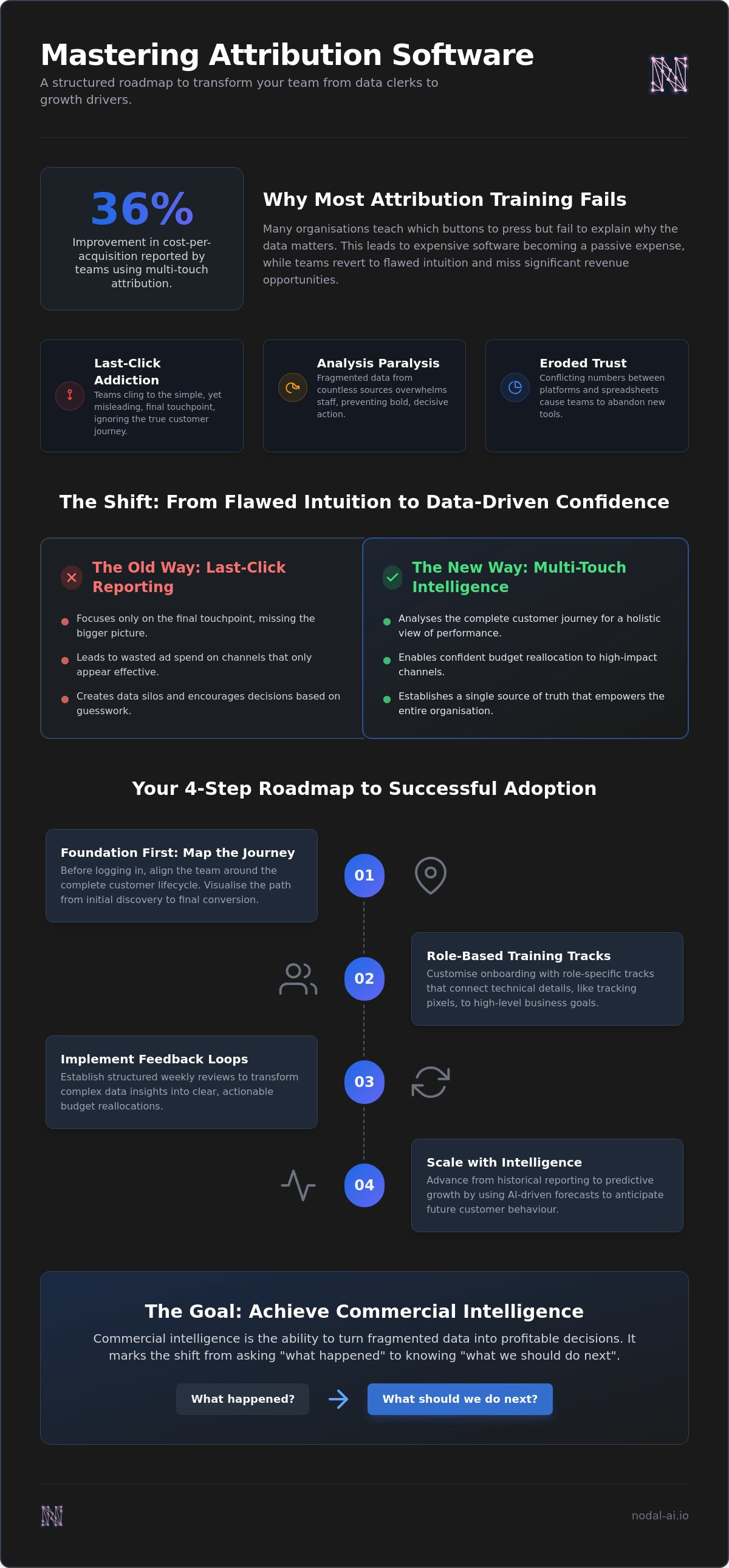
Did you know that teams implementing multi-touch attribution report up to a 36 per cent improvement in cost-per-acquisition within their first year? It is a powerful figure, yet many leaders find their staff still reverting to last-click intuition because the software feels too complex to trust. You likely recognise the exhaustion of managing fragmented data across fifteen different sources, only to find your team trapped in analysis paralysis rather than making bold moves.
Learning how to train your team on attribution software is the bridge between chaotic inputs and high-value commercial growth. By moving beyond basic data entry, you can empower your staff to use predictive modelling and multi-touch insights to reallocate budgets with total confidence. This guide provides a structured roadmap to help you synchronise your tech stack, eliminate ambiguity, and turn your marketing department into a streamlined engine for growth. We will cover everything from mastering customer journey mapping to establishing a single source of truth that your entire organisation can rely on.
Key Takeaways
- Break the "last-click" addiction by aligning your team around the complete customer journey before they ever log into the platform.
- Customise your onboarding with role-specific tracks that connect technical tracking pixels to high-level profit margins.
- Discover how to train your team on attribution software through structured weekly reviews that transform complex insights into clear budget reallocations.
- Advance from looking at what happened to predicting what will happen using AI-driven forecasts of future guest behaviour.
Beyond the Dashboard: Why Attribution Software Training Often Fails
Most leaders mistake software adoption for strategic competence. They teach their staff which buttons to press but forget to explain why the data matters. This is the fundamental reason why learning how to train your team on attribution software requires a shift from technical tutorials to commercial strategy. If the training stops at the dashboard, your team remains data-entry clerks instead of growth drivers. They might know how to generate a report, but they won't know how to use it to scale a campaign.
For years, marketers have relied on the simplicity of the final touchpoint. Breaking this "Last-Click" addiction is a significant psychological hurdle. It feels safe. It feels intuitive. Yet, it ignores the complex reality of modern marketing attribution. Without addressing this mindset, your team will continue to make budget decisions based on flawed metrics that don't reflect the true customer journey. You aren't just teaching a tool; you're re-engineering how your team perceives value.
Trust is the currency of adoption. When data is fragmented across multiple platforms, that trust evaporates instantly. If your team sees conflicting numbers between their manual spreadsheets and the software, they will abandon the tool before the first month is out. You must transform these chaotic inputs into a single, transparent source of truth. This ensures your team feels empowered by the technology rather than overwhelmed by its complexity.
The Cost of Misaligned Attribution Training
Poorly trained teams are expensive. When attribution logic is "siloed" within a single person's head, the rest of the department remains blind. This lack of transparency leads to wasted ad spend on channels that only appear to perform well on the surface. Without a unified understanding, teams revert to intuition during high-pressure budget cycles, missing massive revenue opportunities that only Multi-Touch Attribution can reveal. A fragmented training approach ensures that your expensive software remains a passive expense rather than an active asset.
Defining Commercial Intelligence for Your Team
True success comes from moving beyond historical reporting. When considering how to train your team on attribution software, you must first establish a shared vocabulary. Ensure everyone understands terms like incrementality and path-to-purchase early in the process. Stop asking "what happened" and start asking "what should we do next." This is the core of the Nodal AI approach. Explore how Nodal's features facilitate this shift by automating the heavy lifting of data integration. Commercial intelligence is the ability to turn fragmented data into profitable decisions. By focusing on these outcomes, you ensure your staff understands that the platform is a cognitive upgrade for the entire organisation.
Foundation First: Mapping the Customer Journey Before the Software
Success in learning how to train your team on attribution software starts long before you open a browser. It begins with a whiteboard and a clear understanding of your specific commercial landscape. If your staff don't understand the guest lifecycle, they will view the platform as a collection of random charts rather than a roadmap for growth. You must teach them to visualise the entire path to purchase, from that first social media discovery to the final direct booking confirmation. This foundation ensures that when they eventually engage with the software, they are looking for specific answers rather than wandering through data.
Effective training focuses on identifying "Need Periods" where occupancy dips or demand gaps appear. By teaching your team to integrate external signals such as local events, weather forecasts, or FX rates into their journey mapping, you turn a reactive department into a proactive growth engine. When the team understands how a sudden shift in exchange rates might influence international booking volume, they can use the software to reallocate budget instantly. This level of commercial intelligence replaces guesswork with high-precision action. If you want to see how this looks in practice, you can book a demo to explore our journey mapping capabilities.
Visualising Complex Journeys in Hospitality
Hospitality journeys are notoriously non-linear. Your team needs to distinguish between leads generated by high-commission Online Travel Agents (OTAs) and those that contribute to direct booking revenue. Mapping this journey allows the team to analyse length-of-stay performance and ancillary spend at each touchpoint. For a deeper dive into this process, consult The Definitive Guide to the Customer Journey to ensure your strategy is airtight. This clarity helps the team realise that every touchpoint has a specific commercial value.
From Fragments to Clarity: Consolidating Data Sources
Moving from fragments to clarity requires a unified view of your Property Management System (PMS), Point of Sale (POS), and CRM data. Help your team realise that modern platforms like Nodal use a modular architecture to bridge these gaps without requiring deep technical expertise. This allows them to use AI to identify high-propensity guest segments who are most likely to convert. By consolidating these sources, you remove the ambiguity that often leads to analysis paralysis and replace it with a streamlined, high-level perspective. Mastering how to train your team on attribution software involves showing them how these disparate sources become a single, powerful narrative of growth.
Role-Based Training Tracks: Tailoring Insights for Every Department
A universal training programme often results in bored executives and overwhelmed practitioners. To avoid this, segment your curriculum into role-based tracks that address specific departmental needs. When considering how to train your team on attribution software, the goal is to provide the exact level of granularity each person requires to succeed. By using tools like Spacewize to transform static documents into interactive e-learning, you replace the anxiety of information overload with the confidence of targeted expertise.
- The Executive Track: Focus on high-level ROAS and profit margins. Leaders don't need to know how to set a tracking pixel; they need growth recommendations that justify marketing spend during board meetings.
- The Marketing Ops Track: This is the engine room. These team members require deep dives into UTM parameters and data quality fundamentals to ensure the system remains a single source of truth.
- The Revenue Management Track: This group uses attribution to balance occupancy levels with direct revenue growth. It's about finding the most profitable guest segments rather than just filling rooms at any cost.
- The Creative Team Track: Visual assets are often undervalued in data discussions. This track teaches designers to see which images or videos drive high-value conversions rather than just chasing vanity clicks.
Empowering Executives with Strategic Clarity
Presenting data to a board requires a shift from technical jargon to commercial impact. Use the Nodal Platform features to automate high-level reporting that busy directors can digest in seconds. By focusing on a "Make more, waste less" KPI, you transform marketing from a cost centre into a predictable revenue driver. This clarity provides the reassurance leadership needs to scale budgets confidently, knowing every pound is accounted for in the broader growth strategy.
Upskilling the Practitioners: Technical Excellence
For the people using the tool daily, theory is never enough. Implement hands-on labs using real campaign data to build genuine confidence in the software's logic. This is the stage where you demonstrate the difference between rule-based and data-driven attribution models side-by-side. Showing your staff how to set up automated reporting can save the team 20 or more hours of manual work every month. This is the ultimate relief from complexity; it replaces tedious spreadsheets with streamlined, high-level perspectives. Mastering how to train your team on attribution software effectively means giving your practitioners their time back so they can focus on high-level strategy rather than manual data entry.
Implementing a Feedback Loop: Bridging the Gap Between Data and Action
Training should include rigorous hypothesis testing to move the team from a reactive to a proactive state. Encourage your staff to use the software to run "what-if" scenarios. For instance, if you reduce spend on a specific top-of-funnel channel by 10 per cent, what is the predicted impact on your direct booking volume? This level of inquiry transforms your staff from passive observers into active growth strategists. Always validate these insights by cross-referencing software data with actual bank-balance revenue. If the digital insights don't align with physical receipts, your team will quickly lose faith in the technology. High-level clarity is the goal; accuracy is the requirement.
Standardising the Decision-Making Process
Consistency is the key to scaling any marketing operation. Create a "Playbook" that outlines specific, mandatory actions for common scenarios, such as what to do when ROAS drops on a core channel. This removes the panic from the process and replaces it with a structured, calm response. For a deeper look at these strategies, consult our guide on Mastering Marketing Attribution. By fostering a culture of "test and learn," you empower your team to take calculated risks without the fear of making data-driven mistakes.
Data Governance and Quality Control
The integrity of your commercial intelligence depends entirely on the quality of your inputs. Train your team on the absolute necessity of clean data entry and consistent naming conventions: a single sloppy UTM parameter can ruin a month of reporting. You can use the Nodal Platform to identify these data gaps automatically, ensuring your foundation remains solid. During this process, ensure your team understands UK-specific standards like GDPR to maintain compliance while handling sensitive guest data. High-quality data leads to high-quality decisions. If you are ready to see how automated reporting can clean up your workflow, book a demo of the Nodal Platform today.
Scaling with Intelligence: Moving from Historical Reporting to Predictive Growth
The final stage in learning how to train your team on attribution software involves a fundamental shift in perspective. Most organisations spend their time looking at historical reports to see where they failed or succeeded last month. While this is useful, true commercial intelligence focuses on the future. You must teach your team to move from "what happened" to "what will happen" by embracing predictive modelling. This allows your staff to trust automated growth recommendations for ad spend efficiency, transforming your marketing budget from a reactive cost into a proactive investment.
Trusting an algorithm to guide your financial decisions can feel daunting for teams used to manual control. However, the results of this transition are undeniable. Consider the success of Ovolo Hotels, an organisation that integrated predictive insights into their core strategy. By training their staff to act on forward-looking signals, they achieved a 24.5 per cent increase in ROAS. This success was not merely the result of better tracking; it was the result of a team that understood how to turn automated suggestions into high-precision commercial actions. When you show your staff these concrete wins, the software ceases to be a cold algorithm and becomes a conversational partner in their success.
Mastering Predictive Modelling for Future Demand
Modern attribution allows you to identify high-propensity guest segments before they even begin their search journey. By teaching your team to recognise these early signals, you can prepare for "need periods" weeks in advance rather than discounting at the last minute. For a comprehensive breakdown of these techniques, explore our Predictive Modelling Guide. This approach ensures your team is always one step ahead of market fluctuations, replacing the anxiety of demand gaps with the confidence of data-backed forecasting.
The Future of the Marketing Team: From Analysts to Strategists
As AI-powered insights handle the heavy lifting of data consolidation, the role of your team naturally evolves. When you understand how to train your team on attribution software for predictive growth, you free up their time for creative brand planning and high-level strategic thinking. Positioning the software as a cognitive upgrade for every team member transforms their daily experience. They are no longer bogged down by tedious manual reporting; instead, they are empowered to drive measurable returns. This evolution turns your marketing department into a visionary growth engine that is both competitive and forward-thinking. To see how this transformation can work for your organisation, Book a demo with Nodal AI today and begin your journey toward total commercial clarity.
Transform Your Team into a Strategic Growth Engine
Mastering how to train your team on attribution software is the definitive step toward total commercial clarity. By replacing fragmented data with a unified, modular architecture specifically tailored for hospitality, you empower every department to move beyond historical reporting. You have seen how role-based tracks and consistent feedback loops turn passive analysts into visionary strategists who anticipate demand rather than merely reacting to it. This transition replaces the anxiety of manual spreadsheets with the confidence of high-level, future-facing perspectives.
The results of this shift are concrete and measurable. Organisations like Ovolo Hotels have already realised a 15.3 per cent reduction in acquisition costs by acting on these insights. Our AI-driven growth recommendations save teams over 20 hours of manual labour every month, allowing your staff to focus on high-level creative planning and strategic brand development. You are no longer just tracking clicks; you are building a cognitive upgrade for your entire organisation. Book a demo of the Nodal Platform to see how we help teams master commercial intelligence. Your path to frictionless progress starts here.
Frequently Asked Questions
How long does it typically take to train a team on attribution software?
Initial technical onboarding usually takes a few days, but reaching full strategic competency typically requires four to six weeks of active use. This timeframe allows your staff to move through at least one complete monthly reporting cycle. During this period, the team transitions from merely navigating the interface to confidently reallocating budgets based on multi-touch insights.
Do we need a data scientist to manage our marketing attribution software?
No, you do not require a dedicated data scientist if your platform provides AI-driven growth recommendations and automated reporting. Modern commercial intelligence tools handle the complex data processing internally. This allows your existing marketing and revenue teams to focus on high-level strategy and profitable decision-making rather than deep technical analysis or manual data cleaning.
How do we handle the discrepancy between attribution software and platform-specific data?
You should train your team to treat platform-specific metrics, such as those from Meta Ads, as directional signals while using the attribution software as the single source of truth. Discrepancies occur because individual platforms only see their own touchpoints. The attribution software provides a holistic view, ensuring your budget decisions reflect the entire customer journey rather than siloed, inflated figures.
What is the most effective way to teach non-technical staff about multi-touch attribution?
The best approach is to use relatable metaphors, such as comparing the customer journey to a sports match where the assist is just as vital as the goal. When you learn how to train your team on attribution software using these commercial narratives, the underlying mathematics feel less daunting. This replaces technical anxiety with a practical understanding of how every touchpoint contributes to the final conversion.
Can attribution software training help reduce our customer acquisition costs (CAC)?
Yes, structured training is a primary driver for reducing acquisition costs. By teaching your team to identify and eliminate "leaky" channels that consume budget without providing real incremental value, you naturally lower your CAC. Industry data from 2026 suggests that teams using multi-touch attribution correctly can see a 14 to 36 per cent improvement in cost-per-acquisition within their first year.
How often should we conduct refresher training sessions for the team?
Conduct refresher sessions at least once a quarter to keep pace with platform updates and evolving privacy regulations. These sessions are vital for maintaining high data governance standards and ensuring the team is utilising the latest predictive modelling features. Regular check-ins prevent the team from reverting to old habits, such as over-relying on last-click metrics during busy periods.
Is it necessary to train the creative team on attribution data?
It is essential, as the creative team needs to understand which visual assets drive high-value guest segments rather than just vanity clicks. Providing them with access to attribution insights allows designers to optimise their work for the most profitable stages of the journey. This alignment ensures that your brand's creative output is directly tethered to measurable commercial returns and long-term growth.
What are the common mistakes teams make when first using attribution software?
The most frequent errors include failing to maintain consistent naming conventions and ignoring the psychological shift required to move away from last-click models. Many teams also struggle by treating the software as a passive reporting tool rather than an active participant in their strategy. Understanding how to train your team on attribution software involves setting clear expectations and establishing a weekly cadence for data-driven action.


