

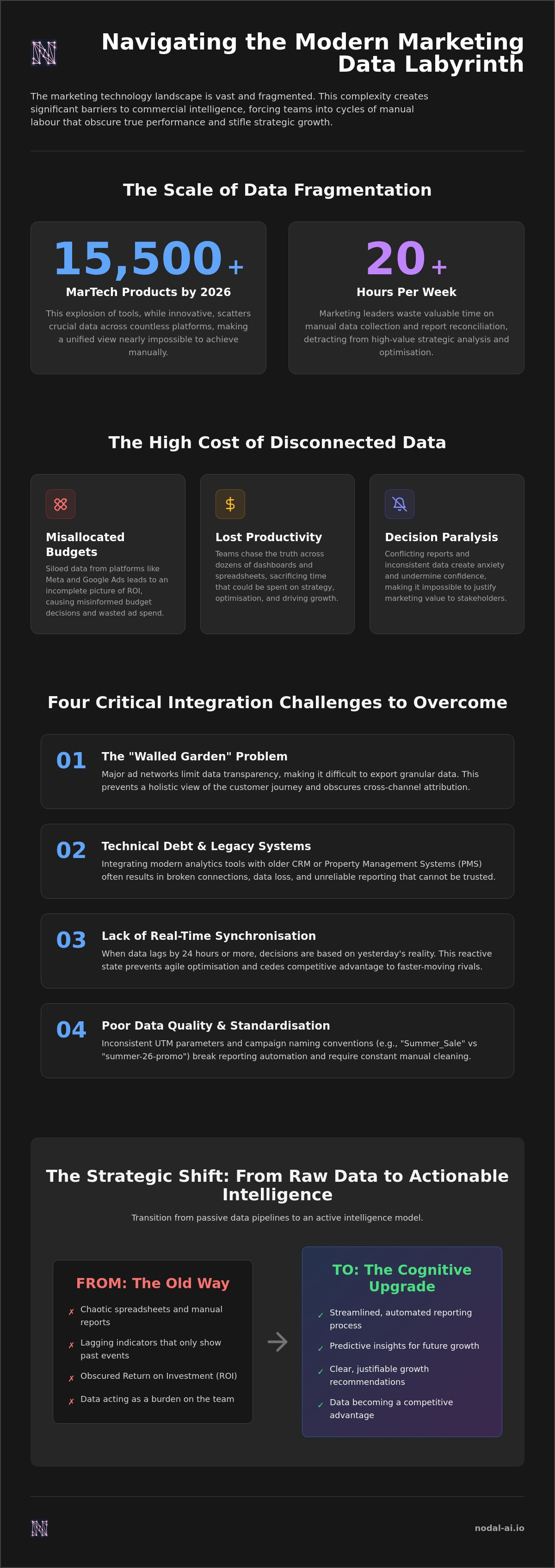
By May 2026, the global marketing technology landscape surged to include over 15,500 individual products. While this growth suggests innovation, it often creates a fragmented reality where marketing leaders spend upwards of 20 hours a week manually collecting data. You probably recognise the frustration of staring at inconsistent reports from Meta and Google Ads while trying to justify your budget to stakeholders. It is a cycle of manual labour that stifles strategic growth and obscures your true return on ad spend.
We understand that marketing data integration challenges are more than just technical glitches; they are barriers to commercial intelligence. This article will help you identify and resolve the hurdles preventing a unified view of your performance. You will learn how to transition from chaotic spreadsheets to a streamlined, automated reporting process. We will preview the steps needed to turn fragmented inputs into clear growth recommendations, ensuring your data acts as a cognitive upgrade for the entire organisation.
Key Takeaways
- Redefine integration as a strategic intelligence layer that transforms fragmented data into a cognitive upgrade for your entire business.
- Identify the five critical marketing data integration challenges, from walled garden transparency to naming inconsistencies, that currently obscure your true return on investment.
- Learn to implement a framework that prioritises commercial goals and customer journey mapping before investing in complex technical architectures.
- Discover how to transition from passive data pipelines to an active intelligence model that delivers automated reporting and clear growth recommendations.
The Growing Complexity of the Modern Marketing Data Landscape
In its simplest form, Data integration is the strategic unification of disparate sources into a cohesive intelligence layer. It's no longer just a technical checkbox for IT departments. By 2026, this process has evolved into a vital commercial necessity. The shift from straightforward multi-channel marketing to the current fragmented ecosystem means that data is scattered across thousands of touchpoints. With over 15,500 MarTech solutions now available, the sheer volume of information is overwhelming for even the most seasoned marketing leaders.
London-based marketing teams aiming for rapid scale often find that manual reporting is their greatest bottleneck. Spending 20 hours a week on data collection isn't just tedious; it's a strategic failure. When your team is buried in spreadsheets, they aren't analysing growth or optimising spend. This manual approach cannot keep pace with the speed of modern commerce. The ultimate goal of resolving these marketing data integration challenges is to achieve commercial intelligence. This is the state where your data stops being a burden and starts being a competitive advantage.
The High Cost of Data Fragmentation
Data fragmentation carries heavy, often invisible costs. Siloed information leads to misallocated budgets and lost productivity as teams chase the truth across different dashboards. In the hospitality sector, this often manifests as OTA leakage. Without clear insights into direct booking performance, businesses rely too heavily on third-party platforms, sacrificing their margins in the process. There is also a distinct emotional toll. The anxiety caused by conflicting reports from Meta and Google Ads creates a sense of paralysis. When your sources don't agree, proving the value of your marketing spend to stakeholders becomes an impossible task.
Moving from Raw Data to Actionable Intelligence
Traditional reporting focuses on lagging indicators, which tell you what happened last month. While this is useful for history, it does little for future growth. Commercial intelligence requires a shift toward predictive insights that suggest what will happen next. This is where AI becomes essential. It bridges the gap between raw data collection and strategic growth recommendations. By automating the heavy lifting, you can transform chaotic inputs into high-value outputs. The Nodal Platform provides this exact transformation, allowing you to move beyond simple pipelines and start making profitable, data-driven decisions at scale.
Five Critical Marketing Data Integration Challenges Hindering Growth
Success in 2026 relies on more than just high ad spend; it requires an uncompromising grip on your data flow. While the technology landscape expands, the friction between disparate platforms intensifies. Many organisations struggle with the Top 10 Marketing Data Challenges identified by industry experts, yet few address how these barriers specifically cripple commercial intelligence. These marketing data integration challenges act as a ceiling on your growth, preventing you from seeing the full picture of your marketing efficiency.
The first hurdle is the "Walled Garden" problem. Major ad networks limit transparency, making it difficult to export granular data into your own systems. When this lack of transparency meets technical debt, the problem compounds. To mitigate these technical risks during custom build-outs, developers often use CodeMouse to automate code reviews and ensure system stability. Integrating modern analytics tools with legacy Property Management Systems (PMS) or older CRM databases often leads to broken connections and data loss. Real-time synchronisation is now non-negotiable. If your data lags by even 24 hours, you're making decisions based on yesterday's reality, not today's opportunity. This delay keeps you in a reactive state rather than allowing you to lead the market.
The Struggle with Data Quality and Standardisation
Poor data quality often stems from human error in campaign setup. Inconsistent UTM parameters and varying naming conventions across Meta, Google, and TikTok break your reporting before it even begins. If one team labels a campaign "Summer_Sale" and another uses "summer-26-promo," your integration layer cannot reconcile them without manual intervention. Automated cleaning processes are the only way to resolve this at scale, ensuring every data point is mapped correctly. Data hygiene is the process of ensuring all incoming marketing information is accurate, consistent, and formatted correctly to serve as a reliable foundation for predictive modelling.
Navigating Attribution and the Customer Journey
Standard integration often fails to map the full customer journey because it relies on outdated models. Last-click attribution is insufficient for modern hospitality and commercial paths, where a customer might interact with five different ads before booking. Connecting top-of-funnel awareness with bottom-of-funnel conversions requires a more sophisticated approach. Mastering marketing attribution is essential for closing these integration gaps and proving the value of every pound spent. To see how these complex paths can be simplified into clear growth recommendations, you can explore the Nodal Platform features to understand our approach to unified intelligence.
Why Traditional Data Pipelines Fail to Deliver Actionable Intelligence
Many marketing leaders believe that once the pipes are connected, the job is done. This is a dangerous misconception. A traditional data pipeline is a passive conduit; it moves information from point A to point B without understanding the commercial weight of that data. Standard ETL processes are designed for technical consistency, not strategic agility. They solve the mechanical side of marketing data integration challenges but leave the heavy lifting of interpretation to your already overstretched team. You need a system that doesn't just store data, but actively interrogates it for value.
Traditional ETL (Extract, Transform, Load) frameworks often struggle with the fluid nature of marketing data in 2026. When an API changes or a new social platform emerges, these rigid pipelines often break, requiring manual fixes and causing data gaps. This technical fragility prevents you from maintaining a unified view of performance. An active intelligence platform, by contrast, is built to be modular. It anticipates these shifts and ensures that your flow of commercial intelligence remains uninterrupted, allowing you to focus on strategy rather than maintenance.
The Volume vs. Value Paradox
Organisations often drown in integrated data while remaining starved for actual growth recommendations. The assumption that volume equals value is a fallacy that leads to dashboard fatigue. True intelligence acts as a filter, not just a collector. It must organise chaotic inputs into a hierarchy of priority actions based on your most critical commercial KPIs, such as ROAS and net profit margins. Without this filtering layer, your integrated data is just a larger pile of noise that requires even more manual labour to decipher.
Beyond Passive Storage: The Need for Predictive Modelling
Moving beyond passive storage requires a fundamental shift toward predictive modelling. This technology turns historical integration into a proactive roadmap for future performance. In the hospitality sector, this means moving away from manual dashboard checks and toward automated alerts for upcoming "need periods." Instead of looking at what happened last week, you receive a cognitive upgrade that tells you where to allocate budget for the month ahead. This is the difference between a tool that stores data and a partner that drives growth. By adopting an active intelligence model, you replace the anxiety of manual tracking with the confidence of automated, forward-facing insights.
A Strategic Framework for Masterful Marketing Data Integration
Solving marketing data integration challenges requires a shift from technical obsession to commercial clarity. Many leaders jump straight into API connections without a blueprint. This leads to expensive technical debt and dashboards that nobody uses. A masterful framework ensures that every byte of data serves a specific business outcome. By following a structured five-step process, you can transform your fragmented inputs into a streamlined engine for growth.
Audit and Alignment: Starting with the "Why"
Before you connect a single data source, you must identify the commercial questions that drive your business. Are you trying to understand which guest segments have the highest lifetime value? Do you need to know exactly how much a specific campaign contributes to net profit? This phase of commercial discovery prevents integration for the sake of integration. When your goals are aligned, your data becomes a tool for decision-making rather than a source of confusion. We encourage teams to see the features that support these high-level commercial goals to ensure their technical roadmap matches their business ambitions.
Once your goals are set, you must map the customer journey across every touchpoint. This includes the digital path and the physical reality of offline and POS data. A common mistake is ignoring the final transaction point in hospitality, which leaves your attribution incomplete. By integrating POS data with your marketing spend, you close the loop and gain a true view of your return on investment. This holistic mapping is the only way to move from guesswork to precision.
Governance and Compliance in the UK Market
With 144 countries now enforcing national privacy laws, a modular data governance framework is no longer optional. In the UK, adhering to GDPR standards while maintaining data accuracy is a delicate balance. Structured governance improves trust across your organisation because everyone knows the data is clean, compliant, and current. Data governance is the set of rules that ensures integrated data remains a reliable asset. It provides the guardrails that allow your team to innovate without risking security or compliance breaches.
The final stages of the framework focus on automation and validation. You must automate the ingestion and cleaning of data to eliminate the 20 plus hours a week typically lost to manual human error. Finally, implement multi-touch attribution to validate the true impact of every marketing pound spent. This allows you to see the value of top-of-funnel awareness that last-click models ignore. To see this framework in action for your own business, book a demo with our team today and start your journey toward total commercial intelligence.
Resolving Integration Complexity with the Nodal Platform
The transition from fragmented data to commercial intelligence requires more than just willpower; it demands a platform built specifically for the complexities of modern marketing. We designed the Nodal Platform to act as the central nervous system for your business. It bridges the gaps left by traditional pipelines and resolves the marketing data integration challenges that stifle growth. By turning passive assets into active participants in your commercial strategy, we provide the clarity needed to lead in a competitive market.
Our modular architecture ensures that your intelligence layer scales alongside your organisation. Whether you are managing a single boutique hotel or a global enterprise, the system adapts to your growing data volume without requiring a technical overhaul. The most immediate relief comes from our automated reporting. By removing the burden of manual data collection, we save marketing teams upwards of 20 hours per week. This isn't just a gain in productivity; it's a restoration of your team's ability to focus on high-level strategy and creative execution.
Tailored Insights for Hospitality and Enterprise
Nodal is engineered to speak the language of hospitality. We integrate seamlessly with industry-standard systems such as Oracle OPERA, Mews, and various POS platforms to ensure no touchpoint is left behind. This deep integration is the key to reducing OTA leakage. By boosting direct booking performance through better attribution and predictive insights, you reclaim your margins from third-party platforms. Our partners have seen tangible results from this approach, including a 15.3% reduction in customer acquisition costs for groups like Ovolo Hotels. We replace the anxiety of conflicting reports with a single, transparent view of your financial performance. For finance leaders who need this same clarity for their ERP data, Stratoryn offers a purpose-built alternative to traditional visualization tools.
Ready to Connect Your Dots?
Overcoming fragmentation is the first step toward mastering your commercial future. You have identified the hurdles, from data quality issues to the limitations of passive pipelines. Now, it's time to implement a cognitive upgrade that transforms your chaotic inputs into a roadmap for growth. Move away from the drudgery of manual labour and start making decisions based on accurate, real-time intelligence. Your data should be your greatest competitive advantage, not your biggest headache. Take control of your performance and turn your marketing spend into a measurable engine for profit. Book a demo with Nodal AI today to transform your marketing data into actionable intelligence.
Master Your Commercial Future with Unified Intelligence
The path to commercial intelligence in 2026 requires a fundamental shift in how you view your data ecosystem. You have seen how overcoming marketing data integration challenges transforms passive information into an active engine for growth. By moving beyond the limitations of traditional pipelines and adopting a strategic framework, you replace manual labour with automated precision. This transition isn't just about technical efficiency; it's about reclaiming your team's time and ensuring every marketing pound is validated through multi-touch attribution.
Leaders who embrace this cognitive upgrade are already seeing measurable returns. Hospitality groups that prioritise unified insights have achieved a 15.3% reduction in acquisition costs. Automated reporting also allows teams to save over 20 hours per week, shifting the focus from data collection to strategic expansion. The choice is clear: remain buried in fragmented chaos or step into a future of streamlined clarity.
Book a demo to see how Nodal AI resolves your data fragmentation and start making profitable decisions today. Your data is ready to work for you.
Frequently Asked Questions
What is the biggest challenge in marketing data integration?
The primary barrier is the fragmentation of data across isolated silos and inconsistent naming conventions. When platforms like Meta and Google Ads use different parameters, it breaks the reporting flow. This creates an environment where teams spend over 20 hours a week on manual collection instead of analysis. Resolving these marketing data integration challenges requires a unified intelligence layer to standardise inputs automatically.
How does data fragmentation affect marketing ROI?
Fragmentation obscures your true return on investment by providing an incomplete view of the customer journey. Without a unified perspective, you risk misallocating budgets to underperforming channels or suffering from OTA leakage in hospitality. Inaccurate data makes it impossible to prove the value of marketing spend to stakeholders. High-level integration replaces this uncertainty with clear, measurable growth recommendations.
Can AI help with marketing data integration challenges?
Artificial intelligence is essential for automating the ingestion and cleaning of disparate data sources. It removes human error by standardising campaign names and UTM parameters in real time. Beyond simple collection, AI provides a cognitive upgrade through predictive modelling. This allows you to move from looking at historical performance to anticipating future revenue opportunities and market shifts.
What is the difference between a data pipeline and an intelligence platform?
A data pipeline is a passive conduit that moves raw information from one location to another. It solves the mechanical problem but leaves the interpretation to the user. An intelligence platform is an active engine that transforms raw inputs into commercial insights. It includes built-in layers for cleaning, attribution, and predictive analysis to drive profitable business decisions without manual intervention.
How long does it typically take to integrate marketing data sources?
Standard manual integrations can take months of technical development and ongoing maintenance. However, using a modular platform designed for hospitality and enterprise data can reduce this timeline significantly. Most organisations can connect their primary ad networks and PMS systems within a few days. The focus is on rapid deployment to ensure you achieve a unified view of performance without lengthy technical delays.
Why is multi-touch attribution important for data integration?
Multi-touch attribution is vital because it validates the true impact of every marketing pound spent across the entire customer journey. Standard integrations often rely on last-click models, which ignore top-of-funnel awareness. By integrating data from all touchpoints, you can see the cumulative effect of your campaigns. This creates a more accurate foundation for improving your return on ad spend and overall commercial performance.
How do you ensure data quality when integrating multiple marketing platforms?
Ensuring data quality requires a robust data hygiene process that standardises information as it enters your system. Automated cleaning tools identify and fix inconsistent naming conventions or broken UTM parameters without manual intervention. This creates a reliable asset for your organisation. High-quality data is the prerequisite for any successful predictive modelling or strategic growth recommendations that lead to long-term stability.
Is marketing data integration compliant with GDPR?
Integration is fully compliant when managed through a structured data governance framework. This ensures that all personal data is handled according to GDPR standards and other regional privacy laws. By 2026, 144 countries have enacted national privacy regulations, making built-in compliance a non-negotiable feature. A secure platform protects your assets while providing the transparency needed for high-level commercial intelligence.


